


SPECIAL FEATURE
This is a special feature for So, Does It Matter? Buckle up—this long-form essay takes about 15 minutes to read, but I believe it’s worth the time. It examines how California’s public employee unions became arguably the state’s most powerful political force, the incentives that sustain that influence, and what it means for taxpayers, public policy, and the future of state government.
This column is free for all our subscribers and guests, and we encourage you to share it. If you are not yet a paid subscriber, please consider becoming one to support our work and to have access to all of our premium content!
This long-form essay is also available on our Podcasting Channel, So Does It Matter? SPOKEN. You can find it on your favorite podcasting app or right here.
⏱️ 17 minute read
Who Really Runs California?
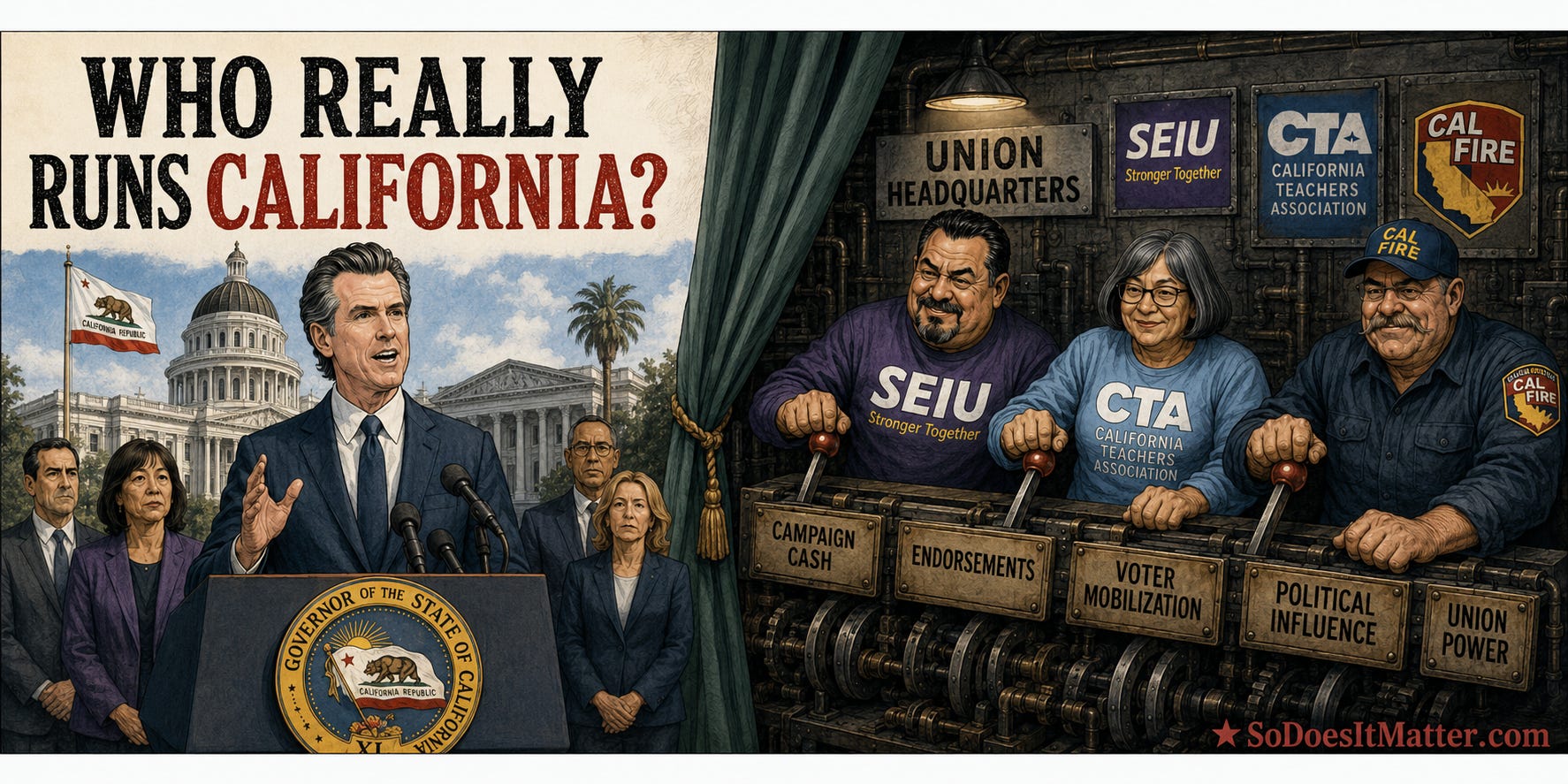
Most people would answer that question the same way. Voters elect a governor, legislators, county supervisors, city council members, and school boards. Those elected officials debate policy, pass laws, negotiate budgets, and make the decisions that shape life across the state.
But anyone who has spent years watching politics in Sacramento and city halls across the state knows there is another layer of influence—one that rarely receives the attention it deserves.
California’s public employee unions have become among the most powerful political institutions in the state. Their influence extends well beyond negotiating wages, pensions, and working conditions for the workers they represent. They help elect the officials with whom they negotiate. They spend extraordinary sums to influence elections and ballot measures. They lobby legislation and shape regulatory policy.
Public employee unions occupy a position unlike almost any other organized interest in American politics.
Businesses negotiate with the government.
Environmental organizations lobby the government.
Taxpayer groups try to influence the government.
Public employee unions do something fundamentally different.
They negotiate directly with the government officials whose campaigns they often helped finance and whose elections they often helped influence.
Nothing like that arrangement exists in the private sector.
Private-sector unions negotiate with businesses. Their interests are naturally constrained by economic reality. Every additional dollar devoted to wages, pensions, or benefits comes from a company that must remain profitable enough to survive. If labor costs become unsustainable, businesses lose customers, relocate, reduce hiring, or fail altogether. The market ultimately imposes discipline on both management and labor.
The government operates under a different set of incentives.
State and local governments do not compete in the marketplace the way private businesses do. When labor costs increase, governments generally have four options: raise taxes, reduce services, borrow money, or defer costs into the future. None of those choices threatens the immediate existence of government in the way excessive labor costs can threaten a private business.
Nor do private-sector unions have any role in selecting the executives with whom they negotiate. The United Auto Workers do not help elect the CEO of Ford. The Teamsters do not finance the executives who negotiate on behalf of UPS. Management and labor begin negotiations with inherently different interests.
Government is different.
In California, public employee unions are often among the most influential organizations helping determine who becomes governor, mayor, county supervisor or school board trustee. They endorse candidates. They contribute millions of dollars to campaigns and independent expenditures. They provide campaign volunteers, voter outreach, mail programs, and political infrastructure that many candidates could not easily replace. By the time contract negotiations begin, the relationship between labor and management has often existed for months or years.
That does not mean elected officials simply surrender to union demands. Many negotiate in good faith and work hard to protect taxpayers while fairly compensating public employees. But in government, the officials responsible for approving compensation packages are frequently supported by the same organizations representing the employees who will benefit from those agreements.
The difference is not merely theoretical. It influences who runs for office, who wins elections, what legislation reaches the governor’s desk, how labor negotiations unfold, and how difficult it becomes to challenge the status quo.
This is not an argument that public employees are the problem. They are not. California depends on dedicated teachers, firefighters, police officers, nurses, engineers, correctional officers, and thousands of other public servants who go to work every day serving their communities. Most are simply trying to build careers, support their families and earn the benefits promised to them.
The focus of this essay is not the individuals who work in government.
It is the political organizations that represent them.
Over the past half-century, those organizations have built one of the most effective and durable political machines in California history. The result is a self-reinforcing political system so woven into California government that many of its most important decisions cannot realistically be understood without recognizing the role these organizations play.
Understanding that system is not about assigning blame.
It is about understanding how California really works.
The question is no longer why public employee unions have influence. The question is how they acquired it.
That story begins more than half a century ago.
Building the Machine
California’s public employee unions did not become powerful overnight.
Their influence was built over decades through legislative decisions, political victories, and institutional changes.
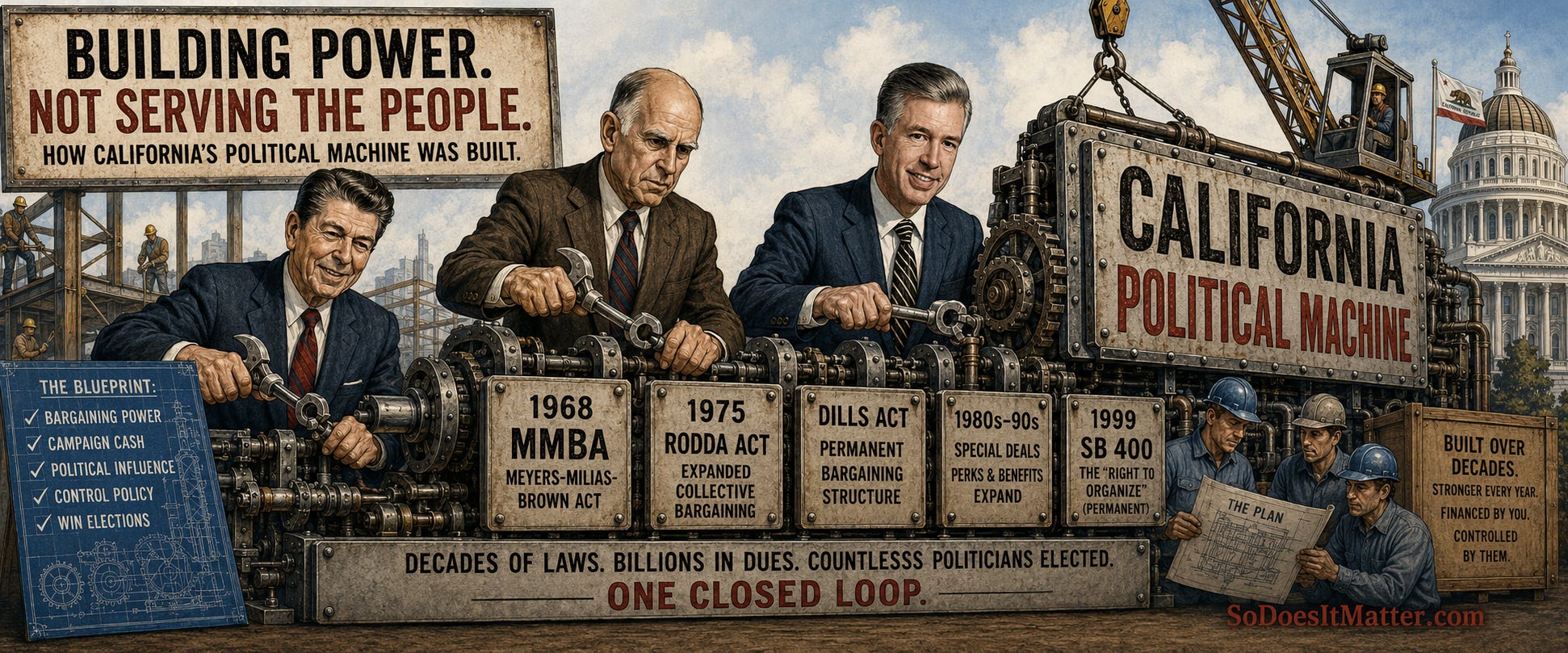
The modern era began in 1968 when Governor Ronald Reagan signed the Meyers-Milias-Brown Act, granting collective bargaining rights to local government employees.
Seven years later, Governor Jerry Brown signed the Rodda Act, extending collective bargaining rights to K-14 public school employees. Brown would later sign the Dills Act, granting similar bargaining rights to state employees. Together, these laws transformed public-sector labor relations throughout California and laid the legal foundation for what would become one of the nation’s most powerful political movements.
None of these laws guaranteed that public employee unions would become dominant political institutions.
They simply gave organized labor the legal framework from which to grow.
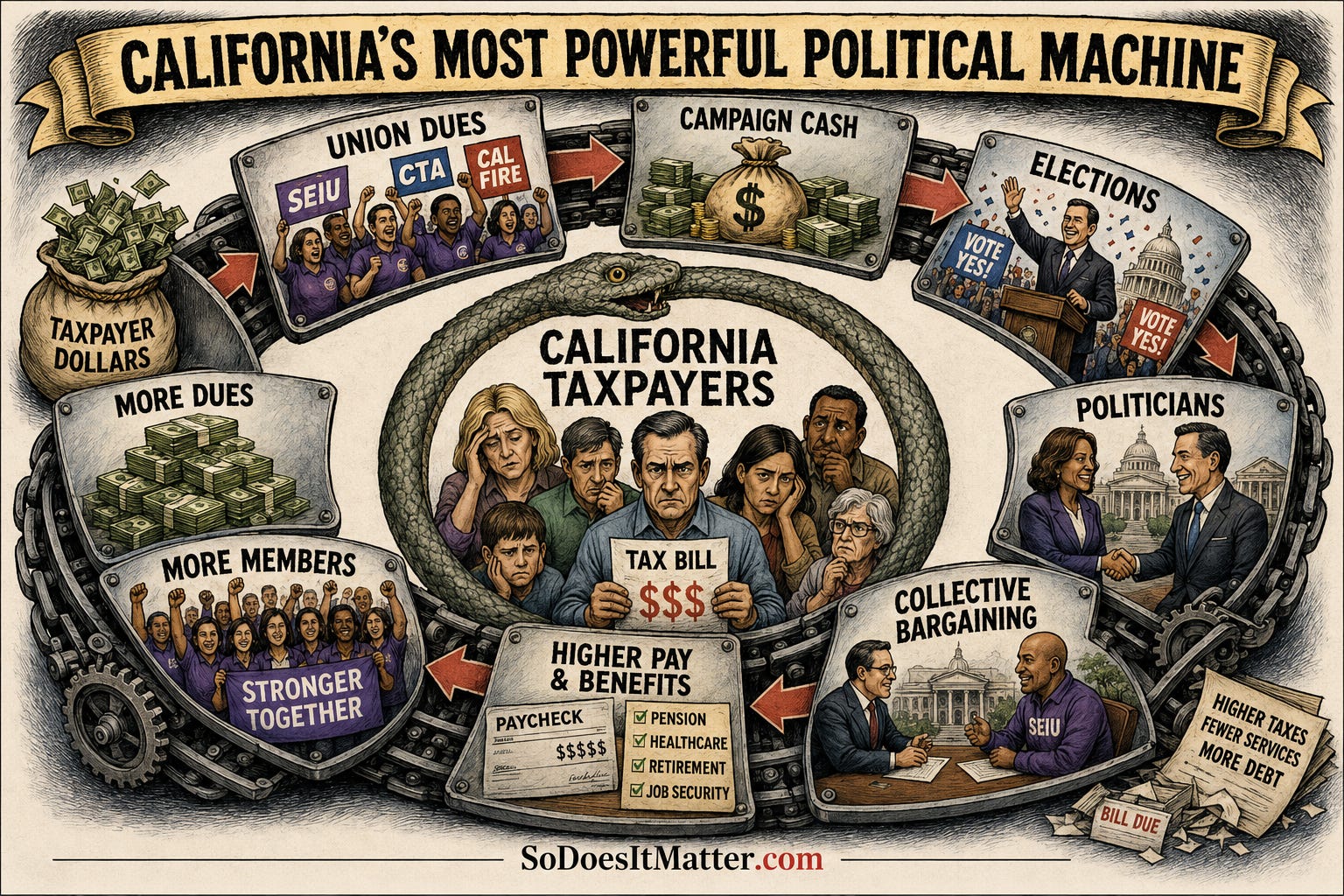
As membership grew, so did dues revenue, and dues revenue paid for political operations that helped elect candidates sympathetic to organized labor. Those officials negotiated the contracts, passed laws, and enacted regulations. Each success brought in more members, more money, and more influence.
The cycle reinforced itself.
Over time, California politics experienced another important shift. Increasingly, candidates for public office were no longer simply endorsed by public employee unions. Many came directly from the labor movement itself.
Another pivotal moment arrived in 1999, when Governor Gray Davis signed Senate Bill 400, expanding pension benefits for many public employees. Its consequences—explored later in this essay—would reflect a governing philosophy that increasingly rewarded providing benefits today while pushing much of the financial cost into the future.
By the end of the 20th century, California’s public employee unions had evolved far beyond traditional labor organizations.
They had become permanent political institutions. Incredibly effective ones.
None of this occurred because of a single law, a single governor, or a single election.
It happened because each political victory made the next one easier.
That is how institutions accumulate power.
Follow the Money
Political influence is measured not by how often you get your way, but by whether the government can realistically move forward without you.
By that measure, California’s public employee unions have become among the most influential organizations in state politics.
That influence is neither hidden nor speculative. It is documented in campaign finance reports filed with the Fair Political Practices Commission.
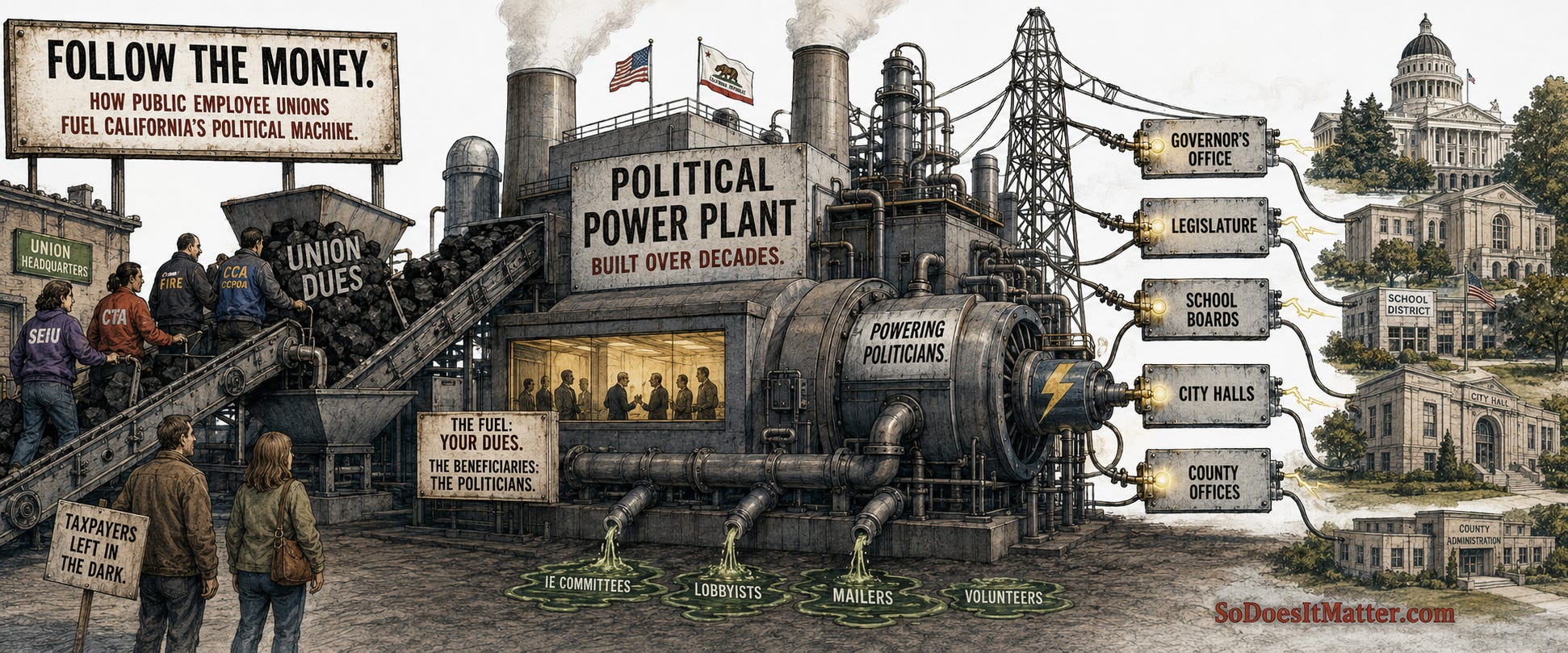
When the FPPC examined a decade of campaign and lobbying reports, from 2000 through 2009, it found that the California Teachers Association alone had spent more than $211 million on California politics—more than any corporation, trade association, environmental group or ideological organization in the state. No one else came close. The second-biggest spender of the decade was another public employee union, the Service Employees International Union, or SEIU.
That money buys far more than television advertising.
It finances candidate recruitment, independent expenditure campaigns, ballot measure committees, voter outreach, polling, and year-round lobbying operations. Public employee unions do not simply become active a few months before an election. They are permanent political institutions whose influence is felt every day the Legislature is in session and every time a city council, county board, or school board meets.
The California Teachers Association is hardly alone.
The Service Employees International Union, the California Correctional Peace Officers Association, the California Professional Firefighters, and numerous other public employee unions collectively spend tens of millions of additional dollars every election cycle.
Money, by itself, does not guarantee political success; California is full of wealthy interests that have spent enormous sums only to lose.
What distinguishes public employee unions is that campaign spending represents only one component of a much broader political operation.
They also provide campaign volunteers, precinct walkers, phone banks, voter registration efforts, policy expertise, and organizational infrastructure that many candidates could not hope to build on their own. Their relationships with elected officials often begin long before an election and continue long after the ballots have been counted.
The result is not merely political influence.
It is political infrastructure.
And that infrastructure extends beyond Sacramento.
Public employee unions are major players in county races, city council elections, mayoral campaigns, school board contests, and special district elections across California. Many of these races receive little public attention, yet they determine who will later negotiate labor agreements, approve pension obligations, and adopt budgets.
Money alone did not build California’s public employee union movement.
But it helped build the political machine that sustains it.
The question, then, is what that political influence actually looks like when government begins making policy.
How Influence Becomes Policy
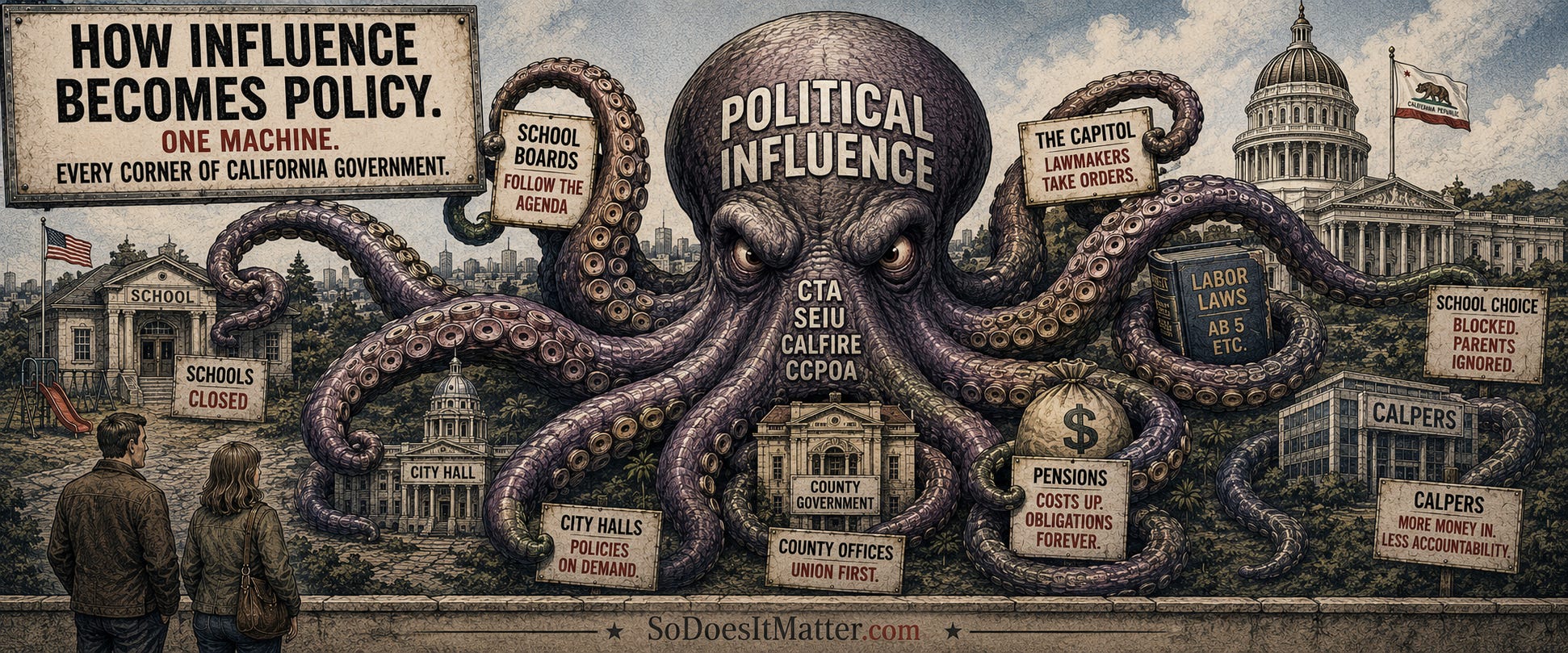
Political power matters only if it changes outcomes.
California offers no shortage of examples. The handful that follow simply illustrate how political influence translates into public policy—and why so many Californians have come to believe that organized interests often carry more weight than the taxpayers who ultimately finance government.
WHEN CALIFORNIA CLOSED ITS SCHOOLS
Perhaps no recent event better illustrates the political influence of California’s public employee unions than the closure—and reopening—of the state’s public schools during the COVID-19 pandemic.
The first weeks of the pandemic were filled with uncertainty, and reasonable people can disagree about many of the choices public officials made with limited information. But one fact is beyond dispute: when California’s leaders considered whether to close schools, the California Teachers Association was not merely another stakeholder. It was one of the few organizations whose position could fundamentally shape the outcome.
On March 13, 2020, as the California Teachers Association publicly urged the closure of every public school in the state, Governor Gavin Newsom signed an executive order guaranteeing that school districts would continue receiving state funding even if classrooms closed. As the pandemic wore on, the union remained deeply involved in the debate over when and under what conditions schools should reopen—California’s classrooms stayed closed longer than most of the nation’s—while millions of parents watched from the sidelines.
I did not experience those shutdowns only as a political professional. I experienced them as a parent whose school-aged children paid the price. I had spent more than three decades around the CTA’s power and thought I understood it. That year taught me I had understated it. The union’s reach was not confined to pay and benefits. It extended to whether my children went to school at all—and to the laws that govern their classrooms, including the union’s long and successful fight to keep individual student outcomes out of teacher evaluations.
Whether every position taken by the union was right or wrong is not the point. The point is that no governor could realistically make decisions affecting nearly six million public school students without accounting for the wishes of one of the state’s most politically powerful organizations. That is not simply influence over a labor contract. It is influence over statewide public policy affecting virtually every California family. And now they influence policy far afield from education as well.
Once you begin looking for the pattern, you see it throughout California government.
AB 5: BEYOND PUBLIC EMPLOYEES
One of the clearest examples came in 2019 with Assembly Bill 5.
Sold as a measure to protect gig workers, AB 5 codified a California Supreme Court ruling on worker classification, expanding the legal definition of who must be treated as an employee rather than an independent contractor. The practical effect was to make it far more difficult for hundreds of thousands of Californians to continue working independently.
The law reached far beyond ride-share drivers. Freelance journalists, photographers, musicians, translators, truck drivers, and countless other independent professionals suddenly found themselves caught in a legal framework that disrupted careers many had freely chosen. Many were not asking the government for protection. They were asking to be left alone.
Organized labor strongly backed the legislation because independent contractors generally fall outside the traditional union model. Employees can be organized. Independent contractors generally cannot.
Whether AB 5 achieved its stated objectives remains a matter of debate. What is not debatable is that it demonstrated organized labor’s ability to shape statewide public policy far beyond wages, pensions, or government employment. The gig companies escaped at the ballot box, but doing so required Proposition 22, the most expensive ballot-measure campaign in California history. The freelancers, musicians, and truck drivers had no such option.
WHEN GOVERNMENT CAN’T AFFORD TO SAY “NO”
The same dynamic plays out far beyond Sacramento.
In 2026, two of California’s most prominent urban school districts—Los Angeles Unified in the south and San Francisco Unified in the north—offered similar case studies. Both faced declining enrollment. Both warned of long-term fiscal challenges. Both knew temporary federal COVID relief dollars were ending. Yet both ultimately approved labor agreements increasing long-term compensation obligations.
In Los Angeles, district officials priced the union’s proposals at more than $4 billion over the contract’s three-year term, at a time when enrollment continued to decline, one-time federal funding was disappearing, and the district was besieged by sexual abuse allegations and hit with expensive judgments. In San Francisco, where the district had been under state fiscal oversight since 2024, leaders argued they could not responsibly afford all of the compensation increases being demanded—and a four-day teachers’ strike followed.
Again, the point is not that teachers are overpaid or undeserving of raises. The question is whether elected officials can realistically refuse demands they believe exceed what taxpayers can sustainably afford, knowing that the fate of their reelection rests in the hands of the very unions with which they are negotiating.
Increasingly, the answer appears to be no.
When saying “yes” is politically easier than saying “no,” long-term financial realities often become secondary. The costs do not disappear. They are simply pushed into the future.
THE GOVERNOR’S PEN
The clearest example of political influence may not be a law that passed, but one that almost certainly never will.
In 2025, Congress created a federal tax-credit scholarship program, effective in 2027, allowing states to expand educational opportunities through privately funded scholarship organizations supported by federally tax-credited donations. The program does not require California to spend additional state education funds, and the governor can authorize participation.
Governor Gavin Newsom could opt California into the program with the stroke of a pen.
He almost certainly will not.
The reason has little to do with administrative complexity. California’s political leadership has long opposed virtually every significant school-choice proposal—vouchers, education savings accounts, scholarship tax credits—and no organization has fought those efforts more consistently than the California Teachers Association.
The point is not whether school choice is good policy. What matters is that when a governor possesses the unilateral authority to expand educational opportunities without requiring additional state spending, yet the proposal remains politically untouchable, it illustrates the extraordinary influence one organized interest can exercise over public policy. That influence shapes the educational choices available to millions of California families.
THE REVOLVING DOOR
California’s political culture reinforces these relationships in less obvious ways. Labor leaders increasingly seek elected office, and former elected officials move into leadership positions within organized labor. Former Assemblywoman Lorena Gonzalez’s path from organized labor to the Legislature and later to the top job at the California Labor Federation is among the most visible recent examples.
There is nothing improper about that career path. The significance is that it reflects how deeply intertwined organized labor and California’s governing institutions have become. The same political networks, policy priorities and relationships often continue regardless of where an individual happens to work.
Taken individually, each of these examples can be debated. Viewed together, they reveal a governing system in which one organized interest has become deeply embedded in the institutions responsible for making public policy. And these are just a handful of examples. There are enough to write entire books.
The question is no longer whether public employee unions have political influence.
The question is what incentives that influence creates.
The Incentives
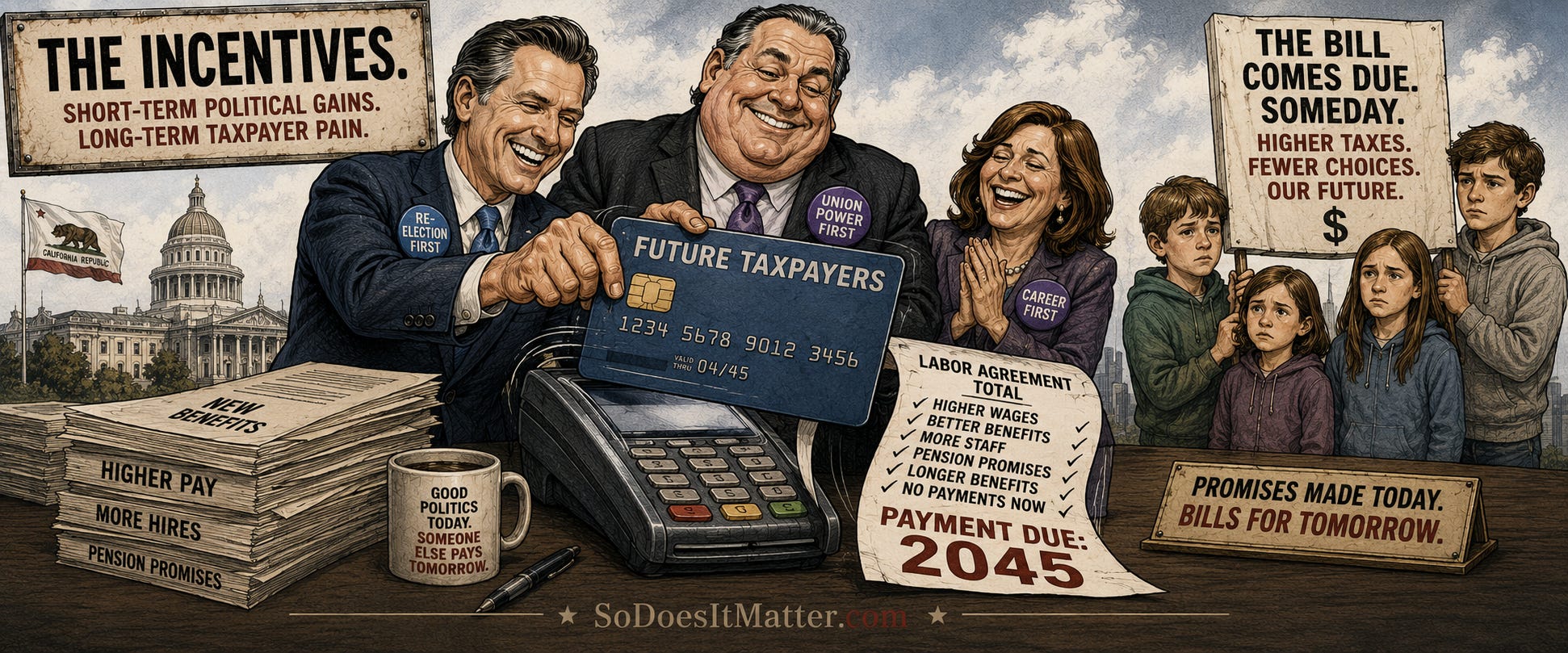
The examples in the previous section are not isolated events. Similar outcomes recur—whether the issue is pensions, labor law, education policy, staffing levels, or government spending—because the system’s incentives all point in the same direction.
This is not a story about villains.
Union leaders are expected to fight for better wages, richer benefits, and stronger workplace protections for their members. Politicians seek reelection and welcome the endorsements, campaign volunteers, and financial support that influential organizations can provide. Viewed individually, each of those objectives is entirely rational.
The problem arises when all those incentives reinforce one another.
No issue illustrates that reality more clearly than California’s public pension system.
Unlike salaries, pension promises do not have to be fully paid for when they are negotiated. Benefits are earned today, but much of the cost is deferred for years—or even decades. That makes pensions uniquely attractive politically. Employees receive enhanced retirement benefits. Union leaders can point to another victory for their members. Elected officials can celebrate a successful labor agreement. Yet much of the financial burden will not be borne until long after those negotiations have ended.
California’s modern pension challenge developed over decades, through legislative decisions, collective bargaining agreements and financial assumptions that often shifted today’s costs into tomorrow’s budgets. Senate Bill 400, signed by Governor Gray Davis in 1999, became one of the defining moments in that history. Supporters argued that robust investment returns would finance much of the expansion in benefits. Critics warned that if those assumptions proved too optimistic, taxpayers would eventually bear the difference.
History has largely validated those concerns.
I saw those incentives up close. I spent years handling media relations for the Orange County Sheriff’s Department, and it never stopped astounding me: able-bodied deputies retiring at 50, because SB 400 and the local benefit enhancements it inspired had made retirement that lucrative, then going to work for another law enforcement agency or a private security firm because collecting a pension and a paycheck at once made economic sense. None of them broke any rules. They responded to incentives.
The numbers tell the story. When SB 400 passed, the state’s annual payment to CalPERS was about $160 million. Two decades later it exceeded $7 billion. Every additional dollar devoted to paying for yesterday’s promises is one less dollar available for today’s services.
Stockton learned that arithmetic the hard way. By the time it filed for bankruptcy in 2012—then the largest city bankruptcy in American history—it had already cut roughly a quarter of its police force while its retirement costs kept climbing. Vallejo and San Bernardino told similar stories.
One of the least understood numbers in California government is the assumed rate of investment return used by CalPERS. It sounds obscure. In reality, it directly affects how much governments must contribute each year toward pension costs. Higher assumed investment returns reduce today’s required employer contributions, leaving more room in current budgets. Money that can be spent on more union jobs, or raises in salaries or benefits for unionized workers. Lower assumed returns require governments to contribute more immediately.
The point is not that anyone is manipulating the numbers. Pension trustees have fiduciary obligations and must make difficult judgments about long-term investment performance. But the structure of the system creates unmistakable incentives. Lower required contributions make it easier to balance budgets, negotiate labor agreements, and avoid difficult fiscal choices today. If future investment returns fail to meet expectations, however, the additional costs do not disappear. They are transferred to future officeholders and future taxpayers.
The governance of California’s largest public pension system reflects many of these same institutional dynamics. Six of the CalPERS Board’s thirteen members are elected directly by active members and retirees of the retirement system. The remaining members are statewide elected officials, political appointees or ex officio officeholders—products of the same political system. This is not an accusation that board members fail to honor their fiduciary responsibilities. It is simply a recognition that California’s pension system operates within the same political ecosystem described throughout this essay.
The same pattern extends beyond pensions.
The Supreme Court’s 2018 decision in Janus v. AFSCME was widely expected to weaken public employee unions by ending the requirement that nonmembers pay agency fees. The decision strengthened the First Amendment rights of public employees. Yet it did not alter California’s political landscape. Unions lost an estimated $50 million a year in agency-fee revenue, but membership largely held. The Legislature enacted laws making it easier for unions to communicate with new employees while limiting competing access, and public employee unions continued to rank among the most influential political organizations in the state.
By the time Janus was decided, California’s public employee unions had already built something more durable than a dues collection system.
They had built political institutions.
They possessed campaign organizations, lobbying operations, long-standing relationships with elected officials, policy expertise, and organizational networks developed over decades. Losing one legal advantage did not erase the political infrastructure they had created.
Even when reform passes, the system absorbs it. Governor Jerry Brown signed a statewide pension overhaul in 2012, but it applied mainly to newly hired employees and left the underlying bargaining structure untouched.
Wisconsin shows what happens when the structure changes. After that state restricted collective bargaining for most public employees in 2011, public-sector union membership fell by more than half within a few years—and with it much of the unions’ political influence. California’s machine is built on California’s rules.
That helps explain why meaningful reform has proven so difficult.
Every participant in the system is pursuing rational objectives. But taken together, those incentives consistently point in the same direction.
More government employment.
Greater compensation.
Larger long-term obligations.
More political resources.
More influence.
The loop reinforces itself.
That does not make reform impossible.
It does make reform extraordinarily difficult because it asks elected officials to challenge organizations that often helped elect them in the first place. The immediate political costs are obvious. The benefits, if they come at all, are often realized years later by someone else.
Understanding that reality does not require believing in conspiracies.
It requires recognizing that institutions respond to incentives.
So, Does It Matter?
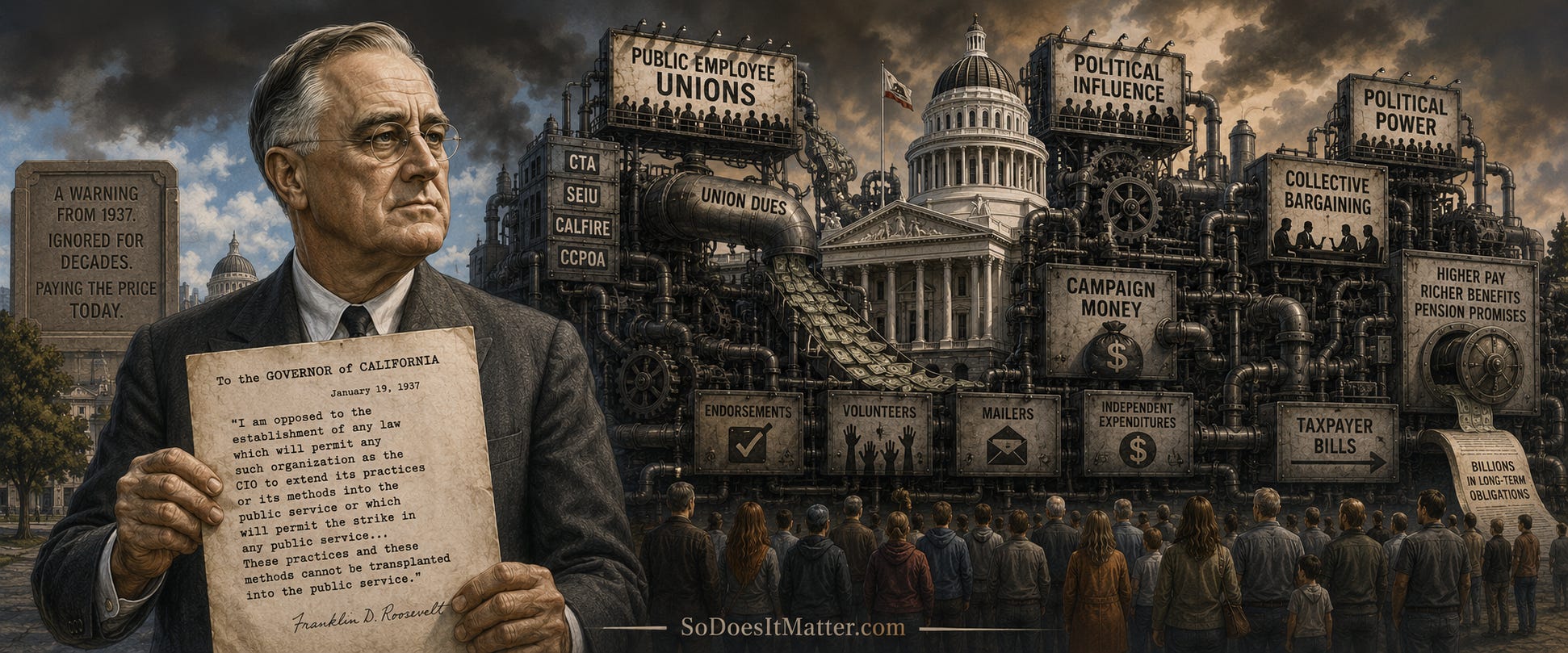
In August 1937, Franklin D. Roosevelt—the architect of the New Deal and the best friend organized labor ever had in the White House—wrote a letter to the president of the National Federation of Federal Employees. “All Government employees should realize that the process of collective bargaining, as usually understood, cannot be transplanted into the public service,” he warned. It has, he continued, “distinct and insurmountable limitations when applied to public personnel management.” The reason was simple. In government, the employer is the whole people.
Roosevelt saw the problem before California signed its first public employee contract. The union model was built for a contest between labor and capital, with the market as referee. Transplant it into the government, and there is no referee. There are only politicians—elected, as often as not, with the help of the organizations sitting across the table.
California set that warning aside in 1968, and this essay has traced what followed. None of it was improper. The unions organized. They raised money. They recruited candidates. They won elections. It was the predictable result of disciplined political engagement sustained over decades—and it produced exactly the system Roosevelt predicted.
So I will end with a conclusion I once would have considered unthinkable: the public good may be better served by repealing the laws that allow government workers to unionize at all.
I know how that sounds. But it was the mainstream American view for most of the twentieth century, and it was Roosevelt’s. The alternative is on display all around us. Left unchecked, these unions will keep doing what they do—growing their size, their scope and their claim on the public treasury beyond anything reasonable. Nothing inside the system has any reason to stop.
Public employees deserve fair treatment. Taxpayers deserve a government that answers first to them. Yet taxpayers are not a permanent political organization. They do not collect dues or maintain year-round campaign operations. They do not have lobbyists at every committee hearing in Sacramento.
Repeal may prove politically impossible; Wisconsin showed that even a partial rollback takes a political war. But whether the answer is repeal, reform or simple restraint, the first step is the same, and it will not come from within. Closed loops do not open themselves. The organizations at its center are doing exactly what they were built to do, and the officials they help elect have little reason to disturb the arrangement that elected them. If the balance is ever restored, the pressure will have to come from the only participants outside the loop: the voters who choose the government at the beginning of the chain and pay its bills at the end.
Nearly ninety years ago, Franklin Roosevelt told us this system could not work.
California has spent the last half-century proving him right.