

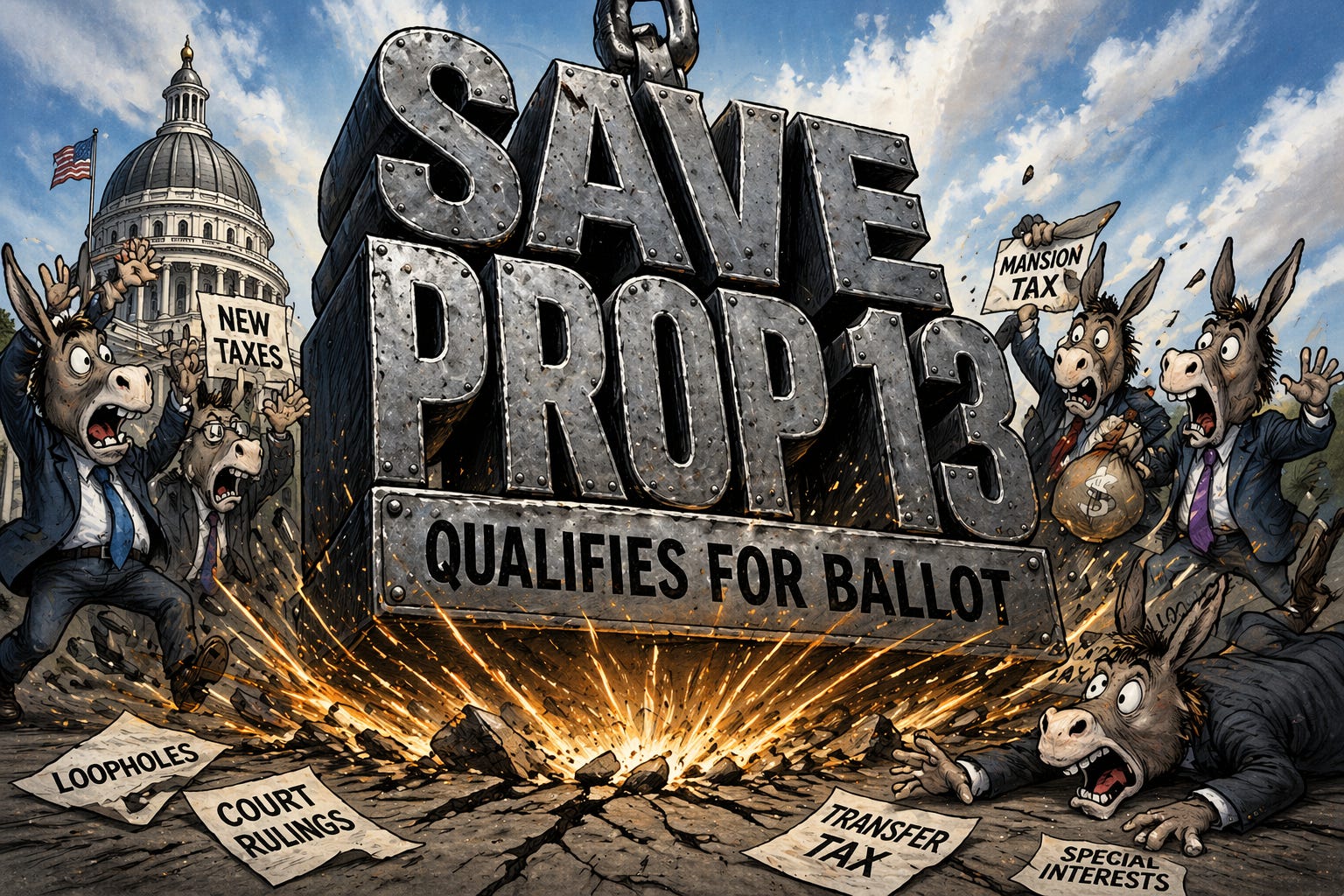
Save Prop. 13 Qualifies, Setting Up Major Tax Fight In California
This measure seeks to reaffirm the two-thirds vote requirement for all taxes, as well as tasking the scourge of excessive property transfer taxes. .

You can listen to this post on our podcast feed, So, Does It Matter? SPOKEN. It’s available on your favorite podcasting app, or you can find it here. Our afternoon content is typically for our paid subscribers. Certain columns, like this one, are made available to all of our readers.
⏱️ 4 min read
A Major Tax Fight Heads To The Ballot
The Save Prop. 13 measure, formally known as the Local Taxpayer Protection Act, is now officially eligible for the November 2026 statewide ballot. It sets up what may prove to be one of the most consequential taxpayer battles in California in years.
The Upland Loophole And The Fight Over Voter Control
At its core, the measure restores the two-thirds vote requirement for local special taxes and closes legal loopholes that have made it easier for governments and their allies to raise taxes.
“This is a major milestone for taxpayers across California,” said Rob Lapsley, President of the California Business Roundtable. “Special interest groups have exploited the court-created Upland loophole to pass new and higher special taxes that have driven costs higher for residents and harmed small and local businesses throughout the state.”
The so-called Upland loophole is not a technical curiosity. It is the mechanism by which local governments have pushed through higher taxes while sidestepping the voter approval thresholds Californians believed were secured under Proposition 13 and Proposition 218.
This measure would close that loophole.
A Major Target Is The Explosion Of Transfer Taxes
There is, however, a second front in this fight, and it may prove even more consequential.
The measure places strict limits on real estate transfer taxes, effectively blocking new “mansion tax” policies such as Los Angeles’ Measure ULA and forcing existing high-rate versions to be scaled back.
This is not incidental. It is central.
The initiative is aimed squarely at a rapidly expanding category of local tax increases that has begun to spread beyond Los Angeles.
“This measure reinforces the intent of Proposition 13 and Proposition 218 by ensuring that government cannot sidestep voter approval thresholds through legal loopholes,” said Jon Coupal, President of the Howard Jarvis Taxpayers Association. “It’s about restoring the integrity of taxpayer protections that Californians have repeatedly supported at the ballot box.”
Measure ULA provides the clearest example of what is at stake.
It has distorted housing markets, discouraged investment, and introduced new uncertainty, all while being promoted as a solution to affordability.
“Uncertainty and lack of transparency in local tax policy make it harder to invest, grow, and create jobs in California,” said Matthew Hargrove, President of the California Business Properties Association. “Measure ULA is a perfect example of what happens when special interests exploit court-created loopholes and drive taxes higher, pushing critically needed investments out of a community.”
What Happens Next And Why This Fight Matters
If enacted, the measure would have effects well beyond Los Angeles.
It would reshape how local governments pursue new taxes across California by tightening voter approval requirements and limiting one of the most aggressive revenue tools to emerge in recent years.
“This measure is about protecting taxpayers and restoring the rights they have given themselves through the ballot process,” said Rob Gutierrez, President of the California Taxpayers Association. “Now, more than ever, Californians deserve full transparency and a clear voice when it comes to taxes that impact their cost of living.”
The campaign now begins in earnest.
Supporters will argue that the measure restores voter control and prevents backdoor tax increases. Opponents will contend that it will make it more difficult to fund local services.
The underlying question, however, is straightforward: Should it be easier for governments to raise taxes, or harder?
So, Does It Matter?
If voters approve this measure, it closes off key pathways local governments have used to increase taxes without meeting traditional thresholds. It also curbs the spread of aggressive transfer taxes like Measure ULA and makes them far more difficult to replicate.
If voters reject it, those same pathways remain wide open, and expect more cities to follow Los Angeles’ lead.
So the question is not complicated. Do Californians want to make it harder to raise taxes, or easier?
And we already know the answer to that question in the state with the highest tax burden in the country.