

Sacramento’s $25 Billion Housing Gamble
A Brand New Big Government Proposal Want To Subsidize Homebuying For Some Chosen People Instead Of Fixing The Policies That Make Housing Scarce

Our afternoon content is typically below a paywall. Or if not, we have some exclusive content below the paywall for paid subscribers. Below the paywall today, I GO OFF in this proposal. It’s worth the price of admission! Oh yes, you can listen to this column on the go, on our podcast channel: So, Does It Matter? SPOKEN. Get to that here.
⏱️ 5 min read
A Familiar Sacramento Solution
California politicians spent decades making it harder to build housing. Now they want voters to approve a $25 billion mortgage program to help people cope with the consequences. That is the basic idea behind a ballot initiative backed by former state legislator Bob Hertzberg. The proposal would authorize the California Housing Finance Agency to issue up to $25 billion in bonds to help buyers purchase newly built homes with as little as 3 percent down. Supporters present the program as a way to help middle-class families buy homes while encouraging builders to construct more housing. In reality, it is another attempt to solve a problem created by government policy with yet another government program. Politico this morning reported:
Former state legislator Bob Hertzberg’s campaign for his housing bond initiative on Thursday submitted more than 900,000 signatures, far more than the 546,651 valid John Hancocks it needs to get on the ballot this fall.
The core problem in California housing is not access to financing. It is supply. For decades, environmental litigation, slow permitting processes, and the extraordinary costs imposed by California’s quixotic anti-carbon-emission policies have made it extremely difficult to build housing in the state, along with restrictive zoning rules that limit where homes can be built. California is widely estimated to be short several million homes needed to meet demand. Even state officials now acknowledge that California has fallen millions of homes short of demand.
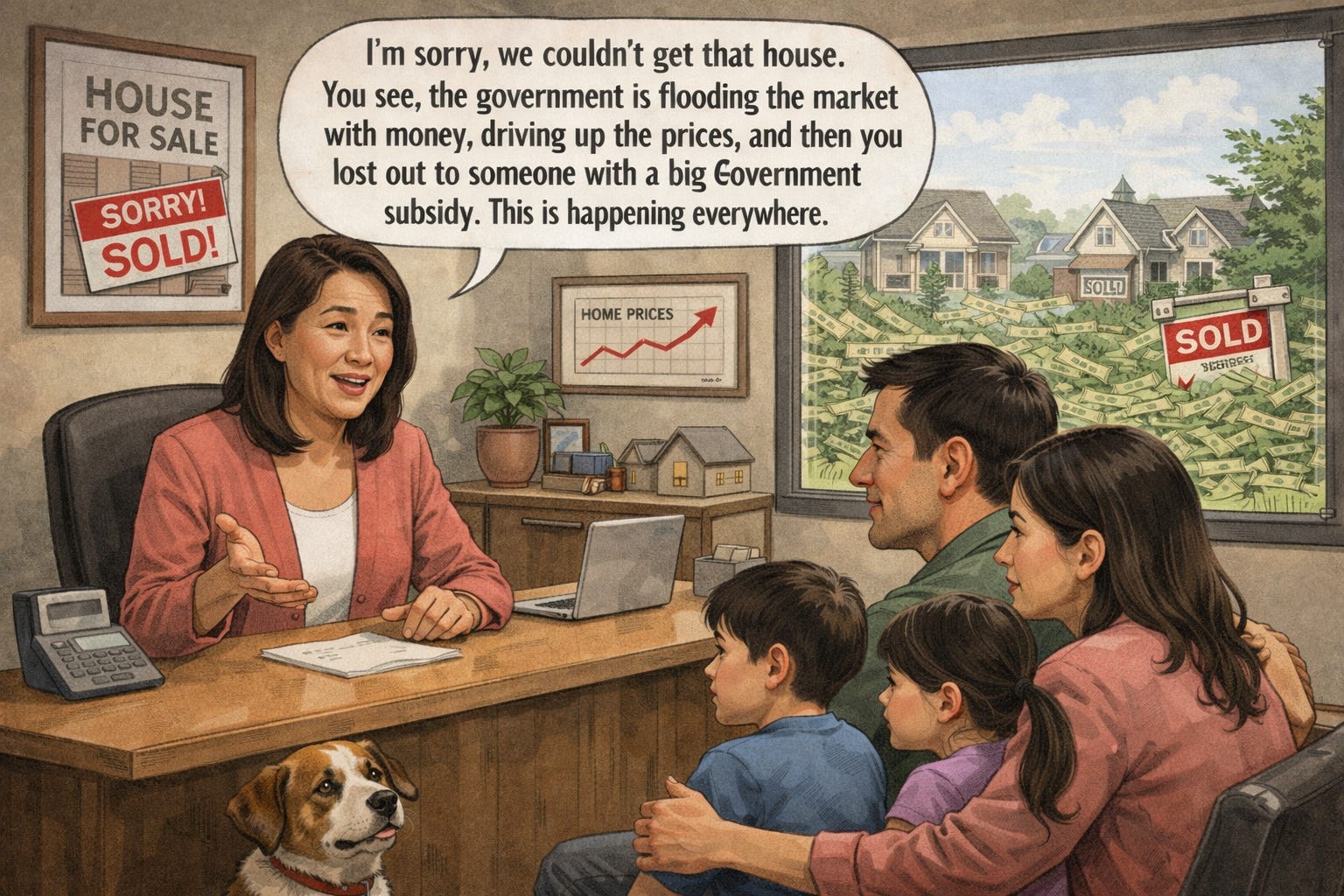
When supply is constrained, increasing buyers’ purchasing power does not make housing affordable.
If government policies make housing scarce, subsidizing buyers does not make housing affordable — it just makes the next house more expensive.
Californians already see how this works in practice across the state. In markets throughout California — especially in Southern California and the Bay Area — buyers routinely compete for a limited number of homes, often bidding above the asking price. Injecting billions of dollars in new subsidized purchasing power into that environment will not magically make homes cheaper. It will simply give more buyers additional money to chase the same limited supply of houses.
How The Program Actually Works
Under the Hertzberg initiative, a buyer would put down at least 3 percent of the purchase price. The state program would then provide a loan covering up to 17 percent of the home’s value. Combined with a traditional mortgage from a private lender, the structure effectively recreates the traditional 20 percent equity threshold lenders prefer. At first glance, that arrangement may sound reasonable. But the details reveal a different picture.
The state’s loan would be subordinate to the buyer’s primary mortgage as a second mortgage. That means the private lender gets paid first if the homeowner defaults and the property is sold. Only after the bank is made whole does the state-backed loan get repaid — if there is anything left. In practical terms, the government would be taking the riskiest position in the financing structure, while private lenders would hold the safest. Programs like this effectively shift a portion of the housing market’s risk from private lenders onto a government-run financing program.
There is also a broader fairness problem. Programs like this require the government to decide which citizens receive subsidized access to housing capital and which do not. Some families will receive government-backed financing to help them purchase homes, while others — taxpayers included — will not. Once the government begins redistributing financial advantages in this way, housing policy becomes less about building homes and more about deciding who deserves a subsidy.
It’s Just Bad Public Policy
Encouraging buyers to purchase homes with only 3 percent down also raises concerns about financial stability. Thin equity leaves homeowners far more vulnerable if housing prices fall or if they encounter economic setbacks. Low-down-payment lending was one of the dynamics that helped inflate the housing bubble that collapsed in 2008. Responsible housing policy should encourage financial resilience, not highly leveraged home purchases that depend on permanently rising home values.
Supporters argue that the bonds backing the program would be “revenue bonds,” meaning they would be repaid by borrowers’ mortgage payments rather than by state tax revenue. Technically, that is true. But anyone familiar with how politics works understands the limits of that assurance. If a major housing program backed by tens of billions of dollars begins to suffer losses, the idea that state leaders would simply allow it to fail without intervention strains credibility.
More importantly, the proposal reflects a bigger philosophical mistake. Instead of addressing the underlying causes of California’s housing shortage, policymakers are trying to engineer affordability through financial complexity. Rather than removing the regulatory barriers that prevent builders from constructing homes at scale, the state is attempting to subsidize buyers navigating a distorted market. That approach treats the symptom rather than the cause.
So, Does It Matter?
California does not suffer from a shortage of mortgage programs. It suffers from a housing shortage. Until policymakers tackle the regulations and political decisions that restrict home construction, programs like this will do little to improve affordability. They may help some buyers in the short term, but they do nothing to fix the structural forces driving housing costs upward.
In many ways, the proposal reflects the governing philosophy that has shaped California for decades. When government policies create economic distortions, the response is not to remove those policies but to layer new programs on top of them. Instead of reducing the regulatory barriers that make housing scarce, the state proposes a $25 billion financing scheme to help buyers navigate the consequences of those barriers.
The result is a familiar cycle in California policymaking: government intervention creates a problem, and the proposed solution is an even larger government intervention. Programs like this rarely make housing more affordable. More often, they make a broken system more complicated, more expensive, and harder to fix.
California’s housing crisis was created by policies that restrict supply. No bond program can solve that problem. The real solution is far simpler: allow Californians to build homes again.
Below the paywall is my fiery rant on this extraordinarily dumb idea.
