

Sacramento Says Build More Homes. Then Makes Them Harder To Build.
The state keeps creating the appearance of reform while driving up the cost of building and buying a home.


Our morning content is free for all subscribers and guests! Usually our afternoon content is behind a paywall… If you are not yet a paid subscriber, consider upgrading — you are missing a significant portion of what we produce each week, and your support makes it possible. If you want to get it all and support my efforts, please consider a paid subscription! There is significant exclusive content below the paywall, after this morning’s column.
Most of our content is available on our podcast feed. So, Does It Matter? SPOKEN. Which is available on your favorite podcast app. You can listen to it right here as well.
🕒 5-minute read
You Cannot Mandate A Housing Boom
Gov. Gavin Newsom and legislative Democrats have set statewide planning targets calling for nearly 2.5 million new homes over eight years. Meeting that goal would require more than 300,000 new homes a year. Actual construction has been running at only a little more than 100,000 annually. That gap exposes a central deception in Sacramento’s housing strategy: state leaders act as though they are clearing the way for more housing while simultaneously making housing harder and more expensive to build.
Newsom and Democratic lawmakers like to present themselves as housing reformers because they have loosened some local barriers, including restrictions on accessory dwelling units, and have promoted certain infill projects. Some of those reforms are worthwhile. But much of Sacramento’s supposed permission to build is illusory when the same political leadership keeps layering on union labor requirements, affordability mandates, CEQA uncertainty, fees, energy costs and other burdens that eat away at the economics of a project.
Housing does not get built because politicians announce ambitious targets or create the appearance of flexibility. It gets built when somebody believes the project will pencil. Most new housing will still have to be financed with private capital, and a parcel can be zoned for hundreds of units while producing nothing if the expected return no longer justifies the investment.
Both Sides Have To Meet
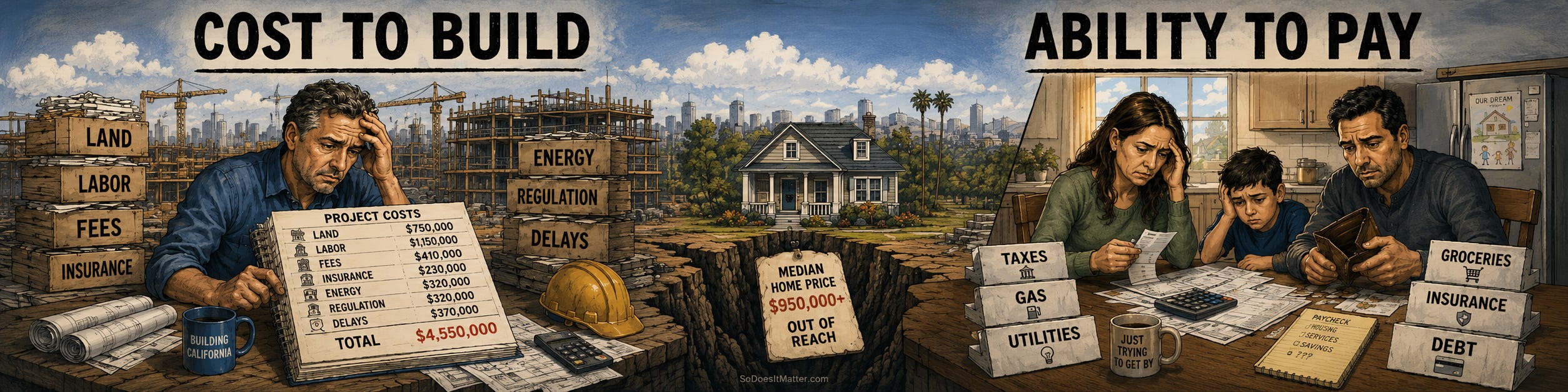
There is another half of the housing equation that gets too little attention in Sacramento. The developer has a minimum price at which it makes sense to build. The household has a maximum price it can afford to pay. A functioning market requires those numbers to meet.
For the investor, land, financing, labor, materials, insurance, taxes, fees, regulation and delay all have to leave room for an acceptable return. For the family, housing has to fit into what remains after taxes, energy, transportation, food, insurance and debt payments. Raise those other costs and there is less money left for rent or a mortgage.
Housing affordability is also a prosperity problem. Higher real incomes increase what households can afford, while lower production costs reduce the price builders need to make a project worthwhile. But if supply stays constrained, rising incomes can simply drive land and home prices higher. California needs more housing supply and more household prosperity.
California does not exactly make prosperity easy. It has the nation’s highest top marginal individual income-tax rate at 13.3%, ranks 48th in the Tax Foundation’s 2026 State Tax Competitiveness Index, and, by Mercatus’ count, has more regulatory restrictions than any other state. Those are policy choices, not acts of nature. They can be changed.
If Newsom and legislative Democrats want Californians to afford more housing, they should stop trying to subsidize affordability and start removing the policies that make housing and everyday life more expensive.
Sacramento Keeps Making The Math Worse
RAND found that multifamily housing costs about 2.3 times as much to produce in California as in Texas and takes more than 22 months longer to complete. Municipal impact and development fees averaged roughly $29,000 per unit here, compared with less than $1,000 in Texas.
Not all of that difference comes from public policy. California has more expensive land, different labor markets and seismic requirements. But RAND also found that approval processes and other policy choices contribute significantly to the gap.
The payoff from reducing those costs could be substantial. RAND estimated that eliminating only half of California’s multifamily production-cost disadvantage could cut the break-even rent on a new market-rate project by roughly 15%. That is a more durable path to affordability than simply telling developers they should charge less.
Delay adds cost as well. Developers carry land and debt while waiting for revenue. Time, in development, is money borrowed but not yet earning revenue.
Affordability mandates need the same scrutiny. Requiring below-market units may sound compassionate, but somebody still absorbs the cost. If the mandate makes a project less viable, fewer units get built and the underlying shortage gets worse. Government subsidies do not solve that problem either. They shift the cost to taxpayers, prop up prices and leave the underlying shortage intact. The durable answer is to reduce the cost of producing housing and allow supply to expand.
Energy and environmental policy create similar tradeoffs. Newsom and legislative Democrats have repeatedly pursued policies that increase costs for electricity, transportation and construction in order to advance other goals. Those choices matter during a housing crisis because higher business costs increase the price necessary to justify construction, while higher household costs leave families with less money for housing.

Stop Playing SimCalifornia
Sacramento increasingly favors dense, infill and transit-oriented development. That is another version of the same mistake: trying to plan the housing market from the state Capitol.
If that kind of housing is what Californians want and the economics support it, developers will have every reason to build it. The same should be true for townhouses, condominiums, subdivisions, suburban and exurban homes, starter homes, luxury apartments and mansions.
A mansion is housing supply.
Government does not need to determine the ideal housing mix for 40 million people. Reasonable zoning still has a role in separating incompatible uses, protecting infrastructure and preserving basic neighborhood coherence. But within those sensible boundaries, Sacramento should stop playing SimCalifornia and let buyers, builders and investors decide what gets built.
So, Does It Matter?
California’s housing shortage is often described as a market failure. Much of it looks more like a political failure. Sacramento politicians claim they are making room for more housing, but too often they are only creating the appearance of permission while continuing to drive up the cost of building through mandates, delays, legal uncertainty and other burdens.
A home gets built only after a series of people say yes: the landowner, lender, investor, builder and ultimately the buyer or renter. Government can influence those decisions, but it cannot fake them. It cannot bury projects under union labor requirements, affordability mandates, CEQA risk, fees and energy costs, then pretend it has done its part by setting ambitious housing targets.
If Newsom and legislative Democrats want more homes, they need to stop mistaking paperwork for production and stop confusing political theater with economic reality.
Mandates do not build homes. Markets do.
For Our Paid Subscribers…
Below the paywall below are links to a trove of other resources on this topic. Starting with three strong and insightful commentaries, and below that a bunch of useful links. This is an important topic, and taking the time get even more educated on it is a great idea…
