Sacramento Is Coming For Your Tires
California regulators say they are saving consumers money by taking away choices. That is how the cost of living gets ratcheted higher, one “reasonable” rule at a time.
Typically, our afternoon content is behind a paywall — or there is something extra for our paid subscribers. If you are not one, please consider upgrading. You are missing a significant portion of what we produce each week, and your support makes it possible. If you want to get it all and support my efforts, please consider a paid subscription! There is some special content under the paywall below for our paid subscribers!
Most of our content is available on our podcast feed. So, Does It Matter? SPOKEN. Which is available on your favorite podcast app. You can listen to it right here as well.
⏱️ 5 minute read
Sacramento Picks Your Tires
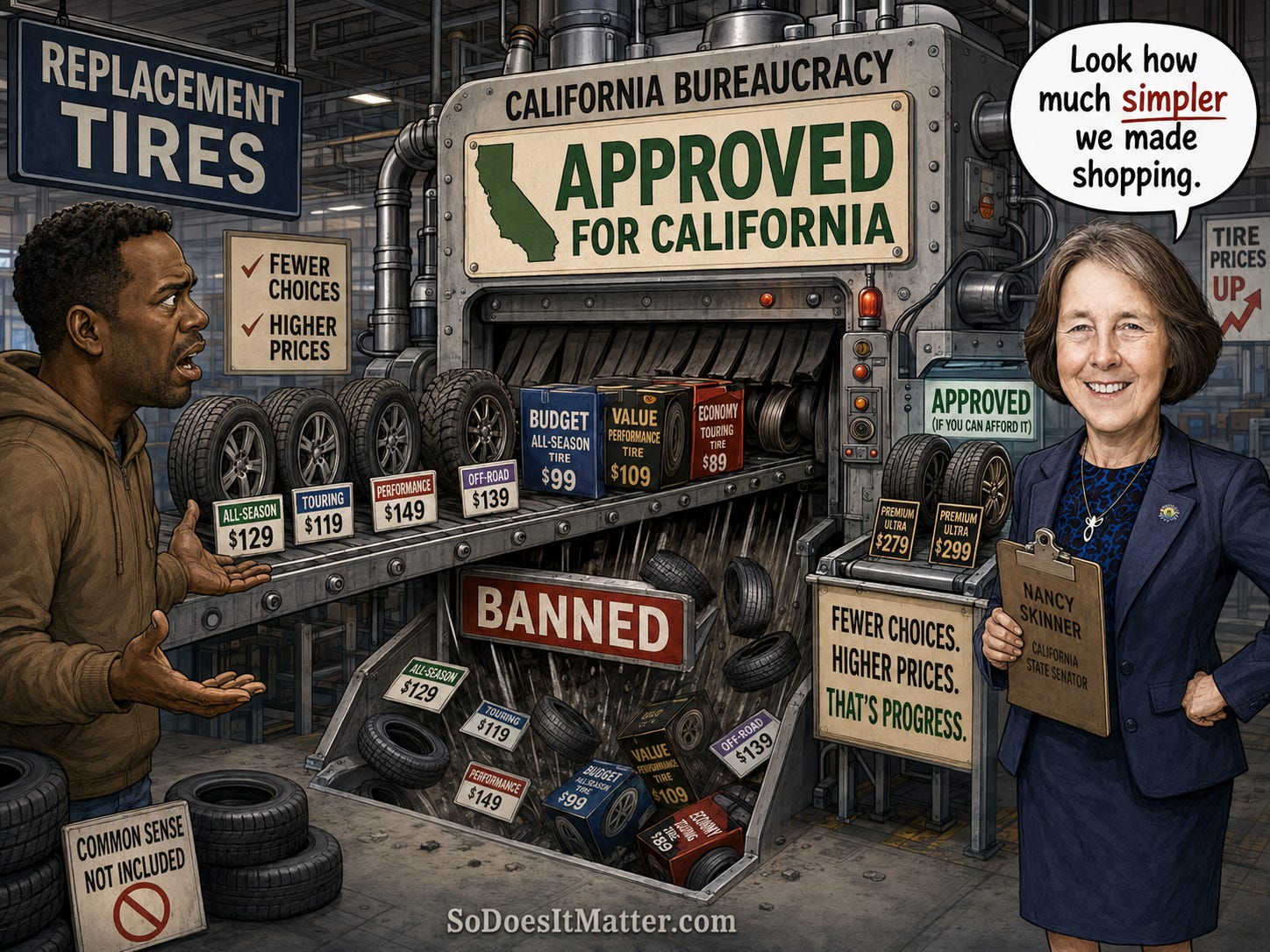
Yesterday, five unelected members of the California Energy Commission voted unanimously to restrict which replacement tires Californians will be allowed to buy. The rule begins phasing in in 2029 and gets substantially tougher in 2033. Tires that fail the new rolling-resistance standards will disappear from California stores, subject to a list of exemptions.
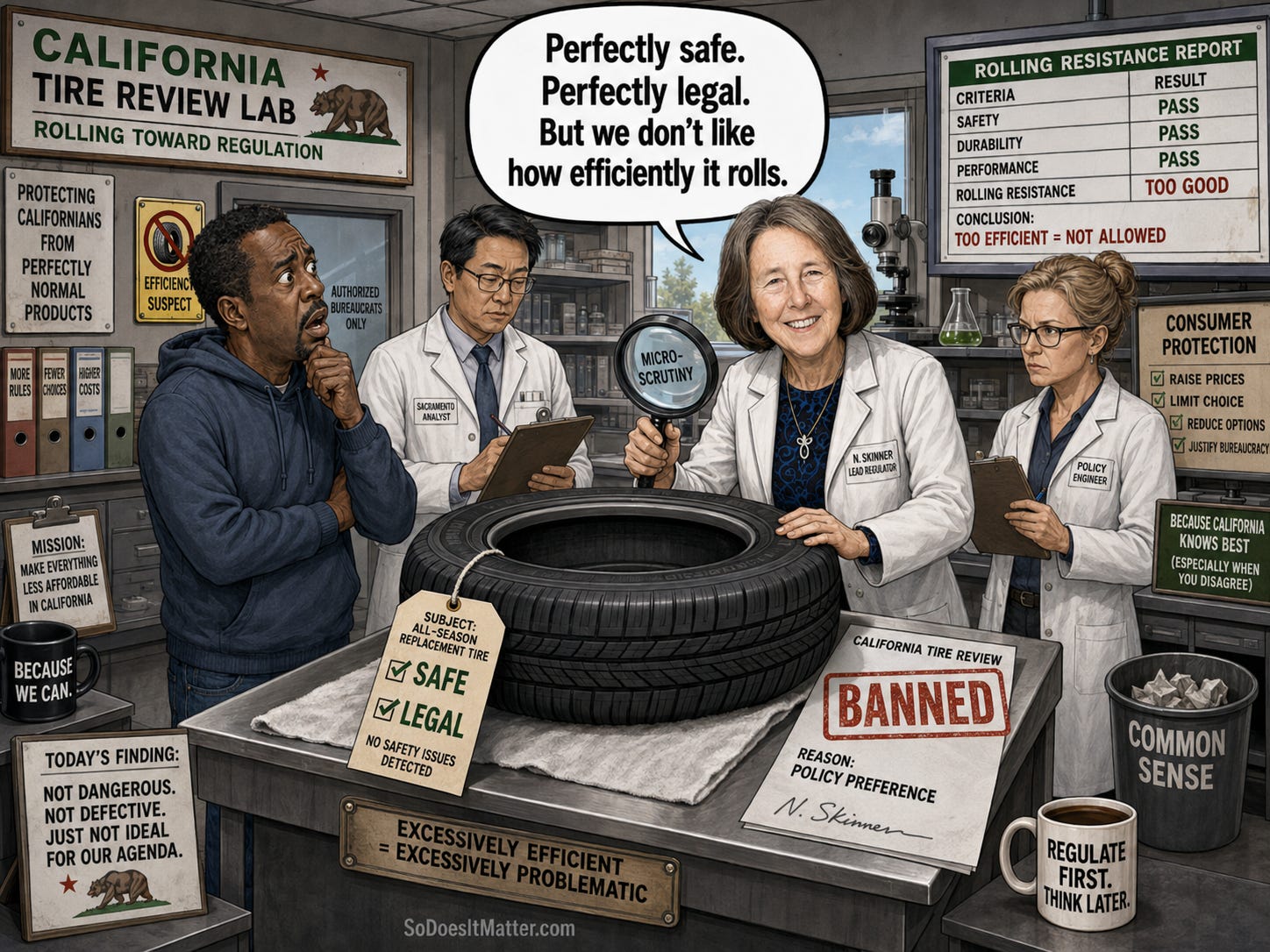
Commission Chairman David Hochschild says this is about “protecting consumers.” Commissioner Nancy Skinner says the rules will save Californians money. But these are not defective tires, and they are not being pulled because they are unsafe. They are legal products consumers buy today because they prefer their price, performance, durability or other characteristics.
Sacramento has simply decided those consumers are making the wrong choice.
So now the choice goes away.
Sacramento Says You’ll Save
The theory is straightforward. Tires with lower rolling resistance require less energy to move a vehicle, so drivers can use less gasoline or electricity. The Energy Commission claims those savings will more than compensate consumers for the higher cost of compliant tires.
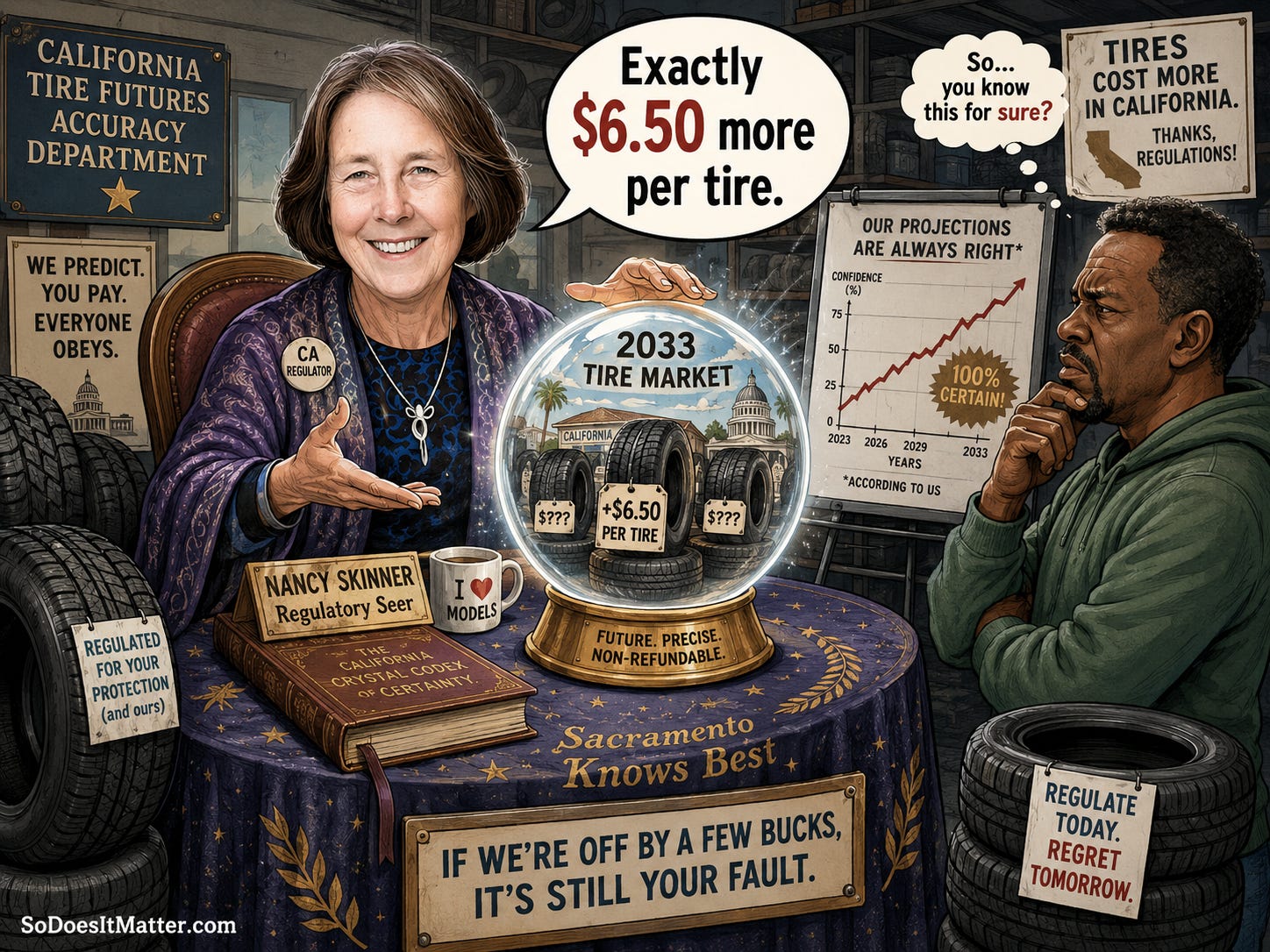
Under its Phase 2 calculations, the commission assumes the regulation will increase the price of a tire by only about $6.50. And a lot depends on that number. Apparently regulators are confident enough about what the tire market will look like years from now to put the added cost at precisely $6.50 a tire.
Industry representatives say the real-world cost could be dramatically higher. Discount Tire says applying the 2033 standard to the products it sells today would knock roughly 70% of those choices off the shelf. Of course manufacturers will redesign tires before then, but redesigning most of a market hardly suggests the cost impact will be trivial.
Even the California Department of Finance questioned the Energy Commission’s cost assumptions.
Maybe the commission’s math works for some drivers. Fine. But why does that mean Sacramento gets to make the decision for everybody else?
A Mandate From Another Era
The Energy Commission did not invent this authority yesterday. It traces back to AB 844, approved in 2003, directing the commission to create a replacement-tire efficiency program.
Think about the timeline. The Legislature passed this thing in 2003. Twenty-three years later, commissioners are deciding what it means in practice — including what tires Californians will be allowed to buy years from now.
Arnold Schwarzenegger had not even become governor when lawmakers handed this authority to an administrative agency. Now five commissioners are deciding precisely how much rolling resistance your replacement tires may have.
No legislator voted yesterday, and no governor signed a bill yesterday. The lawmakers who authorized the program in 2003 did not vote on the specific standards being imposed in 2026.
It is a pretty convenient system. Politicians set the goal, regulators impose the details, and by the time consumers feel the consequences, the people who started the process are long gone.
California Gets Expensive Slowly
Nobody is going to pack a moving truck tomorrow because California regulated replacement tires.
That is precisely the point.
California did not become one of America’s most expensive states because of one spectacular regulation that suddenly added thousands of dollars to everyone’s bills. It happened gradually. Higher electricity and gasoline costs. More expensive housing and insurance. Mandates layered on employers and businesses that eventually show up in what everybody pays.
And now Sacramento is getting into the replacement-tire aisle.
Each agency looks at its own rule, calculates its own supposed benefit and concludes that the burden is manageable. Sacramento gets to put every regulation in its own little spreadsheet. Families get one checking account.
The same household pays the higher electric bill, the higher gasoline price, the higher housing cost, the higher insurance premium and whatever this rule eventually adds to the cost of replacing four tires.
Who adds up the cumulative burden?
Apparently, nobody.
So, Does It Matter?
There is an obvious alternative. Tell consumers which tires are more efficient. Put the rolling-resistance rating on the label, estimate the potential fuel savings and let manufacturers compete.
If these tires really save consumers as much money as the commission says they do, great. Tell people.
But maybe someone drives only 4,000 miles a year. Maybe another buyer cares more about upfront price, tread life, ride, noise or some other characteristic. Regulators cannot know which tradeoff is best for every driver, yet they have decided consumers should not be allowed to make that calculation for themselves.
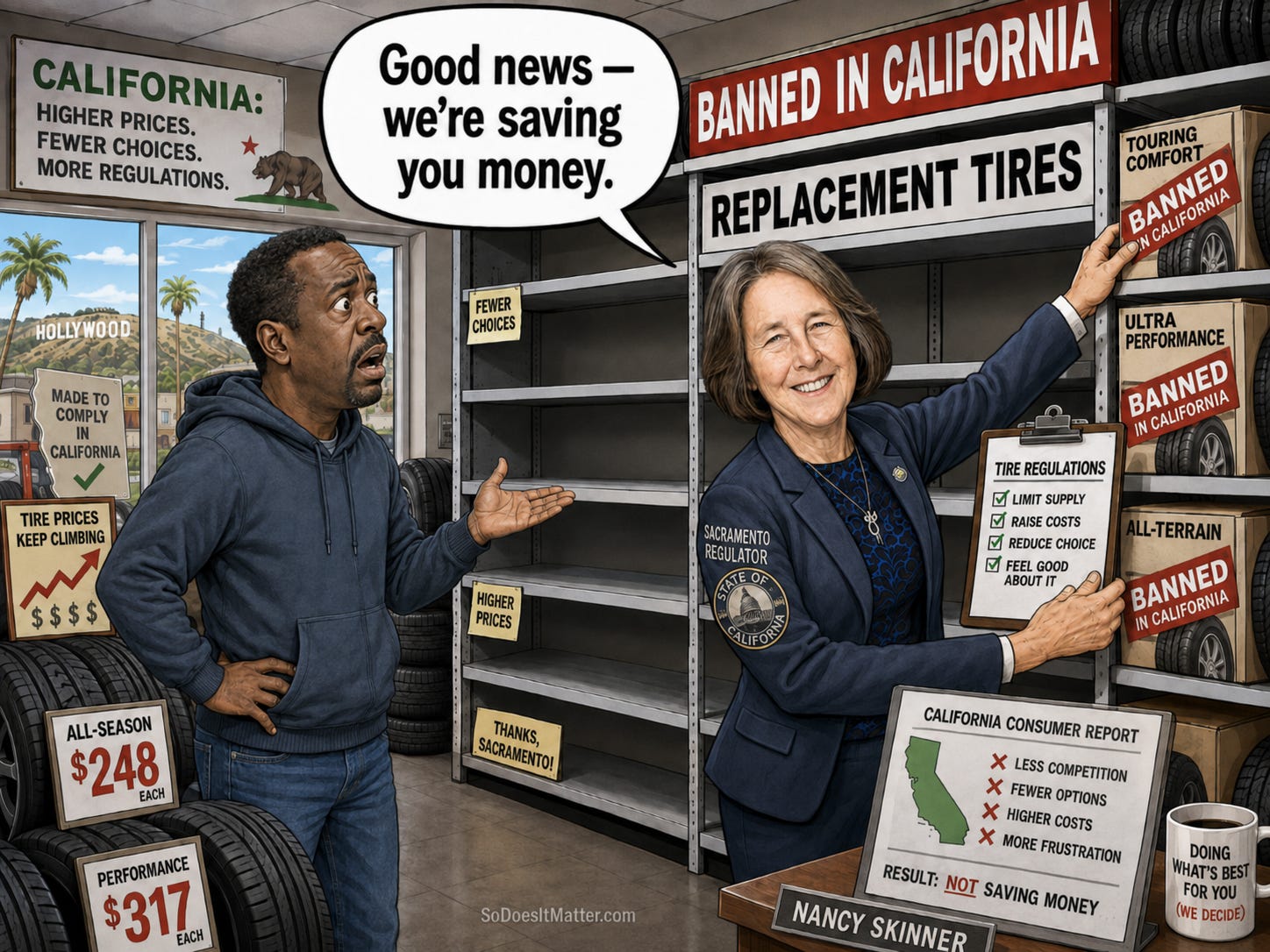
Information is not enough. The state narrows the market and then announces that consumers are financially better off.
That is the mentality behind so much of California government. No single rule costs all that much. There is always a study explaining the benefit. And giving up one more choice never sounds like such a big deal.
California did not become unaffordable because Sacramento regulated replacement tires.
It became unaffordable because Sacramento has spent decades making decisions exactly like this one.
For Paid Subscribers…
Three more very high quality cartoon images that go with this column. You will want to see these!