


Typically, our afternoon content is behind a paywall — or there is something extra for our paid subscribers. If you are not one, please consider upgrading. You are missing a significant portion of what we produce each week, and your support makes it possible. I will try to work my way through all of the November ballot props in time to create a voter guide of sorts.
If you want to get it all and support my efforts, please consider a paid subscription!
Because most of this content is paywalled, it is not available on our podcasting channels.
🕒 6-minute read
What A Terrible Idea
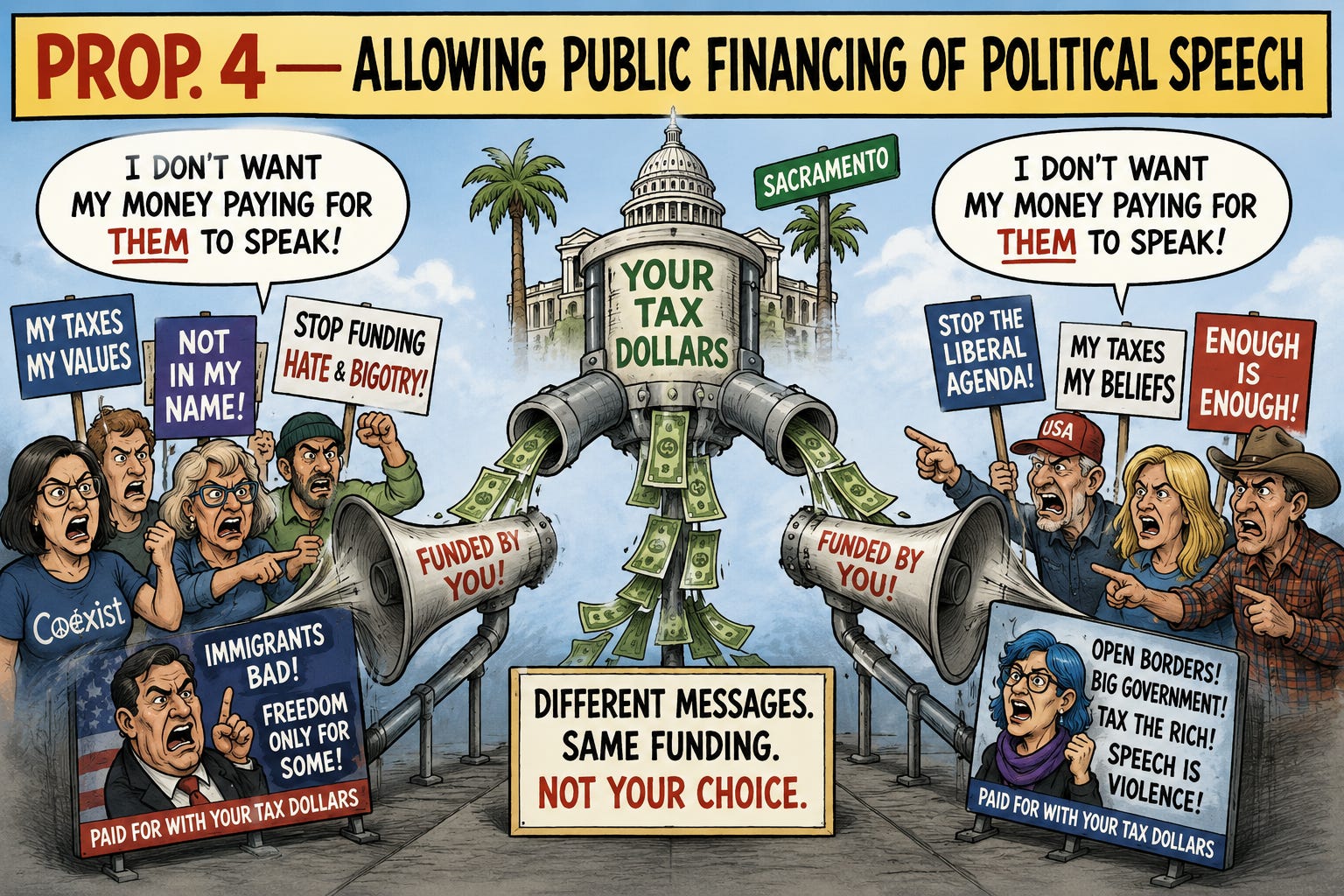
Buried on your November ballot, below the billionaire tax and the housing bonds, sits Proposition 4. The ballot label will tell you it “allows” public financing of political campaigns. Here is what it actually does: it asks voters to repeal the ban on politicians running their campaigns with your tax dollars — a ban California voters enacted themselves in 1988, and have defended every time they have been asked since.
The Legislature put this on the ballot through Senate Bill 42, passed on a straight party-line vote. Every Democrat voted yes. Every Republican voted no. Governor Newsom signed it and called it a victory for democracy.
I have spent four decades in and around California politics. I have watched a lot of bad ideas march past dressed in the language of reform. Proposition 4 is among the worst of them. It is wrong in principle and a disaster in practice. And voters have already answered this question. Repeatedly.
What Proposition 4 Actually Does
In June 1988, California voters passed Proposition 73. Among its provisions: a flat ban on candidates accepting public money to seek office. Because Prop 73 was a citizen initiative, the Legislature cannot repeal it on its own. Only you can.
That is the entire purpose of Proposition 4. It does not create a public financing program. It creates the authority for every government in California that doesn’t already have it: the state itself, all 58 counties, hundreds of general-law cities, every water district and mosquito-abatement board with a pulse and a general fund.
The Unions, the Fine Print, and the Record…
This is where it gets really good… But…
🔒 The Rest Of This Column Is Reserved For Paid Subscribers
What? Are you not one yet?
Please consider supporting this project and my calling of balls and strikes in politics. Paid subscribers receive access to all of my columns, podcasts, interviews, analysis, and bonus content.
It isn’t very much money for a whole lot of return.
Below the paywall, paid subscribers can continue reading about:
The principle Proposition 4 quietly violates
The conflict of interest hiding in plain sight
Why “local control” is not the safe answer it sounds like
The cautionary tales from other public-financing systems
Why Sacramento keeps asking a question voters already answered
Thank you for supporting my independent journalism and helping make this work possible.
