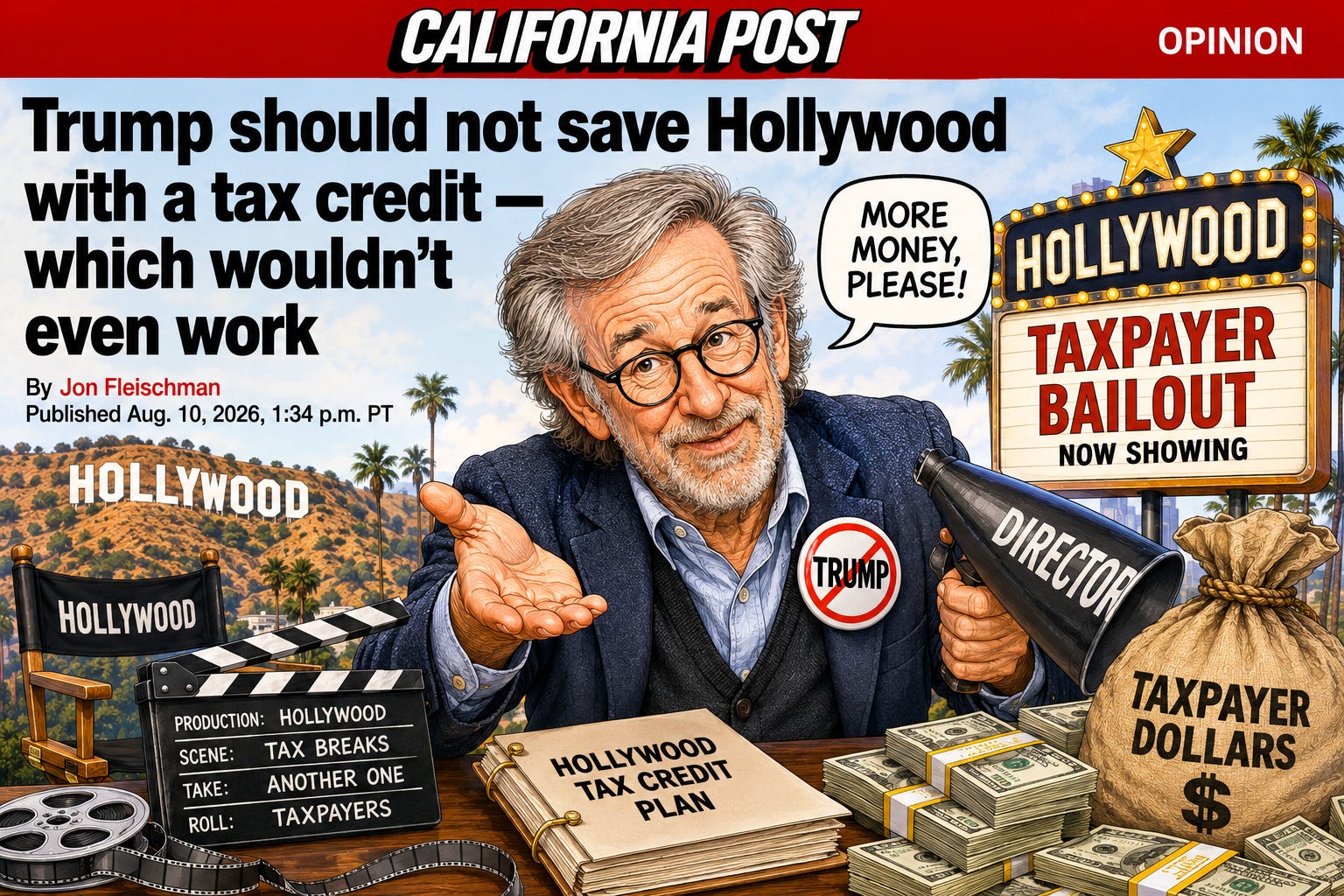
President Trump Should Reject Hollywood’s Bailout Script
Hollywood figures are urging Trump to support a federal film credit that would reward his loudest enemies and subsidize California’s political failures.
Our morning content is free for all subscribers and guests! Usually our afternoon content is behind a paywall… If you are not yet a paid subscriber, consider upgrading — you are missing a significant portion of what we produce each week, and your support makes it possible. If you want to get it all and support my efforts, please consider a paid subscription! There is significant exclusive content below the paywall, after this morning’s column.
Most of our content is available on our podcast feed. So, Does It Matter? SPOKEN. Which is available on your favorite podcast app. You can listen to it right here as well.
🕒 6-minute read
Hollywood Chose The Resistance
The California Post reported over the weekend that former Los Angeles mayoral candidate Spencer Pratt recently met privately with President Donald Trump and pitched a 25 percent federal film-production tax credit to “bring back Hollywood.”
Pratt is not the only one making the pitch. Jon Voight, one of Trump’s special ambassadors to Hollywood, has promoted a federal production credit as part of a broader industry-revival plan. Sylvester Stallone has joined entertainment unions, studios, and trade organizations in urging federal tax policies that favor domestic film production. Hollywood lobbyists and California politicians want Washington moving in the same direction.
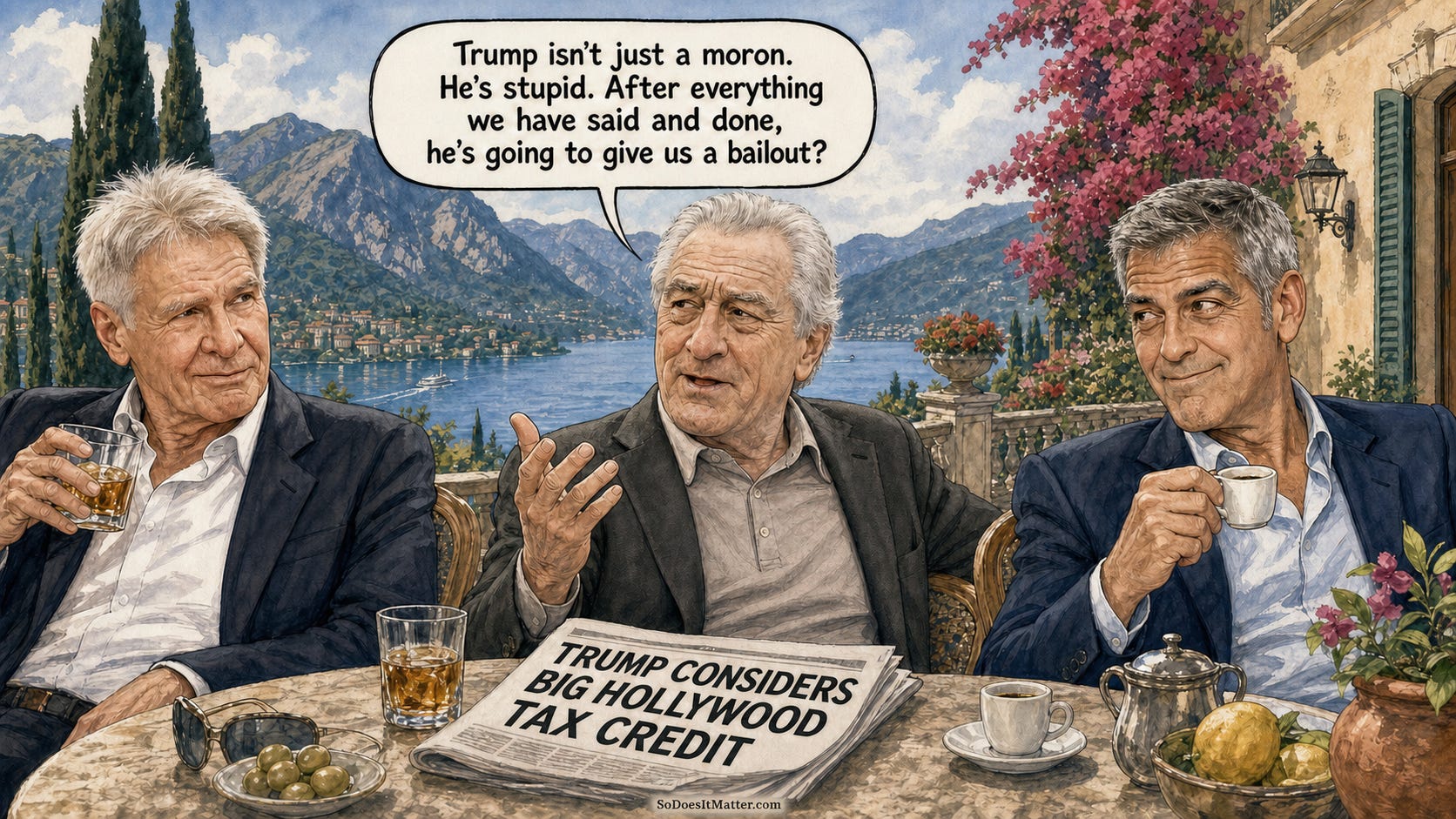
The irony is hard to miss. They are asking for help from a president whom Hollywood has spent more than a decade insulting, undermining and trying to defeat.
Robert De Niro called Trump “a punk,” “a dog,” “a pig” and “a con.” George Clooney branded him a “xenophobic fascist.” Tom Hanks dismissed him as a “simplistic, self-involved gasbag.” Ron Howard described him as a “self-serving, dishonest, morally bankrupt ego maniac.” Arnold Schwarzenegger declared that Trump would be remembered as the “worst president ever.” Harrison Ford recently said Trump “scares the shit out of me” and called him history’s greatest criminal.
That is only a small sample of Hollywood’s attacks during Trump’s political rise, three presidential campaigns, both Trump administrations and return to the White House. Actors, directors and producers have condemned him in interviews, on social media, along red carpets and practically everywhere else a microphone could be found.
And then there are the awards shows. For years, hosts, presenters and winners have used the Oscars, Golden Globes, Emmys and SAG Awards to mock Trump, denounce his policies and lecture his supporters. Anti-Trump politics became part of Hollywood’s institutional culture, not an occasional protest tied to one election.
They Bankrolled His Defeat
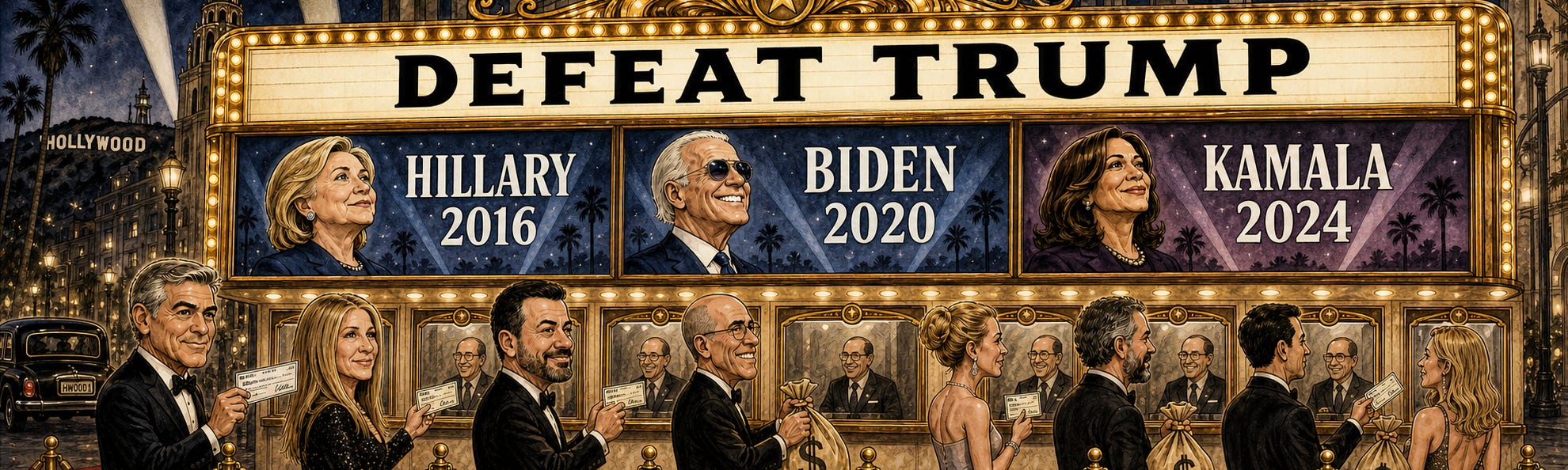
Hollywood did more than jeer from the stage. The entertainment establishment put serious money behind efforts to defeat Trump in all three presidential campaigns.
In 2016, George Clooney hosted major fundraisers for Hillary Clinton and Democratic organizations, with Jeffrey Katzenberg, Steven Spielberg and Haim Saban among the co-hosts. Tickets reached $353,000, and three events were expected to generate approximately $15 million.
In 2020, a virtual Hollywood fundraiser co-hosted by Clooney and Katzenberg raised $7 million for Joe Biden. A separate event hosted by billionaire producer Haim Saban brought in another $4.5 million.
In 2024, Clooney, Julia Roberts, Barbra Streisand, Jimmy Kimmel and Katzenberg helped stage a glittering Los Angeles gala for Biden that raised more than $30 million. When Democrats replaced Biden with Kamala Harris, Hollywood opened its checkbook again. A September Los Angeles fundraiser featuring Stevie Wonder, Jessica Alba, Lily Tomlin and other celebrities raised another $28 million.
Hollywood used its voice, prestige, and money against Trump in 2016, 2020, and 2024. Its leaders were free to do so. But that history gives Trump no political reason to grant their industry special treatment now.
Opposition to Trump does not disqualify anyone from equal treatment under the law. Nor is it, by itself, a reason to reject this credit. The proposal should be rejected because it is terrible public policy.
Corporate Welfare With Better Lighting
Why should one wealthy, politically connected industry receive a federal benefit unavailable to manufacturers, farmers, restaurants, truckers or family-owned retailers? Calling it a “tax credit” does not change what it is. If the proposed credit is refundable and exceeds a company’s tax liability, the difference becomes a government check.
The cost could get absurd quickly. A 25 percent federal credit could be stacked with state subsidies, including California credits that reach 35 or 40 percent for some productions. The government could cover an extraordinary share of expenses that studios and producers should otherwise pay themselves.
Supporters will advertise the entire budgets of participating productions as “economic impact.” That is accounting theater. Some of this work would have taken place in America without a subsidy. Paying a company to do what it was already likely to do produces a windfall, not a new job.
California’s nonpartisan Legislative Analyst’s Office reached much the same conclusion when it reviewed our state’s film credit. It found no compelling evidence that film subsidies grow the overall economy once the loss of government revenue and the displacement of economic activity are taken into account.
Then comes the lobbying over which expenses, productions and companies qualify. The largest studios, streaming platforms and accounting firms will be best equipped to navigate the rules and capture the benefits. Smaller filmmakers and independent businesses will get whatever is left.
Studios will keep the profits from successful productions. Taxpayers will shoulder part of the cost whether a film succeeds or fails.
California Is Driving Hollywood Away
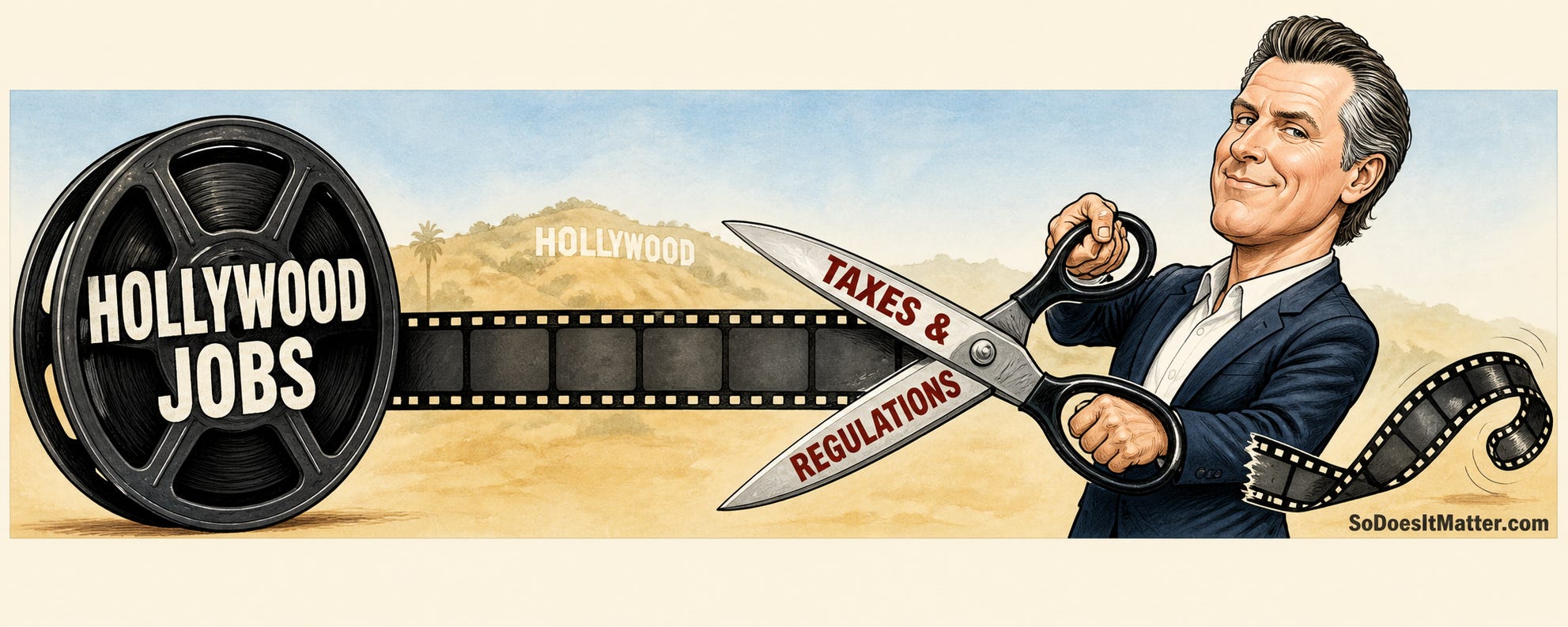
Hollywood faces streaming upheaval, changing viewing habits, labor disruptions and foreign competition. No tax credit can reverse all of that. California’s leaders have made matters worse by making the birthplace of American filmmaking increasingly expensive and difficult.
Under Gavin Newsom and legislative Democrats, businesses face high taxes, costly energy, unaffordable housing and oppressive regulation. In Los Angeles, Karen Bass and the City Council preside over high fees, permitting headaches, public disorder and deteriorating basic services.
Movie producers can read a spreadsheet. They compare those costs with what they would pay elsewhere and make the obvious decision. Instead of confronting the underlying problems, Sacramento pays favored companies to tolerate them.
Now Hollywood’s advocates want Washington to take that failed approach nationwide.
California should fix what California broke. Newsom, Bass, and state lawmakers should reduce business costs, streamline permitting, restrain taxes and fees, improve public safety, and make Los Angeles competitive again. Washington should not make the rest of the country subsidize their refusal to do it.
Trump should welcome filmmakers who want to produce in America and pursue lower taxes and fewer regulatory barriers for every business. He should not accept Hollywood’s request for a special federal benefit available to a politically connected few.
So, Does It Matter?
For more than a decade, Hollywood has used its cultural reach, celebrity voices and financial machinery against Trump. Its leading figures insulted him, turned awards shows into resistance rallies and raised millions for Hillary Clinton, Joe Biden and Kamala Harris.
They were free to do all of it. That freedom does not include an entitlement to have the Americans they ridicule finance their productions.
The federal tax code already contains too many special provisions secured by industries with good lobbyists and political influence. Adding Hollywood would make the problem worse. A private meeting and an impressive-looking economic-impact projection do not turn the industry’s troubles into a federal obligation.
President Trump is being asked to make taxpayers investors in an industry that has treated him, his movement and his supporters with contempt. The proposal would be bad policy without that history. With it, the political case for rejection is overwhelming.
The answer to Pratt, Voight, Stallone and the Hollywood lobby should be simple: no federal Hollywood tax credit. Let Hollywood compete, and let California fix California.
A Version of this Column is in the California Post!
The piece above is a bit longer than a column that I was invited to place into the post.
You can check out the “Post Version” here. Feel free to share either version and spread the word!