

Prediction Online Betting Markets Are Not Public Opinion
Betting Odds Are Misleading California Voters And Fueling Lazy Political Coverage

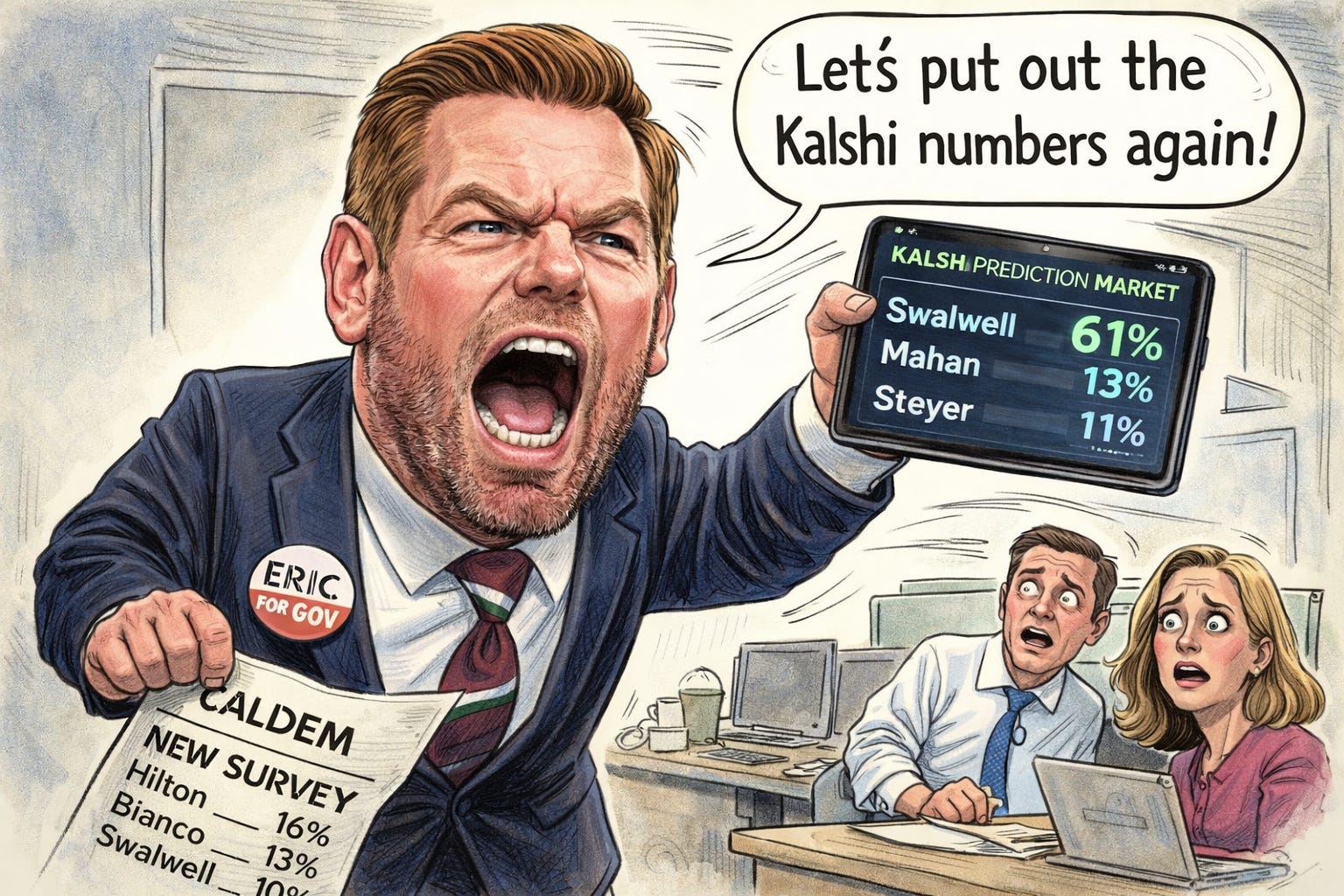
Our morning content is free for all subscribers and guests! You can also listen to this post — along with my California Post column — on our podcast feed, So, Does It Matter? SPOKEN. It’s available on your favorite podcasting app, or you can find it here.
For our paid subscribers, below the paywall, are three more great cartoons!
Also, an earlier post on KCRA3’s Ashley Zavala buttonholing some legislators in the Capitol apparently contained a link that I grabbed last night but then the station made a chance and the link I included went dead.. The post has been updated now. You don’t want to miss it!
⏱ 6 min read
Who Is Actually Driving These Numbers
Prediction markets are being treated as a political scoreboard in California. But they function far more like a niche trading desk than as a measure of the electorate. They are not measuring voters. They are measuring where bettors are putting money, and the growing tendency to blur that line is misleading the public.
There is a simple reality that gets lost in the headlines. The people setting these odds are not a representative slice of California voters. They are a narrow group willing to jump through multiple hoops just to participate.
To access these markets, users must create accounts, verify their identities, fund those accounts, and, in many cases, convert money into crypto. That alone excludes most voters. What remains is a small, self-selected group that is more tech-oriented, more financially engaged, and more comfortable with speculative trading.
Then narrow it further. These are not just bettors. They are people willing to bet on politics, use niche platforms instead of traditional gambling options, and operate in a system that often involves digital currencies. At every step, the pool becomes less representative of anything resembling the California electorate.
And yet, these are the numbers being cited as if they reflect public opinion.
Why Money, Not Voters, Drives The Outcome
The deeper problem is not just who participates. It is how the system works. Prediction markets are not based on one person, one vote. They are based on one dollar, one vote.
That means influence scales with wealth. A single trader with significant capital can move the odds more than hundreds of smaller participants combined. When millions of dollars are wagered on California’s gubernatorial race, those totals do not represent widespread support. They represent concentrated financial positions taken by a relatively small group.
This is the core flaw. Dollars are being mistaken for votes. A system where influence is determined by financial capacity cannot credibly measure democratic opinion.
This is where the narrative starts to break down. When headlines declare that a candidate is “leading” in prediction markets, they are not describing voter sentiment. They are describing where money has been placed. Those are not the same thing, and pretending otherwise is either careless or intentional.
The structure also creates an obvious vulnerability. If odds can be moved by money, then they can be moved in ways that create the appearance of momentum. Even if that is not happening in every case, the system allows for it. That alone should make any serious observer cautious about treating these numbers as meaningful.
How Media And Campaigns Are Gaming The Narrative
This is where the problem crosses from analytical weakness into political distortion. Some media outlets are beginning to use prediction market odds as a shortcut. It is an easy headline. It is clickable. It creates the illusion of real-time insight.
But it is also lazy. It substitutes speculation for reporting. It replaces engagement with voters with a glance at a betting platform. In a state as large and complex as California, that is a poor trade.
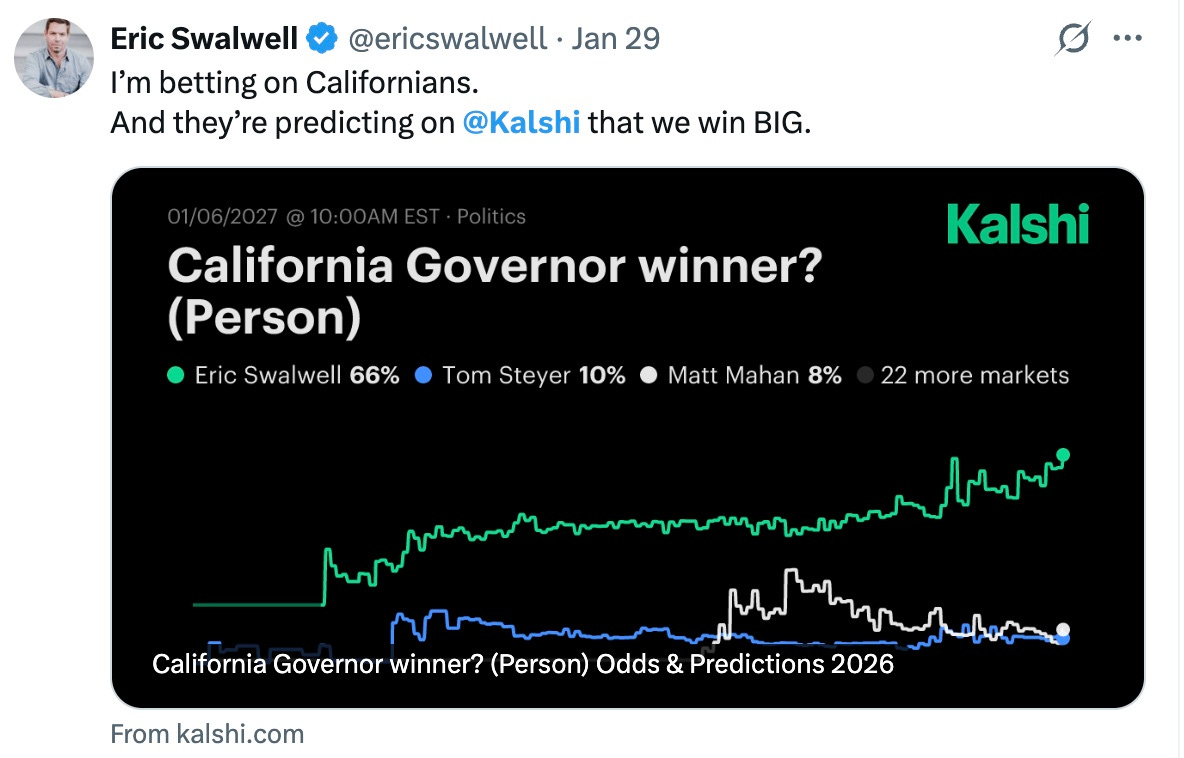
Campaigns have noticed. When Congressman and gubernatorial candidate Eric Swalwell posted, “I’m betting on Californians. And they’re predicting on @Kalshi that we win BIG,” alongside a graphic showing him with a commanding lead, he was not reporting voter support. He was pointing to a betting market and presenting it as proof of political momentum.
That is the sleight of hand. A small group of bettors places money, the odds move, and campaigns translate that into a claim about voters. Then media outlets repeat the framing, with coverage labeling candidates “ahead” in prediction markets even as polling shows a competitive or unsettled race.
That creates a feedback loop. Media coverage amplifies the odds. Campaigns cite the coverage. Donors and activists respond to the perceived momentum. Suddenly, a number generated by a small group of bettors starts to shape the broader political conversation.
That is not analysis. That is narrative construction.
The California Distortion Effect
California makes all of this worse. In many cases, participants in these markets are not California voters, meaning non-voters and non-residents can influence the perceived likelihood of who will lead the state.
That disconnect matters. California’s electorate is large, diverse, and often unpredictable. Reducing that complexity to a set of betting odds driven by a narrow, often tech-heavy group of participants is not just inaccurate. It is misleading.
The state’s concentration of wealth and technology only amplifies the distortion. A participant pool that leans heavily toward Silicon Valley perspectives can skew perceived momentum in ways that do not reflect the broader electorate. In a one-party dominant political environment, where perception already plays an outsized role in shaping viability, that distortion carries real consequences.
There is already evidence of this effect. Certain candidates perform better in prediction markets than in traditional polling, likely because the participant base skews toward specific industries or ideological preferences. That is not insight into the electorate. That is a reflection of who is placing the bets.
California elections are shaped by turnout, regional dynamics, and coalition building. None of that is captured by a trading platform.
So, Does It Matter?
Perception drives politics. When prediction markets are treated as a proxy for public opinion, they create a false sense of who is ahead and who is behind. That can influence media coverage, donor behavior, and even voter expectations.
The danger is not that these markets exist. The danger is that they are being misinterpreted and misused. They are being elevated from a niche financial tool into something that resembles a political scoreboard.
They are not that. They are a snapshot of how a small group of bettors allocates their money, shaped by incentives, biases, and their ability to spend.
But expecting media outlets and campaigns to prioritize accuracy over attention is a losing bet. California elections are decided by voters, not traders.
Below the paywall are three more great cartoons that each could have been up top! These are presented with appreciation to our paid subscribers. Feel free to share them!
