


You can listen to this post on our podcast feed, So, Does It Matter? SPOKEN. It’s available on your favorite podcasting app, or you can find it here.
⏱️ 5 minute read
Undecided Is Winning Los Angeles
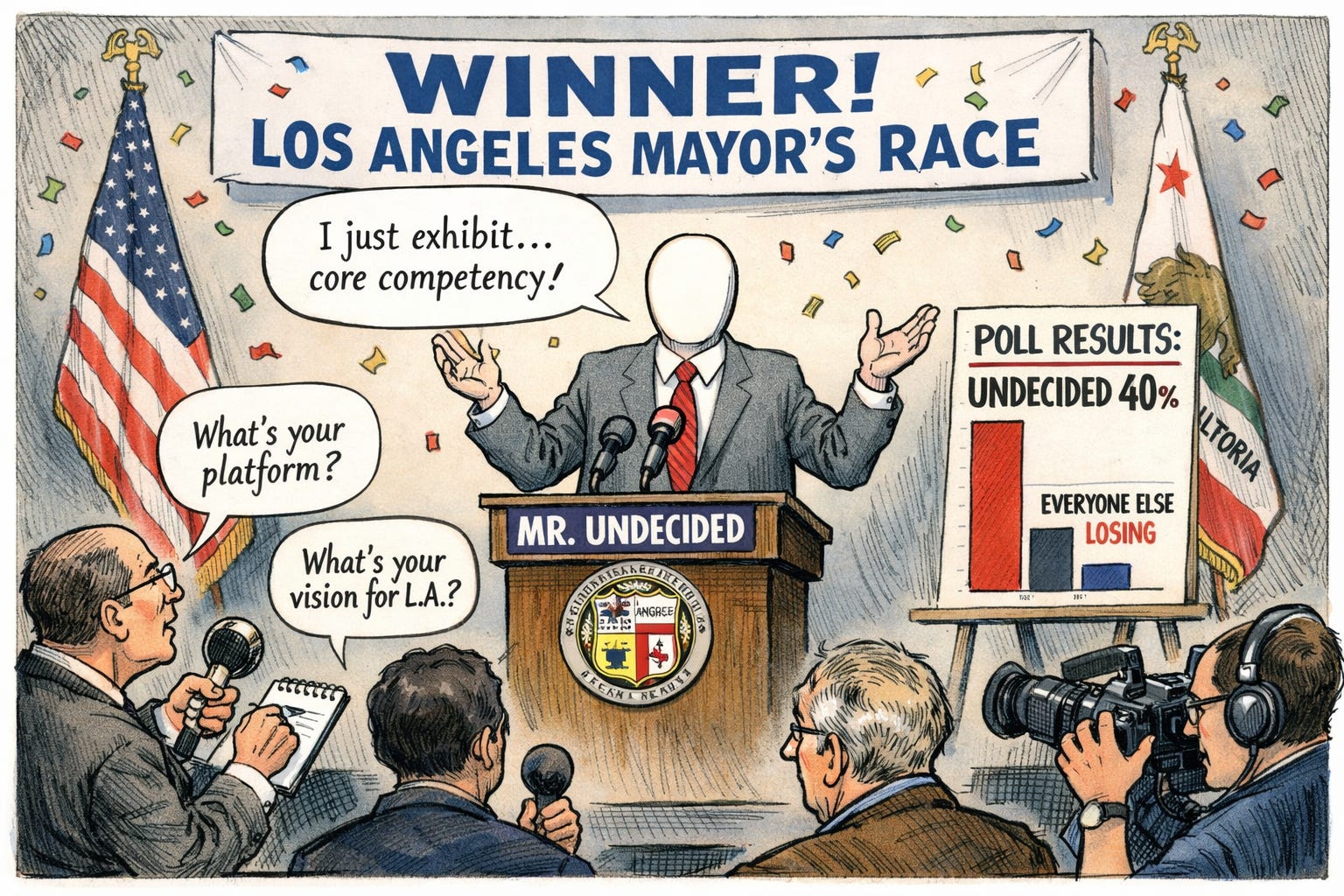
There is a clear frontrunner in the race for Mayor of Los Angeles. It is not Karen Bass. It is not any of the declared candidates. It is Undecided.
Of course, that is not an actual person. But according to the latest UCLA Luskin poll, it might as well be. Roughly 40 percent of likely voters say they have not made a choice. That is not just a large number. That is the dominant bloc in the race.
And this is not stale data. The survey was conducted March 16 through March 23, based on roughly 1,400 interviews and modeled for a likely election turnout. This is a real time snapshot of a race that is not settling because voters are not satisfied.
So here is the real question: what does it mean when a city is preparing to elect a mayor, and nearly half the electorate is effectively saying, none of the above?
The topline numbers are striking. Mayor Karen Bass leads the field with about 25 percent. Online media personality Spencer Pratt sits in second place at roughly 11 percent. Los Angeles City Councilwoman Nithya Raman follows at around 9 percent. A few points are scattered among lesser-known candidates, some of whom benefit from ballot titles that appeal to niche slices of the electorate.
No one is close to majority support. Not even close. This is not a competitive race in the traditional sense. It is a rejection.
A Weak Incumbent And A Hard Ceiling
And that rejection starts with the incumbent.
Karen Bass is not an unknown quantity. She is the sitting mayor of the second largest city in America. She has been in office for nearly four years. Before that, she served in Congress and rose to Speaker of the California Assembly, one of the most powerful posts in state government.
With that resume, reelection should be a formality. Instead, she is stuck at 25 percent in a fractured field, with nearly half the electorate unwilling to back anyone.
That is not a coalition. That is a hard ceiling.
The reason is visible across Los Angeles.
This is a city that looks increasingly ungoverned. Homeless encampments remain widespread despite billions spent in recent years, with audits and court rulings raising serious questions about results. Core infrastructure continues to deteriorate, from cratered streets to failing public services residents encounter every day.
The city now faces a budget shortfall running into the hundreds of millions, with Mayor Karen Bass going to Sacramento hat in hand looking for a state bailout that could approach $1 billion. With the state facing its own budget problems, she came up empty.
A City In Decline And A Leadership Failure
At the same time, one of Los Angeles’ signature industries is shrinking. Film and television production has declined sharply, with soundstages going dark and projects moving to states offering lower costs and aggressive tax incentives. Jobs and investment are leaving.
And for a city preparing to host global events like the World Cup and the Olympics, there is a growing question. Is Los Angeles actually ready?
And when crisis hit, the leadership failure was unmistakable.
As fires broke out in the Palisades, Bass was not in Los Angeles. She was in Ghana, attending the inauguration of that country’s president as part of a Biden Administration delegation in the final weeks of his administration. The image of a mayor halfway around the world while her city faced a developing emergency reinforced what many voters already suspected. City Hall is not in control.
What followed has only deepened that perception. Key questions about preparedness, response, and accountability remain unanswered. For many residents, the takeaway is simple. When it mattered most, the city was not ready.
A Fragmented Field And No Real Alternative
Against that backdrop, voters are also looking at a field that has failed to produce a clear alternative.
Rick Caruso, the billionaire developer who spent heavily in his last campaign, effectively froze the serious challenger lane without consolidating it this cycle. Another successful and wealthy businessman, Austin Beutner, another figure with the profile to mount a credible campaign, entered late and then exited following a personal tragedy.
The result is a fragmented opposition.
Spencer Pratt’s candidacy is less a governing coalition than a protest vehicle, appealing to the city’s scant Republican voters, and a slice of independents without and realistic path to an electoral majority. On the other end of the spectrum, Councilwoman Nithya Raman represents the hard left model of candidacy symbolized by the election of New York Mayor Zohram Mamdani, that has already produced many of the conditions voters are reacting against.
So voters hesitate. And hesitation becomes the dominant force in the race.
That is how you end up with Undecided leading a mayor’s contest.
So, Does It Matter?
Los Angeles is not lacking in potential. It remains one of the most important cities in the world. With competent leadership, it could reverse course and rebuild.
But that requires leadership that voters believe in. Right now, they do not see it.
In the end, cities tend to get the outcomes their political systems produce. If the current trajectory continues, Los Angeles may have to deteriorate further before there is enough pressure for real change.
This feels like the middle of the movie Rocky, where everything has gone wrong and you are left wondering how far Balboa still has to fall before he hits rock bottom.
Los Angeles has not hit rock bottom yet.