Our morning content is typically free for all subscribers and guests. However 35% of our site’s content is behind the paywall, reserved for our paid subscribers. Upgrade today!
⏱️ 6-minute read
The James Bond Moment
Over the weekend, I watched a video about Walther’s re-release of its classic PPK pistol—the sleek handgun made famous by James Bond—a historic design updated for modern buyers. I got excited - I want one!

Millions of Americans can walk into a gun store and purchase that firearm. But can we buy it here in California?
I went to the California Attorney General’s website and checked the official state handgun roster.
Search “Walther,” and you will find 14 approved models — mostly P22 variants and a couple of PDP models.
The PPK (now called just the PP) is not among them. Nope - out of luck!
California does not approve brands. It approves exact models and configurations. Unless a specific model appears on the certified roster, a licensed dealer cannot sell it.
That is how many Californians discover the roster: a handgun sold nationwide simply is not available here.
What Sacramento Has Actually Created
Passed into law as a “gun safety” measure (aren’t they all), it is just a gun control measure.
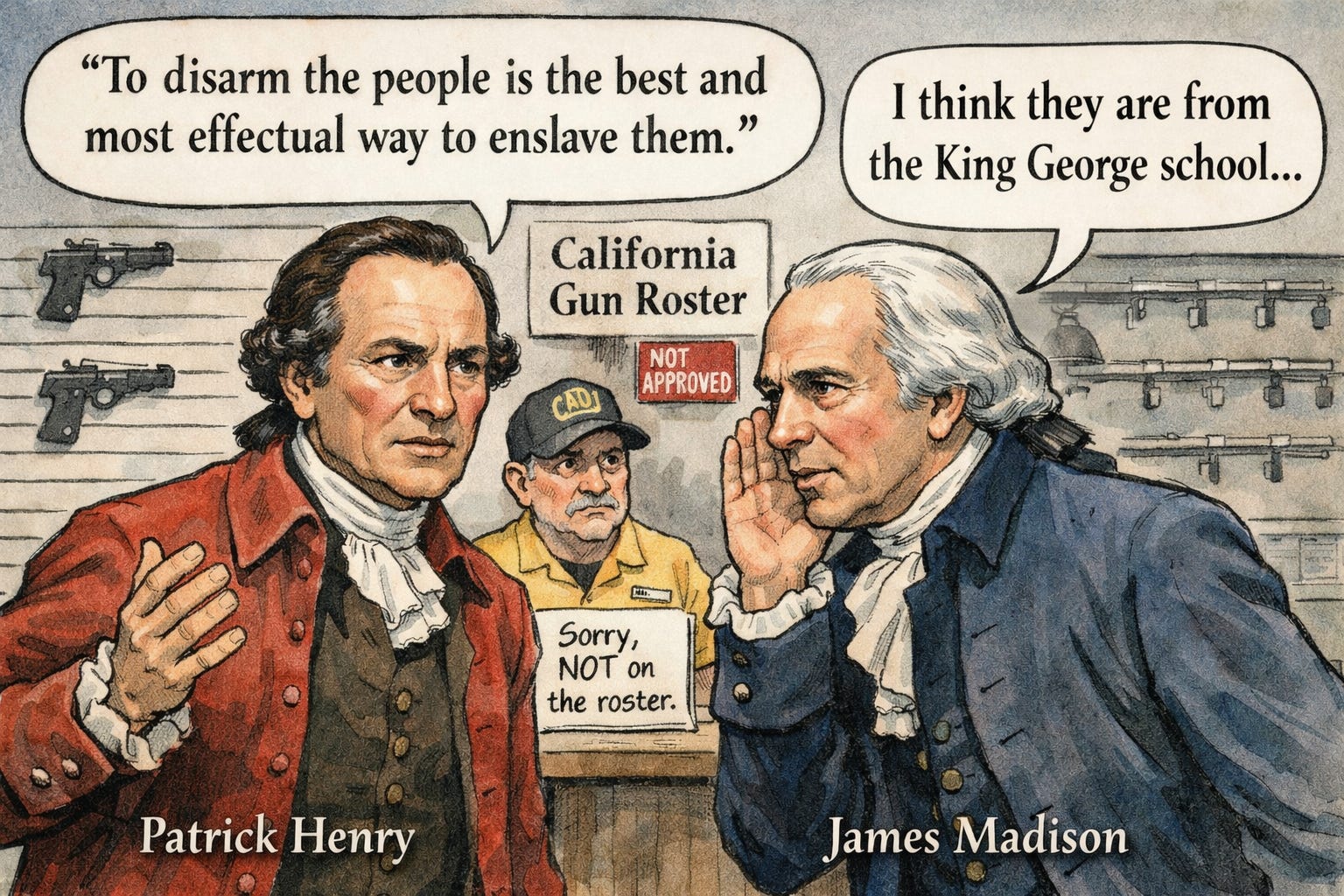
California has assembled a government-approved list that contains only a fraction of the handgun models widely sold across the country. If a firearm does not appear on that list, licensed dealers are barred from selling it to ordinary citizens — even if it is manufactured by a mainstream company and lawfully sold in most other states.
A true safety regulation addresses whether a product functions safely. This regime addresses whether citizens may access it at all.
The roster traces back to the Unsafe Handgun Act, enacted in 1999 and implemented beginning in 2001. Authored by then–State Senator Richard Polanco, the statute required the state to maintain a roster of handguns that had been tested and certified for sale after meeting mandated design and safety requirements.
During the debate, opponents, including the National Rifle Association, the California Rifle & Pistol Association, and Gun Owners of California, warned that the measure would not remain confined to drop testing. They argued that once the state assumed authority to define which handguns were “unsafe,” additional mandates would follow. The Democratic-controlled Legislature approved the bill, and Democratic Governor Gray Davis signed it.
Subsequent amendments added loaded chamber indicators, magazine disconnect mechanisms, and, in 2007, a microstamping mandate.
Once microstamping was treated as operative, new semiautomatic additions slowed dramatically. Federal district courts later issued preliminary injunctions against several roster mandates, but those rulings were stayed on appeal, and the procedural posture has continued to evolve in the Ninth Circuit. The years of litigation underscore the scale of what is at stake.
So, Does It Matter?
This is not an obscure compliance provision buried in statute. It is a state-curated list that determines which constitutionally protected products ordinary citizens may purchase through licensed dealers.
The system narrows lawful choice, inflates costs, deters innovation, and concentrates regulatory discretion in executive agencies.
It is also being challenged in federal court.
Fortunately, California remains part of the United States, and Americans remain protected by the Constitution.
Here Is The Issue Tool Kit — Giving You The Nine Best Arguments Against The California Gun Roster…
1. It Converts a Right Into a Government-Controlled Catalog
California does not ban handguns outright. Instead, it restricts retail sales to a state-approved list. Access to a constitutional right is mediated through bureaucratic certification.
2. It Replaces Performance Standards With Design Mandates
The roster does not primarily measure real-world reliability or market acceptance. It requires state-specified features. A firearm widely used across the country can be deemed “unsafe” here because it lacks a California-mandated component.
That is regulation by design specification.
3. It Created a Structural Bottleneck
The microstamping requirement illustrated how a single mandate can become a choke point. Few manufacturers adopted the technology, and for years, new semiautomatic models were rarely added to the roster.
4. It Locks in Older Designs While the Market Moves On
Firearm engineering has advanced, with improved drop safeties, modular ergonomics, and optics-ready platforms. Unless newer models are separately certified and comply with California mandates, they remain unavailable through licensed dealers.
Older generations persist on the roster while current iterations are excluded.
5. It Can Contract Even When Models Are Added
Under current law, adding certain new semiautomatic models may require removing multiple existing models from the roster—a three-for-one removal rule. Critics argue that this structure embeds contraction into the system itself.
6. It Imposes a Compliance Premium
Testing, certification fees, renewals, and California-specific configurations require manufacturers to weigh whether the market justifies the expense. Some decline to roster particular models. Reduced supply, combined with regulatory overhead, translates into higher consumer prices.
7. It Creates Unequal Treatment
Law enforcement officers are exempt from many roster restrictions and may purchase models unavailable to ordinary citizens. If a handgun is considered “unsafe,” that distinction raises serious questions.
8. It Shifts Discretion Toward Regulators
Under the current framework, Department of Justice determinations on technological feasibility can trigger additional requirements in the future, placing substantial authority in the hands of the administration.
9. This Entire Regulatory Scheme Is Unconstitutional
The Supreme Court’s decision in New York State Rifle & Pistol Association v. Bruen held that firearm regulations must align with the Nation’s historical tradition of regulation. Public-safety justifications alone are not enough.
There was no Founding-era practice of maintaining government-approved lists of weapons for law-abiding citizens. Nor is there a historical precedent for conditioning access to commonly owned firearms on evolving bureaucratic feature mandates.
The handgun roster is the subject of active federal constitutional challenges. In Boland v. Bonta and Renna v. Bonta, plaintiffs argue that the roster and its feature requirements violate the Second Amendment. Federal district courts issued preliminary injunctions against portions of those mandates, but those rulings were stayed on appeal, and the cases continue to proceed in federal court.
This question is not abstract. The constitutionality of the roster is being tested now.
The Final Word
The Walther PPK is not radical. It is a mainstream design sold nationwide. In California, however, its availability depends not on market demand but on bureaucratic approval.
The central question is whether a constitutional right should operate through a government approval list that narrows lawful options and conditions access on the basis of compliance.
The Constitution does not tolerate rights administered by a permission slip.
Oh Yeah… Cigars Have A Roster, Too
Did you know that in addition to a California Handgun Roster, there is a California Cigar Roster? Seriously. I wrote about that here.