

Newsom’s Affordability Plan Makes Wildfire Victims Pay
With his term ending and the 2028 field filling up, Newsom has found an easier way to claim lower costs: move them.
Our morning content is free for all subscribers and guests! Usually our afternoon content is behind a paywall… If you are not yet a paid subscriber, consider upgrading — you are missing a significant portion of what we produce each week, and your support makes it possible. If you want to get it all and support my efforts, please consider a paid subscription! There is significant exclusive content below the paywall, after this morning’s column.
Most of our content is available on our podcast feed. So, Does It Matter? SPOKEN. Which is available on your favorite podcast app. You can listen to it right here as well.
🕒 5 min read
The Clock Is Running On Newsom’s Presidential Run
This column is about Gavin Newsom’s effort to protect utility companies from the cost of fires they cause and pass that cost along to Californians through higher insurance premiums. But let’s start at the beginning.
The 2028 Democratic presidential field is already crowded. A recent national survey of 13 possible candidates confirmed that Newsom faces a competitive field.
Newsom has a deadline of his own. His term ends in January 2027, taking with it the governor’s enormous platform and his role as leader of the resistance to Donald Trump.
He cannot take the office with him. He can take only his record, and California’s reputation as a spectacularly unaffordable place to live is an inconvenient part of it.
A Proposal With Convenient Timing
Newsom’s administration is discussing last-minute legislation that could reduce what utilities pay when their equipment causes wildfires. With no public bill language, the proposal could emerge through a “gut-and-amend” maneuver late in the legislative session.
California’s big investor-owned utilities have been trying for years to limit how much they can be forced to pay after catastrophic wildfires. The Legislature turned back earlier efforts, created the California Wildfire Fund in 2019, and the utilities were still pushing for more protection last year.
Fire survivors and insurance-industry representatives say the ideas being discussed include limits on noneconomic damages, caps on attorneys’ fees, and new limits — possibly even a ban — on insurers going after utilities to recover what they paid on fire claims.
At the same time, the utilities are backing a statewide campaign called “Wildfire Victims First,” pitching the effort as a way to help fire victims and make insurance more affordable. That is worth keeping in mind if the eventual legislation makes it harder for victims or insurers to recover money from utilities that caused the fires.
Limits on noneconomic damages would leave victims carrying more of their losses. Attorney-fee caps could make it harder for survivors to obtain representation. Curtailing subrogation is the cleaner political trick. After paying to rebuild a home, an insurer may pursue the company that caused the loss. Take away that right, and the expense will reappear as higher premiums, tighter underwriting, and fewer policies in high-risk communities.
The burden will fall hardest on people in high-risk communities, who already pay the steepest premiums and have the most difficulty obtaining coverage.
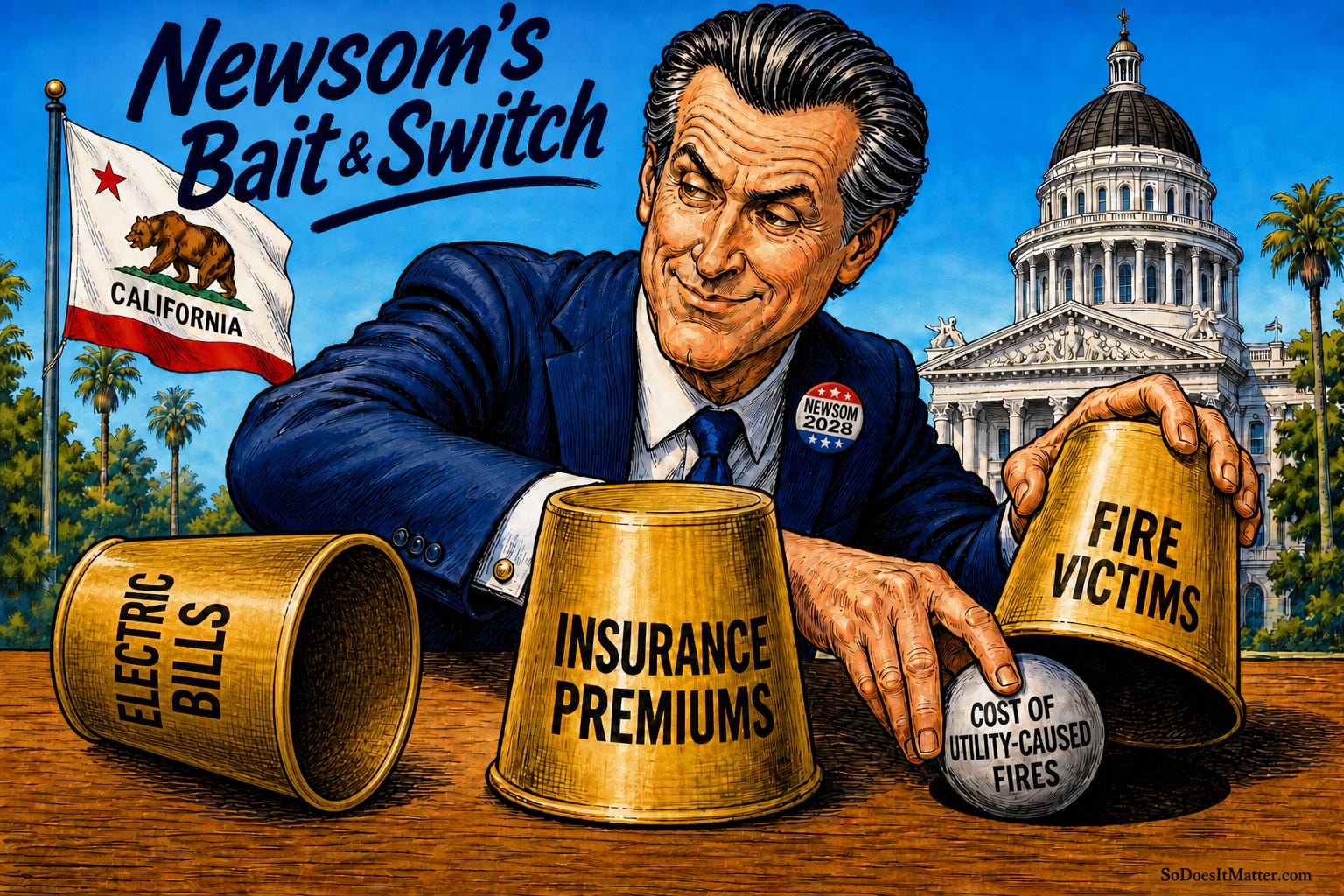
That is the bait-and-switch. Newsom talks about affordability and protecting ratepayers. Utilities get relief, while wildfire victims and homeowners get the bill.
Moving Costs Are Not Cutting Them
California has the nation’s second-highest residential electricity prices. Only Hawaii, isolated roughly 2,500 miles from the continental United States, is more expensive. California has no comparable excuse, yet its home prices are nearly twice the national average.
A January 2025 report from the Legislative Analyst’s Office showed how state policies pile up on electric bills. Non-solar customers of investor-owned utilities pay an estimated 11 to 20 percent more to subsidize rooftop solar. All customers pay another 2 to 4 percent for low-income assistance, roughly 5 percent for renewable-fuel requirements, and about 4 percent for greenhouse-gas programs. Investor-owned utility customers also pay more than 50 percent above customers of publicly owned systems, which face fewer state requirements. That comparison is not an argument for public ownership. It is evidence of how policy costs accumulate on particular customers’ bills.
Actually lowering power bills would require Newsom to acknowledge the costs of his climate taxes, fees, mandates, and regulations. He has declined to defend those trade-offs on their merits or change course. Instead, California keeps moving the wildfire bill around — from utilities to ratepayers, insurers, homeowners or victims — and calling that savings.
Following The Money
The utilities that stand to benefit are deeply invested in California politics. The Washington Post found that PG&E, its employees, and its charitable arm provided roughly $700,000 to Newsom’s campaigns, political causes, and family-connected nonprofits. This included $358,000 for the Representation Project, founded by Jennifer Siebel Newsom.
PG&E, Southern California Edison, and San Diego Gas & Electric also gave more than $1.2 million to sitting legislators during the 2025–26 session. Their rates, profits, liabilities, and even survival can depend on decisions by officials they help finance.
Newsom has reported raising more than $321 million in behested payments since becoming governor. These are uncapped donations public officials solicit for charitable or governmental purposes. In 2024 and 2025, at least $1.9 million went at his request to the California Partners Project, another nonprofit founded by Jennifer Siebel Newsom.
The utilities now asking Sacramento for relief have spent years putting money into the same political system that will decide whether they get it.
So, Does It Matter?
Newsom will present California to Democratic primary voters as proof of ambitious, affordable, and competent progressive government. The real test is what he does when that record becomes politically inconvenient.
Newsom is not really cutting the cost of anything. He is cutting what utilities may have to pay when their equipment causes catastrophic fires. The rest of the bill does not vanish. It gets pushed onto victims, insurers and homeowners. The utility comes out better. Californians still pay.
If Newsom believes victims should recover less and homeowners should pay more to shield utilities from fires they cause, he should say so and defend that decision openly. If he thinks Californians should absorb those costs instead of the utilities, he should say that plainly and defend it.
Newsom wants the country to see a governor who solved an affordability problem. What it should see is a presidential candidate protecting politically generous utility companies, moving their costs onto people with less influence, and trying to carry a cleaner version of his California record out of the state before anyone checks the math.