

New Survey: Americans Continue To Have High Level Of Low Trust To Our Institutions
The Gallup Organization has released it's annual survey measuring how Americans feel about our institutions... Let's dig in...


Our morning content is free for all subscribers and guests! Usually our afternoon content is behind a paywall… If you are not yet a paid subscriber, consider upgrading — you are missing a significant portion of what we produce each week, and your support makes it possible. If you want to get it all and support my efforts, please consider a paid subscription!
Most of our content is available on our podcast feed. So, Does It Matter? SPOKEN. Which is available on your favorite podcast app. But this would not make for a good listen, as it is heavily reliant on charts.
🕒 8 min read
They Did Not Lose Our Trust By Accident
The leaders of America’s most powerful institutions keep asking why the public no longer trusts them. Gallup’s latest survey suggests they should start by looking in the mirror.
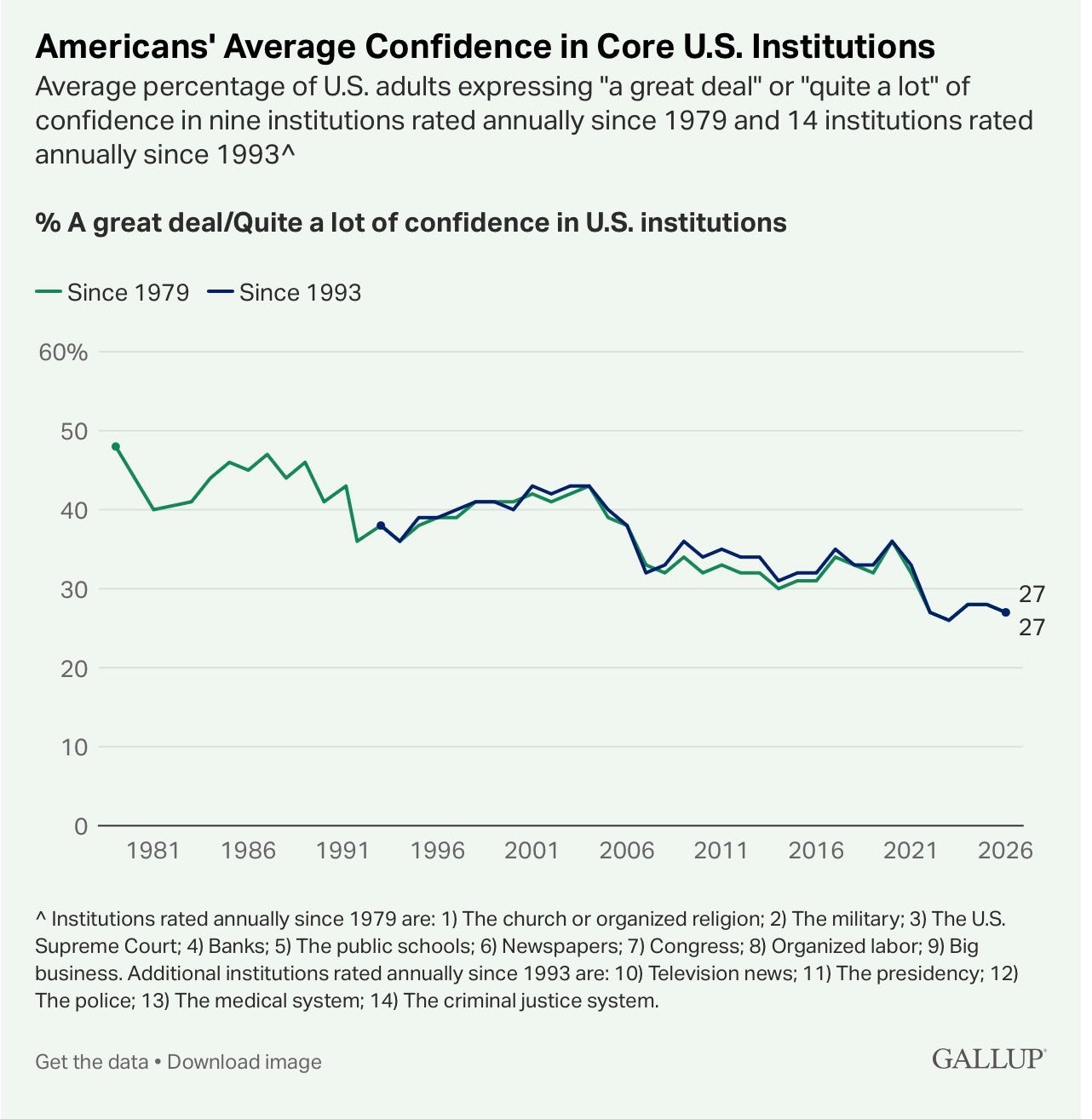
In polling conducted June 1–15, just 27% of Americans expressed a great deal or quite a lot of confidence in 14 core institutions. That is only one point above the record low—and the fifth consecutive year below 30%. Twelve of the 14 institutions are at or near their historical lows.
But “declining confidence” makes the collapse sound like a mysterious change in the national mood. Trust did not simply evaporate.
Gallup points to wars, economic upheaval, the withdrawal from Afghanistan, the Dobbs decision, backlash against COVID policies, and intensifying polarization. My own list would go further: Congress substituted spectacle for performance, journalism increasingly blurred the line between reporting and advocacy, and public health officials too often treated dissent as a compliance problem.
Americans did not stop trusting institutions for no reason.
Clear Missions Still Earn Trust
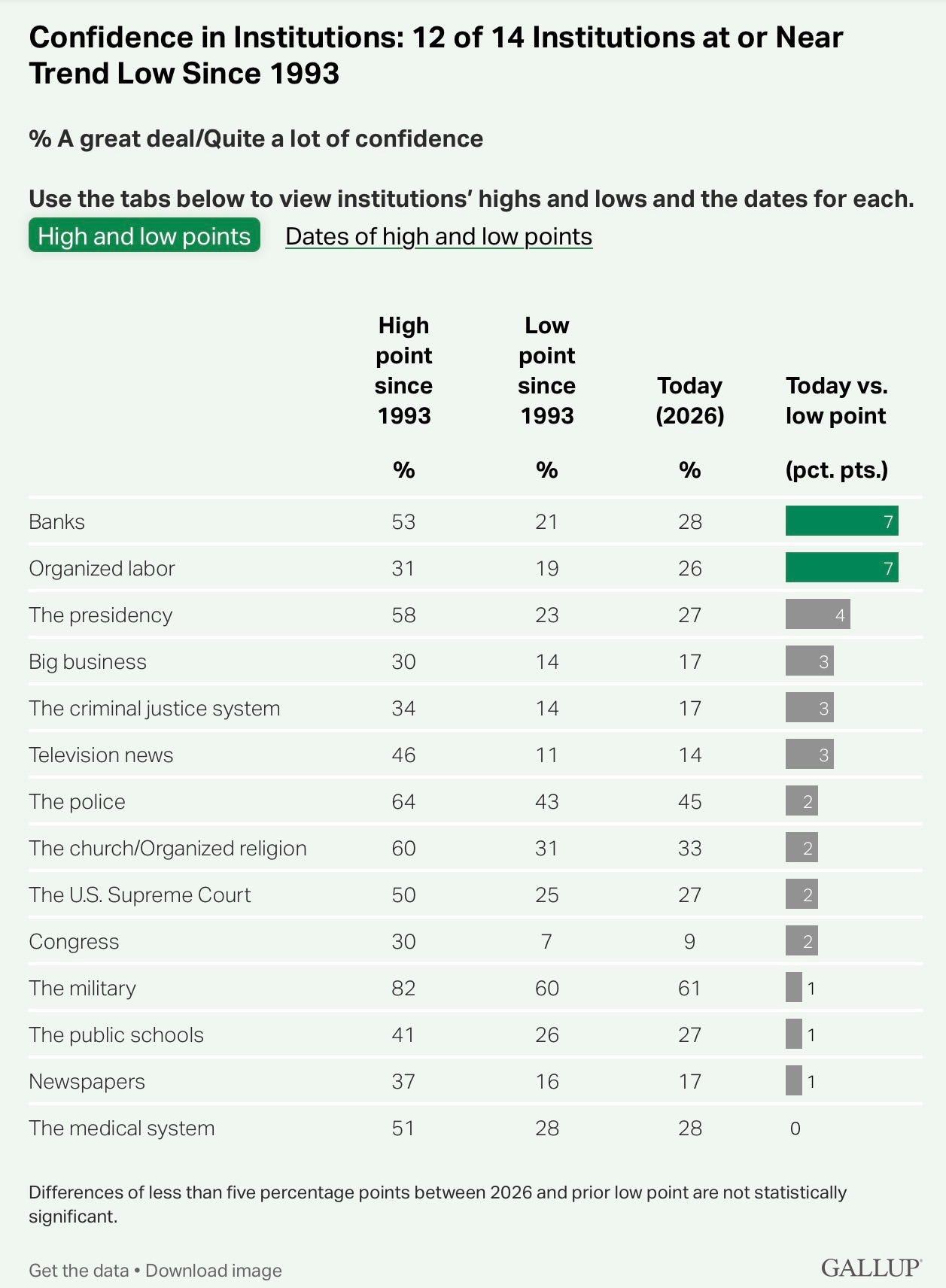
The institutions retaining the most confidence are revealing. Small business leads at 67%, followed by the military at 61%. Police receive 45%, while every other institution measured falls below 40%.
At the bottom sit Congress at 9%, television news at 14%, and newspapers, big business, and the criminal justice system at 17% each. The medical system, public schools, and Supreme Court all remain below 30%.
The contrast is not entirely explained by ideology or performance. But Americans appear more willing to trust institutions with understandable missions—and less willing to trust institutions that exercise expansive power while resisting accountability. A small business must satisfy its customers or close. A bureaucracy can continue operating long after it no longer satisfies the public.
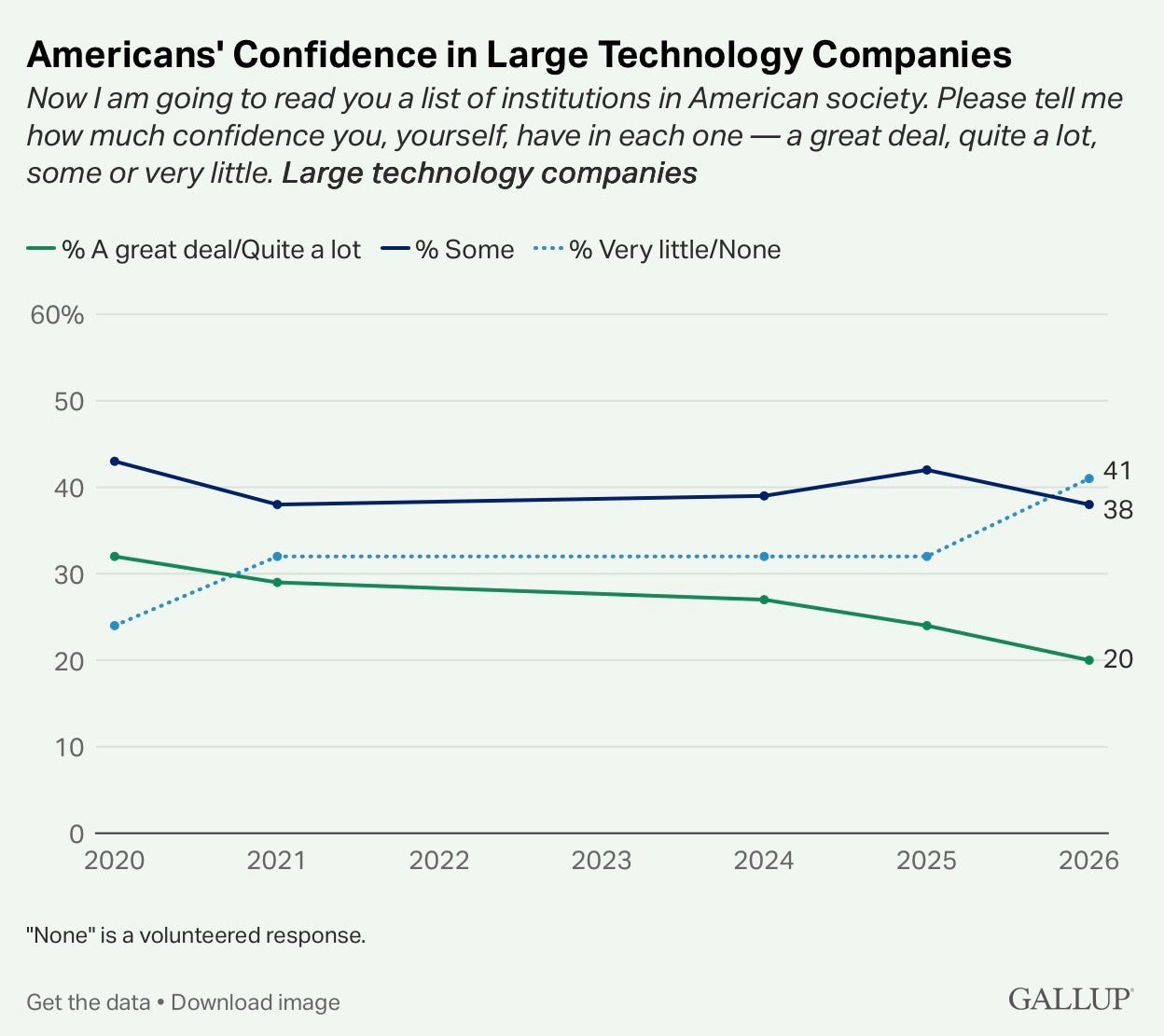
Big Tech offers the survey’s clearest new warning. Confidence in large technology companies has fallen from 32% in 2020 to a record low of 20%. The share expressing very little or no confidence has risen to 41%.
Big Tech promised to democratize information. Instead, a handful of companies acquired enormous power over what Americans see, say, and buy. Confidence collapsed as that power became more visible and accountability remained elusive.
Trust Has Become A Partisan Weapon
Gallup’s results expose another problem: Americans increasingly conflate confidence in an institution with approval of the people who control it.
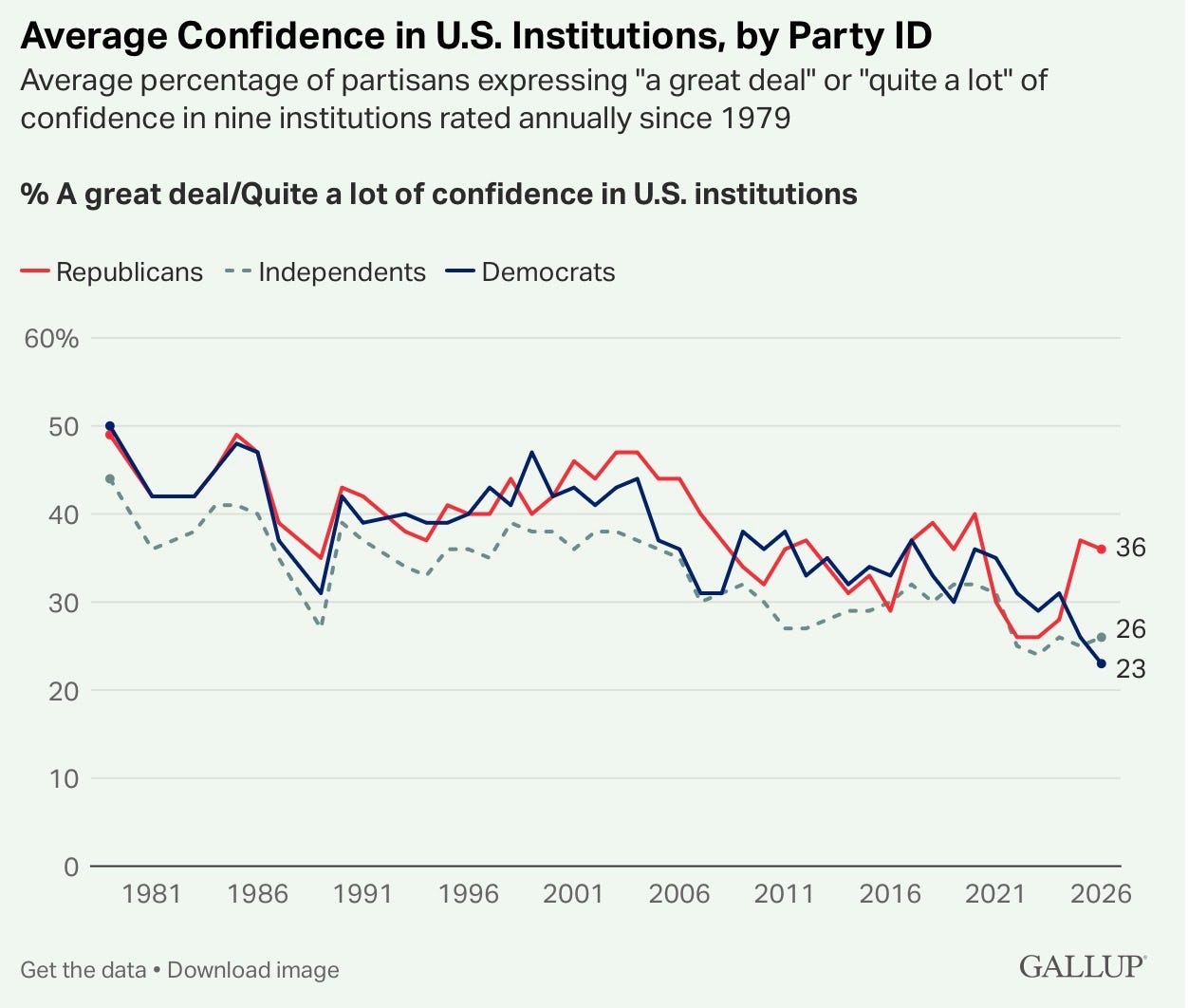
Republicans average 36% confidence across nine institutions Gallup has measured consistently since 1979. Independents average 26%; Democrats stand at 23%. The presidency produces the most extraordinary division—74% confidence among Republicans and just 4% among Democrats.
For years, Democratic leaders warned Americans to respect norms and institutions. Their voters now report just 4% confidence in the presidency under Donald Trump. Conservatives should not congratulate themselves too quickly, however. Republican confidence also rises when Republicans control Washington.
Conservatives should be particularly wary of discovering a newfound reverence for institutions merely because conservatives temporarily control them.
The purpose of conservatism is not to replace progressive institutional obedience with Republican institutional obedience. It is to defend institutions that remain faithful to their missions, constitutional limits, and obligations to the public.
California Shows What Failure Looks Like
Gallup surveyed national institutions, not California agencies. But the mechanism by which confidence is lost—grand promises followed by weak accountability—is familiar in Sacramento.
From fiscal years 2018–19 through 2022–23, California allocated roughly $24 billion to homelessness and housing programs. Yet the state auditor concluded that California had not consistently tracked whether many programs were cost-effective.
Home-insurance availability has deteriorated, pushing more homeowners toward the FAIR Plan, California’s insurer of last resort. The 2026 high-speed rail business plan estimates that it will cost roughly $126 billion to complete Phase 1 from San Francisco to Los Angeles/Anaheim, while initial Merced-to-Bakersfield passenger service is projected for 2033.
These are not Gallup findings. They are documented examples of why public confidence must be earned through accountability and measurable results.
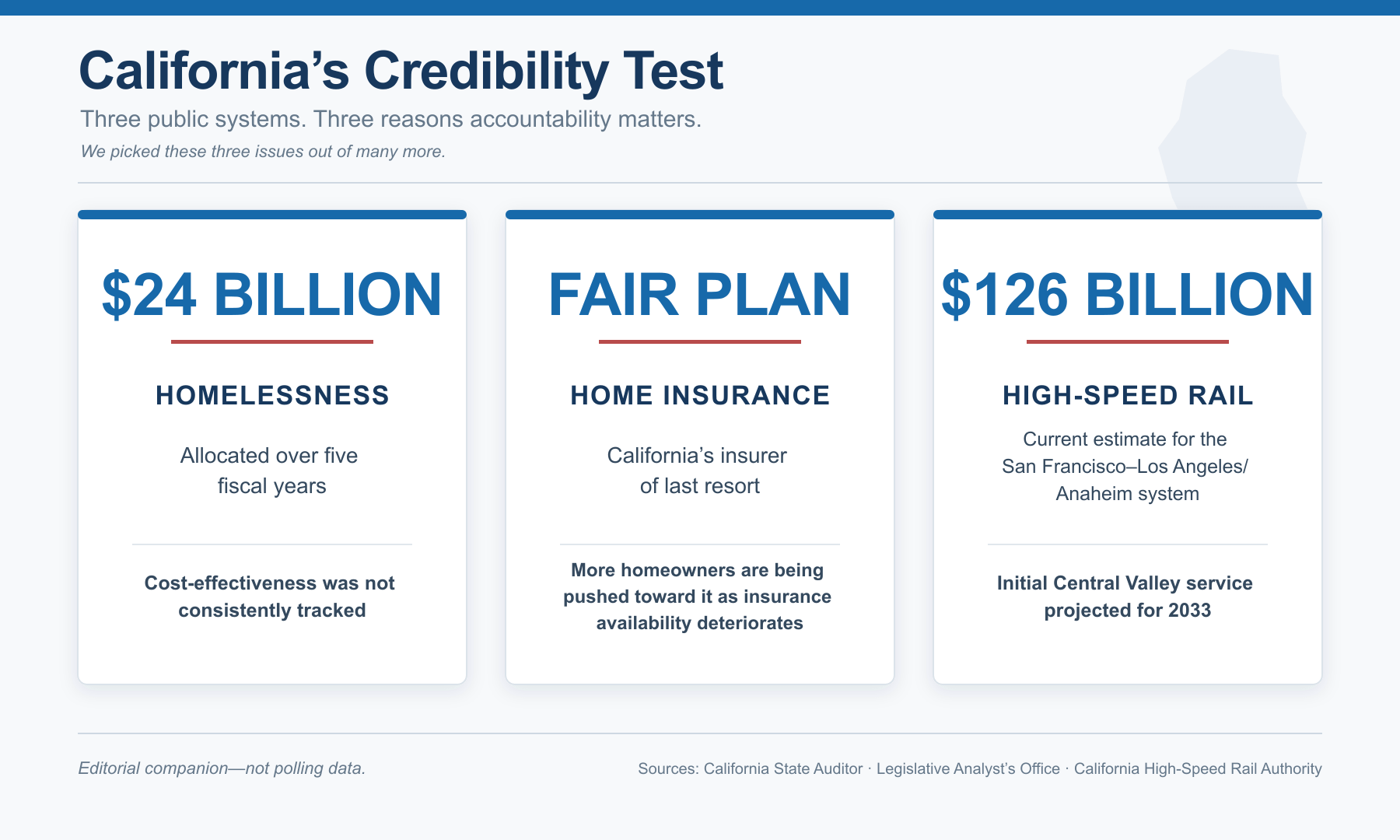
Homelessness: Approximately $24 billion allocated; inadequate cost-effectiveness tracking
Insurance: Availability problems push more homeowners toward the FAIR Plan
High-Speed Rail: Approximately $126 billion estimated for the San Francisco-to-Los Angeles/Anaheim system; initial Central Valley service projected for 2033
So, Does It Matter?
A country cannot function indefinitely when every court decision, election result, news report, and official recommendation is accepted or rejected according to partisan allegiance. Conservatives should not celebrate a society in which nothing is believed and no authority is considered legitimate.
But the answer is not blind obedience. Institutions cannot restore confidence by demanding deference, dismissing criticism, or launching another public-relations campaign.
The answer to institutional failure is not an institution-free society. It is the restoration of institutions to their proper purposes and limits.
Trust returns when institutions become competent, politically restrained and accountable—when officials admit mistakes, answer questions and produce results.
America does not have a trust problem because its citizens ask too many questions. It has a trust problem because too many powerful institutions stopped believing they owed the public honest answers.
Want to dig in more?
Gallup: “Confidence in U.S. Institutions Remains Near All-Time Low”
Methodology…
Gallup’s findings are based on telephone interviews conducted by ReconMR from June 1–15, 2026, with a random sample of 1,001 adults aged 18 and older living in all 50 states and the District of Columbia. The sample included at least 80% cellphone respondents and 20% landline respondents, obtained through random-digit dialing, and the margin of sampling error was ±4 percentage points at the 95% confidence level.
SOMETHING EXTRA FOR OUR PAID SUBSCRIBERS
My substantive, additional take on why conservatives do not want institutions to fail… Below the paywall…
Keep reading with a 7-day free trial
Subscribe to So, Does It Matter? On CA Politics! to keep reading this post and get 7 days of free access to the full post archives.