

New Statewide Survey Results - Governor’s Race: Three Candidates, Two Spots, One Messy June Election
A new Emerson College poll shows the governor’s race tightening into a three-way scramble with the June primary just weeks away. Chance of GOP being locked-out gets more real...


Typically, our afternoon content is either reserved for our paid subscribers or exclusive to those of you who financially support this effort. Today it is the latter, with a full analysis of a separate part of the Emerson College survey, focused on the Los Angeles mayoral race — exclusively for paid subscribers below.
You can listen to this post on our podcast feed, So, Does It Matter? SPOKEN. It’s available on your favorite podcasting app, or you can find it here.
🕐 5-minute read
A New Poll: Let’s Dig In...
A new Emerson College Polling/Inside California Politics survey is just out of the field, and while I am not sure it provides a lot of clarity — as you will see below — it does offer a fresh look from a reputable pollster at the rapidly evolving 2026 California governor’s race. The survey finds former Health and Human Services Secretary in the Biden Administration, Xavier Becerra, narrowly leading the field at 19%, followed closely by former Fox News host Steve Hilton at 17%, and billionaire Tom Steyer at 17%. Riverside County Sheriff Chad Bianco follows at 11%, former Congresswoman Katie Porter comes in at 10%, San Jose Mayor Matt Mahan posts 8%, and former Los Angeles Mayor Antonio Villaraigosa sits at 4%. With the survey carrying roughly a ±3% margin of error statewide, the reality is that California’s gubernatorial contest currently looks far more like a statistical three-way tie than a race with a clearly established frontrunner.
Nearly Half The Electorate Remains Movable
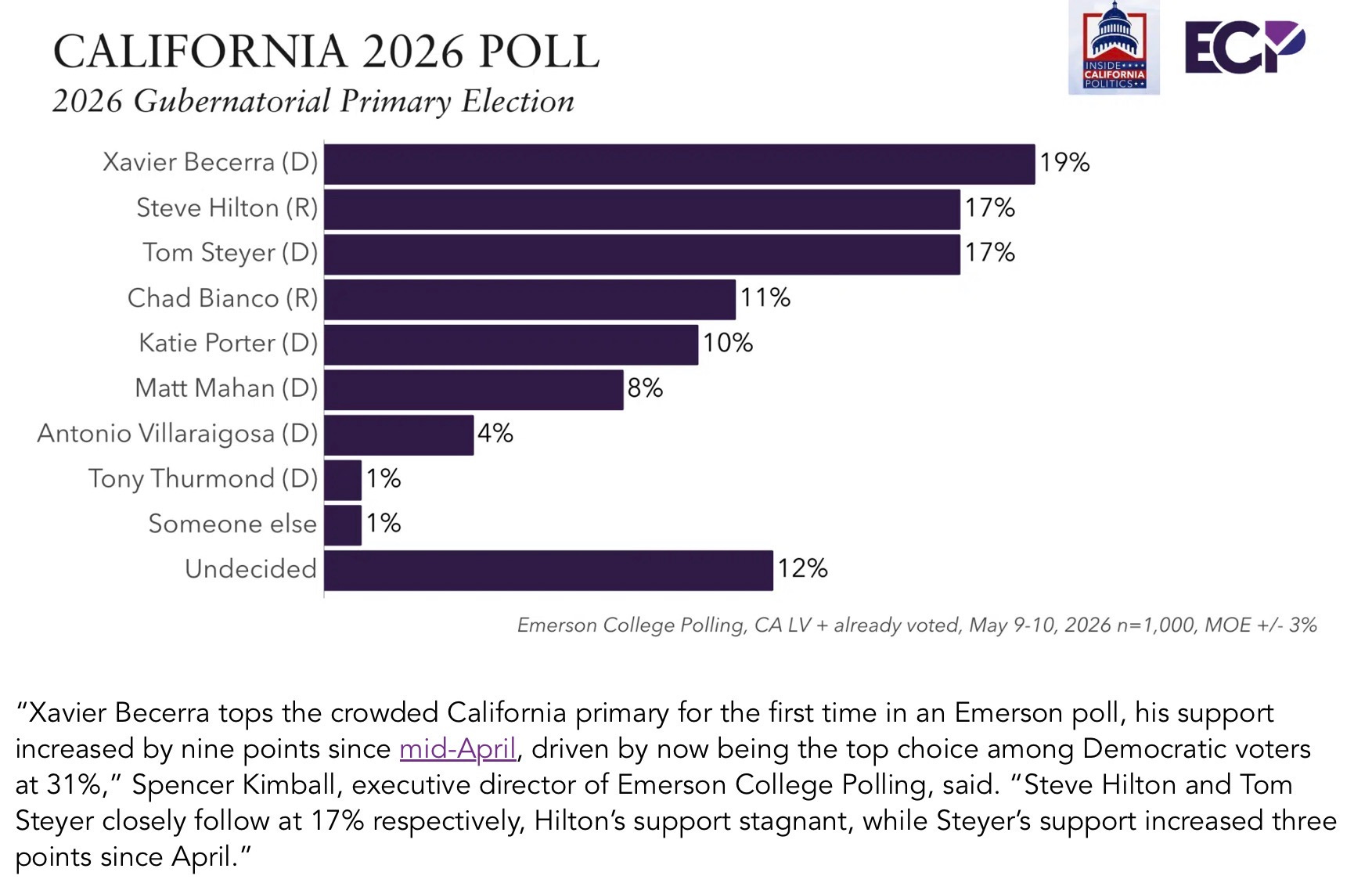
The single biggest takeaway from the Emerson survey may not be who is “leading” the race, but rather how unsettled the electorate still appears. Twelve percent of likely voters remain outright undecided. But even more significantly, among voters who have selected a candidate, 40% admit they could still change their minds before Election Day. When combined, that means nearly half of California’s likely primary electorate is either undecided or not firmly committed to its current choice. In practical terms, only a little over half of voters appear firmly locked in behind a gubernatorial candidate at this stage of the race. That is an extraordinarily fluid environment for a contest involving multiple candidates with substantial statewide name identification — especially with ballots having been received by all voters last week. The poll suggests California voters are still very much shopping, not settling.
There Is Effectively A Three-Way Tie For The Top Two Spots
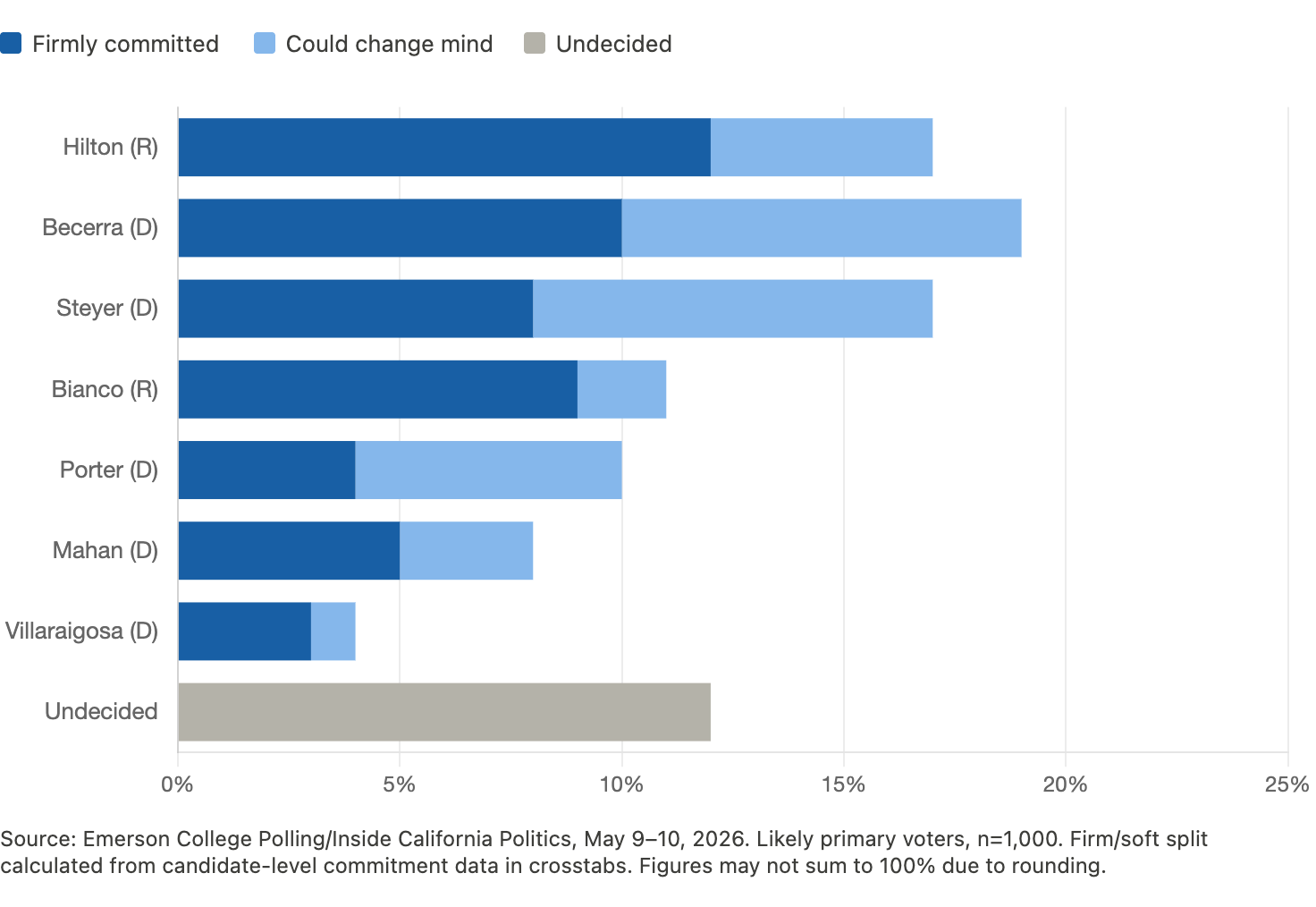
While the toplines show Xavier Becerra narrowly leading the race at 19%, that is not really the most important way to read the survey. In California’s top-two primary system, the key question is not who is technically in first place today, but which two candidates are positioned to advance to the November general. On that score, Emerson shows a three-way fight for two runoff spots. Becerra sits at 19%, while Steve Hilton and Tom Steyer are both at 17%, placing all three well within the poll’s roughly ±3% statewide margin of error. The picture tightens even further when Emerson presses undecided voters to say which way they lean: Becerra moves to 20%, Steyer to 19%, and Hilton to 18%. The race is better understood as three candidates bunched together for two available slots in November.
Steve Hilton Has Emerged As The Republican Frontrunner — But Republicans Still Face A Serious Lockout Risk
One of the clearest findings in the Emerson crosstabs is that Steve Hilton appears to have established himself as the leading Republican in the field. Among Republican voters, Hilton leads with 42.7% support, compared to 29.7% for Chad Bianco. Hilton also substantially outperforms Bianco among independent voters, suggesting his coalition is broader than simply the Republican ideological base. But California’s top-two system creates an entirely different problem. The question is no longer whether Hilton is emerging as the Republican frontrunner. The question is whether the Republican lane itself is large enough to secure one of the two runoff spots in a heavily Democratic state. If enough Democrats consolidate behind Becerra and Steyer, Republicans could still face a real risk of lockout. Bianco is the key variable: to the extent he surges, that would likely come at Hilton’s expense, increasing the likelihood of the GOP lockout scenario.
Not All Support Is Equal
Beyond the topline numbers, one of the most revealing parts of the Emerson survey is the intensity of support behind the various candidates. Steve Hilton’s coalition appears particularly durable, with roughly 73% of his supporters saying they are firmly committed to him. Chad Bianco’s support is even harder, with roughly 79% saying they are definitely behind him. By comparison, Xavier Becerra’s support is considerably softer, with only about 52% firmly committed, while Tom Steyer’s coalition is even more fluid, with a slim majority of his voters saying they could still change their minds before Election Day. In low-turnout primary elections, intensity can be just as important as raw support — a dynamic that could become especially important as ballots begin getting returned over the coming weeks.
So, Does It Matter?
Taken together, the latest Emerson survey does not show a California governor’s race moving toward clarity nearly as much as it shows an electorate still searching for direction. Nearly half the electorate remains either undecided or soft in its support, three candidates are effectively battling for two runoff spots, and while Steve Hilton appears to be consolidating the Republican lane, California’s top-two system still creates a very real lockout risk for the GOP. Meanwhile, Becerra’s late movement suggests institutional Democrats may finally be beginning to consolidate, while Steyer continues hovering close enough to remain a serious contender with virtually unlimited financial resources.
For context, here is how this survey compares to Emerson’s own previous poll, conducted April 14-15:
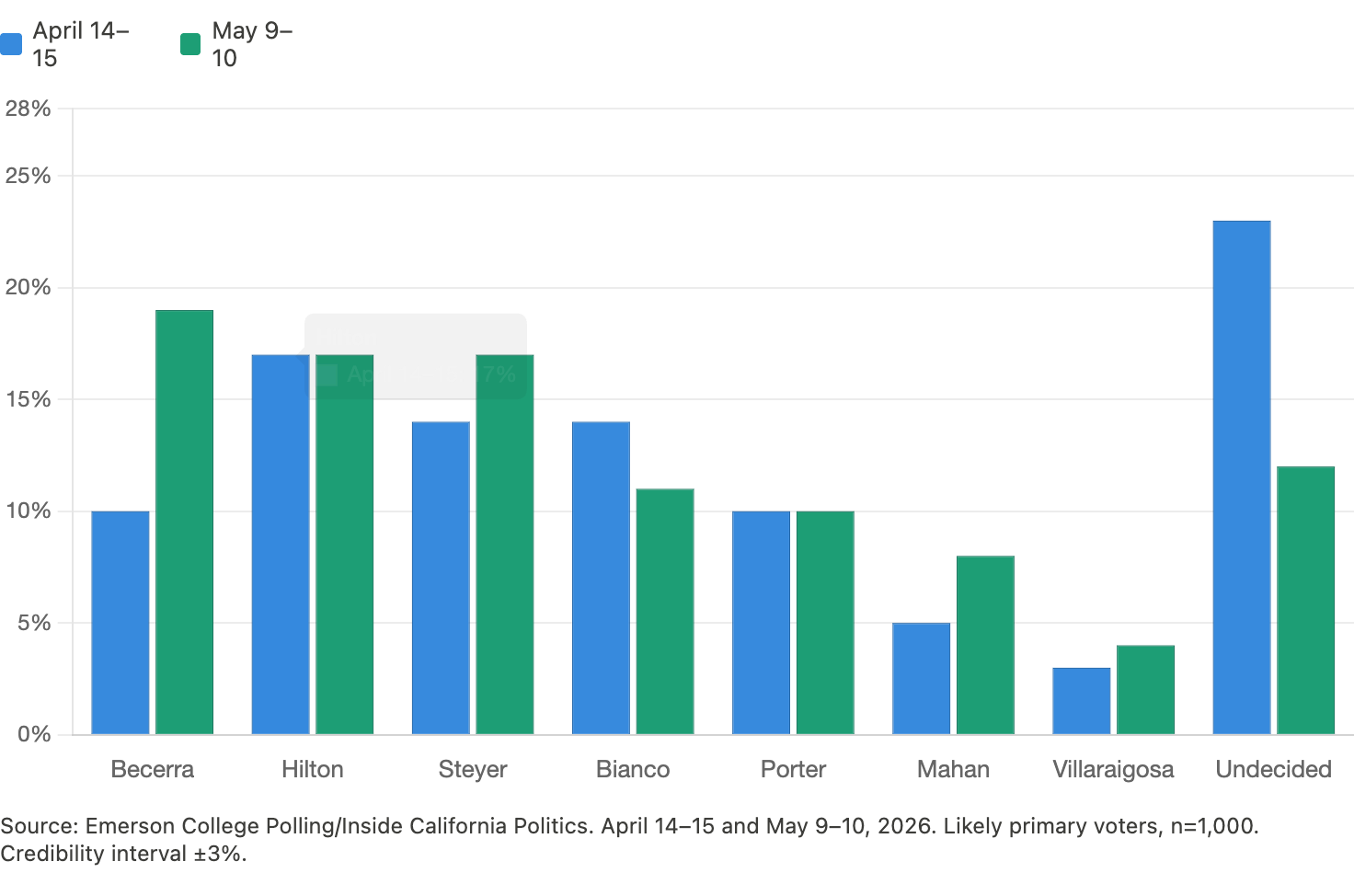
Becerra rose from 10% to 19%, up 9 points.
Hilton stayed at 17%, unchanged.
Steyer rose from 14% to 17%, up 3 points.
Bianco fell from 14% to 11%, a 3-point decline.
Porter stayed at 10%, unchanged.
Mahan rose from 5% to 8%, up 3 points.
Villaraigosa rose from 3% to 4%, up 1 point.
Undecided fell from 23% to 12%, down 11 points.
Becerra is clearly moving, Hilton is holding, Steyer and Mahan are gaining modestly, Bianco is slipping, and the undecided pool is shrinking — though California voters still appear far from settled.
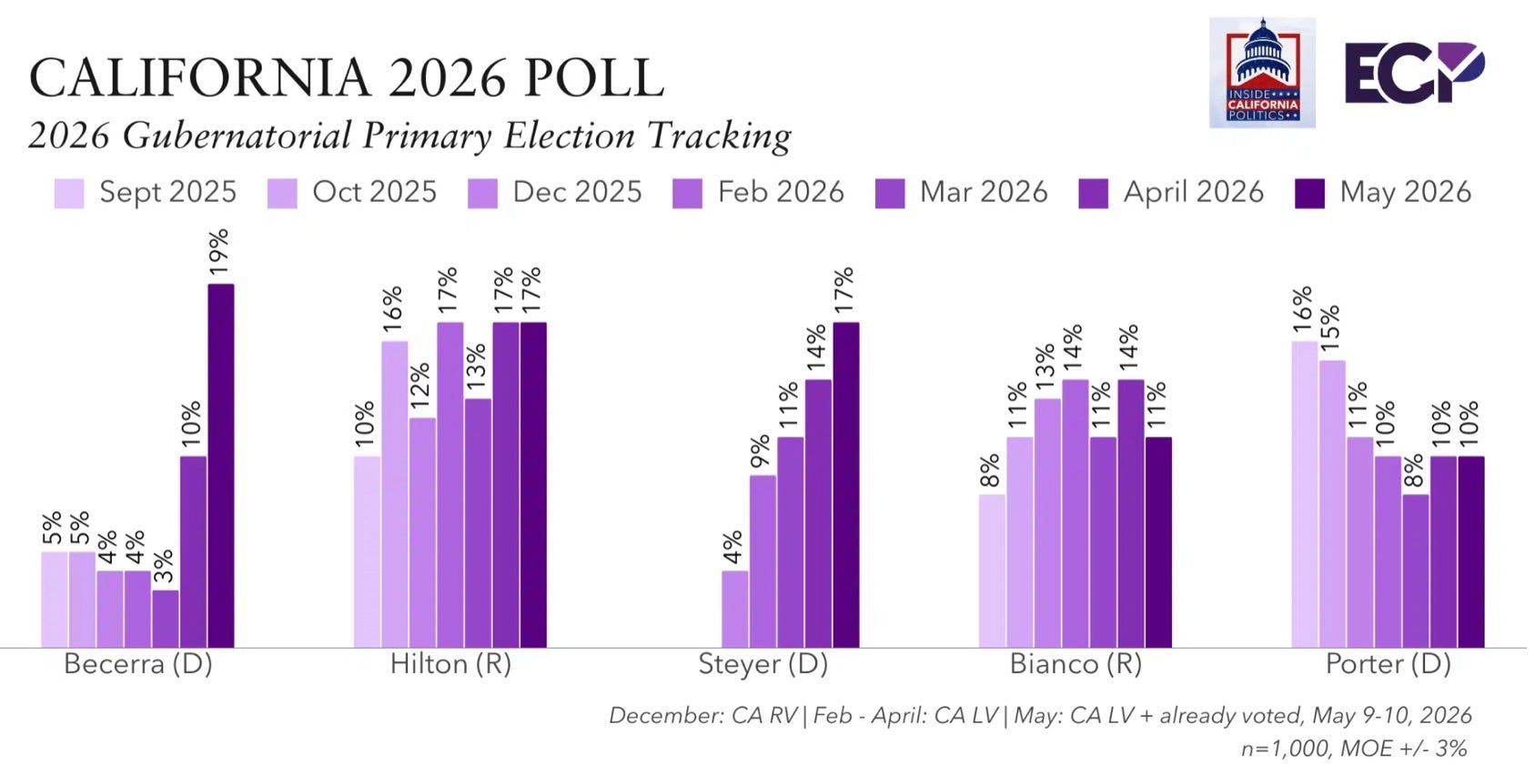
And if you want an even further look-back on Emerson surveys of this race, here’s another chart showing how the top candidates have fared over time…
Methodology: Emerson College Polling surveyed 1,000 likely California primary voters from May 9–10, 2026. The survey was conducted by an online panel using MMS text-to-web and carries a credibility interval of ±3% statewide.
But Wait, There’s More!
Below the paywall, I have results and analysis of Emerson College’s survey of likely Los Angeles voters in the mayor’s race…. You want to read this!
The same Emerson College survey that captured the churning dynamics of the governor’s race also took a close look at a high-stakes contest closer to home for millions of Southern California voters: the race for Los Angeles mayor. For paid subscribers, here is a full breakdown of what the numbers show — and what they may mean for the future of the nation’s second-largest city.
The Los Angeles Mayor’s Race Still Looks Volatile — And The Sample Size Of This Survey Demands Caution
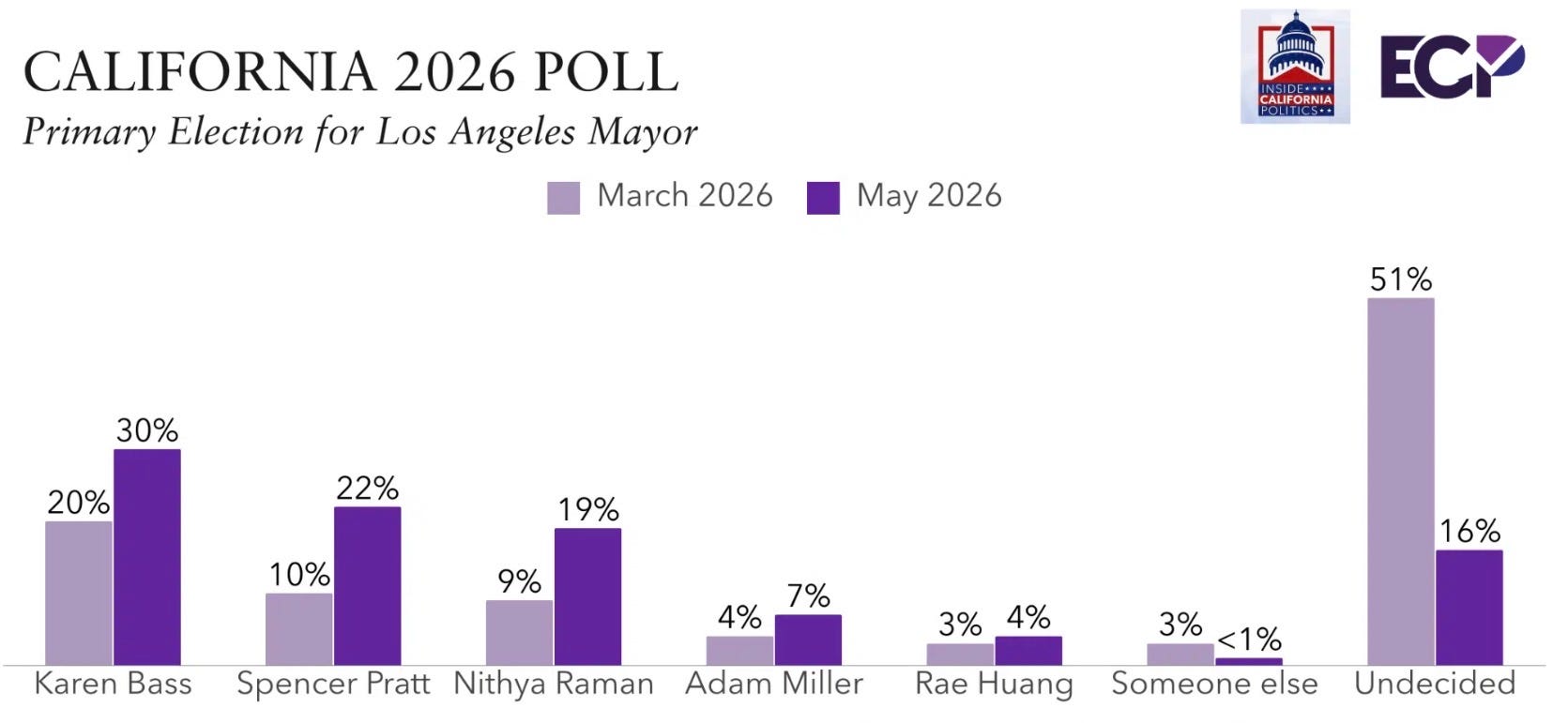
The Emerson survey measured the Los Angeles mayor’s race using a subsample of just 350 likely voters in the city, producing a margin of error of roughly ±5.2% — large enough that sweeping conclusions would be unwise. Still, several things do appear clear from the data. First, the numbers are flat-out bad for incumbent Mayor Karen Bass. Yes, she leads the field at 30%, but for a sitting mayor with universal name identification in an overwhelmingly Democratic city, that is a deeply vulnerable position. It means roughly seven in ten likely voters are currently choosing someone else or remain undecided. For an incumbent seeking reelection, that is not a show of strength. It is a warning sign.
The bigger question is who ultimately emerges as the challenger. Emerson shows Spencer Pratt at 22% and City Councilmember Nithya Raman at 19% — numbers that are statistically very close when the margin of error is taken into account. Pratt’s support appears driven more by anti-establishment frustration and dissatisfaction with City Hall than by traditional ideological alignment. Raman, meanwhile, appears to be consolidating younger progressive voters. Look for Bass's allies, primarily the public employee unions, to be working to boost Pratt into the runoff if their internal polling mirrors this one. Raman, in a runoff, poses an infinitely greater threat to Bass than Pratt once voters understand the partisan divide. To say that Los Angeles is a heavily liberal, Democratic city would be an understatement. In a runoff with Raman, you can count on many Republicans to oppose the Bass challenger, just because. But in a runoff with Pratt, look for Democrats to “come home” to Bass.
The Los Angeles mayor’s race, like the governor’s contest, remains deeply unsettled. Bass is vulnerable, the challenger lane is divided, and with a margin of error this wide, almost any outcome in the top two remains plausible. It is a race worth watching closely as ballots come in over the next few weeks.