

New Report: California Legislative Analyst Lays Out Roadmap for Higher Taxes
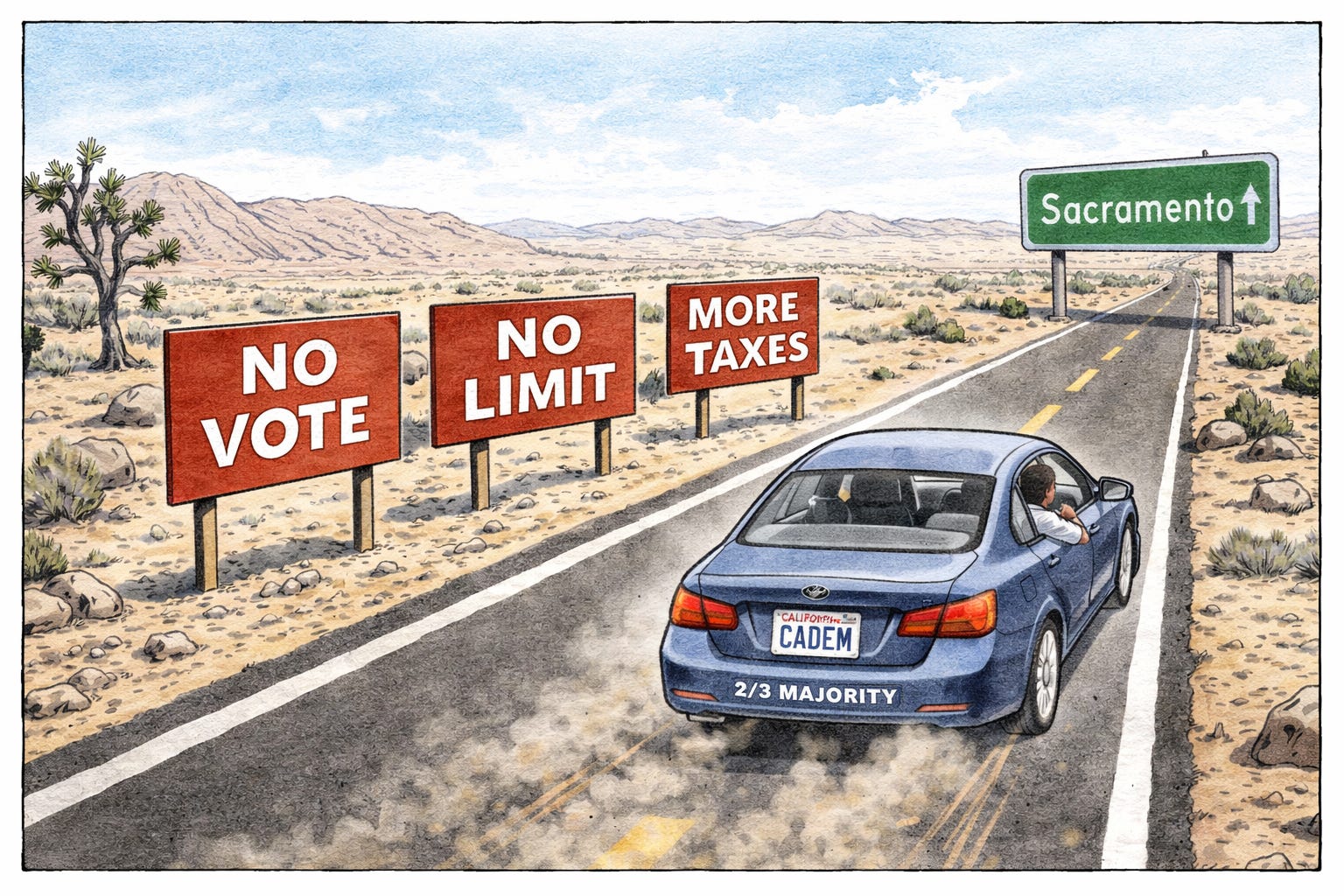
A new Sacramento report details how lawmakers could raise tens of billions in new revenue — and with a two-thirds majority, they don’t need voter approval to do it

Our morning content is free for all subscribers and guests! You can also listen to this post — along with my California Post column — on our podcast feed, So, Does It Matter? SPOKEN. It’s available on your favorite podcasting app, or you can find it here.
⏱️ 4.5 min read
Giving A Supermajority of Democrat Legislators A Candy List
A new report from the California Legislative Analyst’s Office lays out a sweeping set of options to raise taxes in California — notable not just for its scope, but for how directly it maps out paths to generate tens of billions in new revenue.
Democrats in California no longer need voter approval to raise taxes, and this report shows exactly how they might proceed. The state’s nonpartisan fiscal advisor has laid out a roadmap for generating billions in new revenue. Not a single proposal, but a structured set of options that carry real consequences.
For taxpayers, the implication is straightforward: the people running this state no longer need your permission to raise taxes. Because Democrats hold more than two-thirds majorities in both the Assembly and Senate, they can pass tax increases on their own without going to the ballot. No statewide vote and no direct taxpayer check before new taxes are imposed.
That reality makes what comes out of Sacramento’s policy apparatus far more consequential. The report lays out how lawmakers could generate billions in additional revenue. It is a roadmap of options now sitting in front of the Legislature — and those options are unlikely to remain purely theoretical.
A Balanced Report in an Unbalanced Political Environment
On paper, the report presents both sides of the ledger. It includes a range of tax increases as well as a smaller set of options that would reduce taxes or make the system more stable. As fiscal analysis, it lays out choices and tradeoffs in a way that is technically sound and politically neutral.
But that balance exists on paper, not in practice. Offering Sacramento lawmakers a list of ways to raise taxes alongside a handful of ways to cut them reflects a kind of neutrality that does not match California’s governing reality. The state’s leadership has consistently chosen higher spending and higher taxes, and there is little reason to believe this time will be different.
In that context, the report does not function as a neutral menu of equal choices. It functions as a starting point for identifying which tax increases are most viable and how they might be combined to close the state’s budget gap.
The Structural Deficit Driving the Conversation
California is not dealing with a one-time budget shortfall. The state is facing a structural deficit, meaning its ongoing spending commitments exceed reliable revenue year after year. That creates a persistent imbalance that must be addressed either by reducing spending or increasing revenue.
This imbalance is the result of long-term policy choices. During periods of strong economic growth and record revenues, lawmakers expanded programs and locked in higher levels of spending. At the same time, the state’s tax system became increasingly dependent on high-income earners and capital gains, both inherently volatile. When those revenues decline, the gap quickly reappears.
Rather than focusing on spending restraint, the conversation in Sacramento is increasingly centered on how to generate additional revenue to sustain existing commitments. That is the policy lens through which this report should be understood.
The Tax Increase Playbook
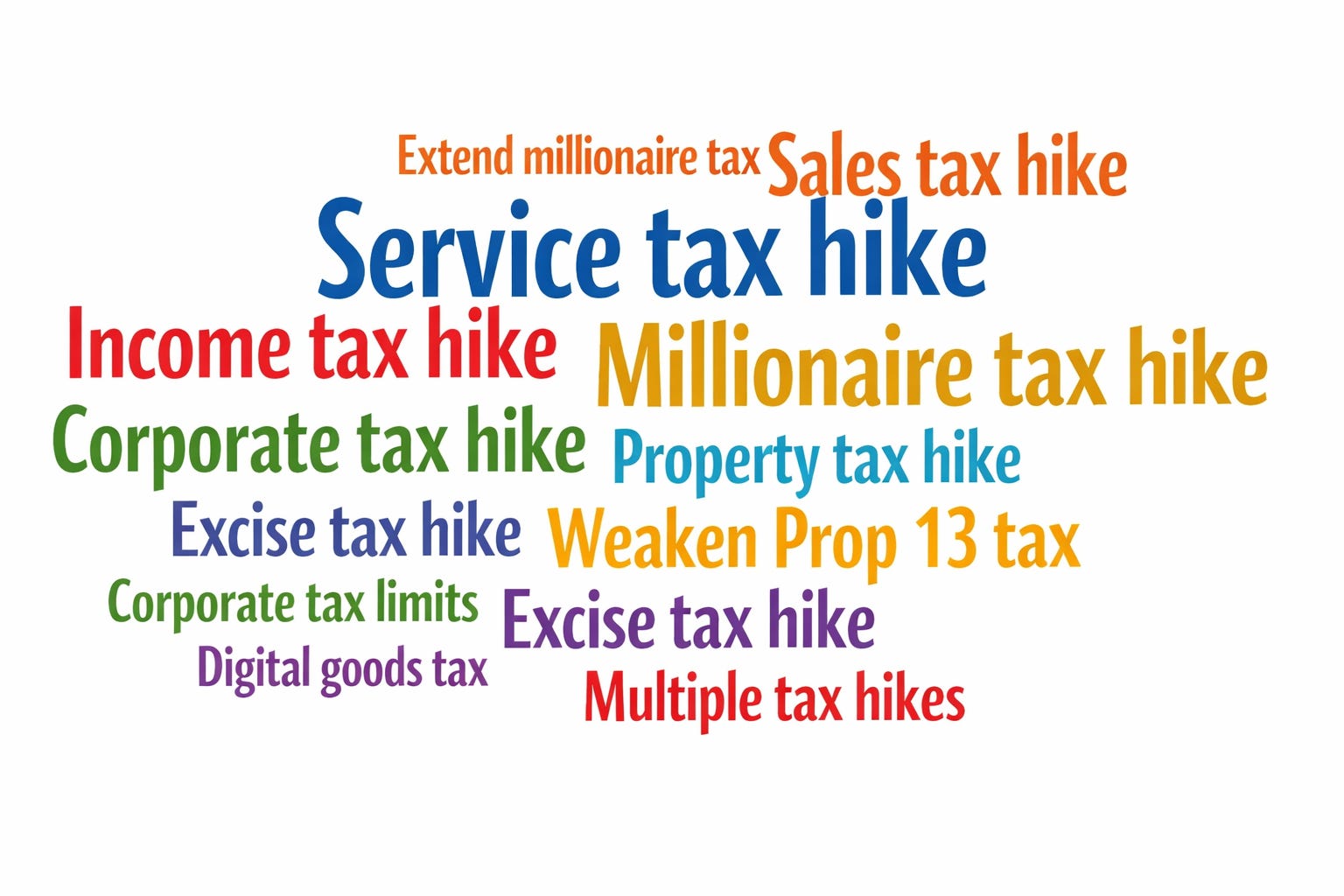
The report outlines a wide range of tax increases and expansions that could generate significant new revenue. These include expanding the sales tax to services, increasing personal income tax rates, extending high-income tax surcharges, raising the statewide sales tax, and increasing corporate taxes. It also examines eliminating tax preferences such as the stepped-up basis on inherited assets and exploring targeted excise taxes.
The report also raises the possibility of revisiting elements of California’s property tax system and broadening existing tax bases to capture more economic activity. Each option could raise substantial revenue on its own, and the report makes clear they could be combined to generate tens of billions of dollars annually, depending on the mix of policies adopted.
Some of these changes would fall primarily on high earners, but others — particularly sales tax expansions and service taxes — would reach directly into the day-to-day transactions of ordinary Californians. That distinction may be politically convenient, but it does not change who ultimately bears the burden.
Taken together, this is not a single proposal. It is a framework for layering multiple tax increases on top of one another to sustain the state’s current spending trajectory.
So, Does It Matter?
This report provides a clear window into the direction Sacramento is heading. It reflects a policy environment focused on identifying new sources of revenue rather than addressing the underlying drivers of spending. That is not a technical conclusion, but a political choice.
With a two-thirds legislative majority in place, the barrier to raising taxes is not voter approval or bipartisan compromise. It is simply agreement among lawmakers who have already demonstrated a willingness to expand government and maintain higher spending.
The report does not guarantee that these tax increases will be enacted. But it makes one thing unmistakably clear: the ideas are developed, the options are on the table, and the Legislature has the capacity to act on them. And with the progressive left, paired with extremely greedy unions, running the state - there is no adult supervision…