

New Report: California Job Growth Lags Nation As High Costs Wipe Out Income Gains
Beneath the headlines, California is losing jobs, growth, and economic ground.

You can listen to this post on our podcast feed, So, Does It Matter? SPOKEN. It’s available on your favorite podcasting app, or you can find it here. Our afternoon content is typically for our paid subscribers. Certain columns, like this one, are made available to all of our readers.
There is great special exclusive content below the column for our paid subscribers!
⏱️ 5 min read
California’s Economic Edge Is Slipping
The Pacific Research Institute released a new study this week, California at a Crossroads: How Bad Policy Cost California Its Economic Edge – and How to Win It Back, which lays out several warning signs about where the state is heading. And the picture it paints is hard to ignore and harder to defend. California remains one of the world's largest economies, and Silicon Valley continues to drive innovation while high-productivity sectors remain strong.
All of that is true. But it is also incomplete.
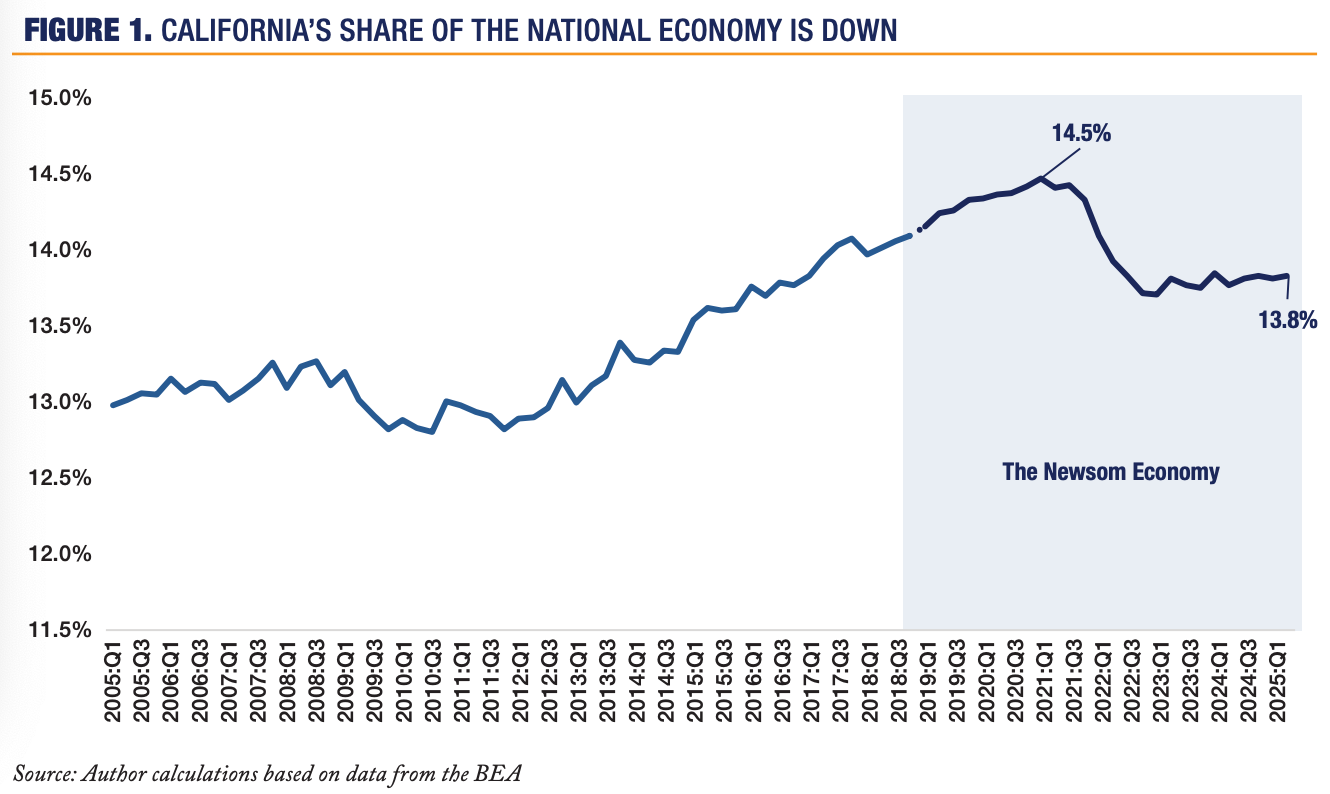
When you step back and look at the full economic picture, a different story emerges. California is not falling apart, but it is no longer leading the way it once did. For years, California did not just grow. It outperformed the rest of the country, expanded its share of the national economy, and reinforced its status as the United States' dominant economic engine.
That is no longer the case.
California’s share of the national economy peaked in 2021 and has since declined, while faster-growing states expand their footprint. That may sound small, but in an economy this large, it is significant. If California had simply held its position, the economy would be significantly larger today. Instead, other states are gaining ground at California’s expense, and the trend line should concern anyone who assumes California’s dominance is automatic.
The Jobs Warning Sign Is Getting Harder To Ignore
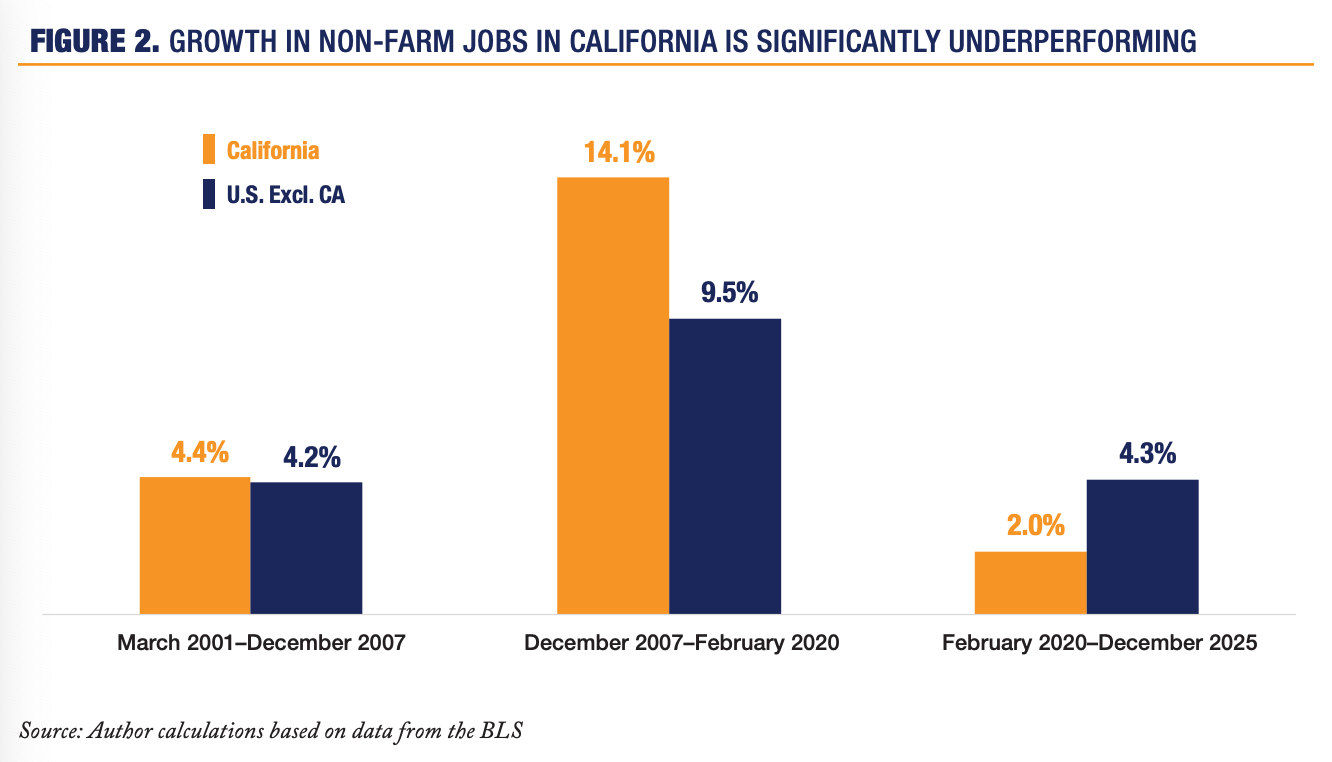
The most troubling trend is not GDP. It is jobs. Since the COVID recovery, California’s job growth has been less than half the rate of the rest of the country. That alone raises concerns about competitiveness and long-term trajectory, but the deeper issue lies beneath the surface.
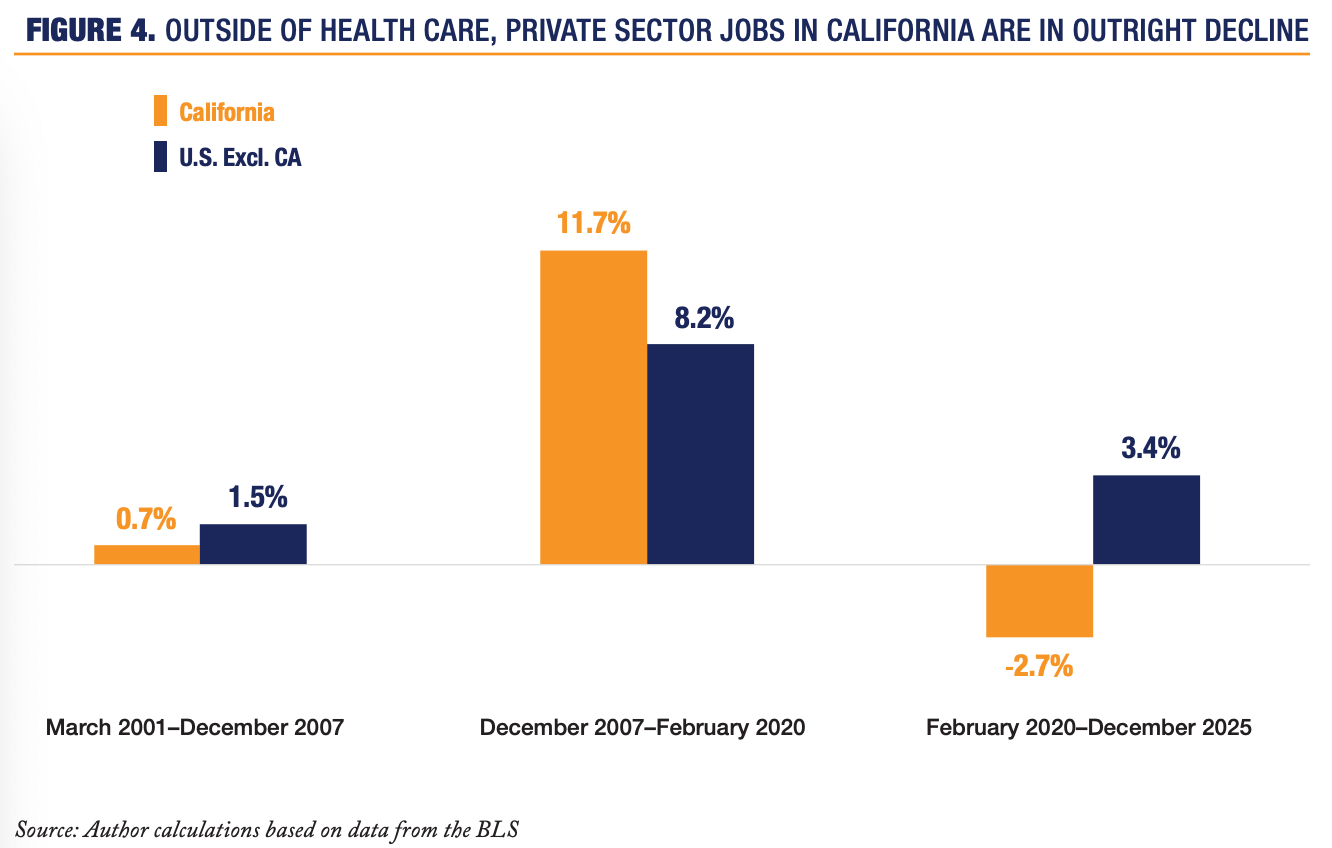
Private sector job growth, the kind that drives innovation and upward mobility, is lagging badly. Strip out healthcare and social assistance, and the picture becomes even more concerning. California is losing private-sector jobs outside healthcare. That is not what a leading economy looks like. It is what a mature economy losing momentum looks like.
For years, California has relied on a simple argument: dominate technology, and everything else will follow. That argument is starting to crack, and the data is catching up to it. California remains the leader in tech jobs, but its share is shrinking. The state lost tens of thousands of tech jobs in 2024 alone, while other states gained.
Texas. Florida. Even smaller states are now competing for growth that once automatically landed in California.
Silicon Valley is not disappearing. But the next wave of expansion is increasingly taking place elsewhere, and California can no longer assume that tomorrow’s innovators will automatically choose to build their companies, hire their workers, and scale their operations here.
California Families Are Paying The Price
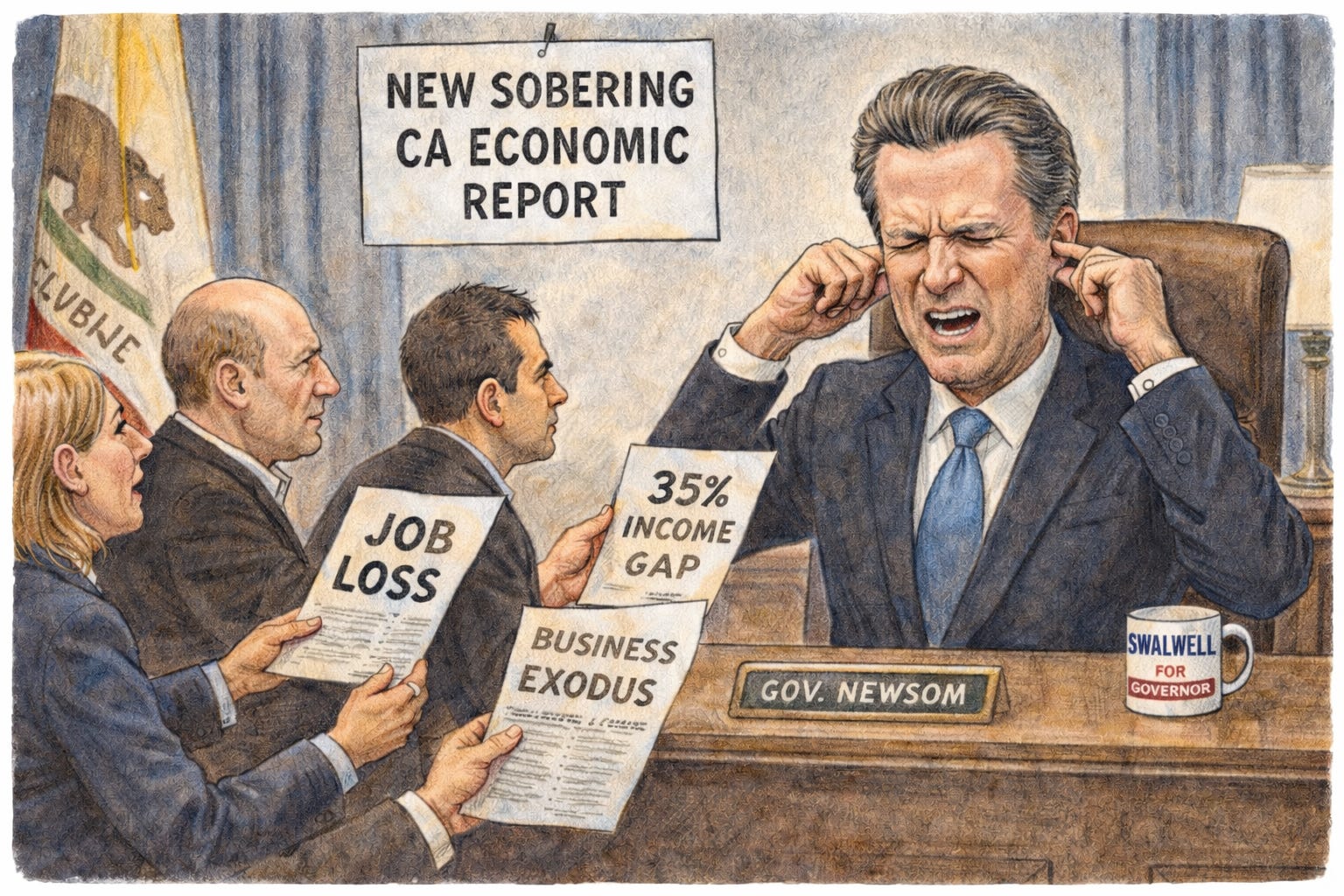
The most revealing finding in the report may be the simplest one. After accounting for taxes, housing, and energy costs, the average California household has about 35 percent less disposable income than the national average. California may look wealthy on paper, but it does not feel that way for many families.
Housing is the biggest driver. The estimated annual payment needed to finance a median-priced home in California is more than double the national average. Energy costs are higher. Taxes are higher. These costs compound, and they change behavior in ways that ripple through the broader economy for employers, workers, and aspiring homeowners alike.
People leave because their money goes further elsewhere. Businesses follow, and they are not coming back quickly.
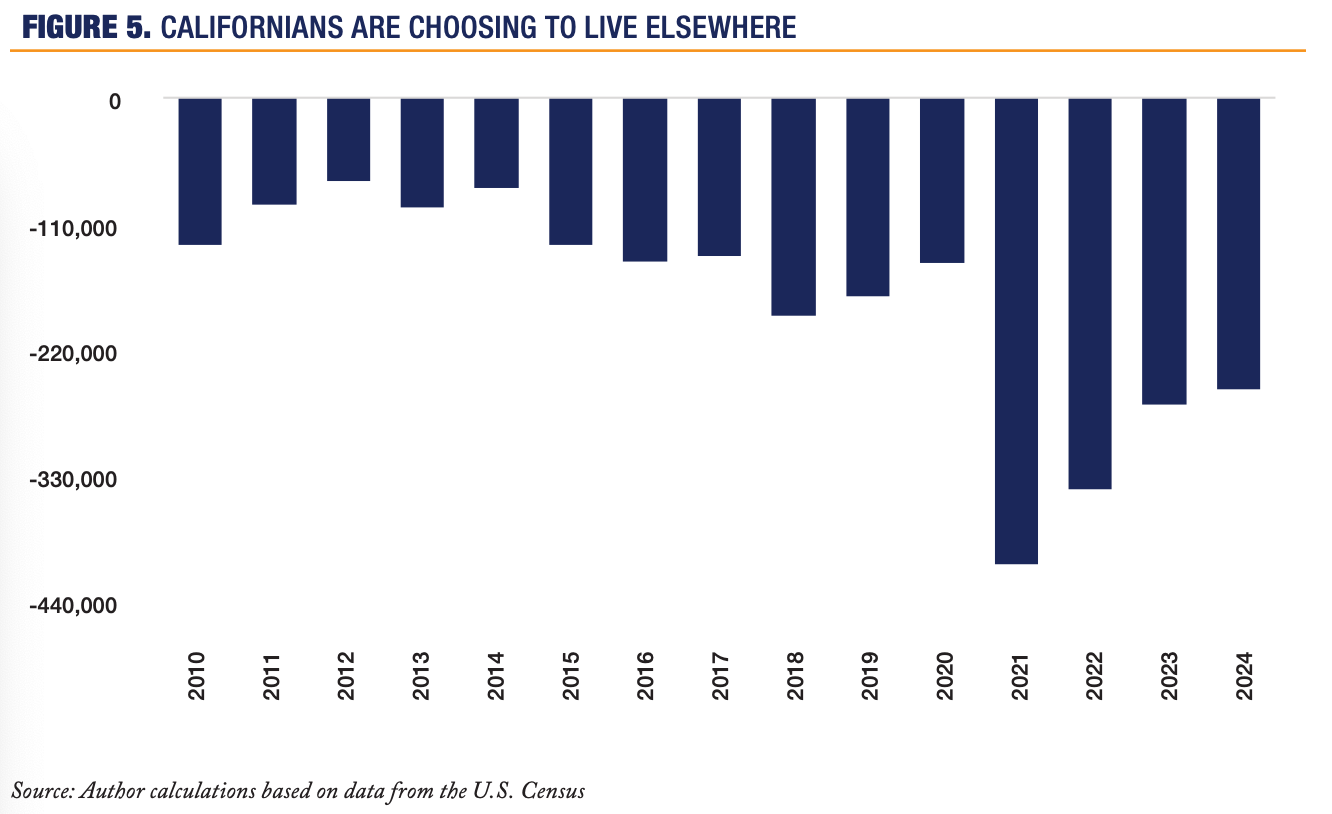
It is tempting to dismiss these trends because California has always been resilient and has always bounced back. But this time is different. The problem is not cyclical. It is structural. High taxes reduce returns on work and investment, regulatory barriers increase the cost of building, hiring, and expanding, energy policies raise costs for both families and businesses, and housing constraints make it difficult for people to stay, let alone move in.
Those forces reinforce one another. They also reflect political choices made over many years by lawmakers and voters who treated growth as a given and competitiveness as something California would always enjoy no matter how burdensome the policy climate became.
So, Does It Matter?
What is emerging is a split economy. At the top, California still dominates. Elite tech sectors and high-end innovation continue to perform and generate enormous wealth. But beneath that, the broader economy is weakening, and that is where most Californians actually live.
Manufacturing has declined over the long term, and the state’s share of national manufacturing jobs has been trending downward for years. California is also losing entry-level jobs in sectors like limited-service restaurants. Small business growth is lagging. The industries that once provided a ladder to the middle class are no longer expanding as they once did.
An economy cannot thrive on its top tier alone. It needs a broad base of opportunity.
Right now, that base is shrinking.
California is becoming a place where it is harder to build, hire, and stay. The state still has enormous advantages: talent, capital, geography, and institutions. But advantages can be eroded, and that is exactly what is happening. These outcomes are not inevitable. They are the result of policy choices. Tax, energy, regulatory, and housing policies all shape how easy it is to invest, build, hire, and stay, and over time those choices add up.
California’s voters have consistently supported leaders and policies that favor a more expansive role for government in the economy. Those choices are now showing up in the data.
An economy as large and dynamic as California’s can absorb a lot. But it cannot ignore incentives forever. If the goal is growth, opportunity, and upward mobility, then the policy direction matters. And unless that direction changes, California will keep falling behind states that chose to compete and chose to win.
BONUS FEATURE FOR OUR PAID SUBSCRIBERS:
Q&A WITH STUDY CO-AUTHOR AND PACIFIC RESEARCH INSTITUTE POLICY EXPERT WAYNE WINEGARDEN…
Here are the questions! You WANT to see the answers…
Is California’s “fourth-largest economy” claim masking real weakness for families?
Why is California job growth lagging so badly since COVID, and is policy to blame?
What is the single worst policy driving jobs and opportunity out of California?
This is your chance to upgrade your subscription, get more content, and support this project!
(Have you tried the podcasting channel yet? As an incentive to free subscribers, the Q&A is available on the podcast, linked above!)
