

New PPIC Survey: Californians Love Green—Until They Have To Pay For It
The latest PPIC survey shows Becerra comfortably ahead, but also reveals growing cracks in support for California’s environmental policies.

Our morning content is free for all subscribers and guests! Usually our afternoon content is behind a paywall… If you are not yet a paid subscriber, consider upgrading — you are missing a significant portion of what we produce each week, and your support makes it possible. If you want to get it all and support my efforts, please consider a paid subscription! And yes, I have been pushing a lot of interesting survey data the last couple of weeks — hopefully that’s okay!
You can also listen to this post on our podcast feed, So, Does It Matter? SPOKEN. It is available on your favorite podcast app. And you can listen to it here.
⏰ 7 minute read
California Isn’t Turning Red
Let’s begin with the reality Republicans too often try to wish away: California is not about to flip.
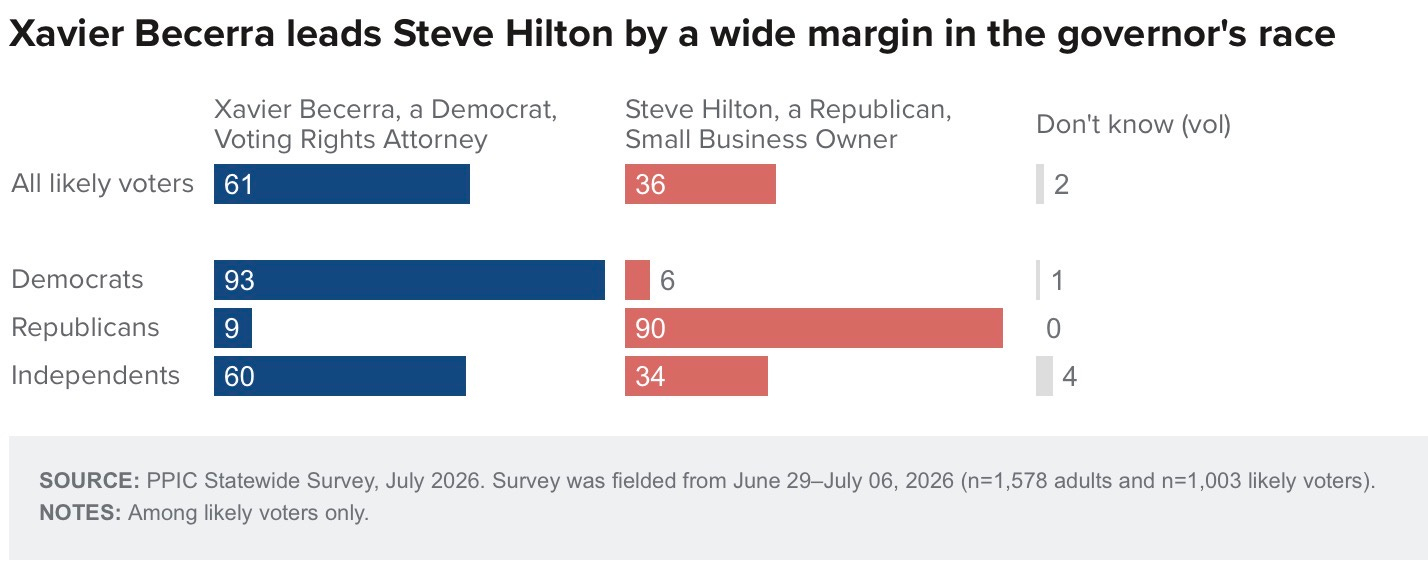
The latest PPIC Statewide Survey, Californians and the Environment — conducted June 29 through July 6 — finds Democrat Xavier Becerra leading Republican Steve Hilton by a commanding 61% to 36% in the race for governor. Unless something unexpected and pretty dramatic changes between now and November, California is going to elect another Democrat.
But that’s only the top line. Spend a few minutes with the rest of the survey, and another story starts to come into focus. Californians continue to embrace the broad goals of environmental protection while becoming noticeably less enthusiastic about many of the policies Sacramento has adopted to achieve those goals.
That’s where this survey becomes useful.
The survey also helps explain Hilton’s challenge. PPIC did not ask a traditional presidential job-approval question, only whether respondents approved of President Trump’s handling of environmental issues, where he received just 28% among likely voters. Running as Trump’s endorsed candidate energizes Republicans, but it also makes winning over California’s independents considerably more difficult.
Environmentalism Still Sells
Conservatives should not kid themselves. California still likes its environmental institutions.
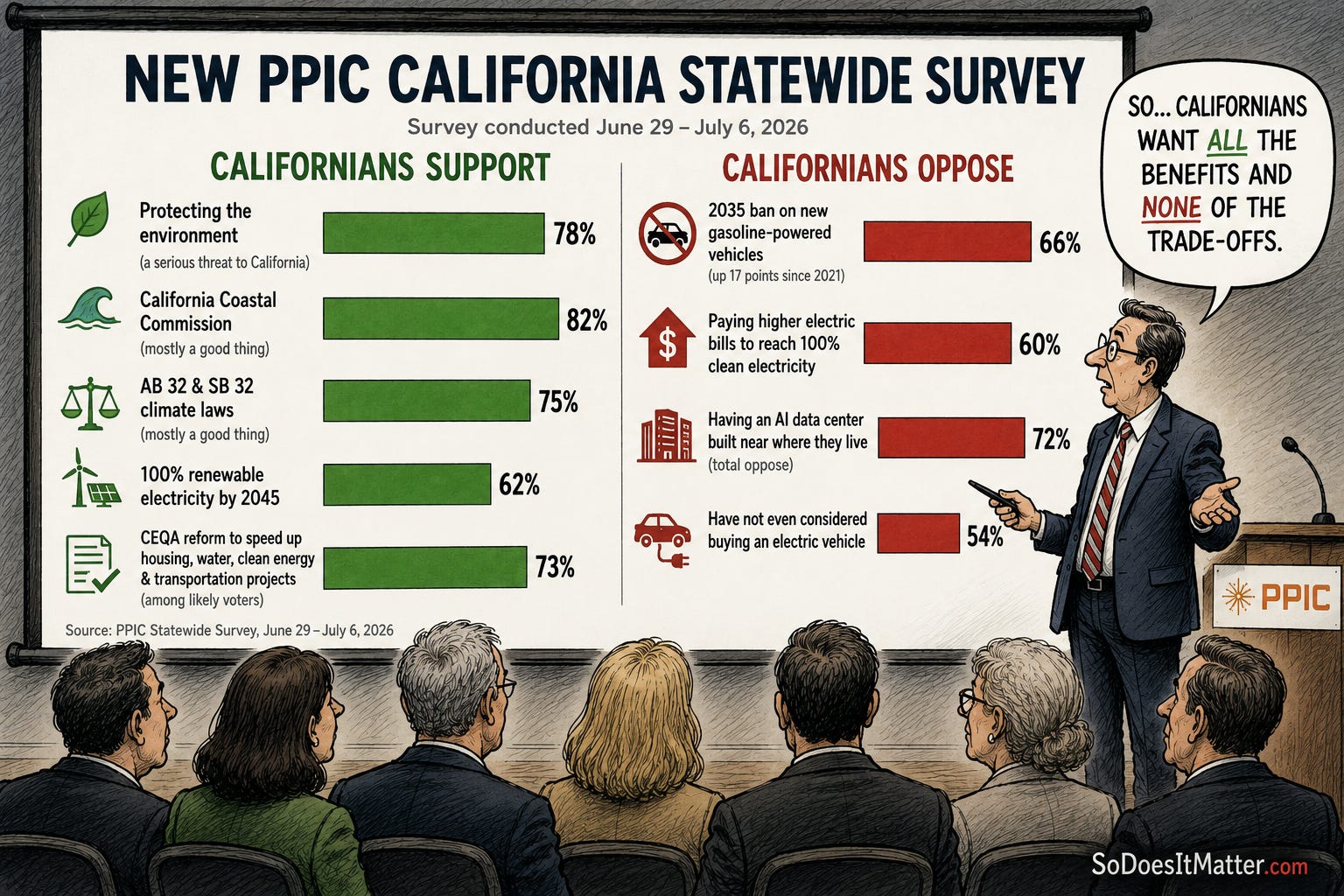
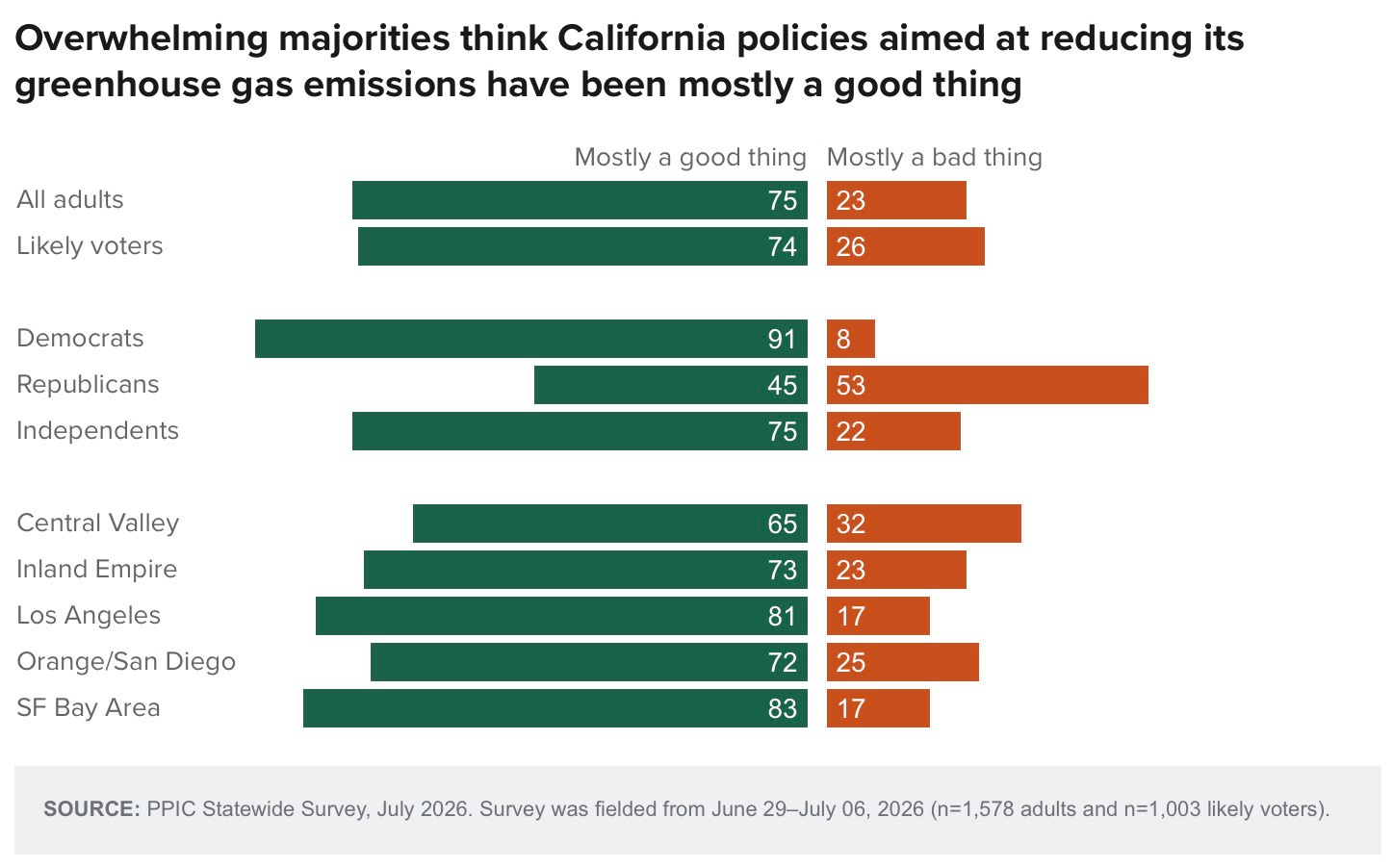
Three out of four Californians say the state’s landmark climate laws — AB 32 and SB 32 — have been mostly a good thing. More than eight in ten say the same about the California Coastal Commission. Six in ten believe climate change is already happening, while nearly eight in ten consider it a serious threat to California’s future.
Here’s where the numbers get interesting. The question is not whether Californians support protecting the environment. They clearly do. The real question is what happens when those broad goals collide with everyday life — higher utility bills, more expensive housing, restrictions on the cars people drive, or new development in their own neighborhoods.
That is where the consensus starts to crack.
Reality Has A Price Tag
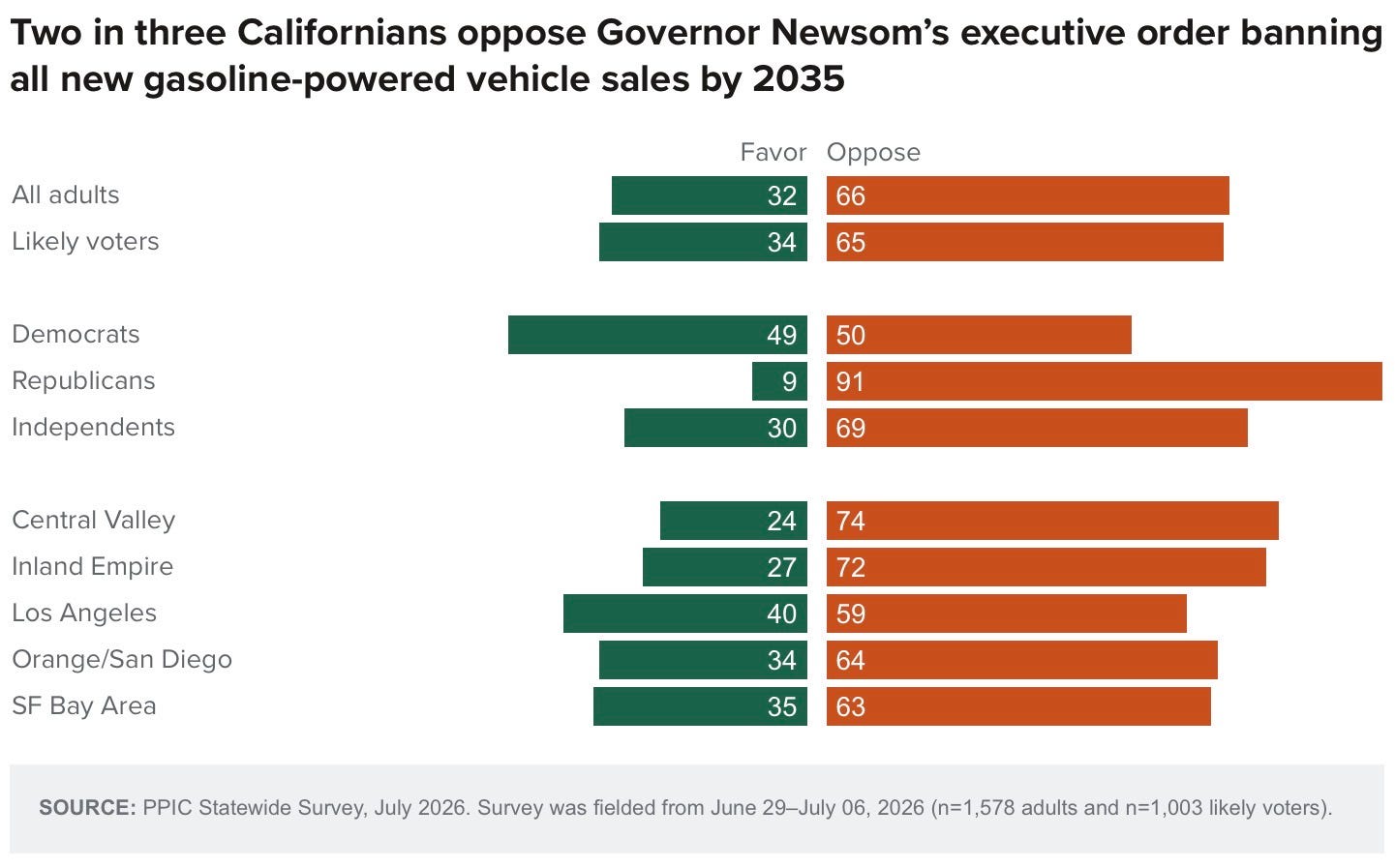
Perhaps the clearest example is Governor Newsom’s executive order banning the sale of new gasoline-powered vehicles by 2035.
Today, 66% of Californians oppose it — an increase of 17 points since 2021. At the same time, interest in buying electric vehicles continues moving in the wrong direction. More than half of Californians now say they have not even considered purchasing one.
One result really jumped out at me.
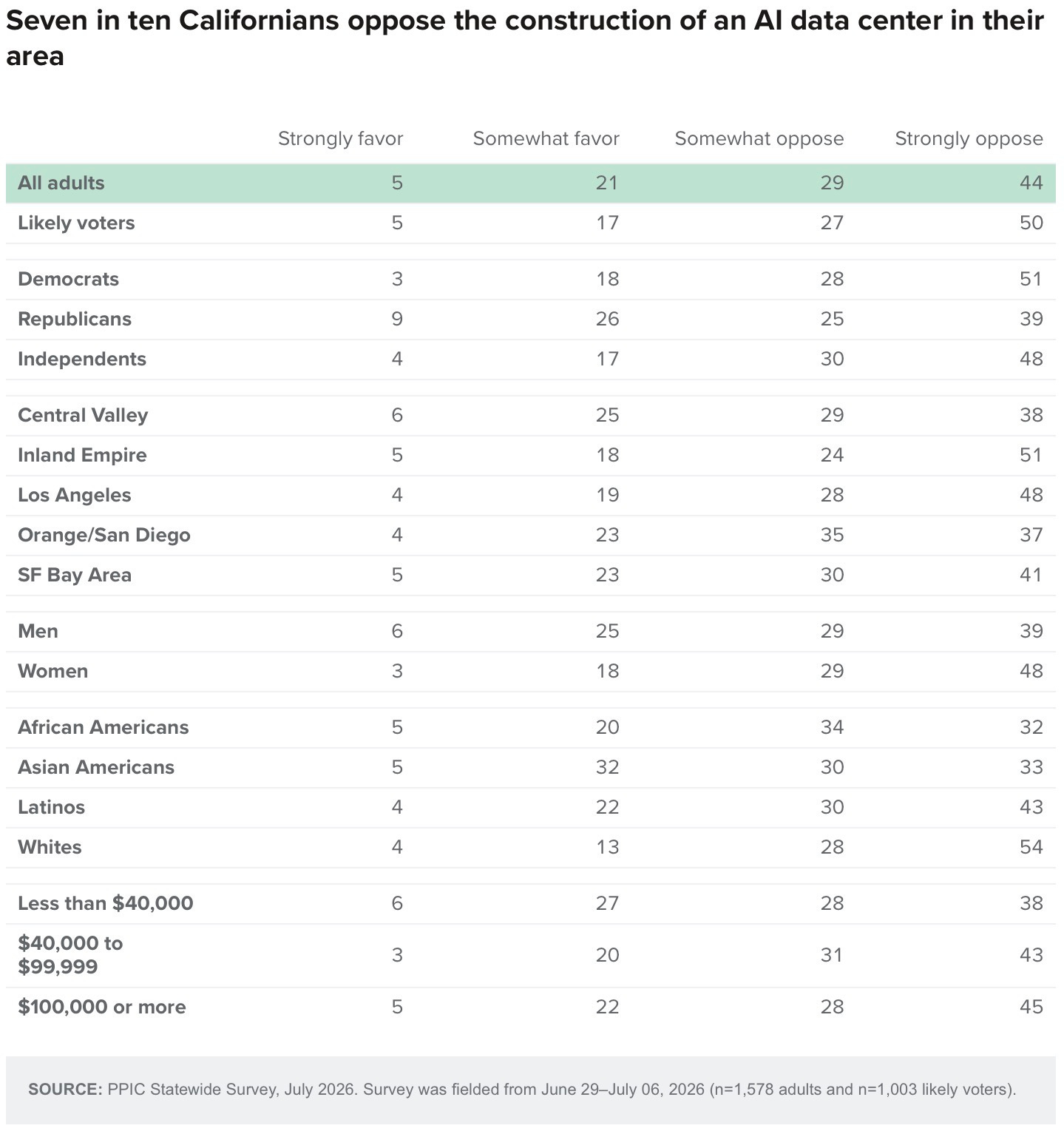
Nearly half of Californians strongly oppose having an AI data center built near where they live, while only 5% strongly support one. That opposition is surprisingly consistent across party lines. Even more striking, 7% of respondents voluntarily identified AI data centers and their environmental impacts as the state’s biggest environmental issue — ahead of energy costs, electric vehicles, and air pollution.
Then there’s this.
Sixty-two percent support California’s requirement that electricity come entirely from renewable sources by 2045.
But 60% say they are unwilling to pay higher electric bills to make it happen.
Meanwhile, nearly three-quarters support taxing corporations based on their carbon emissions — but that question is not anchored to the costs of the policy or to who would ultimately pay them.
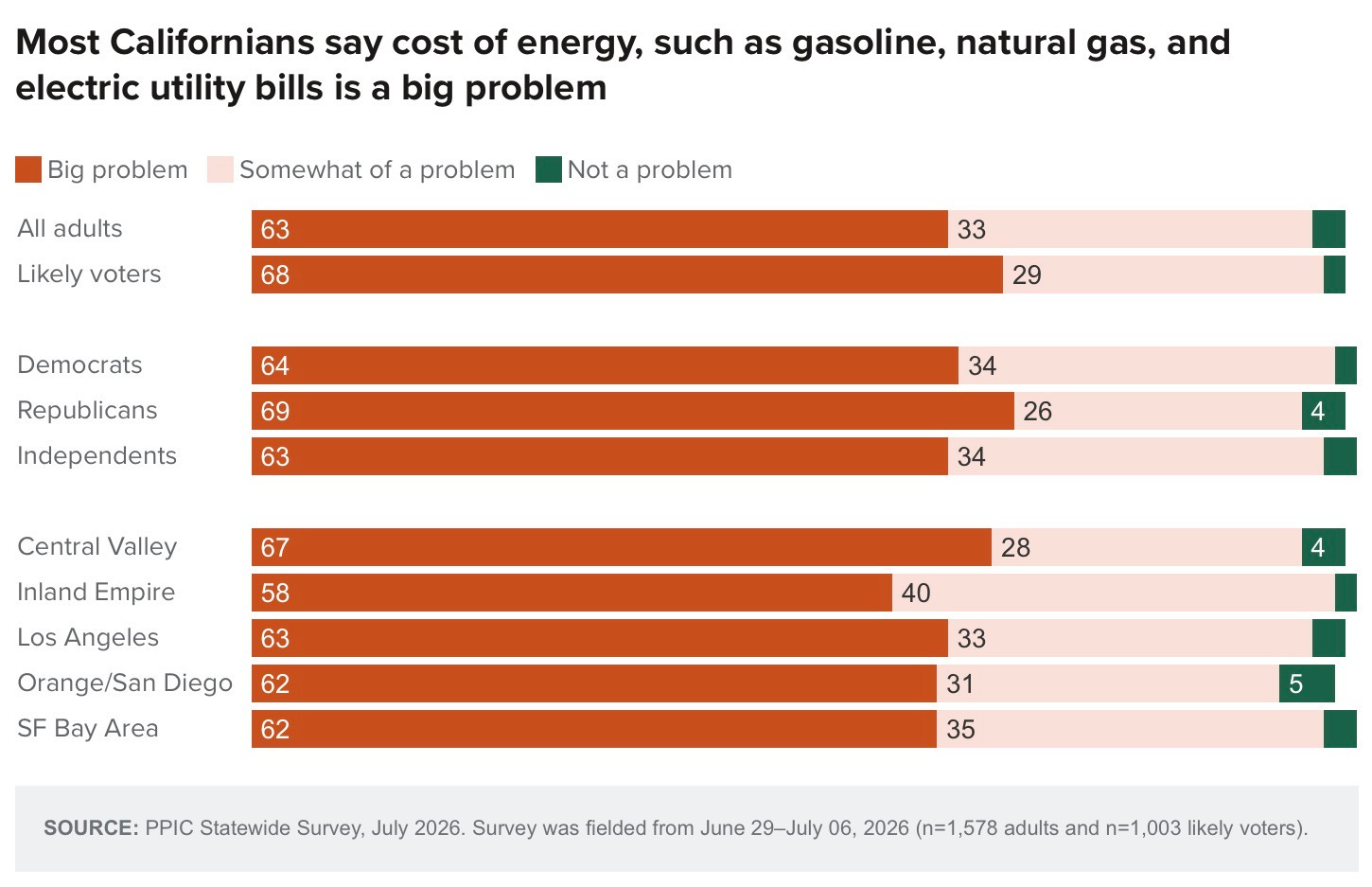
Californians like the sound of ambitious environmental goals. They become much more skeptical when they are asked to pay for them.
Voters Want Results, Not Red Tape
One finding deserves a closer look.
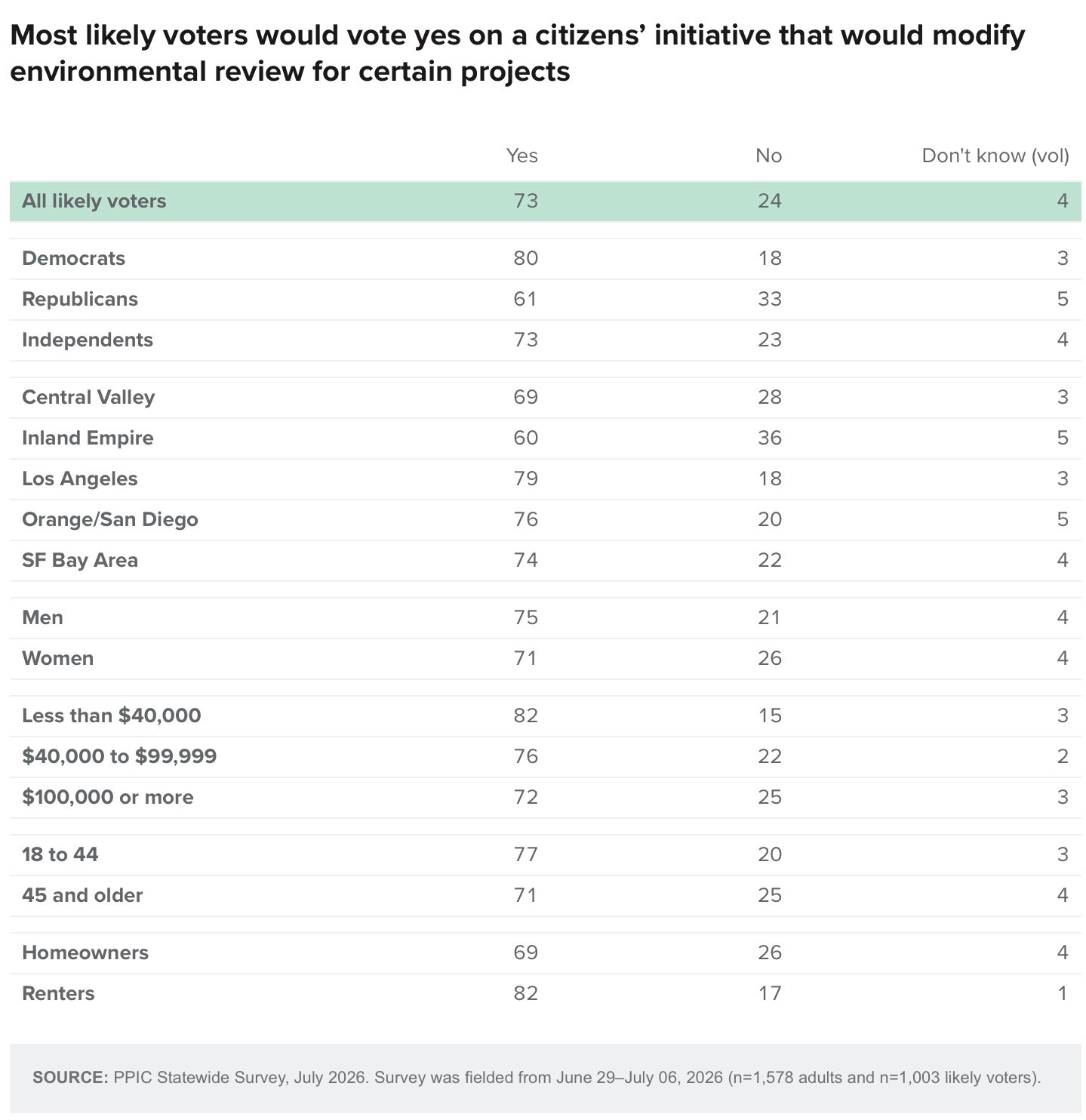
Seventy-three percent of likely voters support a ballot measure, Proposition 45, that would streamline CEQA environmental reviews for housing, transportation, water, and clean energy projects. That support crosses party lines, attracting 80% of Democrats, 73% of independents, and 61% of Republicans.
A separate question points in the same direction.
By a 55% to 42% margin, Californians say the state should ease land-use and environmental restrictions if doing so would increase the housing supply.
Voters are not rejecting environmental protections.
They are rejecting a bureaucracy that has become so cumbersome it prevents California from building the very housing, infrastructure, water projects, and clean-energy facilities that everyone claims to support.
That’s an important difference.
So, Does It Matter?
Party labels still dominate California elections. Put “Democrat” and “Republican” next to two candidates, and the Democrat starts with a major advantage.
But remove the names and ask voters about the policies themselves, and the picture changes.
Californians are skeptical of the gas-car ban. They do not want higher electric bills. They support cutting environmental red tape when it blocks housing, water, transportation, and energy projects.
They have not abandoned environmentalism. They are running out of patience with policies that make life more expensive while producing results they can barely see.
That is the opening for Republicans: not to argue that Californians no longer care about the environment, but to make the case that Sacramento has confused environmental ambition with unlimited cost.
California voters may still choose Democrats.
But they are increasingly questioning the price of Democratic policy.