

New Pew Survey: What Voters Really Want From Their Elected Officials
The most politically engaged voters are also among the least enthusiastic about compromise.

Our morning content is free for all subscribers and guests! Usually our afternoon content is behind a paywall… If you are not yet a paid subscriber, consider upgrading — you are missing a significant portion of what we produce each week, and your support makes it possible. If you want to get it all and support my efforts, please consider a paid subscription!
Most of our content is available on our podcast feed. So, Does It Matter? SPOKEN. Which is available on your favorite podcast app. You can listen to it right here as well.
🕐 5-Minute Read
What Caught My Eye
This past week, the Pew Research Center released a new report packed with data about the political mood heading into the 2026 midterms. There was plenty there for the obvious headlines — President Trump’s approval numbers, or perhaps more accurately his disapproval numbers, how voters feel about the economy, and which party they prefer to control Congress.
But digging deeper, I found something more interesting.
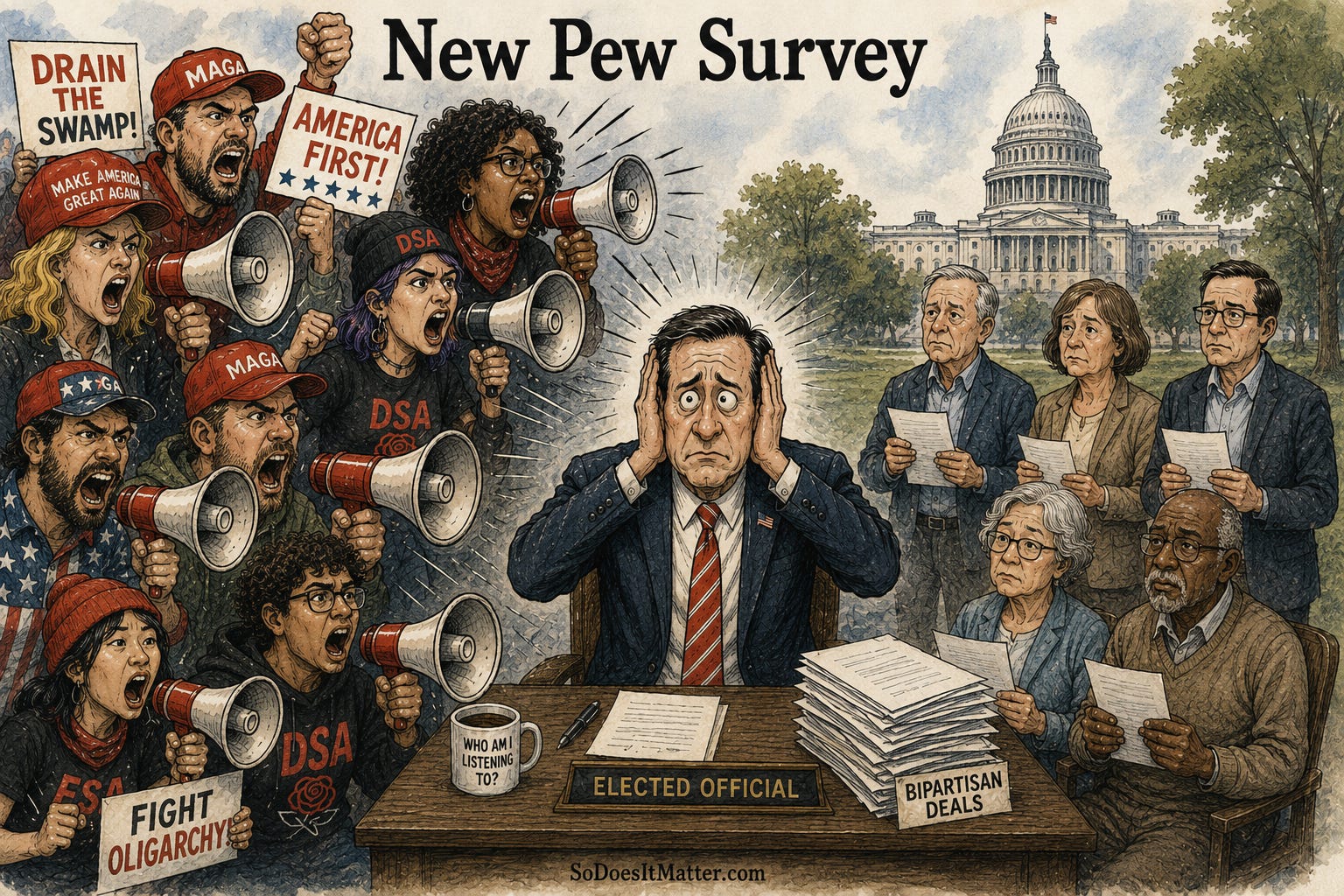
Pew asked voters a basic question about what they want from the people they elect: Do you want your candidate to push hard for your party’s policies, even if that makes it harder to get things done? Or would you rather your candidate find common ground with the other side, even if that means giving up some things your party wants?
That gets beyond who is up or down in the latest poll. It gets at what voters think the job of an elected official actually is.
What Does the Data Show?
Among Republican voters, 58 percent said they would rather have a congressional candidate who pushes hard for Republican policies, even if that makes it harder to get things done. Forty-one percent preferred common ground with Democrats.
Democratic voters were more closely divided: 52 percent wanted their candidate to push hard for Democratic policies, while 48 percent preferred common ground.
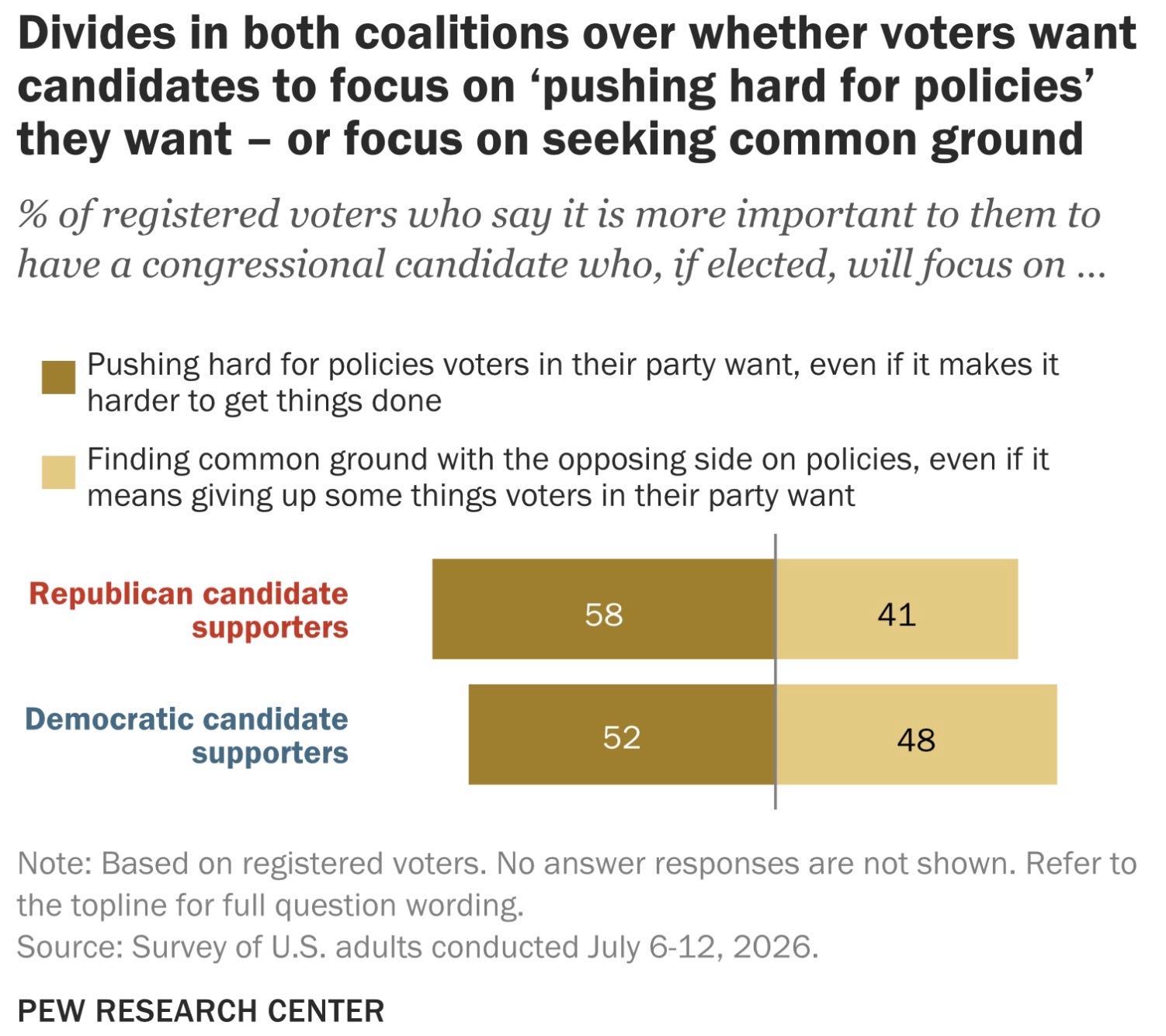
One important clarification: Pew groups voters by which party’s congressional candidate they support, not by registration. So independent or No Party Preference voters who plan to vote Republican or Democratic are included.
Pew does not separately break out NPP or independent voters on this question. But the demographic breakdown offers a clue. Among Republican candidate supporters, 67 percent of strong partisans prefer the “push hard” approach, compared with just 44 percent who are not strong partisans. Among Democratic candidate supporters, it is 60 percent versus 49 percent.
Pretty clear pattern: stronger partisan attachment means a stronger preference for fighting rather than compromising.
And remember how Pew worded the question. Voters were told pushing hard might make it more difficult to get things done.
Majorities on both sides chose that option anyway.
The People Paying Attention Want the Fight
This is where the survey gets really interesting.
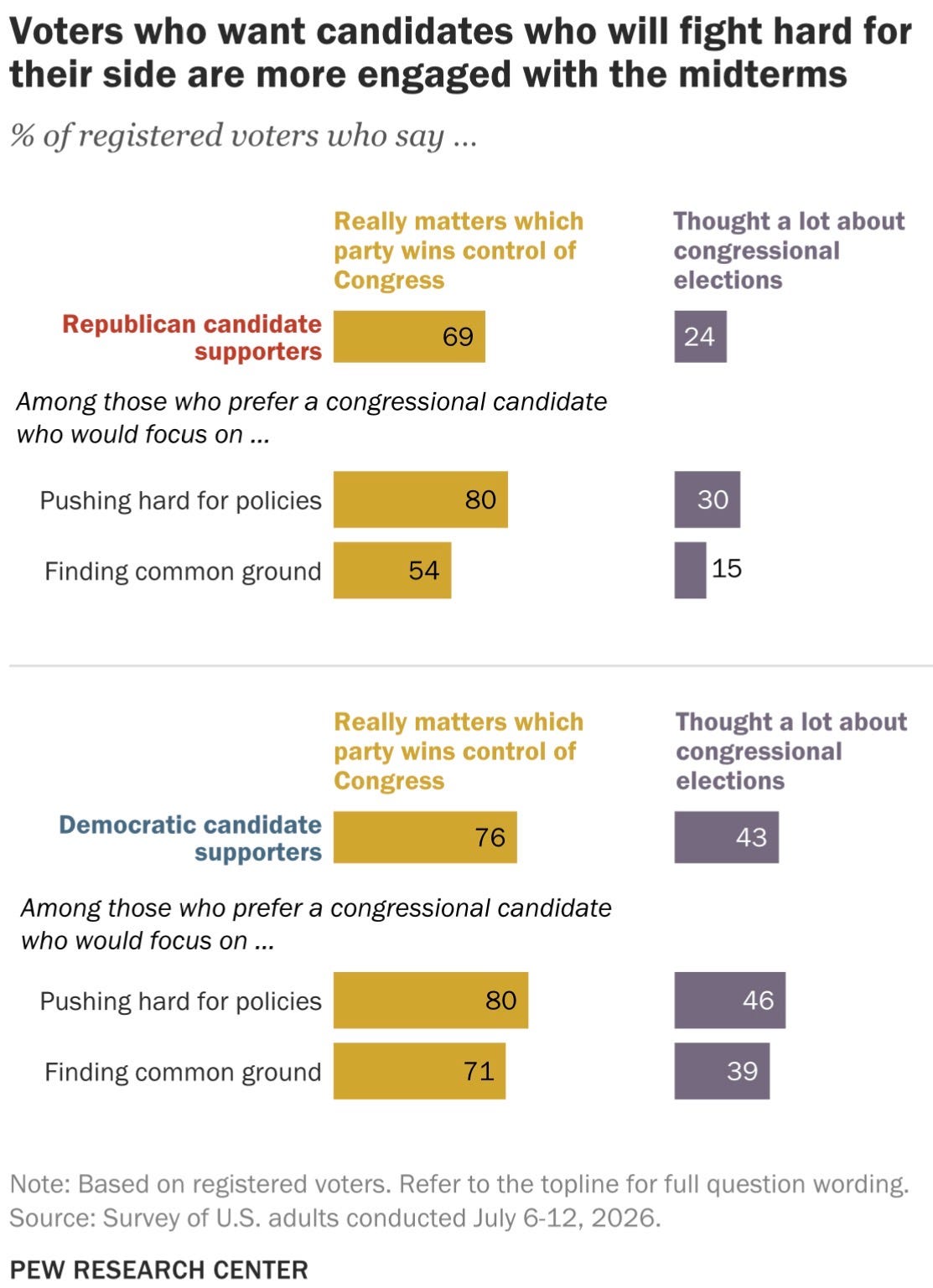
The voters who want candidates to push hard are also more engaged in the midterms — dramatically so among Republicans.
Among Republican candidate supporters who favor pushing hard, 80 percent say it really matters which party controls Congress, compared with just 54 percent among those who prefer common ground. They are also twice as likely to say they have thought a lot about the congressional elections: 30 percent versus 15 percent.
The gap among Democrats is smaller, but it runs in the same direction.
Pew did not ask whether these voters are more likely to donate, volunteer or contact candidates. But after more than three decades working in and around political campaigns, I can tell you that politically engaged voters are also much more likely to do those things.
Someone paying close attention is more likely to email a candidate, make a phone call, talk politics with friends, volunteer, or write a check. Those are the voters candidates hear from. They are the voters campaigns notice.
And they are disproportionately saying: don’t compromise. Fight.
Maybe politicians aren’t ignoring the voters. Maybe they’re listening most closely to the voters who are listening most closely to them.
The Generational Divide
Then I got to the age numbers.
Among Republicans, there isn’t much of a generational divide. Among Democrats, there certainly is.
Seventy percent of Democratic voters under 35 want their candidates to push hard for Democratic policies. That falls steadily with age, bottoming out at just 43 percent among Democrats 65 and older.
That is a 27-point difference.
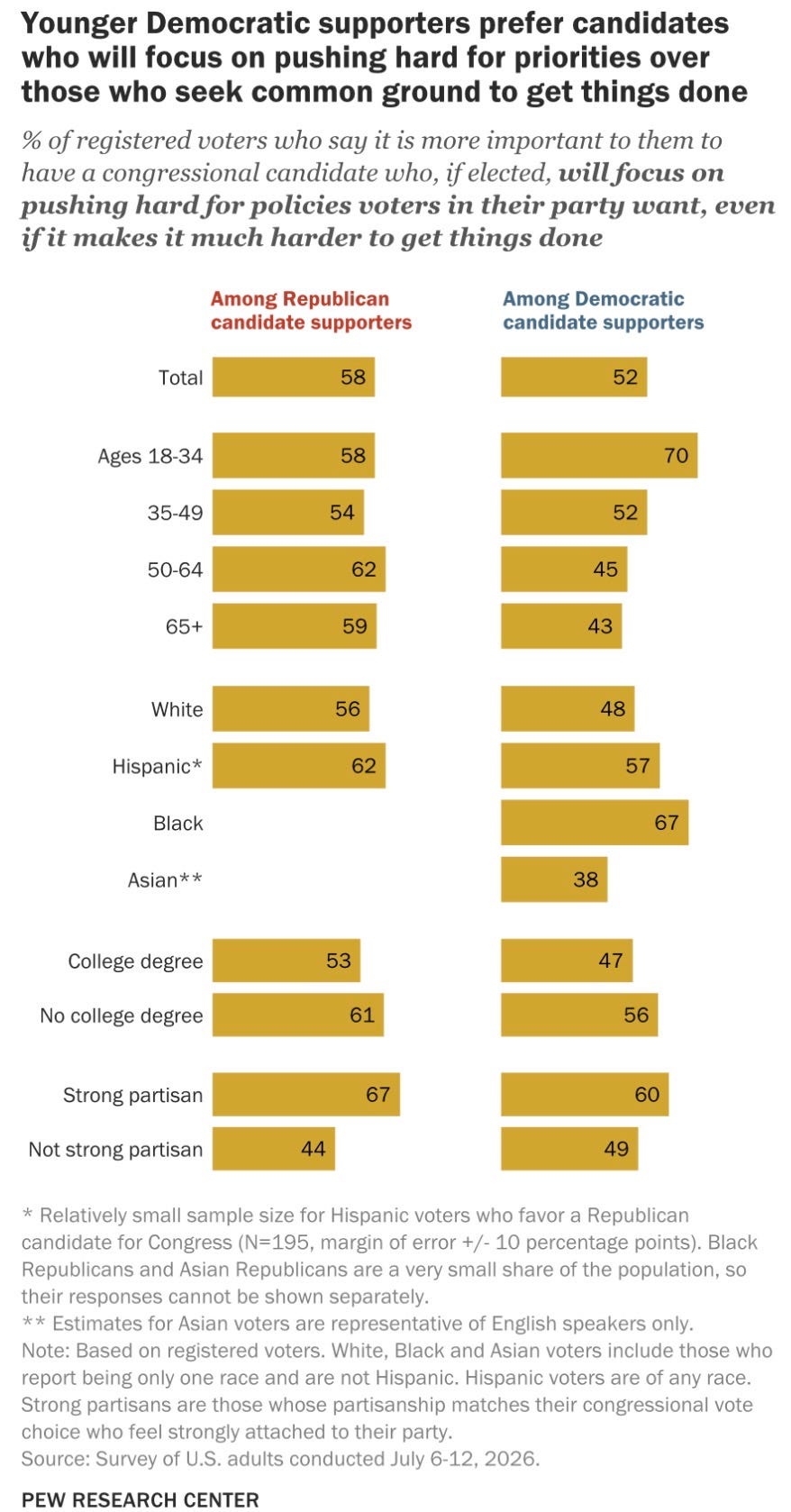
But here is what caught my attention: younger Democrats are more likely to want their candidates to push hard than Republicans in any age group Pew measured.
So let’s dispense with the idea that this is simply a MAGA phenomenon. By this measure, the youngest Democrats are the ones most clearly saying: fight, don’t compromise.
There may be broader context here. In another Pew survey, Democrats under 30 were significantly more likely than older Democrats to view democratic socialist political leaders favorably.
I wouldn’t claim one causes the other. But politically, it is worth noting that the same younger Democratic cohort showing greater receptivity to democratic socialist politicians is also much less interested in compromise.
What About California?
Pew asked about candidates for Congress, not the California Legislature. So I am not going to pretend these national percentages translate neatly to voters choosing a State Senate or State Assembly member.
There is no reason to think this tension disappears down the ballot.
In California, the parties face very different realities. Democrats dominate Sacramento and generally do not need Republican votes to move legislation. For Democrats, “push hard for our policies” is a viable governing strategy.
Republicans do not have that luxury. They do not have the votes to enact conservative policy on their own.
So California Republicans face a different choice: pursue compromise to make legislation marginally better, or prioritize the bully pulpit, draw clear contrasts and make the case for conservative policies.
Sometimes negotiating makes a bad bill less bad. Other times, Republicans give Democrats bipartisan cover for very little while making it harder for voters to see much difference between the parties.
So, Does It Matter?
There is nothing inherently noble about compromise.
Sometimes it moves the ball in the right direction. And sometimes “working across the aisle” is a polite way of asking conservatives to help Democrats advance policies we fundamentally oppose.
For California Republicans, the test should be simple: Did the compromise produce a meaningful improvement? A press release touting “bipartisan cooperation” doesn’t count.
Fighting just to put on a show isn’t much of an accomplishment either.
But too often in Sacramento, especially with Democratic supermajorities in both chambers, the concessions Republicans get for a “yes” vote are so minor they barely change the bill. At some point, shaving a few rough edges off a proposal that is still 95 percent bad is not compromise. It is putting a Republican imprimatur on a Democratic policy.
Sometimes a modest concession is worth taking. Other times, the right thing to do is vote no, explain why, and make sure voters understand the difference between the two parties.
Principle should not be sacrificed merely for the privilege of being called bipartisan.
And remember what the Pew data show: the most engaged voters are disproportionately not big fans of compromise.
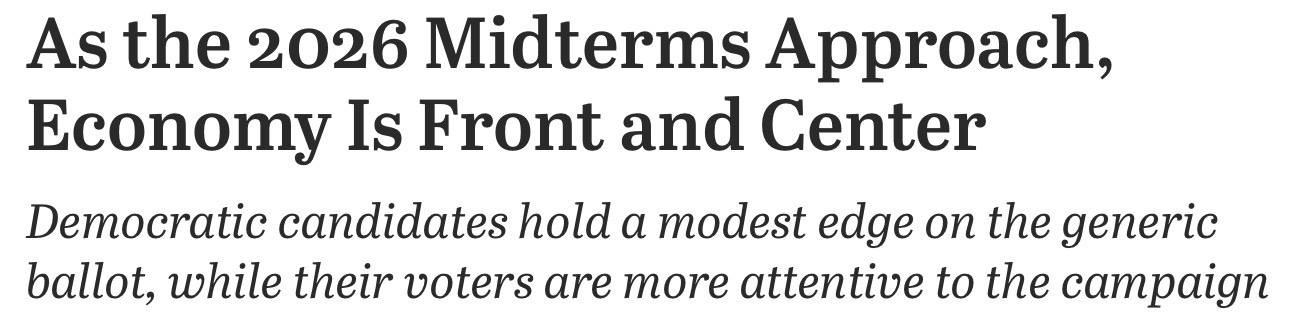
LINK TO THE FULL REPORT
There’s a lot of interesting data in the report, full of charts, here.