


Our morning columns are typically free for all subscribers and guests. If you like this sort of independent writing, calling balls and strikes, please consider a paid subscription. It’s only $7mo or $70yr. And it supports my work! Below the paywall at the bottom of this column is additional data from deeper in the survey. Interesting stuff.
Remember you can now listen to our written posts on your favorite podcast app. Search for “So Does It Matter: Spoken” (or click here).
⏱️ 6 Min Read
With Ballots Arriving in Early May - Field Far From Settled
A new Emerson College Polling survey offers one of the clearest early snapshots of California’s 2026 governor’s race — and the topline underscores just how unsettled the field remains.
In the state’s nonpartisan primary format, Steve Hilton leads with 17 percent. Eric Swalwell follows at 14 percent, with Chad Bianco close behind at 14 percent. Katie Porter posts 10 percent and Tom Steyer 9 percent.
In Emerson College’s December survey, the race looked different: Hilton and Swalwell were tied at 12 percent, followed by Porter at 11 percent. The movement over just two months underscores how fluid the field remains.
Beyond those five, the ballot also included Xavier Becerra (4 percent), Matt Mahan (3 percent), Antonio Villaraigosa (3 percent), Tony Thurmond (2 percent), Betty Yee (2 percent), Ian Calderon (1 percent), Jon Slavet (less than 1 percent), and “someone else” at 1 percent.
Twenty-one percent of voters are undecided.
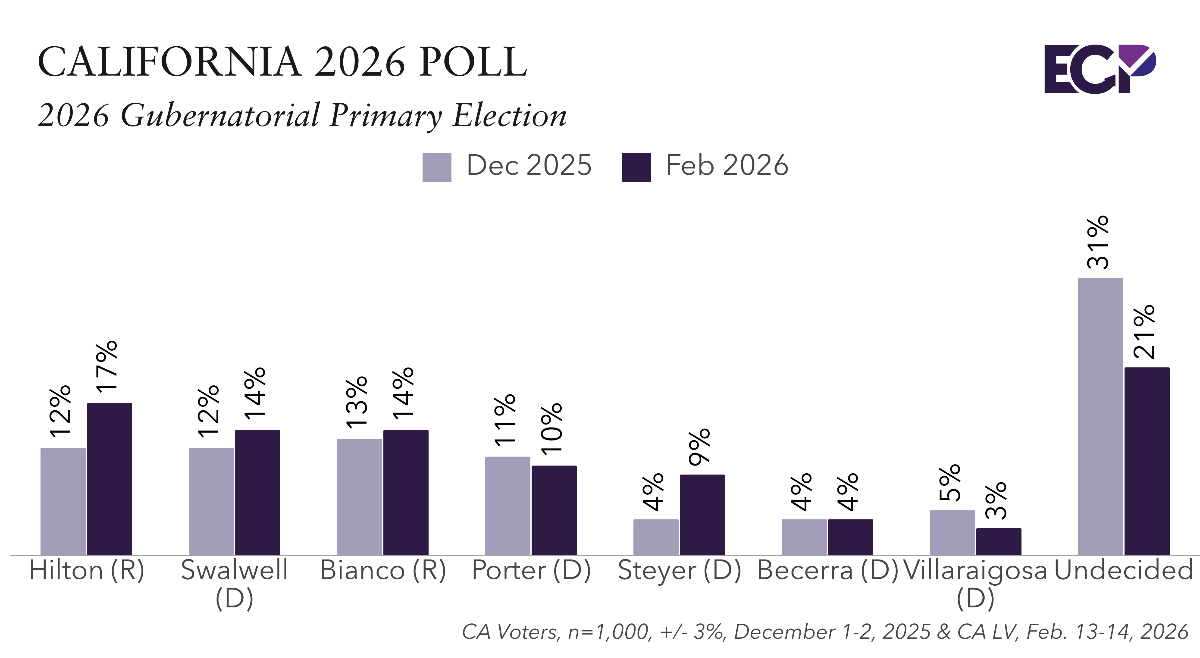
At this stage, the most important number is not 17 percent — it’s 21 percent. That undecided bloc is larger than any individual candidate’s support. In a top-two system, this indicates volatility. The race is fluid.
Steve Hilton’s position is noteworthy for two reasons.
First, he is consolidating Republicans almost evenly with Bianco. Among GOP voters, Hilton posts 38 percent and Bianco 37 percent — effectively tied. Second, Hilton leads independents with 22 percent support, giving him a path in a state where unaffiliated voters often decide who advances.
On the Democratic side, there is fragmentation. Swalwell leads Democrats with 23 percent, followed by Porter at 14 percent and Steyer at 12 percent, while 22 percent of Democrats remain undecided. No Democrat has consolidated the field.
Early polling in California is rarely predictive — but it is directional. The direction here is clear: no one owns this race.
Favorability Ratings: A Volatile Backdrop
Beyond the ballot test, the approval numbers create the political environment in which this race will unfold.
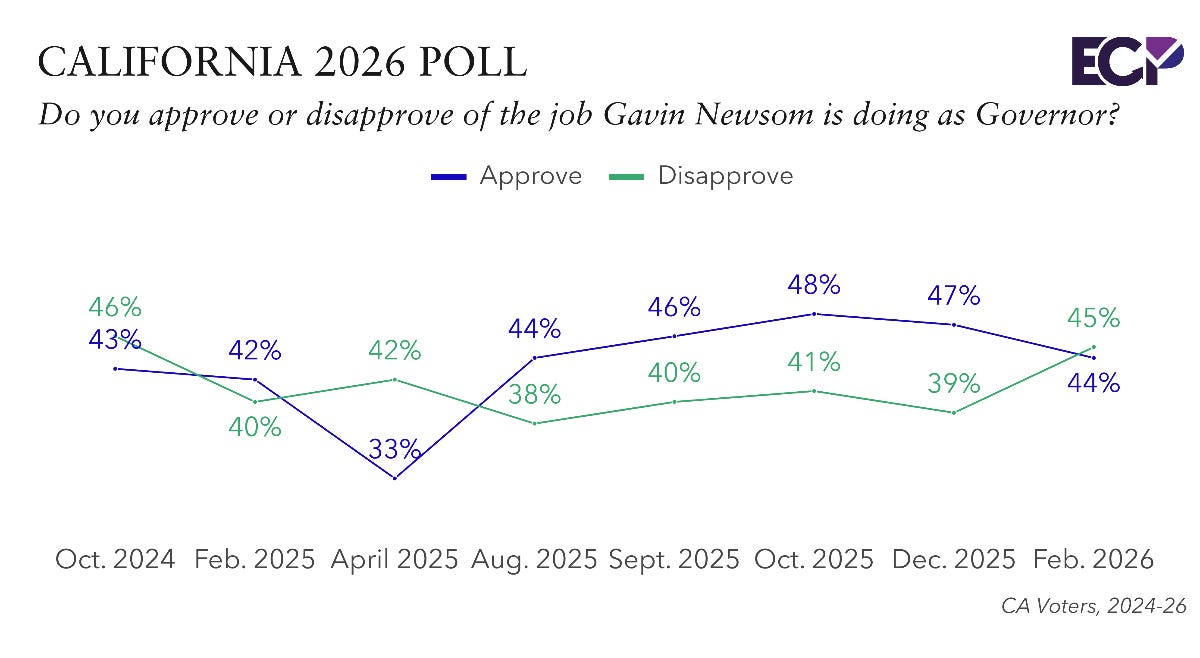
Governor Gavin Newsom posts 44 percent approval and 45 percent disapproval — slightly underwater.
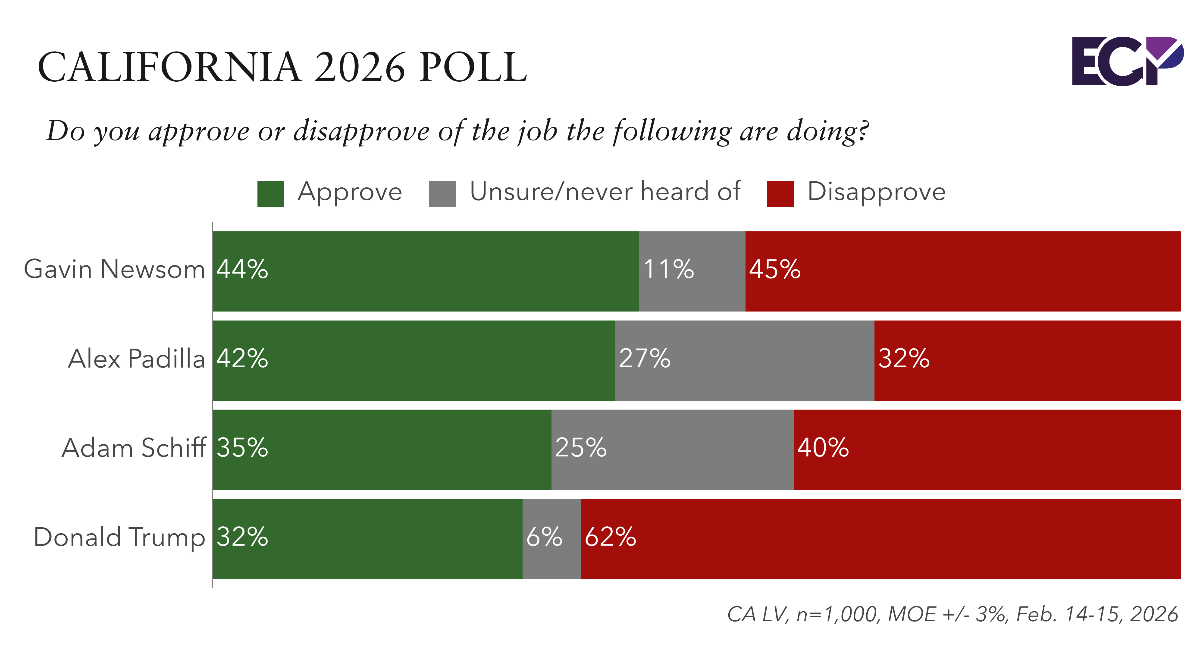
That is not catastrophic. But it is not a position of strength either. An incumbent governor finishing his term with a net-negative approval rating, especially one who wants to sit in the Oval Office, is suboptimal.
Here’s a graphic of Newsom’s approval ratings benchmarks back to October of 2024.
President Donald Trump’s numbers in California remain deeply negative at 32 percent approval and 62 percent disapproval. That underscores the strategic risk for any Republican nominee of being overly nationalized in a state that remains resistant to Trump personally (a.k.a. The Prop. 50 playbook).
Meanwhile, Senator Alex Padilla posts 42 percent approval and 32 percent disapproval. Representative Adam Schiff registers 35 percent approval and 40 percent disapproval. Two high-profile Democrats carry mixed numbers.
The takeaway: California is not monolithic. Party registration advantages do not automatically translate into overwhelming job approval.
Immigration: A Narrow Divide
One of the more revealing questions asked voters which administration’s immigration policies they prefer.
Forty-one percent prefer the Biden administration’s approach. Thirty-eight percent prefer Trump’s. Twenty-one percent prefer neither.
That is a narrow margin in a state often described as solidly progressive.
It does not signal a rightward shift. But it does suggest that immigration remains politically unsettled. A 41–38 split — with one in five rejecting both — indicates competitive terrain heading into 2026.
Top Issues: The Economy Dominates
When asked the most important issue facing California, 37 percent of voters cite the economy. Housing affordability follows at 19 percent. “Threats to democracy” registers 16 percent. Immigration: 8 percent. Healthcare: 6 percent. Crime: 5 percent.
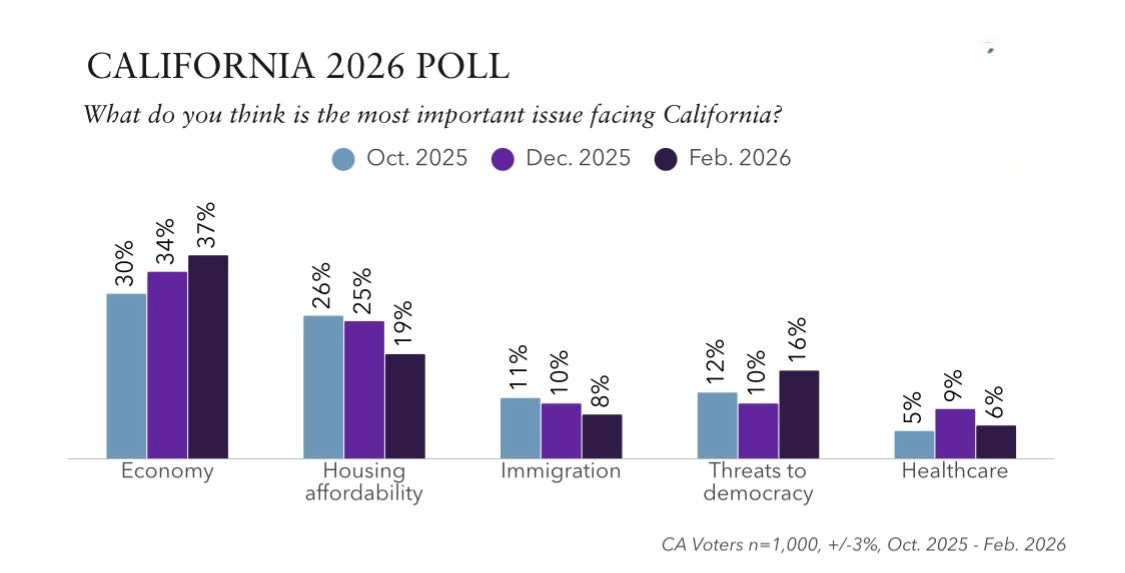
The economy dwarfs every other issue.
In a separate question, 53 percent of voters say they have considered leaving California in the last 12 months due to the cost of living. Forty-seven percent say they have not.
Housing costs, utilities, and groceries rank as the top strains on household budgets. 11% report no financial strain.
This is pocketbook politics.
So, Does It Matter? Three Takeaways And A Reminder
There are three structural insights in this survey:
First, the governor’s race is wide open. No candidate has reached even 20 percent in a crowded field with more than one-fifth undecided.
Second, Newsom’s approval is not robust. A slightly negative job rating signals space for a “course correction” message in 2026.
Third, economic anxiety is the dominant theme. Campaigns that fail to anchor their message in affordability and cost-of-living relief will be out of alignment with voter priorities.
Immigration remains competitive. National partisan branding remains polarizing. And the Democratic field remains fragmented.
But an important reminder — which is straight out of my column from yesterday, where I walk readers through why the odds of both Bianco and Hilton making the top two are very slim — in the close the state’s powerful and well-heeled public employee unions are going to be dumping a huge amount of money into this race. This will matter. And it will matter a lot if the biggest and richest ones coordinate. They will spend a vast sum ($50 million? Even more if they need to…) to lift their favorite Democrat, knock down any other close Dems, and then elevate one of the Republicans, to force a blue on red showdown for November, where they have a huge advantage, and avoid an intra-party battle.
Methodology
This Emerson College Polling survey was conducted February 13–14, 2026, among 1,000 likely California voters. The margin of sampling error is approximately ±3 percentage points. For purposes of this analysis, all percentages have been rounded to the nearest whole number.
For Our Paid Subscribers
Below the paywall, you'll find a link to additional results and details from this new survey. And some interesting data on what Californians think of these new big data centers that are cropping up, with the massive increase in consumption need tied to artificial intelligence applications. And speaking of AI, do voters think this new technology will ultimately create more jobs or take more jobs? It’s all below.
