

Matt Mahan Wants To Be A “Moderate” Democrat. His Housing Plan Suggests Otherwise
Gubernatorial Candidate and San Jose Mayor Matt Mahan offers modest reforms but leaves untouched the governing philosophy that helped create California’s housing shortage.

Our morning content is open to all of our subscribers and guests. Today is my first time writing, with any substance, about Matt Mahan. Beneath this column, under the paywall, I have a six-minute or so hard-hitting video commentary on the Governor’s race, and the curious case of Matt Mahan. I would encourage you to hit the red button above the paywall and try a free weeklong premium subscription, which unlocks about 35% more of our content! Read about what you get with an upgrade here. Oh yes, you can listen to our written content at "So, Does It Matter? Spoken.” Podcast, on your favorite podcasting app. Or go here.
⏱️ 4.5 min read
A Democrat Playing At The Edges Of Reform
San Jose Mayor Matt Mahan has released a multi-point housing plan as part of his campaign for governor. The proposal offers some interesting ideas — but it also illustrates the limits of California’s self-described “moderate” Democrats.
But before diving into the specifics, it is worth pausing on a broader question: whether a Democrat running statewide in California is prepared to confront the governing philosophy that produced many of the state’s current problems in the first place.
I approached Mr. Mahan’s proposal hoping to see exactly that. California’s housing crisis, like many of the state’s policy failures, did not arise out of thin air. It is the predictable result of decades of heavy taxation, aggressive regulation, centralized planning, and a governing culture that assumes government officials are better positioned than citizens and markets to determine how society should function.
It is difficult to imagine any Democrat solving California’s problems without first acknowledging how many of them were created by government itself.
Unfortunately, it does not take long to read Mr. Mahan’s housing proposal to see that he is not prepared to take that step.
While the plan contains a handful of novel ideas aimed at easing some of the symptoms of California’s housing crisis, it avoids confronting the deeper policy framework that produced the problem. Mr. Mahan shows little willingness to challenge the collectivist assumptions that have dominated California governance for decades — the belief that planners in Sacramento should decide where housing is built, how communities grow, and what economic tradeoffs Californians should accept.
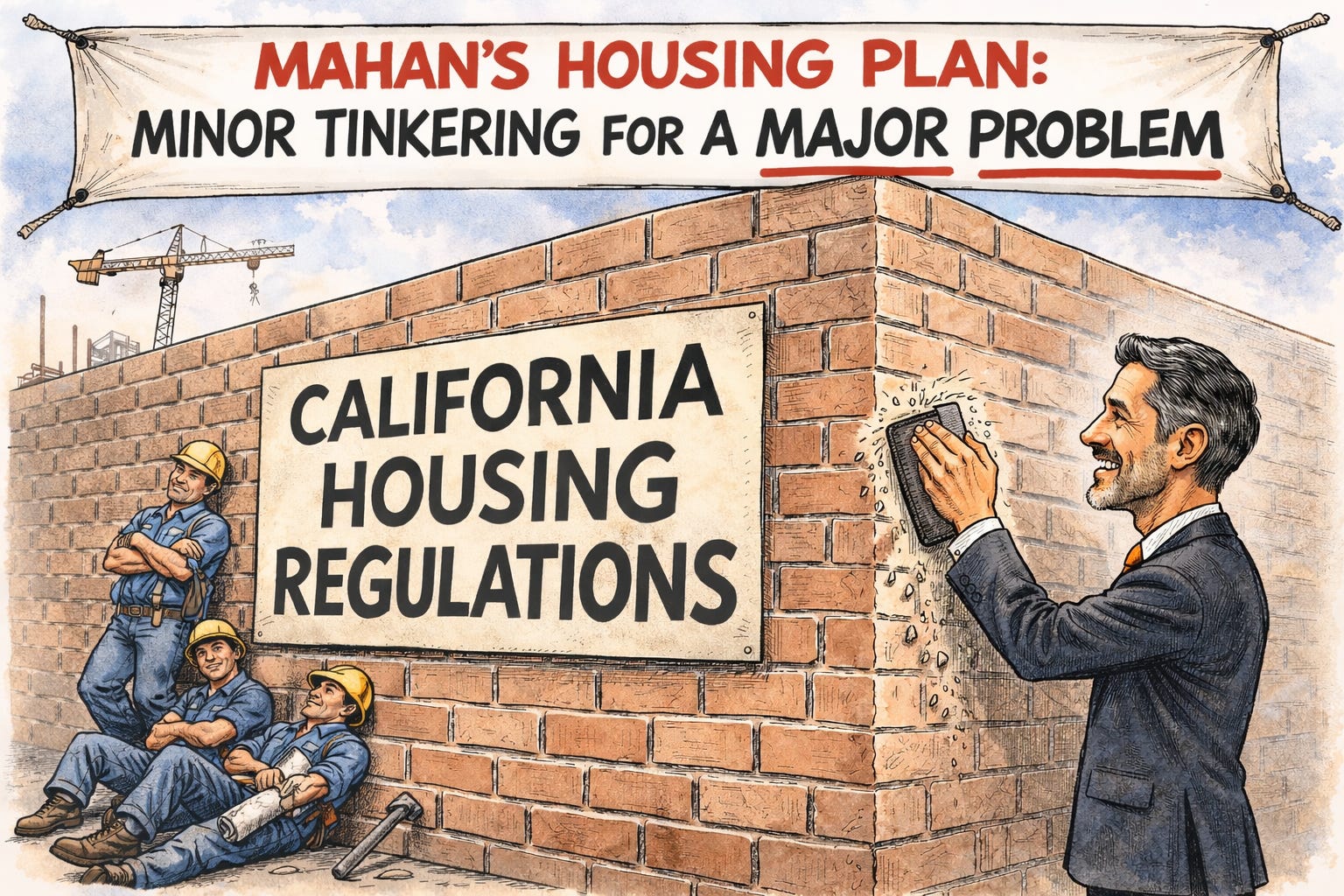
Instead, the proposal largely operates within that existing framework — offering what might best be described as conditional deregulation. This is not merely an omission; it is a choice to leave intact the policy framework that produced the crisis in the first place.
To be fair, Mr. Mahan does identify several policies that contribute to California’s housing shortage, and his proposal includes some ideas that could modestly reduce the cost of building homes. But the deeper question is whether those reforms challenge the governing assumptions that explain why we do not have enough housing construction in California.
Central Planning Disguised As Reform
But the structure of Mr. Mahan’s proposal reveals a deeper assumption that has defined Democratic housing policy in California for decades. Like Gov. Gavin Newsom and the Legislature’s Democratic majority, Mr. Mahan centers his plan on promoting dense “infill housing” within existing urban areas — particularly development near transit and within designated planning zones.
Much of the economic relief he proposes — including fee caps and tax holidays — is tied specifically to these infill projects, meaning the reforms apply mainly where Sacramento planners already want housing built.
That distinction matters because it reveals the plan's central premise: government should steer where housing growth occurs.
California’s housing crisis is often described as a planning failure. In reality, it is largely an economic one. California is estimated to be short several million homes needed to stabilize housing costs and meet demand.
Fees, lawsuits, permitting delays, environmental mandates, labor rules, and zoning restrictions combine to make housing slower, riskier, and vastly more expensive to build in California than in most of the country. The predictable result is that too few homes are built.
The solution, in principle, should be straightforward: make it cheaper and easier to build homes everywhere.
Conditional Deregulation
Mr. Mahan’s proposal stops short of that.
What he offers instead is conditional deregulation: regulatory relief, but only if housing is built where government planners want it.
Tax relief, fee caps, and legal protections are focused largely on infill housing projects within existing cities. Builders seeking to develop housing on the edges of metropolitan areas — where land is cheaper, and construction can often occur more quickly — would see far less benefit from the reforms.
That approach aligns with the dominant planning philosophy in Sacramento, which favors dense urban development and transit-oriented growth.
But it also narrows the scope of reform.
What The Plan Leaves Untouched
More importantly, the plan leaves untouched several of the regulatory forces that drive housing costs in California.
There is no serious proposal to scale back the state’s increasingly burdensome environmental mandates, which add high costs to housing construction. From electrification mandates to the state’s cap-and-invest program that drives up the cost of energy, transportation, and building materials, California’s climate policies now ripple through nearly every stage of housing construction.
Nor does the plan confront the role of labor mandates in driving up construction costs. Prevailing wage laws and “skilled and trained workforce” requirements effectively steer housing construction toward union labor. Those mandates may serve organized labor well, but they also raise the cost of building homes — particularly for private developers attempting to produce market-rate housing.
Yet these cost drivers remain politically untouchable in Sacramento, and Mr. Mahan’s plan leaves them intact.
Where Housing Can Actually Be Built
California does not lack plans to build dense housing in city centers. What it lacks is a policy environment that allows housing to be built wherever it makes economic sense.
For many families, that means suburban or exurban communities where land costs are lower, and homes can be built at prices middle-class buyers can afford. For builders, it means regulatory predictability and the freedom to pursue projects without having to navigate multiple layers of planning mandates.
Yet Sacramento’s governing philosophy continues to reject that idea. Instead of expanding the range of places where housing can be built, policymakers attempt to steer development toward preferred locations. “Nancy state” governance. Government knows best.
Mr. Mahan’s proposal largely follows that pattern.
The Limits Of Mahan’s Moderation
To his credit, his rhetoric is more pragmatic than that of many progressive housing activists. He openly acknowledges that government policies have increased construction costs and slowed housing production. His willingness to talk about fees, permitting delays, and building-code reforms sets him apart from many Democrats who focus almost exclusively on subsidized affordable housing.
But moderation in tone does not necessarily translate into moderation in policy.
By restricting many of his proposed reforms to infill housing and urban development zones, Mr. Mahan accepts the central premise of California’s current housing regime: that government should determine where housing growth occurs.
That premise has not served the state well.
California needs more housing of every kind — apartments, condominiums, townhomes, and single-family homes — built in cities, suburbs, and growing communities alike. Achieving that goal requires broad deregulation that lowers the cost of building homes across the entire housing market.
Targeted incentives for government-preferred development categories are unlikely to produce that outcome.
Mr. Mahan may present himself as a pragmatic reformer. But his housing proposal ultimately reinforces the same planning philosophy that has dominated California policy for decades.
So, Does It Matter?
Which brings us to the broader point about his candidacy.
Mayor Mahan likes to position himself as a more moderate Democrat — someone willing to question the assumptions that have governed California for years. But his housing proposal illustrates the limits of that moderation. While he is willing to play at the edges of the state’s policy failures, he still fundamentally embraces the liberal governing philosophy that produced them in the first place.
Until California leaders challenge that philosophy itself — not merely adjust its symptoms — the state’s housing crisis will persist. And so will the broader failures of governance it has produced.
Jon Fleischman’s Video Commentary
Below the paywall, as only he can, Jon sets out on a nearly seven-minute off-the-cuff commentary about the Governor’s race, and about Matt Mahan, and his housing plan. Support this project, watch this video, and unlock so much more content by upgrading to a premium subscription today. Click the red button and start a free trial!
