


Our morning content is free for all subscribers and guests! You can also listen to this post — along with my California Post column — on our podcast feed, So, Does It Matter? SPOKEN. It’s available on your favorite podcasting app, or you can find it here.
⏱️ 4.5 minute read
The Latest Bass-Era Fumble
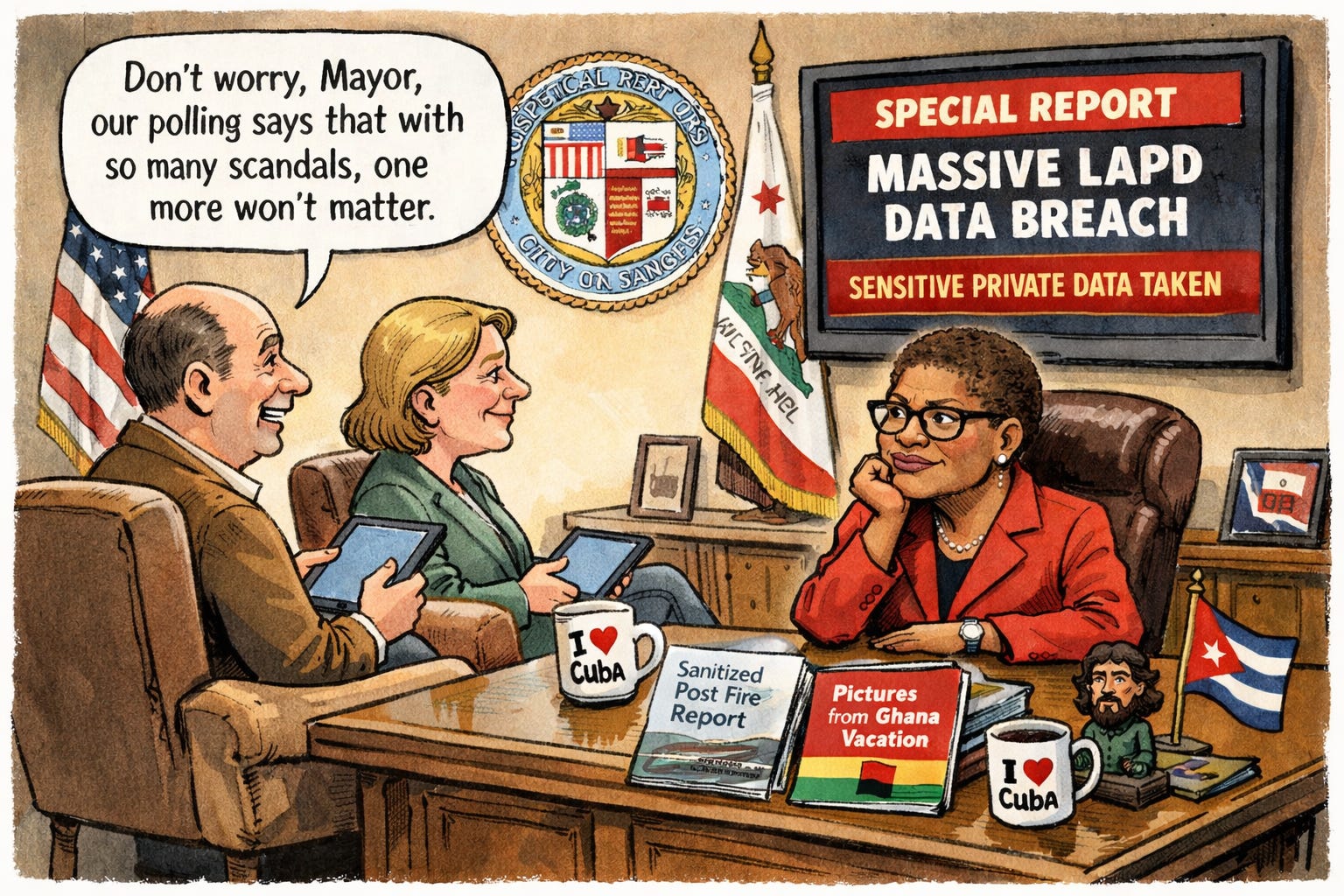
Mayor Karen Bass now has yet another crisis on her hands in a city that already looks increasingly ungovernable. At some point, these episodes stop looking like bad luck and start looking like a pattern of failed leadership.
As if Los Angeles did not already have enough dysfunction on its hands, now it gets to add a major leak of sensitive police records to the list. According to the Los Angeles Times, hackers who breached a third-party file-transfer tool used by the L.A. city attorney’s office obtained 7.7 terabytes of data and roughly 337,000 files, including some of the LAPD’s most sensitive materials: officer personnel files, Internal Affairs records, witness names, medical information, and unredacted criminal complaints.
The LAPD says its own systems were not breached. That is a nice bureaucratic distinction, but not much of a defense. The records were still exposed. The damage is still real.
Not Just Bass’s Problem
Most of the political blame for yet another Los Angeles breakdown belongs with Bass. She is the mayor. She is the face of the city government. She owns the broader atmosphere of drift, weakness, and managerial underperformance that now hangs over Los Angeles.
But you cannot tell this story honestly and leave out City Attorney Hydee Feldstein Soto. This breach came out of her office. The city attorney is not some obscure appointed functionary buried in the bureaucracy. It is an elected office, one with broad responsibility for defending the city, prosecuting misdemeanors, and handling legally sensitive matters at the center of public life.
The city attorney’s office said it learned on March 20 of unauthorized access to a third-party tool used to transfer discovery to opposing counsel and litigants, then moved to secure the system and investigate. But that explanation only raises the obvious question: why was such a huge volume of sensitive material sitting in a vulnerable transfer tool in the first place?
These were not harmless administrative files. They reportedly included health information, witness interviews, disciplinary records, and internal investigative materials that are usually sealed or heavily redacted. In other words, the city government was holding exactly the sort of information it always insists must be tightly controlled, and then failed to control it.
A Failure With Two Elected Owners
The Times reported that within the LAPD, there was virtually no acknowledgment by senior leaders of the breach or its implications, and that one command staff meeting included only a vague reference to employees changing passwords more frequently. That is not a serious response. It is the kind of bureaucratic shrug institutions offer when they are more concerned with containing embarrassment than confronting failure.
And the fallout may not be limited to embarrassment. The leaked records reportedly included material from civil litigation, and at least one police-accountability account on X published an internal affairs report from what appeared to be an ongoing case, despite the LAPD’s statement that the files were from closed matters. If that is true, the consequences could include more lawsuits, more liability, and more damage to witnesses, complainants, officers, and public trust.
That is why both elected officials belong in the frame. Bass owns the collapsing confidence in City Hall. Feldstein Soto owns the office where this specific failure occurred. Different levels of responsibility, but shared responsibility all the same.
Let’s wait for the press conference where these politicians take the blame for this egregious data breach. But don’t hold your breath. The one thing we know about governance at Los Angeles City Hall: there are no adults in the room.
So, Does It Matter?
You really do have to wonder, as the unforced errors in the City of Los Angeles pile up higher and higher, if one more failure even matters. I guess it matters if the elected officials in charge are held to account.
In Los Angeles, that means first Mayor Bass, whose record keeps making her look unequal to the basic management demands of the job. But it also means Hydee Feldstein Soto, whose office is now at the center of one of the most damaging public-sector data failures the city has seen in some time.
And this stuff happening literally at the height of re-election season — well, it doesn’t seem to matter. Feldstein Soto is not running unopposed. She has three challengers, one of whom is raising some money, but still far short of what would normally be needed to knock off an incumbent in a city this large. That does not guarantee her safety, but it does show that even after a failure like this, the barriers to dislodging an incumbent remain high.
Bass, meanwhile, can probably take some consolation in the fact that the mayor’s race is shaping up as a race to the bottom. She may lack core competence, and her record speaks loudly on that point. But when one prominent rival is a fringe socialist on the City Council, and another is a social media celebrity running for mayor as if it were a book-tour side project, the reality is that Bass still looks like the frontrunner by default.
That is not a sign of strength. It is an indictment of the field, and of a city so badly run that obvious failure still has the upper hand.