

Los Angeles Schools Face Financial Collapse As Unions Threaten To Shut Them Down
A Strike Threat Comes As The District Is Already On The Brink Of Fiscal Crisis

Our morning content is free for all subscribers and guests. Did you know you can LISTEN to our content on your favorite podcasting app? Just search for So, Does It Matter? Spoken. Or go here.
⏱️ 5 min read
A Strike Threat That Puts Students Last
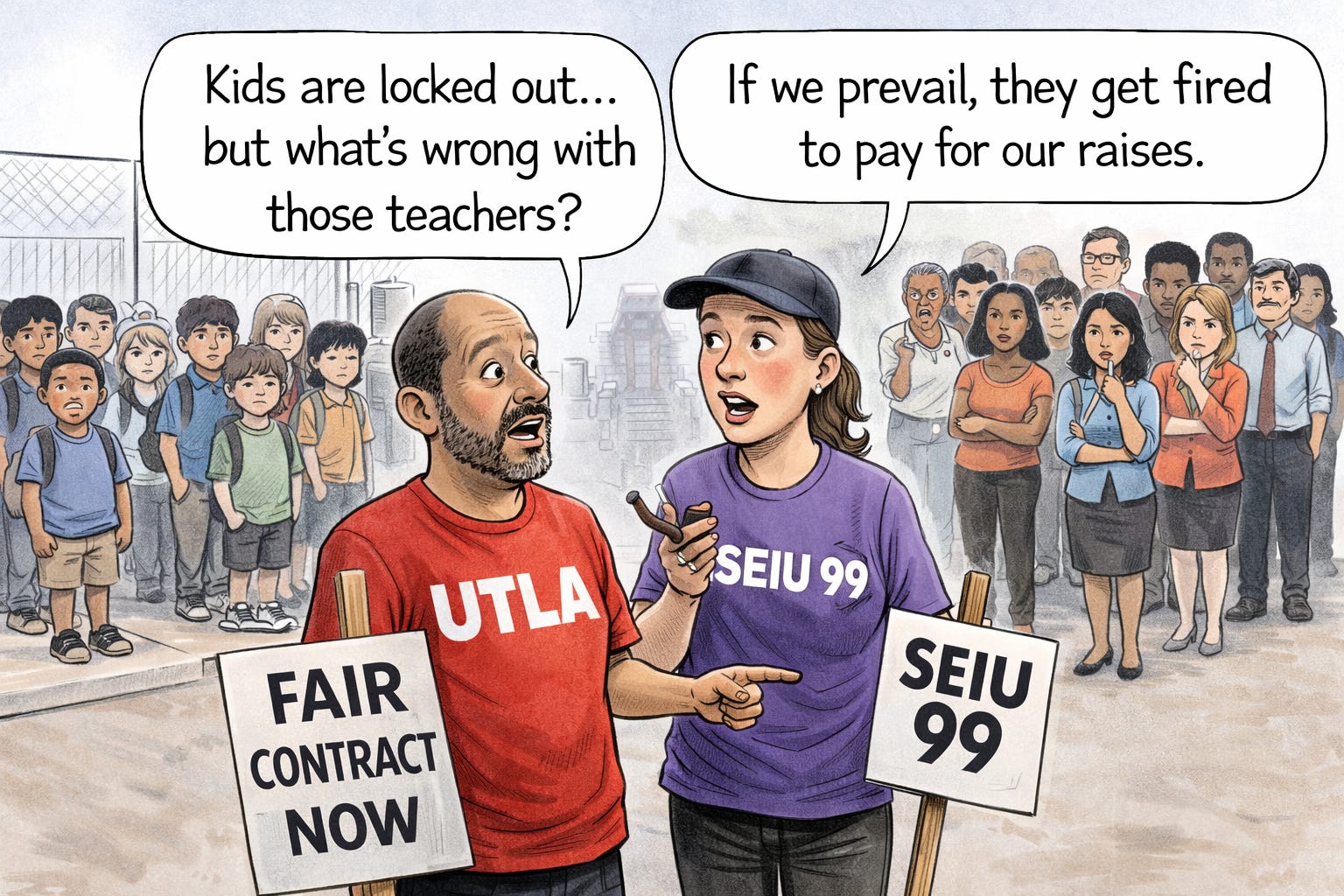
The Los Angeles Unified School District (LAUSD) is now facing a coordinated strike threat from its two largest unions that could shut down schools beginning April 14. United Teachers Los Angeles (UTLA) and SEIU Local 99 have made clear that if demands are not met, tens of thousands of employees will walk off the job. That would effectively close schools for roughly 420,000 students.
This is not a symbolic action. When teachers and support staff strike together, schools cannot function at even a minimal level. We saw this just a few years ago when a similar action forced a shutdown of campuses across the district.
What makes this moment different is the timing. The district is not operating from a position of strength. It is already in financial distress, and this strike threat comes at a moment when the system is struggling to stay afloat.
A District In Deep Financial Trouble
LAUSD operates with an annual budget of roughly $18.8 billion, but it is running multi-billion-dollar structural deficits over the next several years. The district has been covering that gap by drawing down reserves that once stood at about $5 billion. Those reserves are now projected to be exhausted within a few years if current trends continue.
The financial pressure is coming from multiple directions. Enrollment has fallen dramatically, down roughly 40 percent from its peak. In the last several years, the district has lost about 75,000 students. Because state funding is tied to attendance, fewer students means less revenue.
At the same time, the district expanded staffing during the pandemic using federal funds that are now gone. That created an ongoing cost structure with no funding source. The system is carrying those costs into a period of declining revenue.
There are also significant legal liabilities. The district has already committed well over a billion dollars to settle sexual abuse claims, and hundreds of additional lawsuits are still pending. Those costs are not theoretical. They are being financed through borrowing that will require payments for years.
If all of this was not enough, the District Superintendent is on leave after federal agents raided his house, and student scores are not that great.
Staffing Levels That Do Not Match Reality
Despite declining enrollment, staffing has not been reduced in a meaningful way. Recent data show that LAUSD employs roughly 21,000 classroom teachers and more than 34,000 other staff members. A majority of the workforce is not in the classroom.
Over the past five years, the district lost tens of thousands of students but barely reduced its workforce. Teacher staffing has declined only marginally. Non-classroom staffing saw similarly minor reductions.
The result is a system sized for a much larger student population than it serves. District leadership has acknowledged that the workforce today is larger than it was when enrollment was higher.
This mismatch has real financial consequences. Labor is the largest cost driver in any school system, and maintaining a workforce that does not align with enrollment trends worsens the deficit each year.
Unions Demand More While Reality Moves The Other Direction
Against this backdrop, the unions are demanding massive increases in compensation. The Los Angeles Times has reported that teachers are seeking roughly a 17 percent raise over two years, while service workers are pushing for double-digit increases over three years. The district has countered with an offer of about 8 percent over two years, which is already difficult to justify given its condition. Did I mention they want to set the floor for new teacher hires at $80,000 (plus benefits) and allow for Reacher salaries go up above $130,000? And there is a demand for “protection” against losing jobs to artificial intelligence.
What is striking (no pun intended) is not just the size of the demands, but the absence of any discussion about accountability. There is no effort to tie increases to student outcomes or classroom performance. The focus is entirely on across-the-board increases.
The broader economic context also matters. Outside of government, many workers are facing a weak economy, limited wage growth, and job uncertainty. Private sector employers cannot run deficits or draw down reserves to cover rising costs.
Not to mention the fact that a strike would make the district’s financial situation worse. Because state funding is tied to attendance, extended closures can reduce that funding. That compounds the deficit at the wrong time.
And while history suggests that striking employees are often made financially whole after a settlement, students are not. Lost instructional time is not recovered. The academic impact, particularly for students, can be lasting.
So, Does It Matter?
This moment reveals a fundamental disconnect between the system's interests and students' needs. The district is facing a fiscal crisis driven by declining enrollment, rising costs, and liabilities. Yet the response from its largest unions is to demand more and threaten to shut the system down.
There is a difference between advocating for fair compensation and ignoring reality. When a system is running deficits and burning reserves, the conversation should be about sustainability and priorities.
Students should be at the center of that conversation. Instead, they are being used as leverage in a labor dispute that occurs when the system can least afford disruption.
At some point, the adults in the room have to acknowledge the situation for what it is. This is not the moment for unrealistic demands or brinkmanship. It is the moment for decisions to stabilize a system under strain.
On a final note, may I humbly suggest that these union members, who are, like the rest of us, feeling the pinch of tougher times, focus on lobbying Sacramento Democrats to start cutting the taxes, fees, and regulations that make this state the least affordable in the nation. Rather than focusing on trying to blackmail a district in financial distress with a strike.
Remember teachers work less than 40 hours a week, EVERY holiday off, and three months off during the summer. I don't know how much their hourly wage comes to....