

Lawsuits As An Investment Strategy: The Quiet Expansion Of Litigation Finance
How Hedge Funds And Outside Investors Are Quietly Financing Lawsuits In California

Our morning content Is free for all subscribers and guests. Did you know you can LISTEN to our content on your favorite podcasting app? Just search for So, Does It Matter: Spoken. Or go here.
⏱️ 5 min read
The Rise Of Lawsuit Investing
Would it surprise you if I told you another story about how a well-heeled special interest group in Sacramento is helping make California less affordable for the rest of us while making themselves rich in the process?
Let’s dive in.
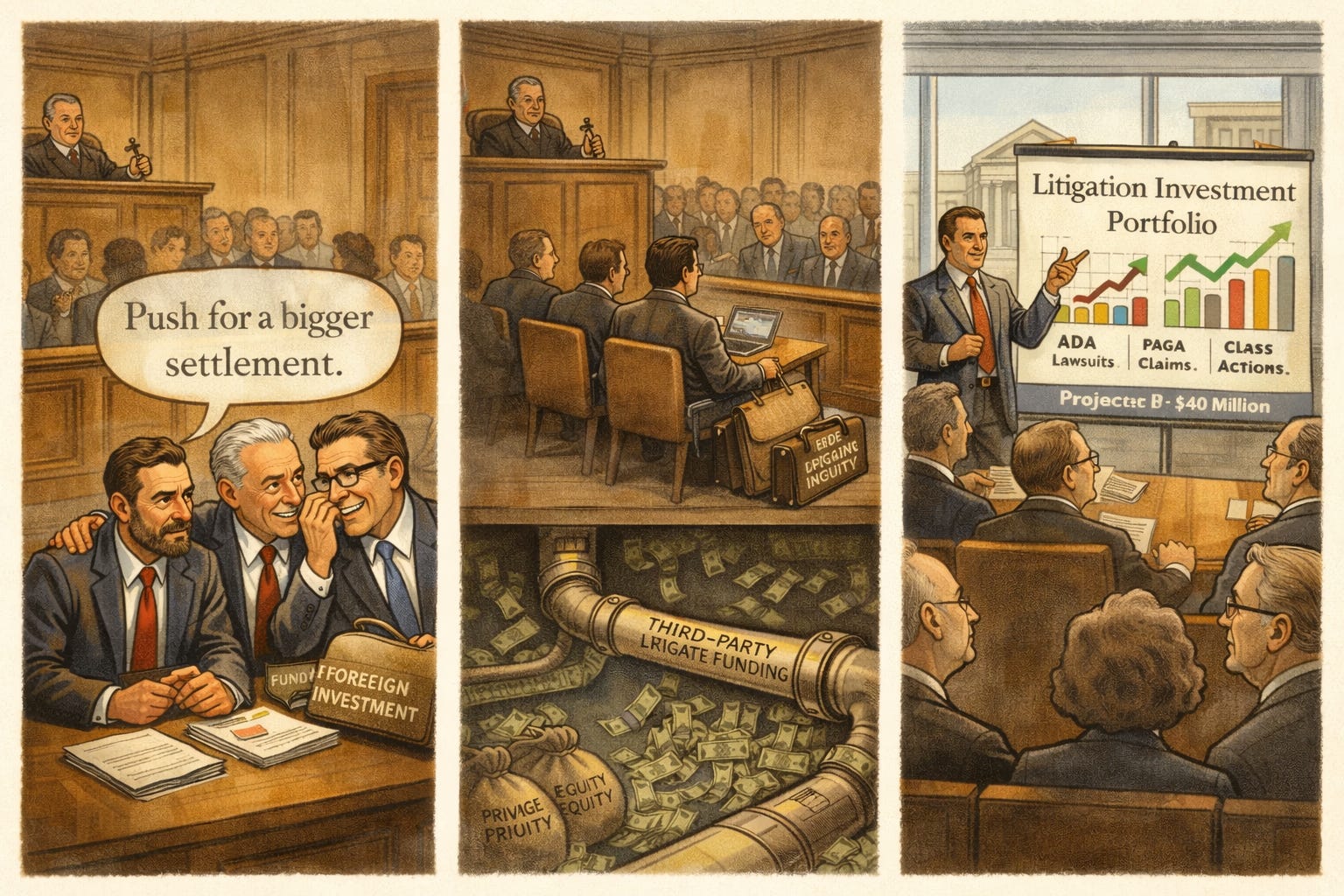
Imagine hedge funds roaming courthouse hallways looking for promising lawsuits the way venture capitalists hunt for startup investments. They bankroll the case, cover the legal costs, and if the lawsuit wins, they take a large share of the payout. In other words, lawsuits themselves have become an investment product.
This practice already has a name: third-party litigation funding. And while most Californians have never heard of it, the consequences are real for businesses, consumers, and the integrity of our civil justice system.
Third-party litigation funding, often shortened to TPLF, works exactly the way it sounds. Outside investors, such as hedge funds, private equity firms, or specialized litigation financiers, provide funding to plaintiffs or law firms to finance lawsuits. In exchange, they receive a portion of any settlement or court award if the case succeeds. If the case loses, the investor absorbs the loss.
Supporters argue the practice expands access to justice by allowing plaintiffs who lack financial resources to pursue legitimate claims. I see something very different. Lawsuits are turning into speculative financial instruments, with investors pushing cases to drag on longer and seek larger payouts to maximize returns. The incentive shifts. Instead of resolving disputes efficiently, the goal becomes generating profits.
California’s Litigation Climate
Litigation finance has grown quickly in recent years. Litigation finance firms now manage billions of dollars in assets, treating lawsuits much like venture capital treats startup companies, a portfolio of bets where a few large wins can generate enormous returns. That should make people stop and ask who is really driving the litigation.
The issue is especially concerning in California, a state already known for an aggressive litigation climate. Businesses here face a steady stream of lawsuits under laws such as the Private Attorneys General Act and the Americans with Disabilities Act. These cases are often filed by specialized plaintiffs’ firms that target technical violations and seek quick settlements.
Introducing outside investors into that environment only makes the problem worse.
When hedge funds or litigation financiers bankroll lawsuits, they have a financial incentive to push for the largest possible settlement or verdict. That can mean encouraging plaintiffs to reject reasonable settlement offers, prolong litigation, and pursue more aggressive strategies because the investor’s return depends on maximizing the payout.
Those costs rarely stay confined to the courtroom. Businesses facing increased litigation risk pass those costs along through higher prices, increased insurance premiums, and reduced investment. The ripple effects eventually reach consumers and workers.
One economic analysis estimates that litigation financing contributes to tens of billions of dollars in lost economic output annually and adds hundreds of dollars in costs to the average household each year.
Sacramento Finally Notices
Despite the industry's growing scale, transparency around litigation funding remains remarkably limited. In many cases, courts do not require disclosure when outside investors are financing a lawsuit. Judges, defendants, and even juries may have no idea that a hedge fund or private investor has a financial stake in the outcome of a case.
That should concern anyone who believes the legal process should be transparent.
California lawmakers have begun to notice.
In 2023, State Senator Tom Umberg introduced SB 581, legislation that would have imposed meaningful safeguards on litigation financing. The bill would have required litigation financiers to register with the state, disclose key terms of their agreements, limit certain fees, prohibit referral kickbacks, and allow courts to void contracts that violated the law.
It was a serious attempt to bring transparency to an industry that has largely operated without oversight.
But SB 581 stalled in the Legislature before reaching the governor’s desk. How much do you want to bet the well-connected trial lawyers had something to do with killing that bill? Hint: The “Consumer Attorneys of California” were official opponents of the bill.
Now Assemblymember Michelle Rodriguez is advancing AB 743, warning that litigation financing currently operates as an “unregulated, shadow financial sector.” Her bill would require commercial litigation finance firms to obtain a license from the California Department of Financial Protection and Innovation.
This more modest proposal passed out of the Assembly without a single vote in opposition.
AB 743 is at least a step toward acknowledging the problem and establishing some oversight.
But the bill falls well short of the transparency and safeguards really needed. Notably, it does not require disclosure of which lawsuits are being financed, meaning courts and defendants may still have no idea when outside investors are backing a case.
So, Does It Matter?
The solution here is not complicated. Strong, meaningful reforms that bring this practice fully out of the shadows are necessary, so that everyone involved in the legal process, including judges, jurors, and opposing parties, knows when outside investors are financing a lawsuit and have a financial stake in the outcome.
If lawsuits are going to become an investment vehicle for hedge funds. and private investors, the least Californians deserve is transparency about who is funding litigation in their courts. Our civil justice system is supposed to resolve disputes and deliver justice, not operate like a casino where outside investors bet on legal outcomes.
More Cartoons!
Below the paywall for our paid subscribers are three more cartoons that didn’t make the top spot! Check ‘em out!
