

Last Day Of July 4 Sale - AND... Jon's Weekly Reading Recommendations! Articles, Charts, Videos, Podcasts & More… [Unlocked]
Final Hours: Lock In Your $55 Subscription Before Tonight!

Happy Independence Day!
Two hundred and fifty years ago, Americans signed a document declaring that government exists to serve the people — not the other way around.
That idea remains worth defending.
It is certainly worth defending here in California.
As we celebrate the Fourth of July with family, barbecues, fireworks, and a grateful appreciation for the freedoms we often take for granted, I wanted to send one final reminder that today is also the final day of our Independence Day subscription special for So, Does It Matter?
For the last two days, new readers have been able to lock in a full year of paid access for just $55 instead of the regular $70 annual rate. And the kicker — it’s a forever price. You lock it in!
That works out to about $4.50 per month for exclusive columns, podcasts, videos, subscriber discussions, and the deeper analysis that simply doesn’t fit into social media posts or free headlines.
At midnight tonight, the sale ends and the subscription price returns to normal.
If you’ve been considering becoming a paid subscriber, today is the day.
For those of you already supporting this project financially: thank you. Your support makes independent California political commentary possible, and I appreciate it more than you know.
And to wet your whistle (if you are a free subscriber now), I have UNLOCKED today’s Reading Recommendations. Normally, this is behind the paywall. Check it out!
Jon
Reading/Watching Recommendations!
TWO COMPLIMENTARY CURATED LINKS FOR ALL READERS:
NANCY PELOSI IS THE WRONG NAMESAKE FOR BERKELEY’S INSTITUTE FOR REPRESENTATIVE DEMOCRACY
Writing in Reason, Ari Shtein argues that if Nancy Pelosi is to be honored with an institute dedicated to representative democracy, her political legacy deserves closer scrutiny. Shtein contends that Pelosi’s tenure in congressional leadership was marked by partisan maneuvering and institutional hardball that contributed to a decline in public trust in government. The essay questions whether effective political leadership and strengthening democratic norms are necessarily the same thing — and whether universities should distinguish between the two.
L.A. METRO IS A CRIME-RIDDEN HELLSCAPE
In this investigative report for City Journal, Christopher Rufo and Haley Strack examine the condition of the Los Angeles Metro system and argue that years of lax fare enforcement and shifting public-safety policies have contributed to increased disorder and crime on trains and buses. The authors trace policy changes dating back nearly a decade and contend that efforts centered on equity and decriminalization have come at the expense of rider safety, particularly for working-class Angelenos who depend on public transit every day.

Want More?

OK, this column is like an iceberg. You can see 10% of it above the waterline. Below the paywall is SO MUCH MORE. I curate a BUNCH of articles, a great chart, a great video, a great long-form story, and much more. And what happened on this day in America — in 1778?
BONUS, WITH THE END OF OUR SALE TONIGHT AT MIDNIGHT, I PULLED THE PAYWALL SO YOU CAN SEE WHAT YOU ARE MISSING MOST SATURDAYS!
Take advantage of the $55 forever sale, and get this kind of stuff almost every Saturday!
More Curated Reads…
THE CALIFORNICATION OF STEVE HILTON
Writing in Vanity Fair, Harry Lambert profiles Republican gubernatorial candidate Steve Hilton and traces his unlikely path from British political strategist to California populist insurgent. Lambert explores Hilton’s evolution from adviser to former British Prime Minister David Cameron to Silicon Valley entrepreneur, Fox News host, and now statewide candidate for governor. The piece paints Hilton as a restless political entrepreneur betting that voter frustration with affordability, homelessness, and one-party rule has created an opening for change in California.
SACRAMENTO DEMOCRATS ARE RAISING TAXES ON PRIVATE HEALTH INSURANCE
Writing in the California Post, Roxanne Hoge, Chair of the Los Angeles County Republican Party, argues that Senate Bill 125 would shift more of California’s Managed Care Organization tax burden onto private health insurance plans, raising costs for families already struggling with affordability. Hoge says the proposal reflects Sacramento’s familiar pattern: expanding government, overspending, and then passing the bill to working Californians through higher premiums. She frames the tax as another example of Democrats avoiding fiscal discipline while describing the cost increase as an act of compassion.
CALIFORNIA UNIONS WANT TO UNWIND A LANDMARK PENSION REFORM. WHO WILL FOOT THE BILL?
Writing in CalMatters, Dan Walters examines Assembly Bill 1383, a union-backed effort to loosen limits from Jerry Brown’s 2012 public pension reform. Walters explains how earlier pension expansions created long-term fiscal pressure, why police and fire unions are now pushing for changes, and why local governments fear higher costs. His warning is straightforward: if public safety unions succeed, other unions may follow, widening California’s already serious unfunded pension liabilities.
AFTER 250 YEARS, ARE AMERICA’S BEST DAYS STILL AHEAD?
Writing in Reason, Steven Greenhut reflects on America’s 250th anniversary through the lens of a country that has endured political upheaval, economic downturns, and social division before. While acknowledging rising polarization and declining civic trust, Greenhut argues against the temptation toward national pessimism and warns that the greatest threat to the American experiment is the growing willingness to use government power against political opponents. His conclusion is cautiously optimistic: America’s future depends on renewing a commitment to liberty and limited government.
AMERICA’S INFORMED CONSENT
In this essay for Rx for Liberty, Dr. Jeffrey Barke examines the concept of informed consent not merely as a medical principle, but as a broader civic and cultural value that he argues has been eroded in recent years. Barke explores the relationship between personal autonomy, government authority, and public health decision-making, contending that a free society depends on individuals having access to information and the ability to make their own choices about risk, responsibility, and medical care.

THE GREATNESS AND UNIQUENESS OF THE AMERICAN FOUNDING
In this essay for The Resurgent, Erick Erickson argues that America’s Founding was not simply another revolution, but a historically unique moment that blended Enlightenment thought, biblical principles, self-government, and constitutional restraint into a political system unlike any that came before it. Erickson contrasts the American experience with the European revolutions and contends that the country’s enduring strength lies in the ideas embedded in its founding documents rather than in ethnicity, geography, or bloodline.

Quick Hits…
Chick-fil-A has been dethroned as America’s favorite fast-food chain.
Couple climbs Empire State Building—and gets engaged, then arrested.
The Queen song Freddie Mercury wrote in 10 minutes in the bathtub.
One in five Americans believes aliens have already made contact.
The most misspelled word in each state.
One Good Chart (Well, Two)…
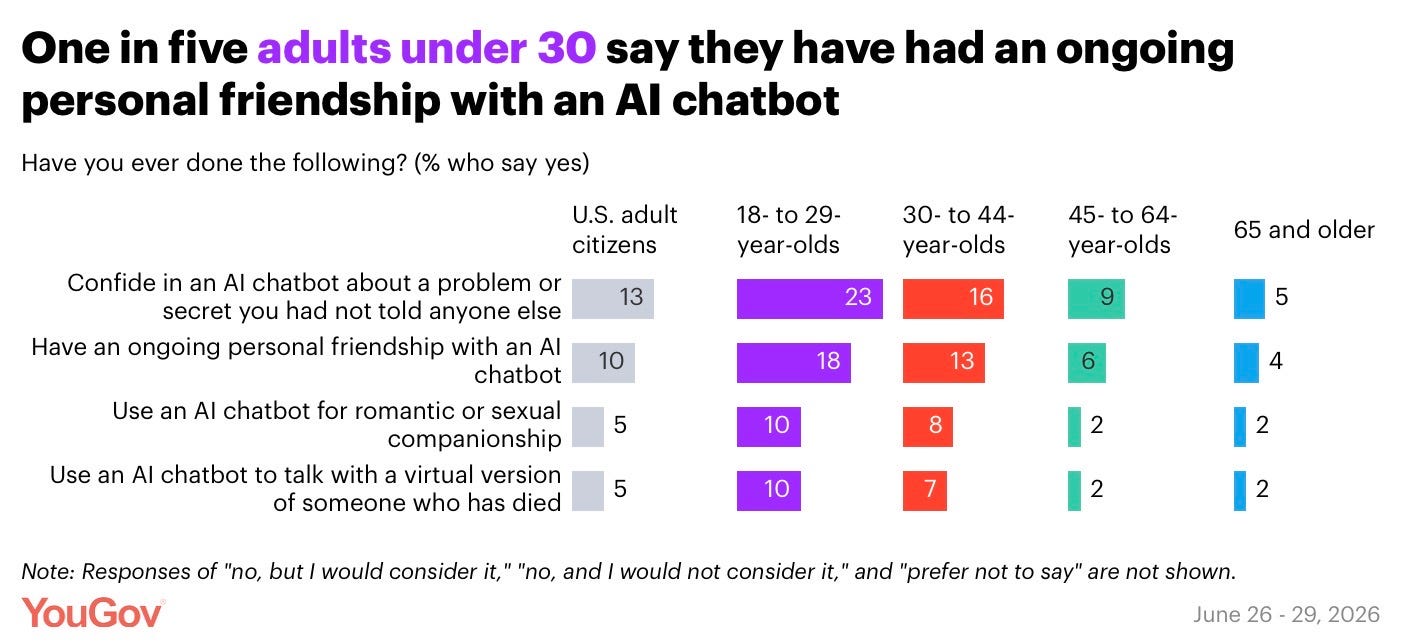
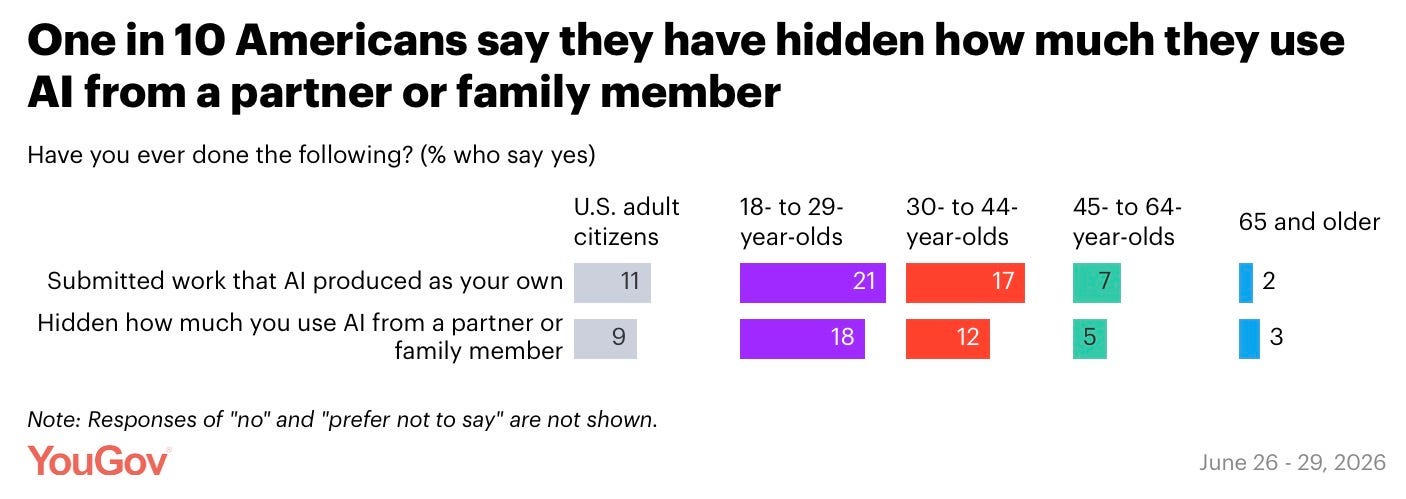
In YouGov, Jamie Ballard looks at how Americans are using artificial intelligence in increasingly personal ways. The survey, titled One in Five American Adults Under 30 Say They Have Had an Ongoing Personal Friendship with an AI Chatbot, finds that younger adults are especially likely to treat AI as more than a tool. The first two charts are the ones that matter most: one shows how many Americans have formed ongoing personal relationships with AI chatbots, and the other shows how many have confided secrets or problems to AI that they had not told anyone else.
Another Good Chart…
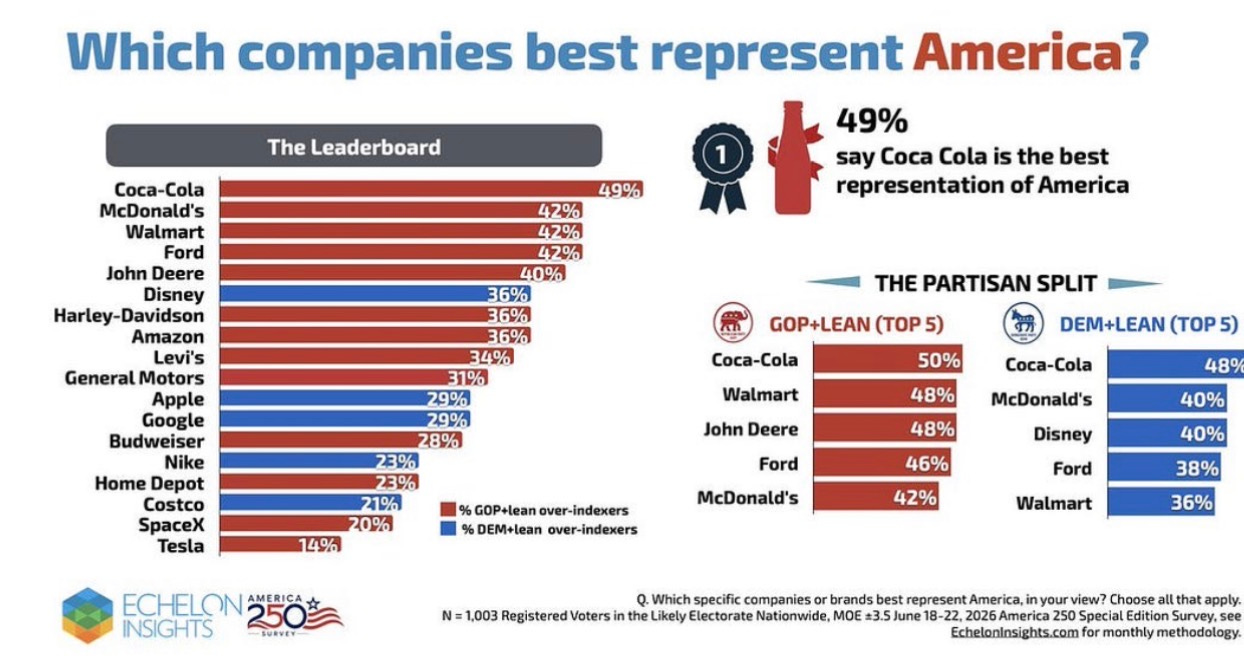
Coca Cola! Who knew?
One Long Form Read…
FORGET WORK — PASSIVE INCOME IS THE NEW AMERICAN DREAM
In The Wall Street Journal, reporter Joe Pinsker explores the growing American fascination with “passive income” and the belief that traditional careers no longer provide the financial security or personal freedom they once promised. Through stories of entrepreneurs selling oversized lint rollers, AI-generated Etsy products, licensed voice clones, and online retail schemes, Pinsker examines both the opportunities and pitfalls of the trend. The article distinguishes legitimate income streams from scams and unrealistic promises, while highlighting the economic anxiety driving many people to seek alternatives to the conventional 9-to-5. It is a thoughtful look at how technology, AI, and changing attitudes toward work are reshaping the modern American dream. Gift Link!
One Great Podcast…
HAPPY BIRTHDAY AMERICA: CELEBRATING WHAT IS EXTRAORDINARY ABOUT OUR GREAT NATION
In a special Independence Day edition of Verdict with Ted Cruz, Senator Ted Cruz reflects on the ideas, institutions, and values that he argues make the United States unique as the nation enters its 250th year. The episode revisits the courage of the Founding Fathers, the principles of the Declaration of Independence and Constitution, and the concept of American exceptionalism. Cruz also discusses civic education, patriotism, family traditions surrounding the Fourth of July, America’s alliance with Israel, and the role major events like the FIFA World Cup can play in fostering national unity. Running just under 43 minutes, it is a timely holiday listen for anyone reflecting on the American experiment. Link (To Apple Podcasts, You Can Find This On Your Fave App)
One Great Video…
WHAT’S AT RISK IN CALIFORNIA’S WEALTH TAX VOTE
On California Insider, host Siyamak Khorrami interviews Joshua Rauh, Stanford finance professor and Hoover Institution senior fellow, about California’s proposed one-time wealth tax on billionaires. Rauh argues the measure could accelerate the departure of founders, investors, and capital from the state, with consequences that reach far beyond the ultra-wealthy. He explains why some high-net-worth Californians are treating the proposal as a warning sign rather than a temporary tax.
Another Great Video…
CALIFORNIA JUST NEEDS BETTER LEADERSHIP FEAT. SEN. TONY STRICKLAND
On the State of Gold Podcast, host Jon Slavet interviews California State Senator Tony Strickland about the state’s political and fiscal challenges. Strickland argues that California is one leader away from prosperity, making the case for Steve Hilton, Proposition 36 funding, budget accountability, and a renewed Reagan-style optimism. The conversation covers population decline, public safety, the billionaire tax, and the broader fight over whether California can restore opportunity for the next generation.
On This Date… In 1776!
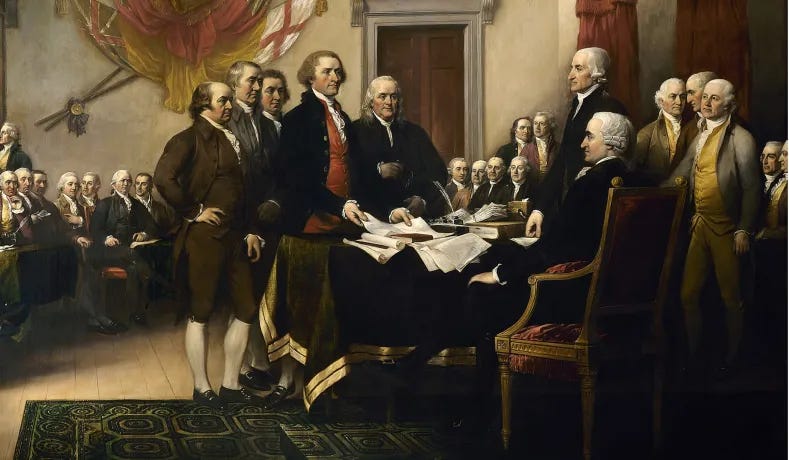
THE ADOPTION OF THE DECLARATION OF INDEPENDENCE!
A NATION IS BORN
On this day in history, July 4, 1776, the Continental Congress adopted the Declaration of Independence, announcing to the world that the thirteen American colonies were no longer subjects of the British Crown, but free and independent states.
The decision was anything but inevitable. For months, many Americans had hoped for reconciliation with Great Britain. But repeated disputes over taxation without representation, restrictions on colonial self-government, and what many viewed as abuses by King George III convinced the colonies that independence was the only remaining path.
Thomas Jefferson drafted the Declaration, drawing upon ideas that were revolutionary for their time but remain powerful today. The document declared that rights do not come from kings, politicians, or governments, but are endowed by the Creator. Governments exist to protect those rights and derive their authority from the consent of the governed.
The men who approved the Declaration understood the risks. Signing their names to the cause of independence could have cost them their property, their freedom, and their lives if the Revolution failed. Benjamin Franklin famously remarked that they must all hang together, or they would most assuredly hang separately.
Although most delegates signed the document in the weeks that followed rather than on July 4 itself, the date of its adoption became America’s birthday.
Two hundred and fifty years later, the Declaration of Independence remains one of the most influential political documents ever written. Its principles inspired movements for liberty around the world and continue to challenge Americans to preserve the freedoms that previous generations fought to secure.
The Declaration was not merely the beginning of a new nation. It was the beginning of an idea that free people can govern themselves.
This is a great fun video profiling the signers of the Constitution using AI — worth it, but a time suck! Good luck!
Happy Independence Day!
Jon