

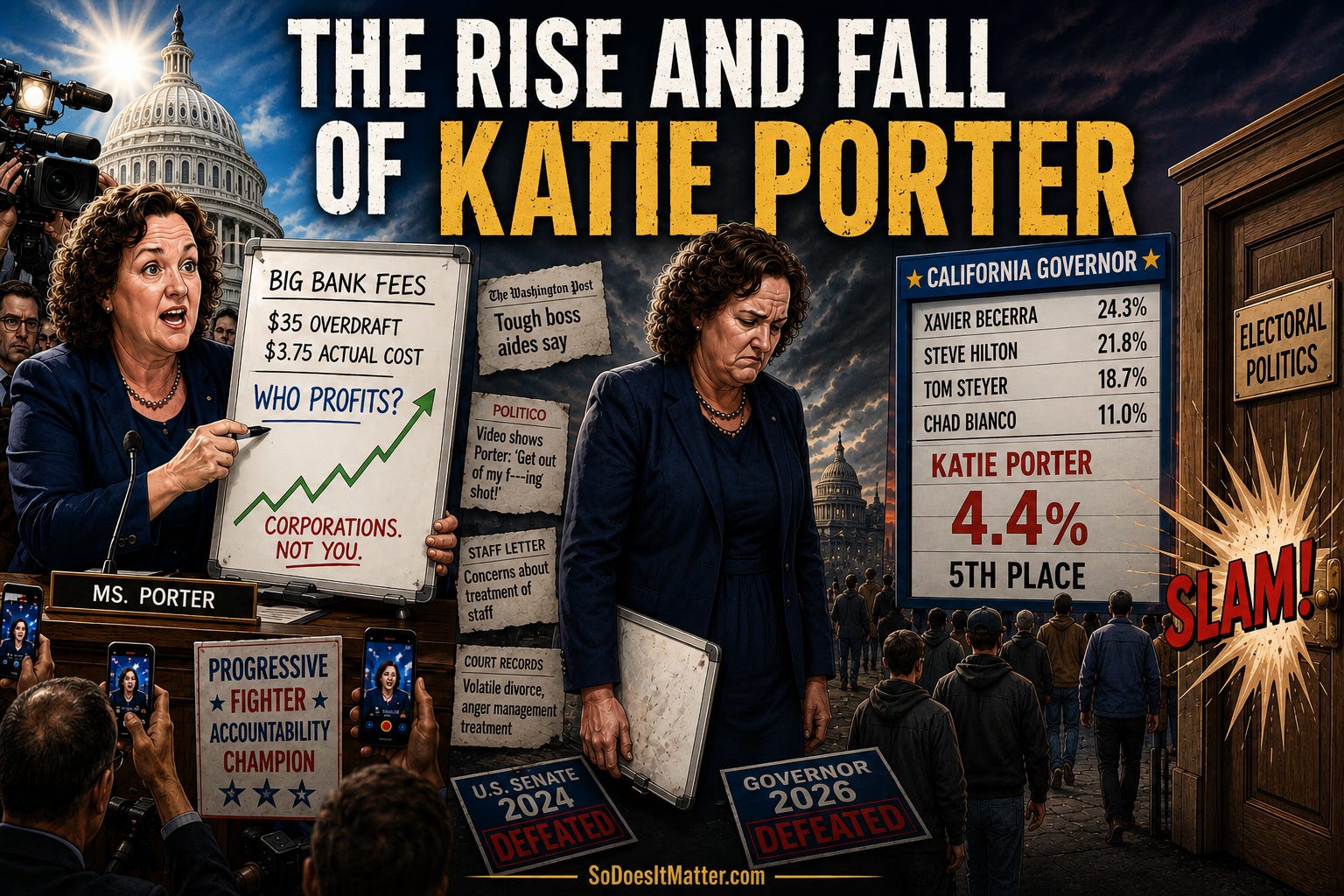
Katie Porter Says She Is Closing the Door on Politics. Voters Slammed It Shut.
How a whiteboard-wielding progressive superstar went from national celebrity to 4.4 percent of the vote.

Our morning content is free for all subscribers and guests! Usually our afternoon content is behind a paywall… If you are not yet a paid subscriber, consider upgrading — you are missing a significant portion of what we produce each week, and your support makes it possible. If you want to get it all and support my efforts, please consider a paid subscription! There is exclusive content below this column for paid subscribers…
Most of our content is available on our podcast feed. So, Does It Matter? SPOKEN. Which is available on your favorite podcast app. You can listen to it right here as well.
🕒 8-minute read
The Chronicles of Katie - From Boom To Bust

Katie Porter is done. Not just done running for governor. Not taking time to lick her wounds after finishing fifth with a humiliating 4.4 percent of the vote. As reported Friday by The Sacramento Bee, the former Orange County congresswoman and onetime progressive superstar now says she is closing the door on electoral politics altogether.
“I am closing the door on being a candidate,” Porter told the Bee. “I cannot foresee that path back.”
But here is the question: Did Katie Porter close the door on electoral politics? Or did California voters close it in her face?
It is a remarkable ending for a politician who, not long ago, seemed to have no shortage of paths forward. The whiteboard-wielding progressive darling flipped a Republican-held Orange County congressional seat, became a national fundraising phenomenon and turned congressional hearings into made-for-social-media performances. A protégé of Elizabeth Warren, Porter seemed destined for bigger things: the U.S. Senate, the governor’s mansion, perhaps beyond. For years, Porter’s national progressive celebrity was mistaken for statewide political strength. By the time California voters rendered their own verdict, those turned out to be two very different things.
As someone who has criticized Porter for years, I could simply say good riddance. But that would miss the real story. Republicans did not finally figure out how to end Katie Porter’s political career. We certainly tried. Scott Baugh came remarkably close.
Republicans did not retire Katie Porter.
California Democrats did.
And it did not happen overnight. The warning signs were there for years. To understand how one of the Democratic Party’s brightest progressive stars ended up with 4.4 percent of the vote, you have to start with how high she once climbed.
The Progressive Superstar
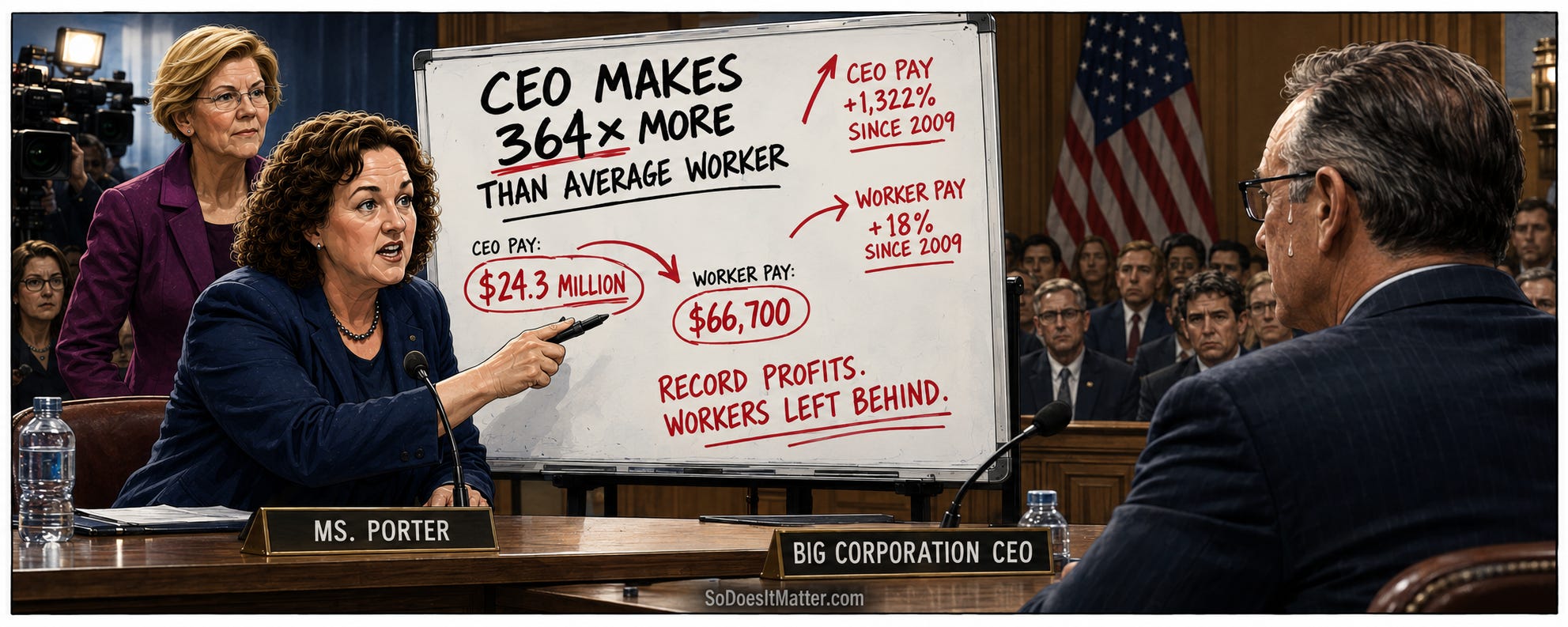
Katie Porter arrived in Congress in 2018 with a compelling biography. A UC Irvine law professor and protégé of Elizabeth Warren, she defeated Republican Rep. Mimi Walters in a historically conservative Orange County district and quickly became one of the Democratic Party’s most recognizable freshman members.
Her breakthrough came not from floor speeches or legislative dealmaking, but from congressional hearings. Armed with a whiteboard and an instinct for confrontation, Porter turned dry policy exchanges into viral political theater. She grilled corporate executives, bankers and Trump administration officials in clips tailor-made for social media, winning praise from progressives who saw her as unusually prepared, fearless and effective.
Porter built a national following and a formidable small-dollar fundraising base that gave her political reach far beyond Orange County. She won reelection in 2020 and increasingly looked less like a swing-district congresswoman and more like a future statewide candidate.
Conservatives, including me, saw something different. Porter was no moderate Democrat who happened to represent a competitive district. She came from the Elizabeth Warren wing of the party and embraced the politics that came with it. But whatever you thought of her ideology, there was no denying the trajectory.
Katie Porter was a rising star.
And rising stars usually start looking for a bigger stage.
Scott Baugh and the First Warning
The first real warning sign came in 2022. By then, Porter’s ambitions for higher office were hardly a secret. But before she could think seriously about running statewide, she decided that she first had to win reelection to Congress.
Enter Scott Baugh.
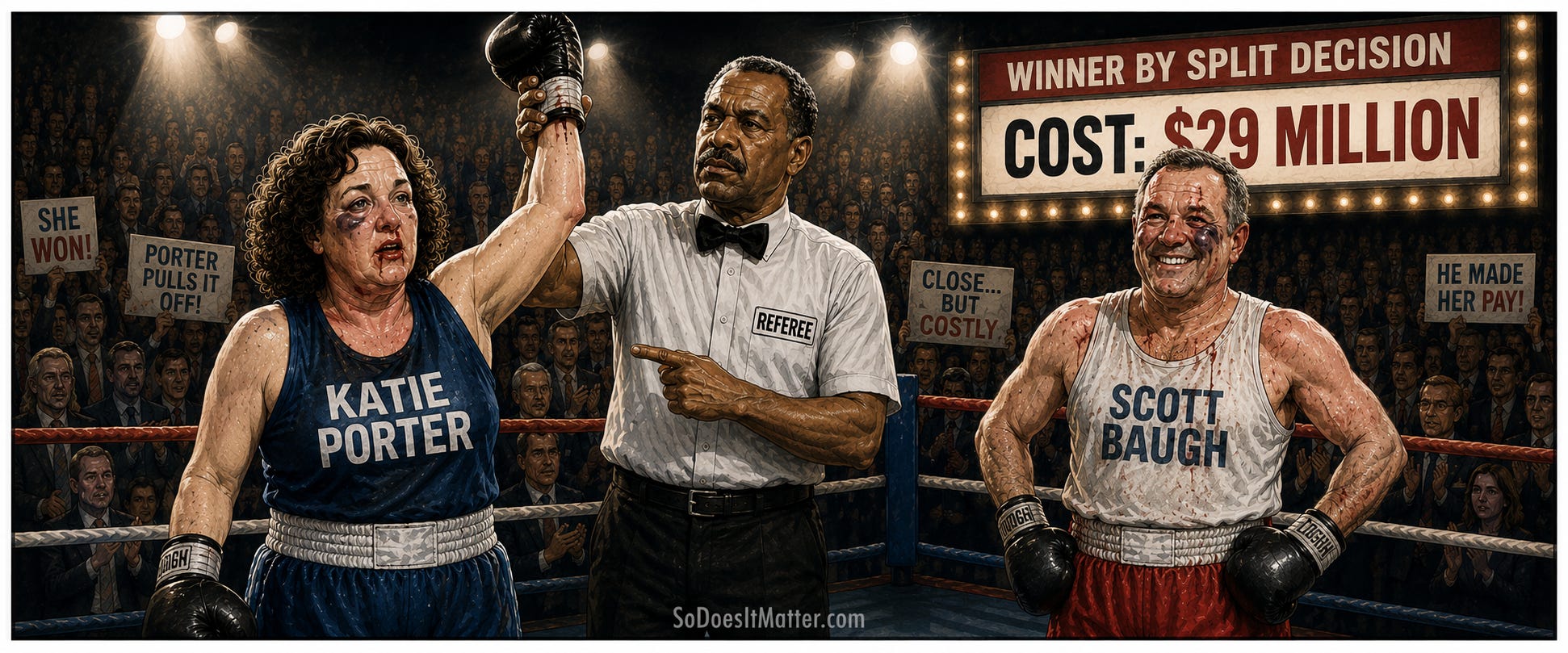
Baugh, a former Republican leader of the California Assembly and former chairman of the Orange County Republican Party, gave Porter a much tougher race than a nationally prominent Democrat with her fundraising prowess might have expected. Porter ultimately defeated him, but barely: 51.7 percent to 48.3 percent, a margin of just 9,113 votes.
And it cost her dearly.
Porter’s campaign spent nearly $29 million during the 2021-22 election cycle, an extraordinary sum for a House campaign. Baugh’s campaign spent only a fraction of that amount, though outside spending also poured into the race. Porter survived, but the victory came just as she was preparing for the vastly more expensive proposition of running statewide in California.
She was not broke. Porter still had more than $7 million in campaign cash at the end of 2022. But she had just been forced to deploy an enormously expensive political operation to win another term in Congress by three points, just as she was preparing to make the leap into statewide politics.
In retrospect, perhaps everyone should have paid more attention to what Scott Baugh had just accomplished. Porter was still a national progressive celebrity and fundraising powerhouse.
But for the first time, the distance between Katie Porter’s national political profile and her actual appeal to voters was becoming difficult to ignore. Campaigns have a way of exposing weaknesses that media attention can conceal. Scott Baugh did not end Katie Porter’s rise. He exposed how much more fragile it was than many people realized.
The Senate Gamble

Two months after surviving Baugh, Porter made her move. In January 2023, even before Sen. Dianne Feinstein announced her retirement, Porter jumped into the race for her U.S. Senate seat. She gave up the relative security of Congress and bet her political future on winning statewide.
Porter remained a formidable fundraiser, ultimately bringing in more than $30 million for the Senate effort (but had she retired from Congress and not faced Baugh, she would have had twice that amount). But Adam Schiff entered the contest from a much stronger financial position. While Porter had just spent heavily defending her House seat, Schiff had cruised through a safe-seat reelection and accumulated a massive war chest. By the closing weeks of the primary, Schiff had roughly a two-to-one advantage in television advertising.
Schiff outplayed her. California’s top-two primary meant his biggest threat was not Republican Steve Garvey. It was Porter. Schiff flooded the airwaves with ads ostensibly attacking Garvey, knowing that raising the former Dodgers star’s profile among Republican voters could help propel Garvey into the November runoff and knock Porter out. Schiff finished first with 31.6 percent, Garvey took 31.5 percent, and Porter finished a distant third with just 15.3 percent.
Porter had gambled her House seat and lost. Giving up an office you already hold is one of the biggest gambles in politics. Winning can launch a career. Losing often ends one. She was not going to the Senate, and she was not going back to Congress.
Her immediate reaction did her few favors. Porter complained about “billionaires spending millions to rig this election,” language she later clarified was not an accusation of voter fraud. The progressive star who had entered the race expecting to compete with Schiff had been outspent, outmaneuvered and eliminated.
Still, Porter was not ready to leave the stage.
Then the Cameras Turned Around
Porter built her national reputation in front of cameras. Put a corporate executive or government official in the witness chair, pull out the whiteboard and start asking pointed questions. Porter controlled the exchange, and millions watched the resulting clips online.
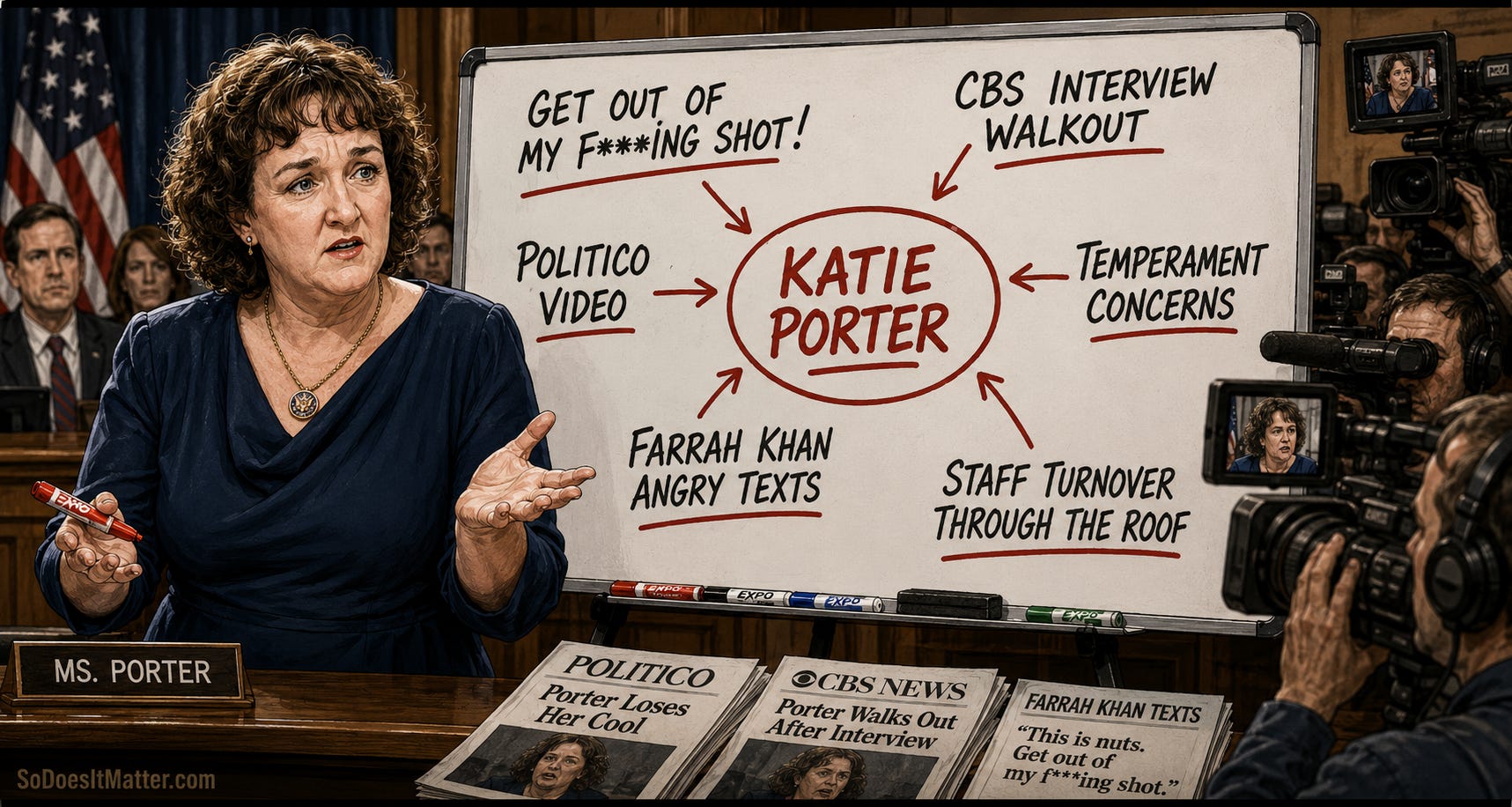
But there had long been signs of another side to her confrontational style. Former staffers described difficult experiences working for her, and a 2023 Washington Post examination aired concerns about her management style. Her congressional office experienced higher-than-average staff turnover in all but one year. In one remarkable text exchange with then-Irvine Mayor Farrah Khan, Porter declared, “I am a United States Congresswoman,” before warning, “You can lecture me on professionalism. And see what happens.”
Then came something worse. Politico published previously unseen video from 2021 showing Porter during an online event telling a staffer who briefly entered the frame, “Get out of my fucking shot!” followed by, “Stay out of my shot.”
The complaints about Porter’s temperament were no longer merely stories from former employees or attacks from political opponents. Voters could watch her behavior and decide for themselves. Porter later acknowledged that she “absolutely could have done better.”
Thirty current and former staff members eventually signed a public letter defending Porter. But it was too little, too late. Viral videos are hard to unsee.
There was other baggage. Court records from Porter’s contentious divorce described an extraordinarily volatile marriage, with allegations on both sides and an incident in which Porter threw hot mashed potatoes at her then-husband. Both sought help for anger management. The details are messy and should not be overstated, but they added to a picture that was becoming increasingly difficult for Porter to escape.
For years, Porter’s critics had been telling voters something about Katie Porter.
Now they did not have to.
They could press play.
The Comeback That Wasn’t

Porter did not respond to her Senate defeat by stepping back. She ran for governor, presenting herself as the same unapologetic progressive who had first made her famous. Her platform included abolishing ICE, moving California toward single-payer health care, free child care and tuition-free public universities. She was not trimming her ideological sails.
But the temperament issue followed her directly into the race. In October 2025, Porter bristled during a CBS interview when asked how she planned to appeal to Californians who had voted for Donald Trump. “I don’t want to keep doing this,” Porter said. “I’m going to call it.” She ultimately continued the interview, but the exchange went viral and handed her critics more ammunition.
Democratic opponents openly questioned her fitness to lead, and her campaign spent months trying to repair damage that had already been done. Porter even tried humor, releasing an ad that played off the infamous “get out of my shot” video.
It did not work.
By then, the campaign had stopped being about Katie Porter’s agenda. It had become a referendum on Katie Porter herself.
Porter had once been considered one of the leading candidates for governor. By the June 2026 primary, she had collapsed to 4.4 percent, finishing fifth behind Xavier Becerra, Steve Hilton, Tom Steyer and Chad Bianco. A politician who had once commanded national attention and raised enormous sums from progressive donors could barely register with California voters.
Porter offered explanations. She argued that the election was unusual, that Democratic voters were making strategic choices and, repeatedly, that criticism of her temperament was shaped by sexism. She told LAist that she could not remember the word “temperament” being used against a male candidate.
But by then, the campaign had become less about the future Porter was promising and more about the candidate voters thought they already knew.
And when California Democrats finally had the chance to judge Katie Porter for the state’s highest office, almost all of them chose someone else.
So, Does It Matter?
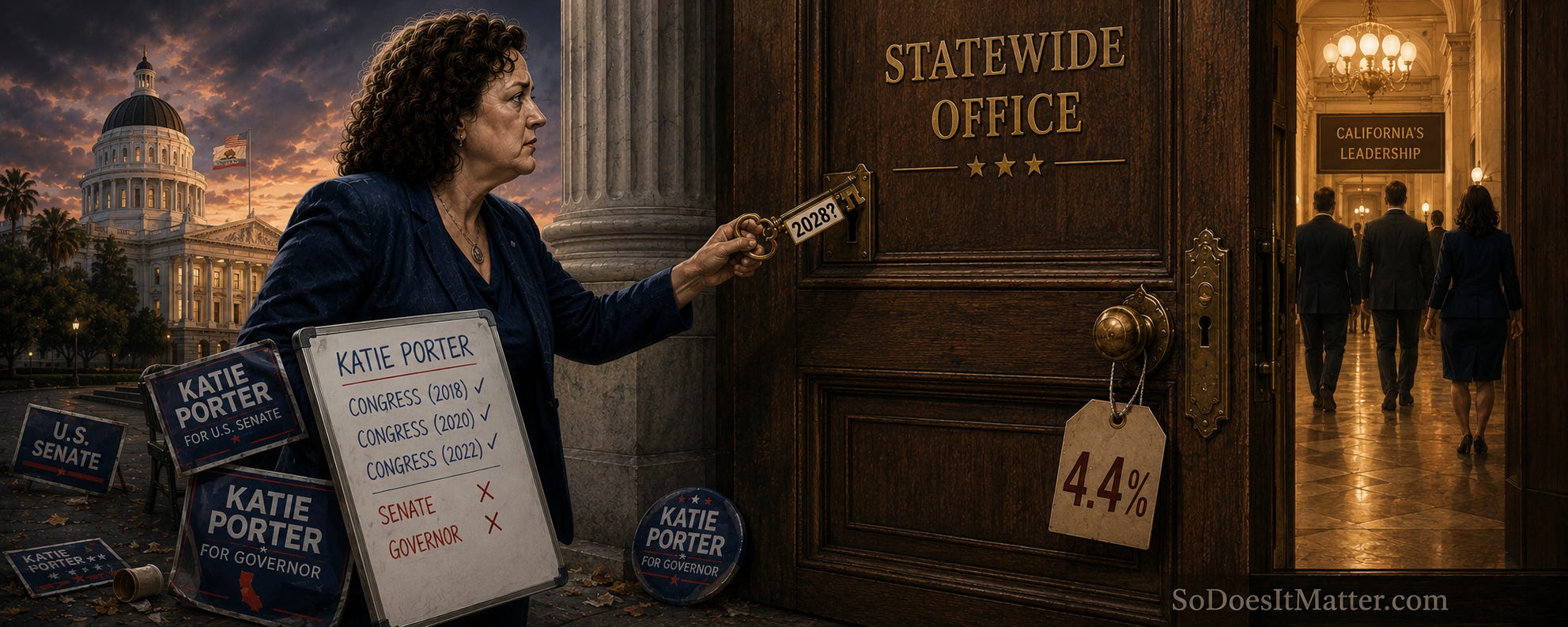
Which brings us back to Porter’s declaration that she is “closing the door” on being a candidate.
In explaining her political demise, Porter offered perhaps the most revealing line of all: “I don’t know what I could have said or done other than be a man.”
Really?
She could have treated people around her differently. She could have answered a reporter’s entirely predictable questions without threatening to end the interview. She could have refrained from telling an employee to “get out of my fucking shot.” She could have avoided sending an elected mayor messages reminding her, “I am a United States Congresswoman,” followed by, “You can lecture me on professionalism. And see what happens.”
None of that required Katie Porter to become a man.
Women in politics can face double standards. But sexism is not a magic eraser. It does not erase Porter’s own words, her own behavior or the videos millions of voters could watch for themselves.
Conservatives like me spent years warning voters about Katie Porter’s politics. We opposed the progressive agenda, the Warren-style economics and, eventually, a gubernatorial platform that included abolishing ICE and moving California toward single-payer health care. We also saw a politician whose national celebrity increasingly seemed out of proportion to her actual appeal to voters.
Scott Baugh forced her to spend nearly $29 million to survive by three points. Porter then gambled her House seat on a Senate campaign and lost. Adam Schiff outspent and outmaneuvered her. The stories about her temperament piled up. Then came the videos. Given one last chance to reinvent herself in the governor’s race, she finished fifth with 4.4 percent.
That is not sexism. That is a political career collapsing under the weight of bad decisions, bad behavior and, ultimately, voter rejection.
And here is the part Porter still seems unwilling to confront: Republicans did not do this to her. Conservatives did not do this to her. Donald Trump did not do this to her.
California voters did - mostly of her own party.
So when Katie Porter says she is now “closing the door” on being a candidate, perhaps she has the sequence of events backward.
The voters slammed it shut.
That woman is an abomination. She's NO LADY and she makes all women look bad. I am embarrassed that she is from California. I hope that she just fades into private life. I pity her children. She is NOT a good role model with that mouth and her attitude.