



This Saturday feature, which is a labor of love for me, is packed with amazing content. It’s very popular. For those of you who subscribe ($70/year, $7/month), this column is a thank-you for your support of my independent work. There are a couple of items above the paywall worth reading/watching. But that is the tip of the iceberg. SO MUCH more under the paywall.
THANK YOU for being part of this project and for putting a spotlight on California politics!
Jon’s Saturday Mini Column
HOW CALIFORNIA COULD COUNT VOTES FASTER: REQUIRE MAIL BALLOTS BY ELECTION DAY
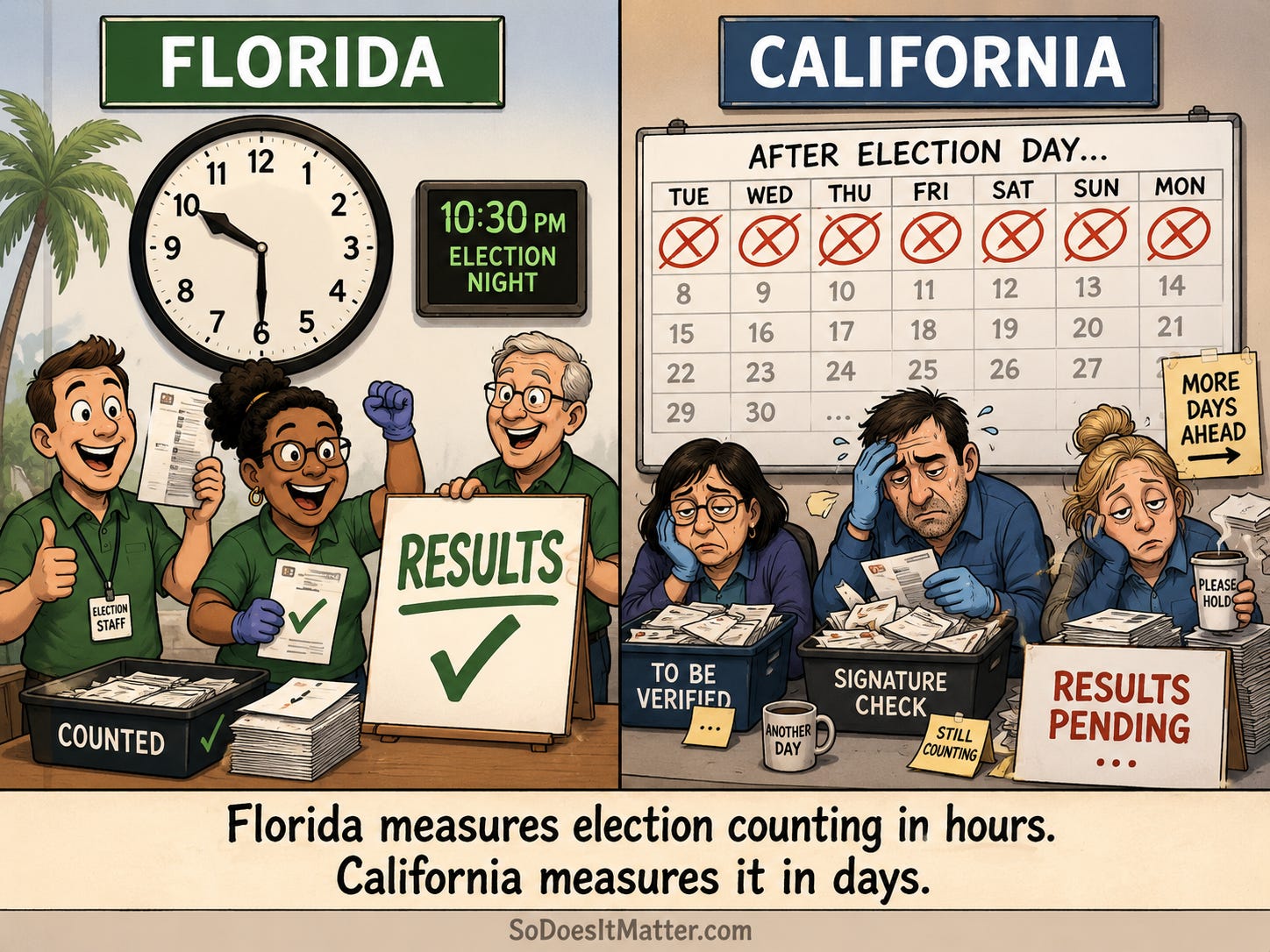
The New York Times’ Bayliss Wagner asked a very good question this week: Why can Florida count most of its ballots within hours while California can take days — sometimes weeks — to finish? There are several reasons, but one stands out because it is so easy to fix: Florida requires mailed ballots to be received by Election Day. California does not. Here, a ballot can be postmarked on Election Day and still be counted if it arrives up to seven days later. That guarantees delay.
California election officials can process mail ballots before Election Day, just as Florida does. But they cannot count ballots they do not yet have. When large numbers of voters wait until the last minute to mail or drop off ballots, county election offices spend days after the election receiving, verifying and processing them. Wagner notes that roughly a third of Floridians vote by mail, so this is not simply a story about Florida relying heavily on in-person voting. Florida has mail voting. It just has a deadline that makes sense.
California should adopt the same rule: If you want to vote by mail, your ballot must be in the hands of election officials by the time polls close. That would not eliminate every delay. California still has signature verification, provisional ballots and other administrative issues. But it would remove one of the biggest built-in causes of late counting.
There is also a larger issue here: public confidence. When election results dribble out for days, sometimes reversing leads along the way, voters understandably become suspicious — even when nothing improper is happening. Fast counting is not merely convenient. It makes elections easier to understand and harder to distrust. Florida learned that lesson after 2000. California should learn it now.
(Gift link to NY Times story.)
Reading/Watching/Listening Recommendations!
AB 1383 IS A COSTLY PENSION MISTAKE IN THE MAKING
Former State Senator John Moorlach, writing for the California Policy Center, warns that AB 1383 could repeat one of Sacramento’s most expensive pension mistakes. The bill would boost retirement benefits for public-safety employees while reducing what workers must contribute, shifting more costs to taxpayers and local governments. Moorlach draws a direct line to SB 400, the 1999 pension expansion whose costs exploded far beyond promises, arguing California lawmakers are preparing to make essentially the same mistake again, with taxpayers paying.
FIVE CALIFORNIA PROPOSITIONS ASK THE SAME QUESTION: WHO SHOULD PAY BILLIONS IN TAXES?
Dan Walters, writing for CalMatters, surveys five major tax measures on California’s November ballot and shows how each reflects a larger fight over who should finance government. The proposals range from Proposition 40’s billionaire wealth tax and Proposition 3’s permanent surtax on high earners to measures designed to blunt those taxes or make local tax hikes harder to pass. Walters provides a useful roadmap to the competing tax philosophies voters will confront — and the enormous sums ultimately at stake.
Want More?

OK, this column is like an iceberg. You can see 10% of it above the waterline. Below the paywall is SO MUCH MORE. I curate a BUNCH of articles, a great chart, a great video, a great long-form story, and much more. And what famous moment in California political history happened on this day in 1968?
There’s a free trial - try it out and read all kinds of stuff, curated as a special thank you to our hundreds of paid subscribers!
