

Jews Are A People. The State Still Shouldn’t Classify Us.
California has found another group that doesn’t fit its official categories. Maybe it is time to rethink the categories.

Typically, our afternoon content is behind a paywall — or there is something extra for our paid subscribers. If you are not one, please consider upgrading. You are missing a significant portion of what we produce each week, and your support makes it possible. If you want to get it all and support my efforts, please consider a paid subscription!
You can listen to this content on our Podcast — So, Does It Matter, Spoken! - on your favorite podcast app. Or you can just go listen here.
🕒 5-minute read
Start With The Truth
Yesterday, the New York Times published an article by Yair Rosenberg, “Who Is a Jew? California Considers a Small Box With Big Implications.” (I paid for a New York Times subscription so you don’t have to—this is a gift link.)
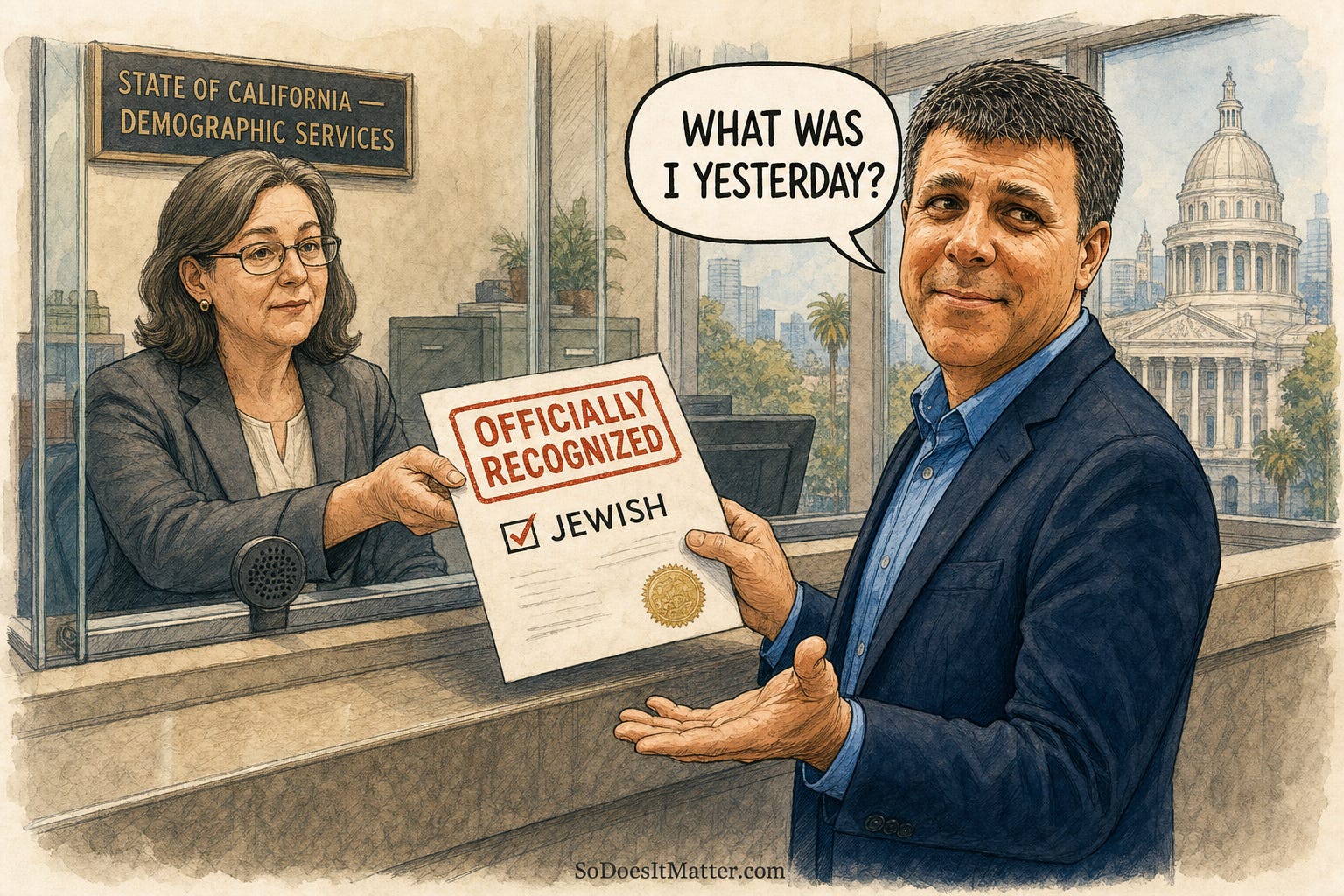
The article concerns California Senate Bill 1387, which would add Jewish identity to demographic forms that already ask about ancestry or ethnicity. As I read it, I kept going back and forth. The problem Rosenberg describes is real, but I am not persuaded that the bill is the right answer.
Jewishness has never fit comfortably into the categories Americans use for identity. I am Jewish whether or not I attend synagogue regularly and regardless of how I answer a question about religious belief. Judaism is a religion, but being Jewish also connects someone to a people, a history and, for many of us, an ancestry.
Antisemites have rarely limited their hatred to observant Jews. Supporters of SB 1387 are right to say that treating Judaism exclusively as a religion leaves out much of what Jewish identity means.
Rosenberg writes that supporters hope the new checkbox will “break Jews out of the box.” I understand the appeal. I am less comfortable with what happens once the state creates the box.
Why The Bill Is Tempting
Under the current version of SB 1387, agencies that already collect information about ancestry or ethnic origin would have to offer a separate Jewish category. The bill also changes provisions dealing with education, corrections, disability benefits, and family leave.
This is not a secret effort to compile a list of Jews. The information is self-reported, personally identifying information is designated confidential, and published data would be aggregated. Supporters believe better information could help California measure antisemitism, identify health concerns, and determine whether Jews are being overlooked by public programs.
Within the system California already has, their argument is reasonable. If government studies nearly every community through demographic data, leaving Jews out can make us statistically invisible. Some Jews will see the new category as overdue recognition, and I cannot fault them for that.
My hesitation begins further back. I am not sure government should be sorting people into so many categories in the first place. Adding Jews may correct an omission while making the larger system more entrenched.
When The Question Fits
Some demographic information serves an obvious purpose. Police should record whether a crime was motivated by hatred of Jews. Civil rights agencies need sufficient information to investigate discrimination. Doctors sometimes need to know about a patient’s ancestry.
In those cases, the reason for asking is clear. The connection becomes harder to see when someone applying for disability or family-leave benefits is asked to identify as Jewish simply because the state already collects other demographic information.
The medical argument is also more complicated than it sounds. Ashkenazi, Sephardi, Mizrahi, Ethiopian, and other Jewish populations do not have identical health histories. A general Jewish category might produce numbers without telling researchers very much.
There is also the ordinary tendency of government information to take on new purposes. Agencies compare outcomes, legislators react to disparities, and advocacy groups use the numbers to argue for policies. That may be entirely appropriate in a particular case. It is still a reason to ask what the state intends to learn before requiring the information across multiple programs.
A limited survey designed to answer a specific question may be more useful than adding the same category wherever ethnicity is already collected.
The Part That Bothers Me
I do not think the sponsors of SB 1387 are acting in bad faith. They see a community facing hostility and want the state to accurately recognize it. I appreciate that intention.
Still, I am uneasy when the government asks Jews to identify ourselves in its databases, even for benign reasons. Some of that unease comes from history, but there are practical questions too. Records are often kept longer than expected, and information gathered by one agency can eventually be connected to information held by another.
The bill makes personal information confidential, which is important. It says less about how long records may be retained, whether agencies may link them across systems, or how small a reported group may be before aggregation ceases to provide meaningful anonymity.
Lawmakers could add stronger safeguards. That would improve the bill, although it would not settle my underlying concern about making Jewish identity part of the state’s ordinary demographic system.
I do not want California to treat Judaism as nothing more than a private faith. I also do not think official classification is necessary to acknowledge Jewish peoplehood. My identity as a Jew does not require Sacramento’s confirmation.
So, Does It Matter?
California has other ways to address the problems identified by the bill. It can prosecute antisemitic crimes and enforce laws against discrimination. When officials need reliable population data, they can commission anonymous research directed at the particular question. Medical researchers can ask about the ancestry relevant to the condition they are studying.
That approach would require the state to explain why it needs sensitive information and to collect only what serves that purpose. It would also leave room for people whose identities do not fit neatly into a government category—which, if we are honest, is most of us.
I can remain fully Jewish, attached to my people, our history and our traditions, while asking the government to deal with me as an individual citizen. Equal treatment does not require anyone to flatten the private and communal parts of life that matter most.
The long-term policy should be to rely less on racial and ethnic boxes, not to keep adding new ones until every American has been assigned a more precise official identity.
California does not need a special box for Jews. It should start moving away from the boxes it already uses. If the government insists on giving its citizens one box to check, I would rather it simply say “American.”