

Issue Tool Kit: Nine Ways California’s Climate Agenda Is Driving Up the Cost of Living
Sacramento’s energy policies are quietly driving up the cost of gasoline, electricity, and everyday life

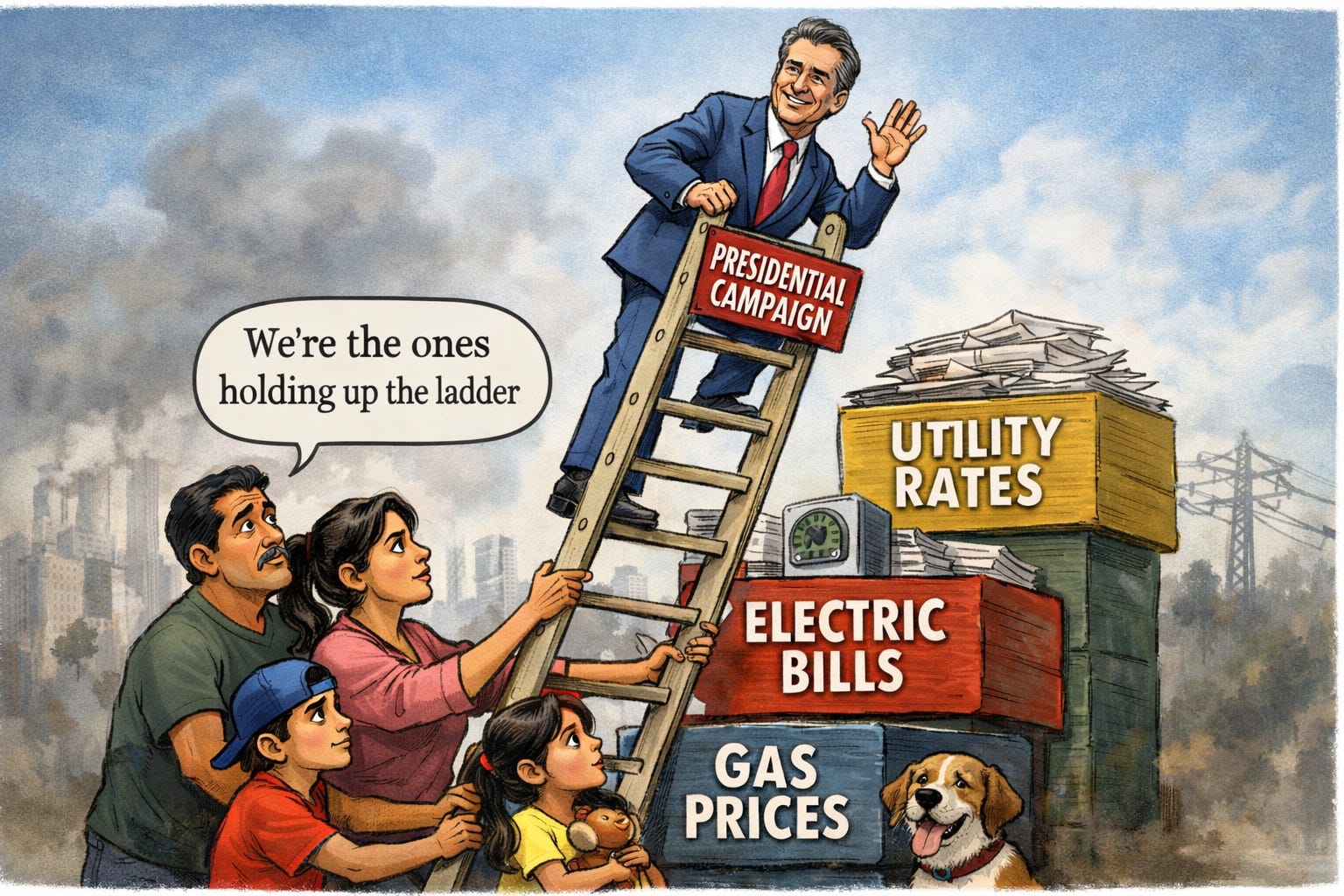
Normally, this column would have a teaser and then a paywall break, as afternoon content. But since this ran without a paywall on the California Globe this morning, we present it in full here. For paid subscribers, under the paywall, are three runner-up cartoons that could have been atop this column!
All of our written content here can also be heard on our podcast stream — “So Does It Matter? Spoke” — which you can find on your favorite podcasting app. Or just go here.
Climate Policies: Making Things A Lot More Expensive
November, Governor Gavin Newsom, playing faux President, traveled to the United Nations climate summit in Belém, Brazil, where he declared that California’s climate policies prove environmental leadership and economic prosperity can go hand in hand. His message was simple: California’s aggressive climate agenda is making life more affordable for the people who live here.
Claims like this make it worth examining how California’s climate policies affect the cost of living in our state. Energy powers transportation, agriculture, manufacturing, and the electricity that keeps our homes running. When policymakers deliberately make energy more expensive, those costs ripple through the entire economy.
Energy analyst Alex Epstein has argued that cheap, plentiful energy is the lifeblood of modern civilization. If that is true—and it clearly is—then policies that deliberately restrict affordable energy sources inevitably make everyday life more expensive. California’s climate agenda does exactly that.
Here are nine ways California’s climate agenda is driving up the cost of living.
1. HIDDEN ENERGY TAXES
Programs such as Cap-and-Trade (which Governor Newsom has now rebranded “Cap and Invest”) and the Low Carbon Fuel Standard effectively function as taxes on energy. Major carbon emitters—including refineries, electricity producers, industrial facilities, and fuel suppliers—must purchase emissions allowances to comply with state regulations.
Those compliance costs ultimately flow through the economy as higher gasoline prices, higher electricity costs, and higher prices for goods and services. Analysts estimate California’s carbon pricing system alone adds roughly 23 to 26 cents to the price of every gallon of gasoline, while the state’s environmental fuel programs combined add more than fifty cents per gallon.
2. DELIBERATE RESTRICTIONS ON ENERGY SUPPLY
Many of California’s climate policies are designed to discourage the use of fossil fuels, which remain the most affordable and reliable energy sources available today. Nowhere is that clearer than in the steady contraction of the state’s oil-refining capacity. Two major California refineries have announced closures: the Phillips 66 refinery in Wilmington (Los Angeles) and Valero’s refinery in Benicia, which is expected to shut down in 2026.
Together, those facilities account for roughly 17–20 percent of California’s gasoline refining capacity. When refineries disappear, gasoline demand does not disappear with them. As energy analyst Alex Epstein has argued, policies that restrict affordable energy inevitably raise costs throughout the economy.
3. HIGHER ELECTRICITY PRICES
California already has some of the highest electricity prices in the United States. Economist Wayne Winegarden has documented that residential electricity prices in California are roughly 46 percent higher than the national average, while business electricity prices are about 69 percent higher.
These higher prices are largely the result of climate-driven energy mandates—renewable portfolio standards, carbon pricing programs, and electrification policies—that force utilities to replace cheaper sources of power with more expensive alternatives. Winegarden has also estimated that if California households paid electricity prices closer to the national average, the typical household could save roughly $500 per year on electricity alone.
4. LONG-TERM COSTS FOR HOUSEHOLDS
The financial consequences of California’s climate agenda may not always appear immediately in a single year’s utility bill, but over time they accumulate in significant ways. Once again, we turn to economist Wayne Winegarden, whose research estimates that California’s mandated transition to its current clean-energy system could cost households between roughly $17,000 and $20,000 over the coming decades.
Those costs stem from replacing conventional power plants with renewable generation, expanding transmission infrastructure, electrifying transportation and buildings, and investing in battery systems. Utilities ultimately recover these capital costs through higher electricity rates.
5. LAYERS OF ENERGY REGULATION
California’s energy system is governed by a dense web of overlapping mandates. Renewable portfolio standards, carbon pricing programs, electric vehicle mandates, electrification requirements, and fuel regulations all operate simultaneously.
One example is California’s requirement for a unique CARB gasoline formulation, often called the “California blend.” Because this specialized fuel is produced primarily inside the state, it limits the ability to import gasoline from other markets when supplies tighten. Analysts estimate the requirement adds roughly 10–15 cents per gallon to the cost of gasoline while also making the state more vulnerable to price spikes when refinery capacity is lost.
6. DRIVING INDUSTRY OUT OF CALIFORNIA
Energy-intensive industries—from manufacturing to heavy industry—struggle to remain competitive when electricity and fuel prices are dramatically higher than in other states. Increasingly, companies are choosing to expand elsewhere rather than operate under California’s high-cost regulatory environment.
Several high-profile relocations illustrate the trend: Chevron moving its headquarters from San Ramon to Houston, Tesla shifting its headquarters from Silicon Valley to Austin, and technology giant Oracle relocating from Redwood City to Texas. When companies relocate, the jobs, investment, and tax revenue often move with them.
7. DEPENDENCE ON INTERMITTENT ENERGY
Wind and solar power can contribute electricity to the grid, but they cannot provide power continuously on their own. Solar panels generate electricity only when the sun is shining, and wind turbines only when the wind is blowing. In practice, these sources operate at far lower utilization rates than conventional power plants. Solar power in California typically produces electricity only about 25 percent of the time over the course of a year.
Because electricity demand does not disappear when the sun sets or the wind dies down, the grid must maintain backup generation—usually natural gas plants—or rely on battery systems that typically provide only a few hours of backup power. Maintaining these parallel systems increases the overall cost of producing electricity.
8. DISPROPORTIONATE COSTS FOR WORKING FAMILIES
Higher gasoline and electricity prices function like regressive taxes, placing the heaviest burden on people who can least afford them. While wealthy households may barely notice rising energy costs, commuters, small businesses, and working families feel the impact immediately.
Economists measure this through what is known as “energy burden”—the share of household income spent on energy costs. Research from the American Council for an Energy-Efficient Economy shows that the typical U.S. household spends about 3 percent of its income on energy, while low-income households spend roughly 8 to 9 percent, nearly three times as much.
9. HIGH COSTS FOR LITTLE GLOBAL IMPACT
California’s climate policies are often presented as if they will significantly influence the trajectory of global climate change. California’s emissions represent only a tiny fraction of the world’s total. Even if the state eliminated all its greenhouse-gas emissions tomorrow, the effect on global temperatures would be essentially undetectable.
California accounts for roughly 1 percent of global greenhouse-gas emissions. That reality highlights the central tradeoff in the state’s climate agenda: Californians are being asked to absorb higher energy prices and a higher cost of living for policies that have only a marginal impact on global emissions trends.
So, Does It Matter?
Energy policy is economic policy. When the price of energy rises, it affects nearly every aspect of daily life—from grocery prices to housing costs to the electricity bills families pay every month.
Governor Gavin Newsom may prefer to present California as a model for the rest of the country as he tests the waters for a presidential run. But the nine facts outlined above are inconvenient truths he will have to confront on the campaign trail, as he explains to voters across America why the state he governs costs so much more to live in than almost anywhere else in the country.
