

In California, One Party Rule Means One-Sided Housing Policy
New survey shows Democrat control of state government has led to a housing policy out of line with a majority of Americans...


Our morning content is free for all subscribers and guests! You can also listen to this post — along with my California Post column — on our podcast feed, So, Does It Matter? SPOKEN. It’s available on your favorite podcasting app, or you can find it here.
⏱️ 4-min read
Policy Driven By Power, Not Preference
California’s housing crisis isn’t only about supply. It’s about who gets to decide how people live. For years, Sacramento has advanced a specific vision: denser housing near transit, with smaller units and less space. That vision has not emerged from market demand; it has been imposed through policy.
That is the predictable result of one-party governance. When a single political party controls the Legislature, the Governor’s office, and most major local governments, competing views are not reconciled; they are sidelined. Policy stops reflecting broad public preference and begins to reflect the priorities of those in power.
A Majority Preference Ignored
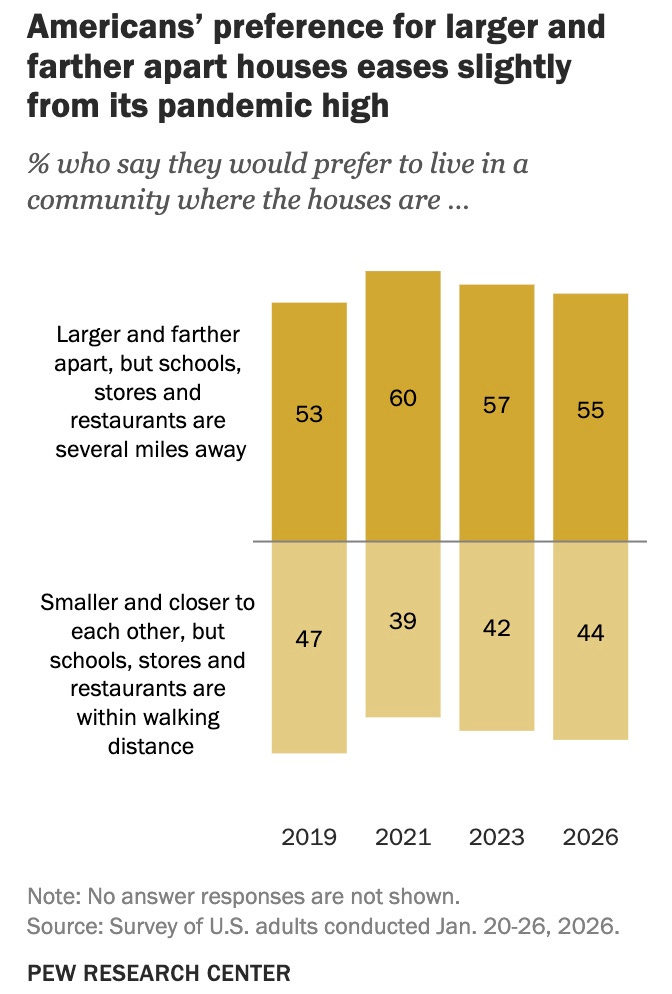
New data from the Pew Research Center underscores how wide that gap has become. Americans were asked whether they prefer larger homes in more spread-out communities, even if that requires driving, or smaller homes in denser, walkable areas. The result was decisive.
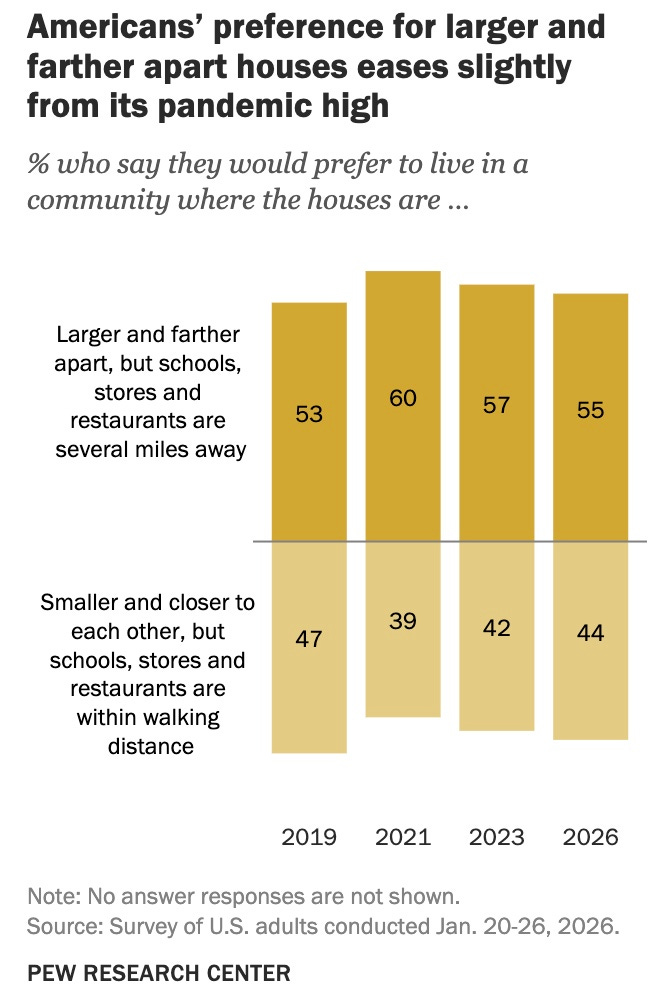
A majority, 55 percent, prefer larger homes in less dense communities, while only 44 percent favor denser, walkable living. This preference has remained consistent for years, before and after the pandemic, making it a stable majority view. California policy is moving in the opposite direction.
State lawmakers have spent years promoting high-density development near transit, overriding local zoning and accelerating approvals for multi-story housing in areas not designed for it. The objective is not just to increase supply, but to reshape how people live. That shift reflects a policy choice rather than a response to consumer demand.
The Partisan Divide Driving Housing Policy
That approach is reflected in laws like SB 79, which fast-tracks high-density housing near transit while leaving broader barriers intact. The partisan divide in the data makes that objective clearer. Among Republicans, 71 percent prefer larger, lower-density communities, while Democrats tilt toward denser, walkable environments.
This reflects fundamentally different preferences about how communities should be organized. In California, only one side of that divide governs. Because California’s policymakers are overwhelmingly Democratic, housing policy has been shaped around the preferences of Democratic voters, dense, urban, transit-oriented development, precisely the model the survey shows they favor.
At the same time, the state has preserved, and in many cases expanded, the barriers that make it difficult to build the kind of housing a majority prefers: single-family, lower-density homes. CEQA litigation, layered permitting, high-impact fees, and labor mandates continue to constrain supply where demand is strongest. This is not a neutral policy outcome; it is a directional one.
So, Does It Matter?
Geography reinforces the point. Urban residents are more likely to prefer density, while suburban and rural residents favor more space and less crowding. Even in suburban areas, a majority still leans toward lower-density living.
Yet California’s housing mandates increasingly extend beyond urban cores into suburban communities, requiring higher-density development near transit corridors regardless of local preference. That is not a response to demand, it is a substitute for it. None of this denies the severity of California’s housing shortage, as the state clearly needs more homes.
But increasing supply does not require prescribing a single model of living, nor leaving in place the cost drivers that have made housing prohibitively expensive. Instead of broad reform, reducing regulatory burdens, streamlining approvals, and allowing different types of housing to compete, Sacramento has concentrated on advancing one type of development while leaving the rest constrained.
The result is predictable: insufficient supply, misaligned with consumer preferences, and persistently high costs. Housing policy ultimately reflects who has a voice in the process. The data shows that a majority of Americans prefer space, privacy, and lower-density communities.
In a competitive political system, that preference would shape policy outcomes. In California’s one-party system, it does not. That is why the state continues to pursue housing policies that diverge from the majority preference, and why those policies continue to fall short.