

In California, a “Polyamory” Push And The Decline Of Marriage
As some California cities consider legal protections for multi-partner relationships, the deeper story is not tolerance. It is surrender.

You can listen to this post on our podcast feed, So, Does It Matter? SPOKEN. It’s available on your favorite podcasting app, or you can find it here. Our afternoon content is typically for our paid subscribers. Certain columns, like this one, are made available to all of our readers.
⏱️ 6 min read
From Fringe Lifestyle To Cultural Warning Sign
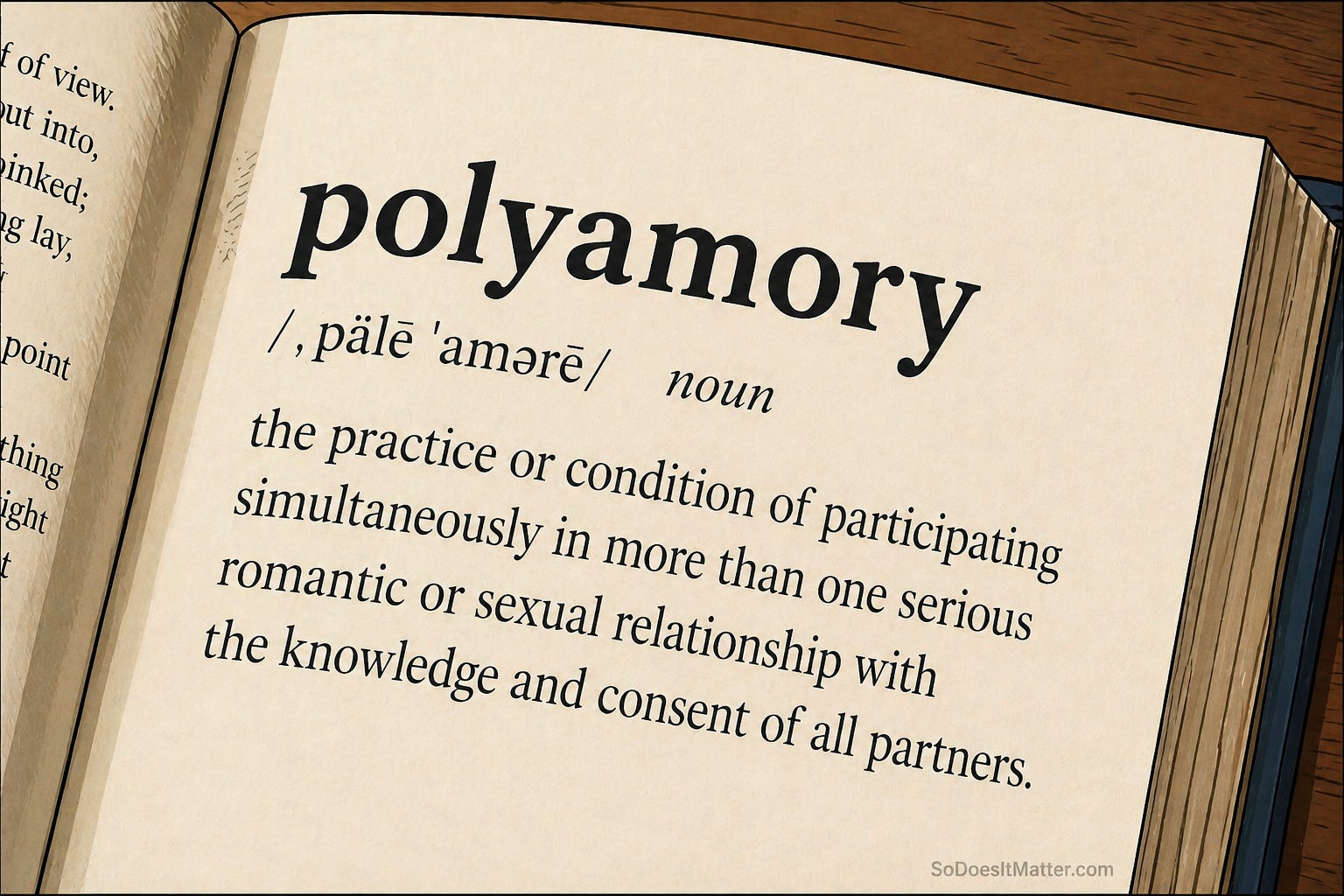
Polyamory is defined as: The practice or condition of participating simultaneously in more than one serious romantic or sexual relationship with the knowledge and consent of all partners.
That used to be a fringe concept. Now, according to a recent Los Angeles Times story, California cities are exploring ways to recognize and protect multi-partner relationships under the law. In Oakland and West Hollywood, policymakers are considering changes that would extend legal protections to these arrangements.
Supporters frame this as practical: hospital visitation, housing rules, workplace benefits, and medical emergencies. But those are administrative symptoms. The deeper issue is cultural. America is losing confidence in marriage as a fixed, stabilizing institution.
Once marriage becomes merely one lifestyle choice among many, more radical alternatives inevitably ask for the same cultural and legal legitimacy.
Marriage Is Losing Its Cultural Centrality
This did not come from nowhere. It is unfolding against the backdrop of a long decline in marriage as a defining institution in American life. Today, fewer than half of U.S. households are married couples, down from roughly two-thirds in the 1970s, according to U.S. Census Bureau data.
The more telling change is not only behavioral. It is attitudinal. According to the 2025 American Family Survey, only about 45 percent of Americans say society is better off when more people are married. Pew Research Center data show that 44% Americans—especially those who have never married—view marriage as very important to a fulfilling life.
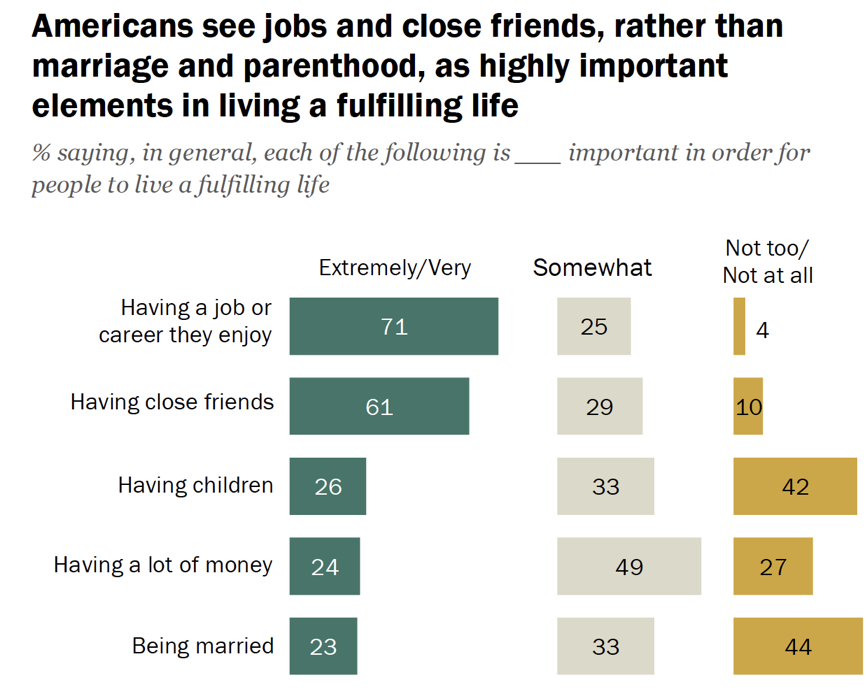
That is the earthquake. Americans are not merely marrying less. They are increasingly unsure that marriage matters.
That matters because the legal push for polyamory is not happening in a strongly pro-marriage culture. It is happening in a culture already unsure why marriage should be privileged at all.
Marriage has not disappeared. It has been demoted. It is no longer widely treated as the expected framework for adulthood, family formation, sacrifice, and responsibility. It is now one option among many, competing with cohabitation, long-term singlehood, and increasingly fluid relationship arrangements.
Marriage Is More Than A Contract
The family is not a sentimental preference or a nostalgic artifact. It is one of civilization’s great ordering institutions. It teaches permanence, duty, restraint, sacrifice, and responsibility. It takes private desire and binds it to obligations beyond the self.
For those of us shaped by faith, marriage is not merely a private arrangement between consenting adults. It is a binding commitment, a stabilizing institution, and one of the ways society teaches men and women to build something larger than appetite or preference.
For generations, those expectations were reinforced not just by culture, but by religious traditions, including the Judeo-Christian understanding of marriage as a covenant rather than a convenience. As those influences have weakened, so too has the sense that marriage carries obligations beyond personal fulfillment.
As C.S. Lewis wrote in Mere Christianity, “Love in this second sense—love as distinct from ‘being in love’—is not merely a feeling. It is a deep unity, maintained by the will and deliberately strengthened by habit.” That understanding of marriage as a disciplined, enduring bond stands in sharp contrast to relationship models built on fluidity and expansion.
Dennis Prager has long argued that once a society begins redefining marriage, it should not be surprised when the institution continues to evolve beyond its original structure. Earlier debates focused on who could enter marriage. What is now emerging goes further, challenging whether marriage is even limited to two people.
This is not a hypothetical slippery slope. It is the next application of the same logic.
The problem is not simply that polyamory is unusual. The problem is that it reflects a culture increasingly uncomfortable with limits, permanence, and exclusive commitment. When every boundary becomes negotiable, every institution eventually becomes unstable.
This has always been the tension at the heart of a free society: we prize individual liberty, but we rely on strong institutions, especially the family, to sustain that liberty. When those institutions weaken or fail, government inevitably moves to fill the gap, often at the expense of individual freedom.
So, Does It Matter?
It is easy to dismiss practices like polyamory, or even polygamy, a more formalized and historically controversial form of multi-partner relationships, as marginal behavior. Most Americans will never seriously consider them. But fringe ideas matter when they reveal where the culture is drifting.
When fewer people believe marriage matters, alternative relationship models do not merely emerge. They seek recognition. Then normalization. Then protection. What begins as private experimentation becomes public policy.
A society cannot endlessly weaken its core institutions and expect no consequences. When the family deteriorates, the damage does not remain private. Children, schools, neighborhoods, churches, synagogues, courts, employers, and government all absorb the cost.
So yes, this matters. Not because every household in California is about to become a “throuple,” but because this is another sign that marriage is being pushed from the center of American life to the margins.
Marriage is not just one relationship model among many. It is the institution that helps keep private life ordered enough for public liberty to survive.
Let's call it what it is: legally-recognized "polyamory" is polygamy. Once the "relationship" becomes legally binding on all parties, there is no significant difference. And centuries of human existence have shown the dangers and problems of polygamy. Do not misunderstand me: I'm fine if individuals wish to engage in polyamorous relationships. But giving such relationships legal standing and binding terms is a bad jump down a slippery slope.