

Happy Tax Day! California Taxpayers Deserve Relief.
California’s tax burden is not just high. It is a governing philosophy.

You can listen to this post on our podcast feed, So, Does It Matter? SPOKEN. It’s available on your favorite podcasting app, or you can find it here. Our afternoon content is typically for our paid subscribers. Certain columns, like this one, are made available to all of our readers.
⏱️ 5 min read
Tax Day Is A Reminder Of The Trap
Tax Day is supposed to be a yearly annoyance. In California, it is an indictment.
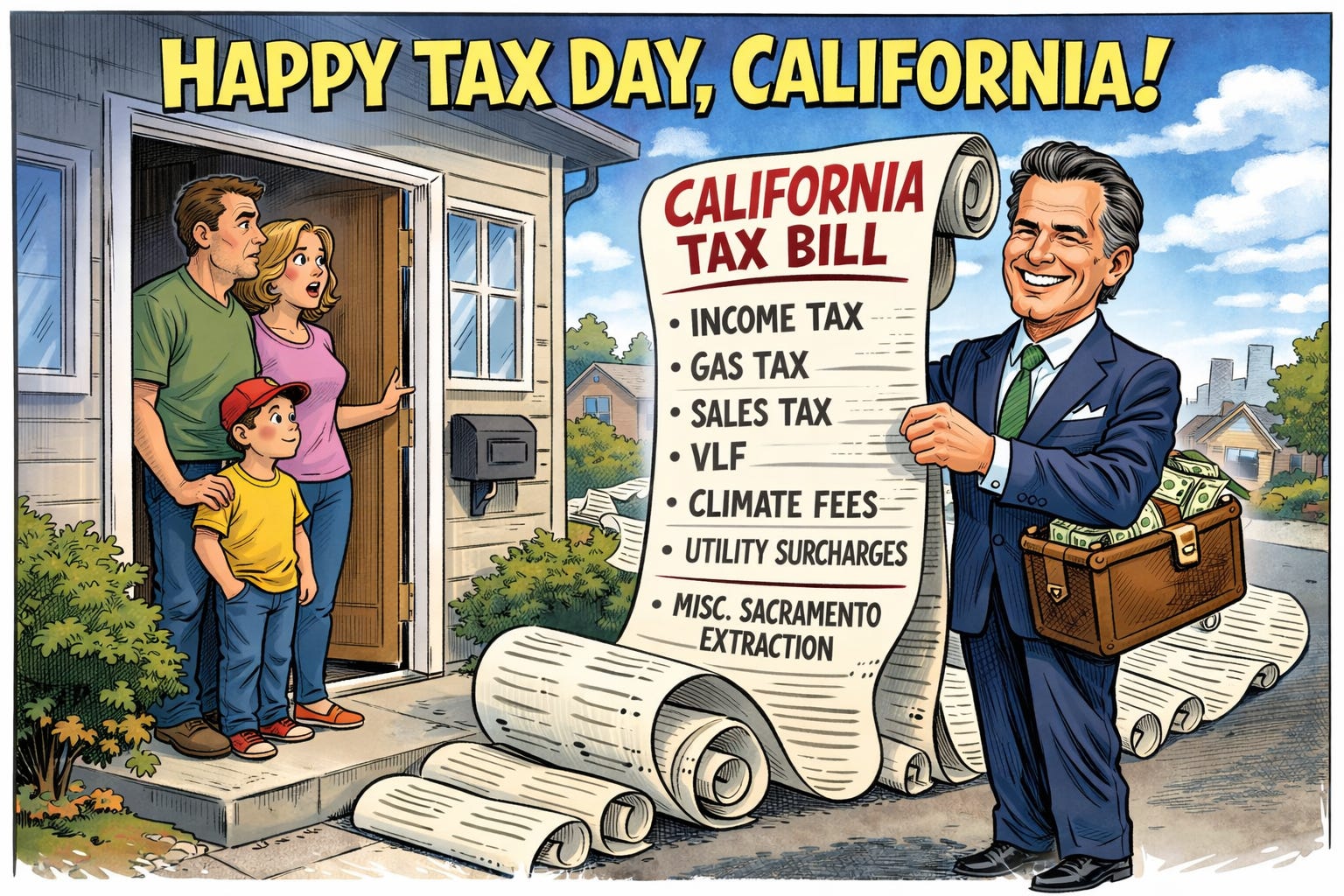
California taxes work: shopping, driving, business activity, vehicle ownership, and property. Then acts surprised when families feel squeezed, and employers think twice about staying. The top state income-tax rate is 13.3 percent. The statewide sales tax rate is 7.25 percent before local add-ons. The gas tax is 61.2 cents per gallon. Corporations pay 8.84 percent, plus the state’s $800 minimum franchise tax. Wage earners face a 1.3 percent SDI deduction with no wage cap. Vehicle owners get hit with the Vehicle License Fee. Homeowners pay property taxes and, in many places, additional voter-approved assessments layered on top.
That is a high-burden state whose governing class acts as if the problem is never overspending, overpromising, or overregulating. The problem, somehow, is that taxpayers still have too much left. Perhaps presidential candidate Gavin Newsom can boast on the campaign trail about how much his state extracts from its taxpayers. Californians are the ones stuck paying the bill.
That is the real lesson of Tax Day in California. Government here is not merely expensive. It is entitled. Sacramento behaves as if it has the first claim on what citizens earn, save, spend, and invest. What remains in private hands is treated less like earned income than like revenue the state has reluctantly declined to seize.
Sacramento’s Appetite Never Ends
What makes California especially maddening is not just the level of taxation. It is the mentality behind it.
The state taxes success as if ambition were a vice. It taxes commerce as if ordinary exchange were suspicious. It taxes mobility as if driving were a moral failing. It taxes employers and investors, then causes confusion when businesses slow hiring, delay expansion, or decide the math no longer works. Through it all, the same political class wraps itself in the language of compassion while making daily life more expensive for the very people expected to bankroll its ambitions.
None of this is accidental. California’s ruling class does not believe prosperity is safest in private hands. It believes wealth should be filtered through political institutions and redistributed according to ideological fashion by people who think they know better than the taxpayers funding the system.
That is why Sacramento almost never begins with restraint. It would require admitting that the government has grown too large, promised too much, and become far too comfortable with other people’s money. It is easier to demand more revenue than to confront the possibility that the real problem is the size and arrogance of the machine itself.
So the cycle repeats. Revenues come in. Politicians spend aggressively. New obligations are piled on. Then, when pressure builds, taxpayers are told that unless they surrender more, something essential will be lost. This is not prudent governance. It is an endless shakedown dressed up as public service.
The Hidden Tax Burden Is Crushing
And that is just the visible tax bill.
California also slaps residents with a second tax system that politicians prefer not to call taxes at all: climate fees, carbon costs, fuel rules, utility mandates, and regulatory burdens embedded in the price of ordinary life. Cap-and-trade, the state’s ever-expanding climate bureaucracy, low-carbon fuel rules, and a tangle of emissions mandates all drive up the price of gasoline, goods, and doing business. Californians are not merely paying taxes at the pump. They are paying for Sacramento’s climate alarmism every time they fill the tank.
The same bait-and-switch shows up on electricity bills. Rates are driven higher not simply by market forces, but by a political class determined to use the power grid as an instrument of ideological ambition. Families are forced to absorb the cost of green mandates, forced procurement choices, compliance burdens, and a regulatory culture that treats affordability as an afterthought. Businesses get hit, too, and those costs do not disappear. They reappear in higher prices, less hiring, delayed investment, and fewer opportunities.
This is one of the dirtiest tricks in California politics. Politicians lecture the public about climate virtue while hiding the price tag inside utility bills, fuel prices, and the broader cost of living. They avoid the word tax because they know voters would revolt if these costs were presented honestly. But a government-imposed burden is still a burden, whether it comes as a formal tax, a fee, a surcharge, or a climate regulation designed to extract more money from people who are already paying too much.
Taxpayers Pay Premium Prices For Political Failure
The real scandal is not just that Californians pay so much. It is that they pay so much and are still expected to tolerate dysfunction.
California does not offer taxpayers disciplined excellence. It offers a chronic disorder wrapped in self-congratulation. Residents are asked to accept extraordinary tax burdens while political leaders preside over recurring fiscal anxiety, affordability crises, and a cost of living that drives families and employers to reconsider their future here.
That is why this issue lands so hard. Californians are not just angry about rates. They are angry about contempt. They are tired of being told to accept premium tax burdens, regulatory burdens, and cost-of-living pressures while the people imposing them act as though objection itself is selfishness.
People can tolerate taxation more easily than contempt. What infuriates Californians is not only that the state takes so much. It is that the people doing the taking behave as though no one has any right to complain. The same politicians who impose crushing costs on working people will lecture them about fairness, as though fairness means government always gets more, and taxpayers are expected to nod along.
So, Does It Matter?
Taxes reveal not merely economic policy but political character.
They tell you what the government thinks of the citizen. And in California, the government plainly thinks citizens exist to finance its priorities. The productive are not treated as the source of prosperity to be protected. They are treated as recurring revenue streams to be tapped harder whenever Sacramento lacks the courage to govern responsibly.
California taxpayers do not owe the political class an apology for wanting to keep more of what they earn. The political class owes taxpayers an apology for taking so much, regulating so aggressively, and still insisting it is never enough.
That is the California tax story on April 15. Not merely that the state taxes heavily, though it does. It is that the place's governing philosophy is built on extraction. More from paychecks. More from purchases. More from drivers. More from homeowners. More from employers. More through direct taxation, and more through hidden regulatory costs passed along in every corner of economic life. If Gavin Newsom wants to run for president, he is free to do so. But he should be honest enough to tell voters in the rest of the country what his model actually looks like in practice: a state that treats taxpayers as an endless source of revenue and then calls it compassion.
Unfortunately, some of my more liberal friends have no problem paying higher and higher taxes. If you look at the CA voting patterns, it seems that many CA voters have no problem with paying more. Unless, of course, they don't connect the dots to what their vote actually means.