

Gavin Newson’s Hollywood Bailout Bust
In signing his final budget, the Governor managed to screw Hollywood studios from capitalizing on the massive corporate tax credits the Democrats sent their way.

Our morning content is free for all subscribers and guests! Usually our afternoon content is behind a paywall… If you are not yet a paid subscriber, consider upgrading — you are missing a significant portion of what we produce each week, and your support makes it possible. If you want to get it all and support my efforts, please consider a paid subscription! There is exclusive content below this column for paid subscribers…
Most of our content is available on our podcast feed. So, Does It Matter? SPOKEN. Which is available on your favorite podcast app. You can listen to it right here as well.
This column below first appeared last Saturday on the Daily Signal website, which I encourage you to visit, and bookmark. Lots of great news and opinion there!
🕒 6 min read
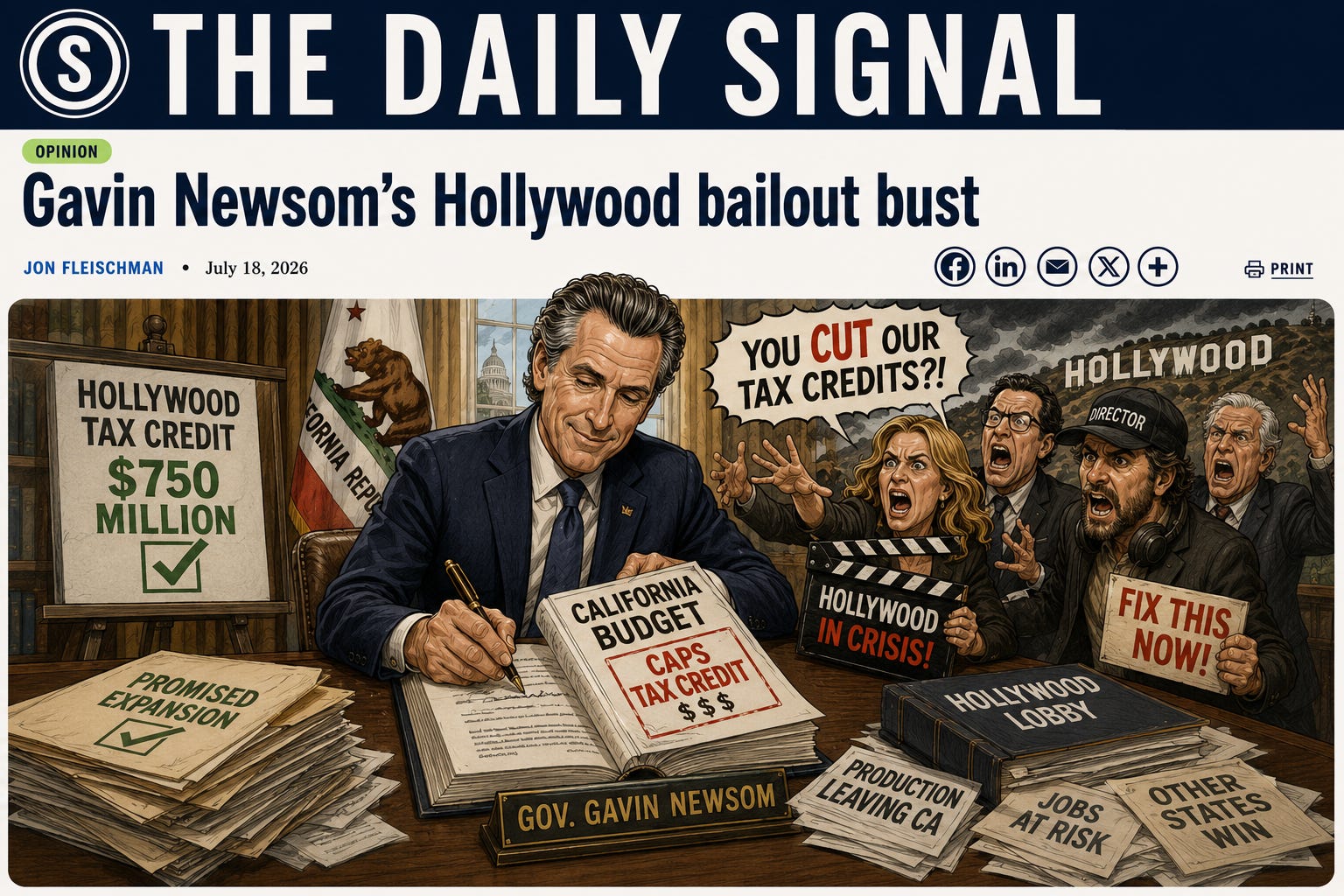
Gov. Gavin Newsom spent the past year celebrating a massive expansion of California’s Hollywood tax credit program, boosting it to a record $750 million a year.
Then his own budget managed to kneecap it.
Now Sacramento is scrambling to fix one of the governor’s biggest political headaches.
More than three dozen California lawmakers, including senior Democratic legislators, are urging Newsom to reverse a budget provision they say will cripple Hollywood’s newly expanded tax credits.
Sacramento expanded Hollywood’s subsidy with one hand while quietly weakening it with the other.
Lawmakers now say a broader corporate tax credit limitation buried in the state budget inadvertently swept up the very film tax credits they had spent months promoting. Assembly Democratic Caucus Chair Rick Chavez Zbur, who helped write the original expansion, said members believed a carve-out for film credits had already been secured before the budget vote.
Just months after celebrating the historic expansion, Newsom signed a budget extending broader limits on the use of corporate tax credits.
Through 2029, companies generally remain limited to claiming $5 million in credits annually. Beginning in 2030, they generally will be limited to claiming either $5 million or 70% of their California tax liability in a given year, whichever is greater.
Hollywood says this change significantly diminishes the value of the newly expanded incentive.
The result was a bizarre contradiction: Lawmakers increased the subsidy on paper while simultaneously limiting the extent to which many companies could actually claim the credits.
This is Newsom’s budget. He proudly signed it. If that budget accidentally kneecapped one of his signature Hollywood initiatives, the responsibility begins with him.
The episode is both embarrassing and revealing.
Because beneath the legislative fumble lies a much bigger story about how California governs.
The problem with these tax credits has little to do with Hollywood. It has to do with government deciding which industries deserve special treatment and which are left to fend for themselves.
California imposes one of the nation’s most expensive business climates, then selectively hands out tax breaks to politically favored industries as compensation.
That’s a politicized tax policy.
Manufacturers don’t receive Hollywood-sized carve-outs. Family-owned restaurants don’t. Independent retailers don’t.
Thousands of California employers simply pay the state’s high taxes, navigate its regulations and hope they can survive.
Hollywood gets a government subsidy.
Supporters argue that the credits are necessary because other states aggressively recruit film production. It’s true that Georgia, New Mexico and others have built generous incentive programs to lure studios away.
But that argument raises an even more uncomfortable question.
If California has become so expensive that Sacramento must continually subsidize one favored industry just to keep it from leaving, perhaps the real problem isn’t the size of the tax credit.
Perhaps it’s California.
Instead of fixing the business climate for everyone, Sacramento keeps creating carve-outs, exemptions and targeted subsidies for the industries with the greatest political influence.
The government is choosing winners and losers.
California doesn’t really have a coherent tax policy anymore so much as it has a tax code filled with political exceptions.
Which brings us back to Hollywood.
Hollywood isn’t just one of California’s most iconic industries. It is one of the Democratic Party’s most valuable political assets, generating campaign contributions, celebrity endorsements, elite fundraisers and the kind of national political validation every Democratic presidential hopeful craves.
That makes this budget mistake different from almost any other.
If Sacramento accidentally undercut tax credits benefiting manufacturers or family-owned businesses, would lawmakers rush to pass corrective legislation?
Maybe. Maybe not.
Hollywood, however, doesn’t have to wonder.
When Hollywood calls, Sacramento answers.
Hollywood has every right to lobby for its interests. Every industry does.
The real question is why Hollywood almost always finds lawmakers sprinting to its rescue while millions of ordinary Californians are told to get in line.
That answer has far more to do with politics than economics.
As Newsom continues positioning himself for what increasingly looks like a presidential campaign, the last constituency he can afford to alienate is Hollywood.
It has fueled Democratic fundraising, celebrity activism and campaign infrastructure for decades — the kind of national validation any Democrat eyeing 2028 needs badly.
That’s why this story isn’t really about a drafting error buried deep inside a budget bill.
It’s about political priorities.
Newsom’s own budget created a problem for one of California’s most politically connected industries.
Now the pressure is on to solve it — and fast.
Watch how quickly this gets fixed.
California families have spent years asking Sacramento for relief from soaring taxes, unaffordable housing, skyrocketing insurance premiums and an increasingly hostile business climate.
They are routinely told change takes time.
Hollywood probably won’t have to wait.
Newsom’s budget created this mess.
His presidential ambitions will almost certainly clean it up.
Below the paywall I lay out succinctly the eight reasons why Hollywood Film Credits are a bad, bad idea.
Keep reading with a 7-day free trial
Subscribe to So, Does It Matter? On CA Politics! to keep reading this post and get 7 days of free access to the full post archives.