


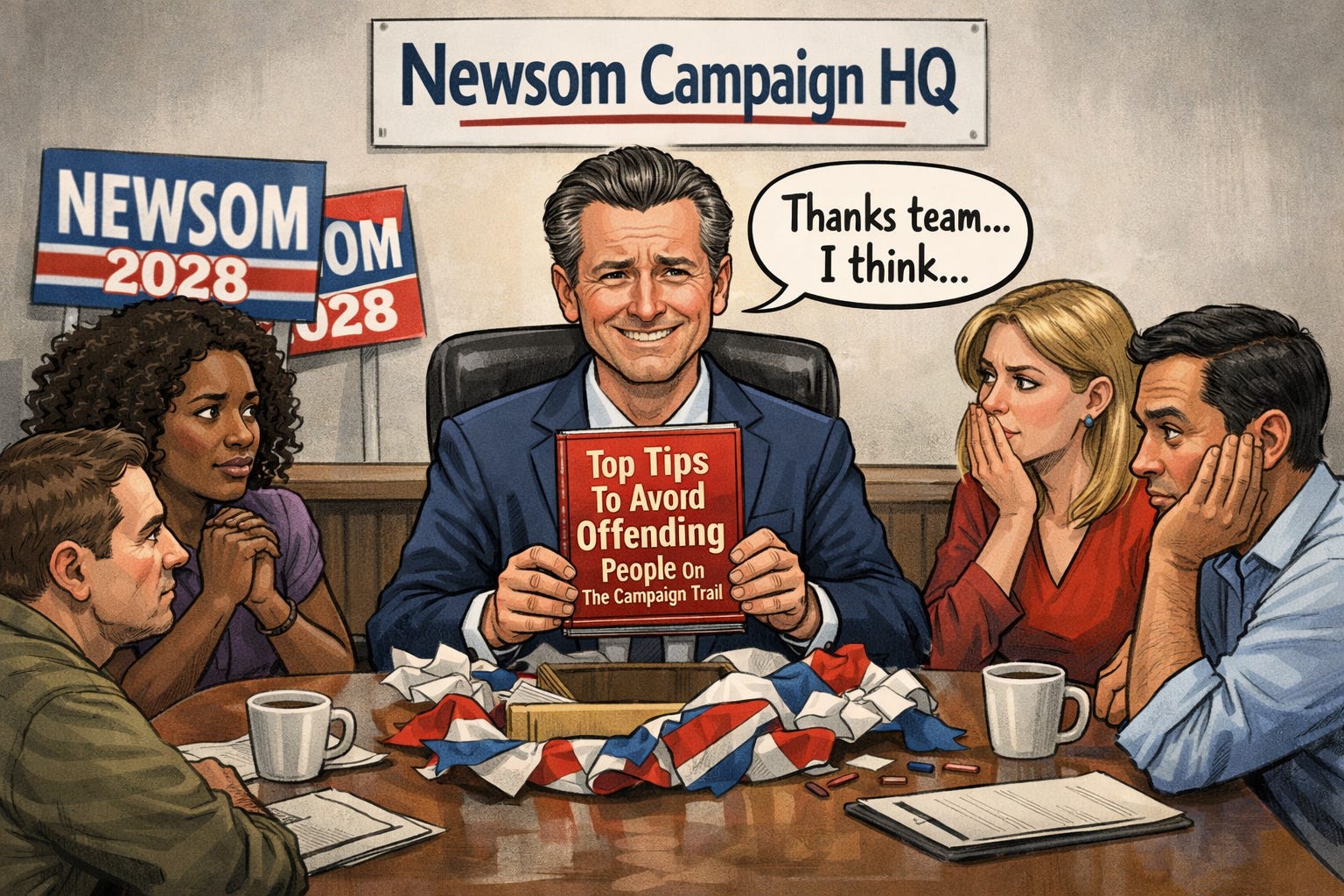
For our paid subscribers, under the paywall, is a short video commentary on this subject, as well as the runner-up cartoon image for this post. Oh yes, don’t forget you can listen to this content on our podcasting stream, So, Does It Matter? SPOKEN.
⏱️ 7 min read
An Unsettling Comparison In A Controlled Setting
This was not an off-the-cuff hallway comment or a tense exchange with reporters. It was a staged book-tour interview in Atlanta promoting Young Man in a Hurry, with Newsom seated across from Mayor Andre Dickens before a largely Black audience. The setting was orderly and predictable, built to showcase his personal story, including his struggles with dyslexia.
WATCH THE VIDEO FOR YOURSELF
What he chose to say in that moment was intentional. “I’m not trying to impress you,” Newsom said. “I’m just trying to impress upon you, I am like you. I am no better than you. I am a 960 SAT guy… You’ve never seen me read a speech, because I cannot read a speech.” The key phrase was “I am like you,” followed immediately by low test scores and difficulty reading speeches.
That structure is where the problem lies. In a room anchored by a Black mayor and a largely Black audience, the bridge he attempted to build rested on academic underperformance and illiteracy. There are many ways to tell a dyslexia story. Newsom selected one that creates the appearance of equating likeness with diminished academic capacity.
More Than A Viral Clip
This is not simply about whether opponents can weaponize a short video segment. Modern politics rewards sharp clips and punishes carelessness. But the deeper issue is the instinct behind the comparison.
When someone says “I am like you” and then defines that likeness in terms of low academic achievement, it reveals something about how he thinks connection is established. Even wrapped in self-deprecation, that framing carries historical weight. Leaders with national ambitions are expected to understand the weight without being reminded.
Intent does not eliminate appearance.
A politician may sincerely believe he is sharing a personal struggle, yet still create the impression that certain audiences will relate to a sense of deficiency rather than perseverance or success. That is why the reaction extended beyond partisan critics. Many viewers heard a governor frame commonality with a Black audience through diminished aptitude and felt immediate discomfort.
The Response Reveals As Much As The Remark
The reaction afterward was equally revealing. Rather than acknowledge that the phrasing could reasonably be interpreted as inappropriate, Newsom lashed out at critics and told Sean Hannity to “spare me your fake f—ing outrage.” His team dismissed the controversy as manufactured theater.
That approach narrows the conversation instead of addressing it. Some voters watched the interview and simply concluded that the comparison itself appeared troubling. Not malicious. Not conspiratorial. Troubling.
Watch the exchange and pay attention to Mayor Dickens’ reaction. There is a polite, reflexive laugh that reads less like shared humor and more like social navigation. It is the kind of response people give when they sense the ground shift beneath a public conversation.
If this were merely a technical wording mistake, reflection would have followed. Instead, the posture was defiance. That signals that the governor does not believe the appearance problem is legitimate.
So, Does It Matter?
This matters because presidential politics is about judgment and awareness. When a governor in a friendly interview defines similarity to a Black audience through low SAT scores and an inability to read speeches, it creates the appearance of assumptions operating beneath the rhetoric.
This was not a stray adjective or a garbled statistic. It was a structured thought delivered slowly and with emphasis: “I am like you,” followed by academic deficiency. That framing, whether intended or not, suggested lowered expectations rather than shared aspiration.
Voters evaluating a potential presidential candidate place more weight on policy competence than on other factors. They measure instinct, historical awareness, and the ability to understand how language resonates across communities. A leader who fails to anticipate the weight of certain comparisons or who refuses to recognize how they appear invites scrutiny about readiness for a national stage.
Newsom ended 2025 as the putative frontrunner in the sweepstakes for the yet-to-be-held 2028 Democratic nomination for President. Incidents like this one are a sure-fire way to relinquish poll position to someone else.
Video Commentary and Runner-Up Cartoon
Below the paywall is a video commentary from me on this subject, along with the runner-up cartoon I almost used above. My commentary focuses on putting this gaffe in the context of Newsom’s Presidential ambitions. Both are worth checking out.
If you like this kind of independent perspective, not beholden to anyone - calling balls and strikes, please consider a paid subscription to support my work. It really helps me to put more time into the So, Does It Matter? project. And I try hard to add a lot of content just for paid subscribers, and you would get access to all of it!
