

Gavin Newsom’s Final Budget: More Spending, More Taxes, More Government
Gavin Newsom’s final California budget reveals the tax-and-spend governing philosophy he wants to take national in 2028.
REMINDER, WE ARE ON A VACATION SCHEDULE THIS WEEK.
Our morning content is free for all subscribers and guests! Usually our afternoon content is behind a paywall, but not when I am previewing a California Post column… If you are not yet a paid subscriber, consider upgrading — you are missing a significant portion of what we produce each week, and your support makes it possible. If you want to get it all and support my efforts, please consider a paid subscription!
You can also listen to this post on our podcast feed, So, Does It Matter? SPOKEN. It is available on your favorite podcast app. And you can listen to it here.
⏱️ 5 minute read
Gavin’s Final Report Card
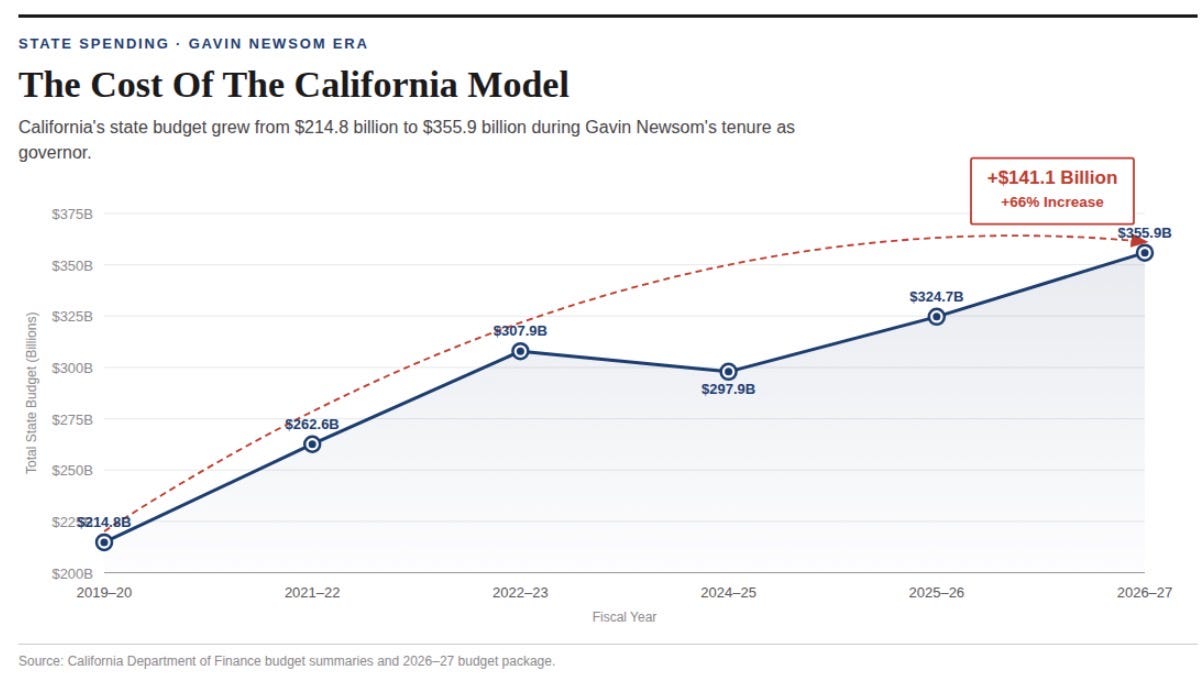
Governor Gavin Newsom is getting ready to leave California with the largest budget in state history.
That is not a footnote to his governorship. It is central to it.
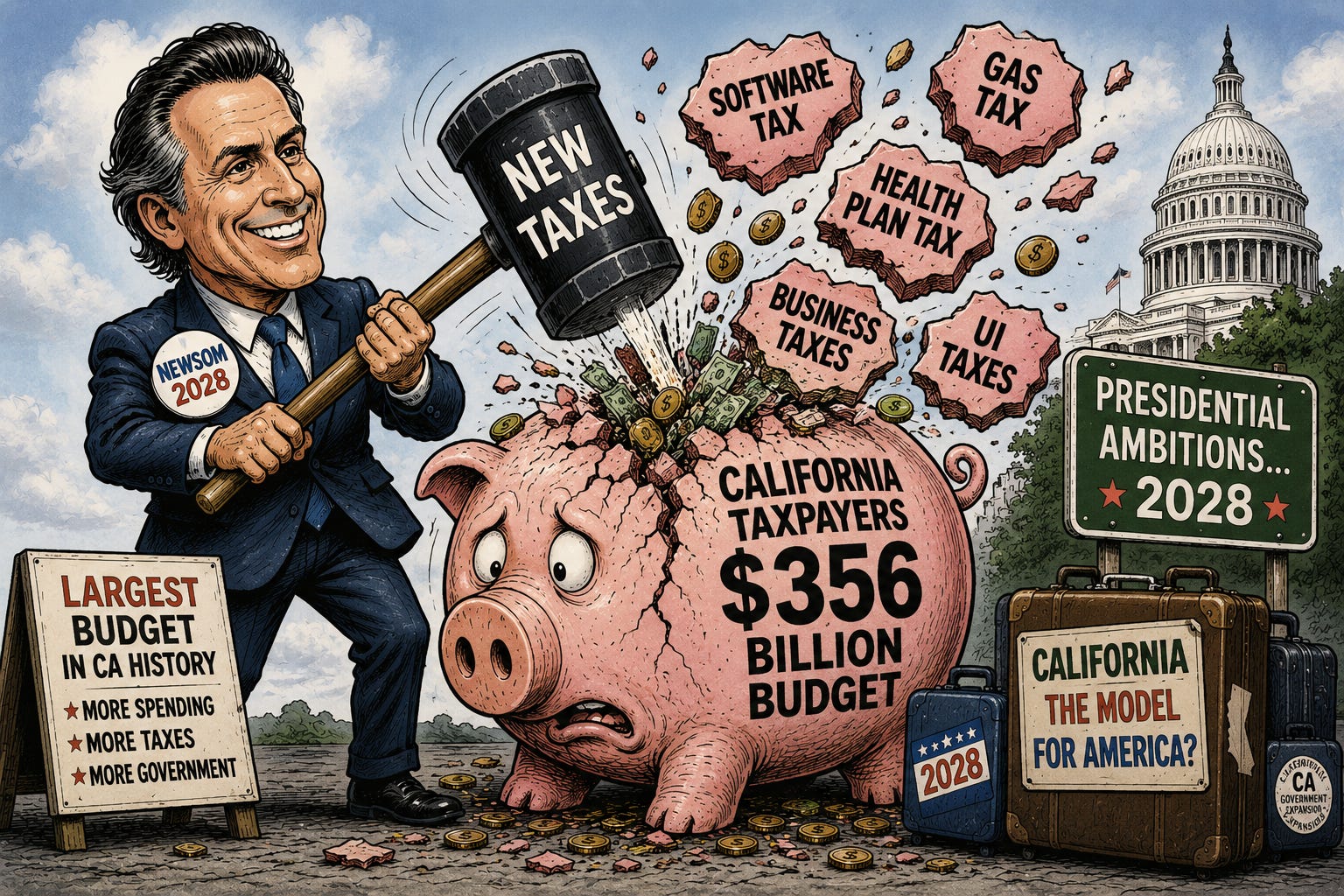
This week, California lawmakers passed the main budget bill for a spending plan approaching $356 billion, the largest in state history. At a time when Californians consistently rank affordability as their biggest concern, Sacramento’s answer was not to reduce costs, streamline government, or provide meaningful tax relief. Instead, Sacramento Democrats are advancing new taxes and revenue increases while preserving a government that has grown dramatically under Newsom’s watch.
This one matters because it is his last.
It is the final budget of a governor with obvious presidential aspirations, and it provides perhaps the clearest picture yet of the governing philosophy he would bring to the White House.
The Biggest Government Ever
The most important number in this budget is not any individual tax increase.
It is $356 billion.
California’s budget has roughly doubled over the past decade. According to the Legislative Analyst’s Office, General Fund spending has grown by more than $100 billion since 2020 alone, reaching about $248 billion in Newsom’s final budget proposal. During that same period, California’s population has remained largely stagnant, hundreds of thousands of residents have moved to other states, and the cost of living has become one of the state’s defining political issues.
Yet government spending continued to grow.
During and after the COVID pandemic, California benefited from a flood of federal spending, combined with soaring tax revenues generated by the technology sector and stock market. Sacramento Democrats treated much of that temporary windfall as though it would last forever.
Programs expanded. Commitments were made. Spending ratcheted upward.
When the temporary revenue surge faded, the spending largely remained.
The Legislative Analyst’s Office has repeatedly warned lawmakers about California’s structural budget challenges. Its November fiscal outlook projected an $18 billion budget problem for 2026-27 and structural deficits growing to roughly $35 billion annually beginning in 2027-28. In other words, even after years of extraordinary revenues, California’s spending commitments are still growing faster than the money available to pay for them.
That explains why Sacramento Democrats are again searching for new revenue despite presiding over the largest budget in state history.
The Taxes Keep Coming
Among the most significant provisions in the budget package is a new tax on prewritten software and software-as-a-service subscriptions.
That may sound technical, but it affects almost every business and many ordinary Californians.
The Legislative Analyst’s Office says the proposal would extend the sales tax to prewritten software broadly, no matter how it is delivered, beginning with the new year. Custom software would remain exempt. The administration estimates the change would raise $450 million for the General Fund and $560 million for local governments in just the first half-year.
Businesses rely on subscription software for payroll, accounting, inventory management, scheduling, cybersecurity, customer relations, and countless other functions. Consumers use these products as well. Californians who subscribe to Microsoft 365 for Word, Excel, Outlook, and PowerPoint, Adobe software, QuickBooks, or other prewritten software products could find themselves paying sales tax on subscriptions that have never before been taxed.
That makes this more than a business tax.
It is an app tax, a software tax, and another cost-of-living increase in a state that is already too expensive.
David Kline, Vice President for the California Taxpayers Association, warned that Californians have made it clear that affordability is their biggest concern, yet lawmakers are responding with tax increases that “will only make things worse.”
Kline noted that the software tax will affect “payroll, accounting, security, scheduling, inventory management, and every other aspect of running a business.”
Those costs do not disappear. Businesses absorb some of them. Consumers absorb some directly. And because businesses inevitably pass costs along, consumers will likely pay again through higher prices.
The budget also extends limitations on business tax credits, imposes additional taxes on health plans, and leaves California employers carrying the burden of the state’s unpaid unemployment insurance debt. The Employment Development Department says California employers already face an extra federal unemployment tax because the state has not repaid its loan, and those costs are expected to keep rising until the debt is paid off.
Meanwhile, Sacramento Democrats rejected Republican efforts to suspend California’s gasoline excise tax.
The California Model
As reported by the California Globe, Assemblyman David Tangipa reacted to the budget by saying, “The math isn’t mathing.”

His observation captures the broader problem.
California does not suffer from a lack of tax revenue. California suffers from a government accustomed to perpetual growth.
Even in a year marked by budget challenges, Sacramento Democrats continued funding priorities that have defined the Newsom era, including taxpayer-funded health care for undocumented immigrants and continued spending on the state’s troubled high-speed rail project.
What is difficult to dispute is that they represent choices.
Every dollar spent on those priorities is a dollar unavailable for tax relief, infrastructure, water storage, wildfire prevention, public safety, or paying down long-term liabilities.
A budget shows what politicians actually chose when the speeches were over.
So, Does It Matter?
For years, Gavin Newsom has worked to make himself a national figure by serving as one of President Trump’s most performative Democratic foils. He has picked fights with Republican governors, launched national media campaigns, debated conservative leaders, and positioned himself as one of his party’s most aggressive spokesmen.
Fine. Let him fight online.
But the budget is where the governing happens.
This budget shows what Newsom-style progressive government looks like in practice: a record $356 billion budget, new taxes, larger government, more spending commitments, continued structural deficits, and an ongoing search for additional revenue whenever the numbers stop adding up.
Sacramento Democrats can call these investments. Californians are entitled to call them the bill for years of unchecked government growth.
Before the governor embarks on what many expect will be a campaign for president, Californians should remember something important.
This budget was written by Democrats.
The main budget bill was passed by Democrats.
Republicans voted no.
If you appreciate a record $356 billion budget, new taxes on software and businesses, continued gas taxes, and a government that keeps getting bigger and more expensive, Sacramento Democrats would undoubtedly welcome your thanks.