

Gavin Newsom’s Fantasy Budget: A January Miracle Built on Fiction
California’s governor says the state faces only a small deficit, but the independent analyst warns of a much bigger problem. That gap says a lot.

This column was originally paywalled, but has now been made available to all.
⏱️ 6-minute read
A Budget That Only Works If You Don’t Look Too Closely
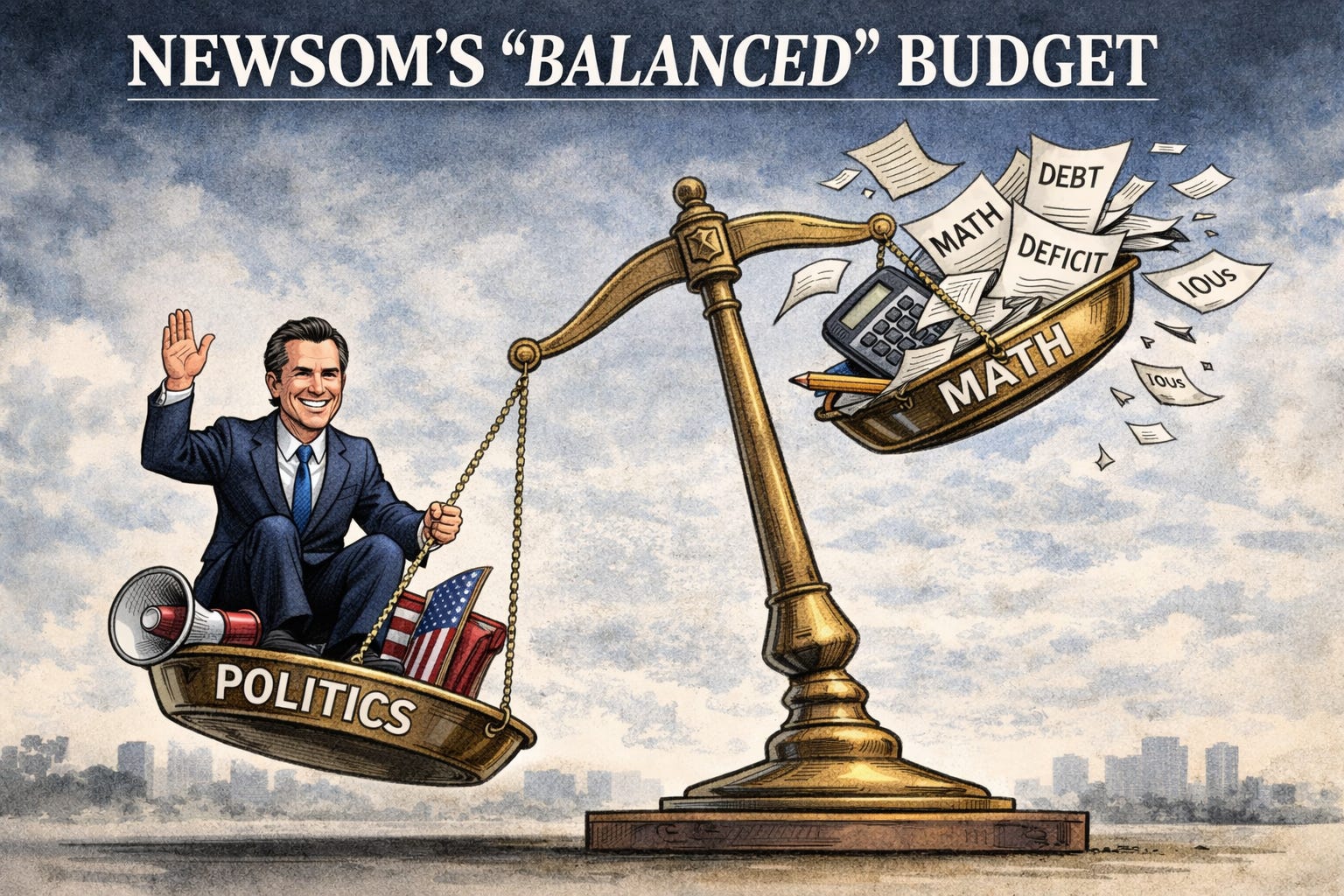
Governor Gavin Newsom says California is facing just a $3 billion budget shortfall. His administration is highlighting this number as he presents his final budget proposal as governor.
But there is a much more cautious view. The nonpartisan Legislative Analyst’s Office says California should actually plan for a shortfall closer to $18 billion. This isn’t just a technical difference—it shows two very different approaches to risk.
Budgets should help a state get ready for the future, not just make voters feel better. When the governor’s estimate is so different from the independent analyst’s, it raises questions about which number is careful and which is just hopeful.
This conflict is present throughout the whole proposal. And none of Newsom’s proposals contemplates the kinds of systematic spending reductions that will be needed to address massive shortfalls, predicted by both the LAO and the Governor, starting next year..
Christmas in January, Fueled by Borrowed Confidence
Despite clear warning signs, Newsom has chosen to present this budget as a moment of abundance. Just to pick an anecdotal segment from the proposed budget, schools and community colleges are promised an “unexpected” $22 billion in additional funding. Universities are assured that relief is on the way. Programs are extended, block grants expanded, and commitments reinforced.
It’s worth looking more closely at the source of this confidence. Much of the expected revenue growth depends on capital gains and wealth from artificial intelligence companies. Even the governor’s finance department admits these sources are unpredictable and tend to rise and fall over time.
Instead of lowering expectations or building up reserves, the budget relies on optimistic assumptions. It makes new commitments without meaningfully preparing for possible federal cuts to health care, nutrition, or child care funding. If those reductions occur, the pressure would land squarely on the general fund.
Optimism might look good in politics, but it is not a replacement for real preparation.
The Deferral Shell Game
Looking more closely, much of the so-called new funding is neither new nor fully delivered. For the University of California and California State University systems, the main numbers mostly reflect payments promised years ago as part of a long-term agreement.
Even these commitments are still partly delayed. Hundreds of millions of dollars are set aside for future budgets. Universities have to plan for the money they are owed but have not yet received, and the state offers loans as a short-term fix.
This setup lets the administration say it is meeting past promises without actually providing the money right away.
The same thing is happening in K–12 education. Billions of dollars that school districts say they should get now under Proposition 98 are being held back to help balance the general fund. That money might be given back later, but only after it has been used to fill gaps elsewhere.
This isn’t real fiscal restraint. It’s just a delay that is being called careful pl”
Politics Over Preparedness
These choices don’t happen in a vacuum. Newsom is no longer just thinking about California’s long-term finances. He is acting as a national political figure, and his decisions have bigger political effects.
Admitting to an $18 billion shortfall would mean making tough choices and possibly upsetting powerful groups. By saying the problem is only $3 billion, the governor can keep making promises and maintain a sense of control, even if the numbers don’t really support that confidence.
Public employee unions and education groups, which wield significant influence in California politics, benefit from these new promises. The job of keeping those promises is quietly passed on to taxpayers and future lawmakers.
The political benefits come right away. The financial risks are pushed into the future.
Why Newsom Faces Little Pushback: Weak Opposition and a Cooperative Press.
Newsom can operate with this degree of flexibility for a straightforward structural reason. Republicans in the Legislature remain below one-third in both chambers, effectively removing them from budget negotiations and depriving them of meaningful leverage. Reduced numbers translate into reduced relevance, and reduced relevance brings limited scrutiny.
The other reason is the Capitol press corps. Most reporters, with a few exceptions, do not question the governor’s version of events. Instead of looking at the gap between Newsom’s $3 billion deficit claim and the Legislative Analyst’s more cautious view, major news outlets repeated the administration’s message. Two of the state’s biggest newspapers ran headlines like, “California faces $3 billion deficit in Gavin Newsom’s final state budget” and “Gov. Gavin Newsom unveils $348.9 billion budget, with $2.9 billion deficit,” without mentioning that the governor was also predicting a much stronger economy and about $15 billion more in revenue than the state’s own analyst. When the opposition has no power, and the press does not dig deeper, honesty becomes optional.
So, Does It Matter?
Budgets show what leaders care about, but they also show their motives. In this case, the motive is becoming clear.
This budget is not designed primarily to prepare California for the next downturn. It is designed to carry Gavin Newsom to his next political chapter. Minimizing the deficit, leaning into optimistic revenue projections, and announcing generous spending commitments all serve to advance the narrative that California is thriving under his leadership. That narrative is useful on the national stage, even if it is fragile at home.
Acknowledging an $18 billion shortfall would complicate that story. It would require restraint, risk admissions, and decisions that anger powerful allies. Instead, this budget papers over uncertainty, defers obligations, and shifts costs into the future, where someone else will be forced to deal with them. The applause is immediate. The consequences are delayed.
California is not a prop in a presidential audition. It is a state with volatile revenues, long-term obligations, and taxpayers who eventually pay for political ambition disguised as optimism. When the revenue assumptions fail, when federal cuts arrive, or when deferred bills come due, the press conferences will be over, and the talking points will be left behind. What will be left is the bill. It won’t go to Washington, Iowa, or New Hampshire. It will be sent to Californians.