

Gavin Newsom And The Democratic Party’s Socialist Future
As democratic socialists gain influence inside the Democratic coalition, California’s governor has decided to ride the wave rather than resist it.

Our morning content is free for all subscribers and guests! Usually our afternoon content is behind a paywall… If you are not yet a paid subscriber, consider upgrading — you are missing a significant portion of what we produce each week, and your support makes it possible. If you want to get it all and support my efforts, please consider a paid subscription!
You can also listen to this post on our podcast feed, So, Does It Matter? SPOKEN. It is available on your favorite podcast app. And you can listen to it here.
⏰ 5 minute read
A Different Audience
When Gavin Newsom recently embraced a national billionaire tax, many observers focused on the apparent contradiction. After all, Newsom has opposed California’s own billionaire tax proposal, warning that it would drive wealth and investment out of the state. Yet he now finds himself endorsing essentially the same concept at the federal level.
The contradiction disappears once you understand who Newsom is talking to. The audience is not California voters. The audience is Democratic activists, national labor leaders, progressive organizations, online influencers, and the party activists who will help shape the 2028 Democratic presidential nominating process. It is also the people likely to control many of the delegates who gather at the Democratic National Convention.
Newsom may oppose California’s wealth tax initiative. He appears to have reached a different conclusion about opposing the Democratic leaders and activists around the country who want one.
Progressive Is No Longer Progressive Enough
For years, Republicans warned that socialism was gaining influence inside the Democratic Party. Many Democrats dismissed those concerns as partisan rhetoric. That argument is becoming harder to sustain.
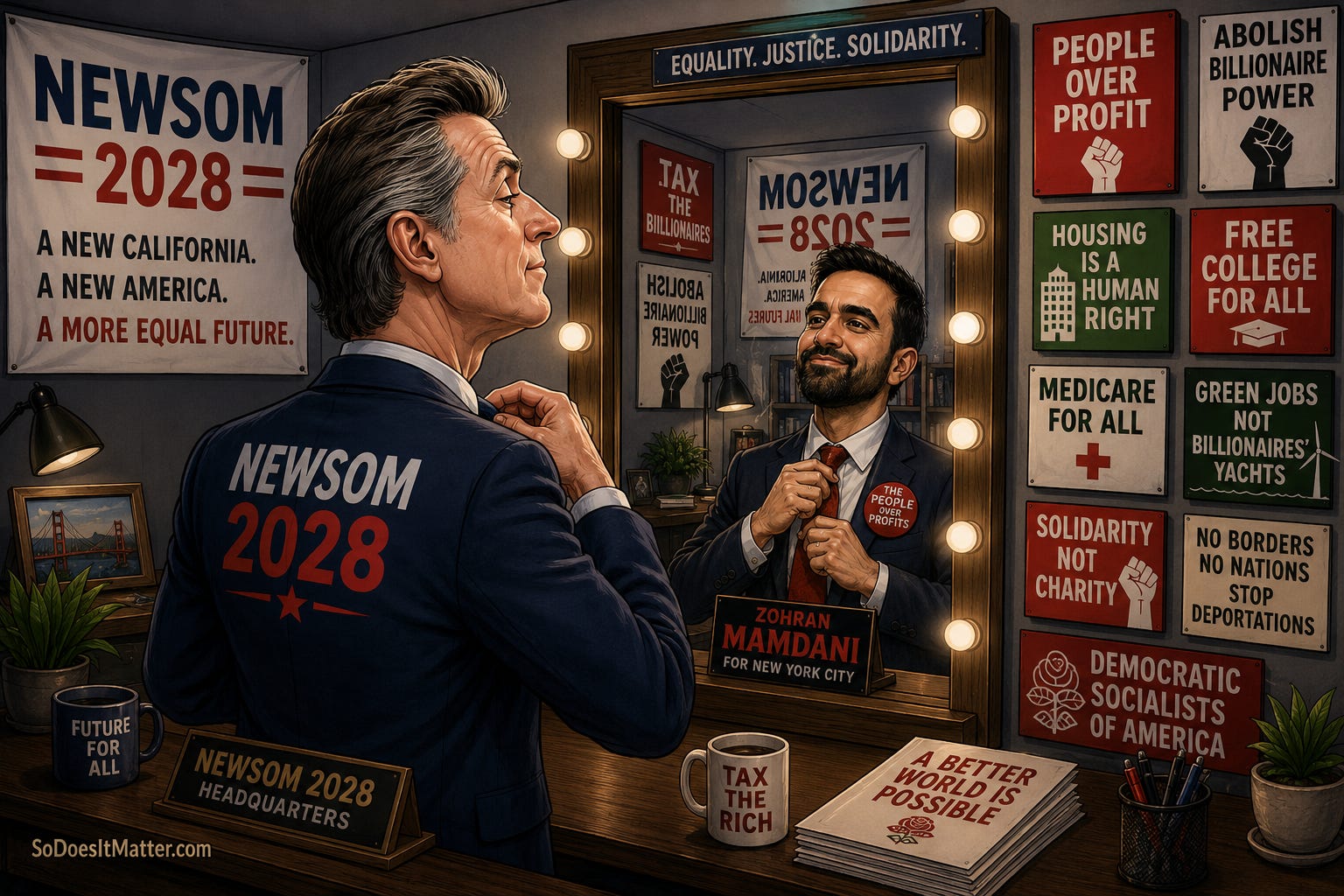
The rise of New York democratic socialist Zohran Mamdani offers perhaps the clearest example yet that the center of gravity inside the Democratic coalition continues moving leftward. The old fight between moderates and progressives is fading. Increasingly, the new fight is between progressives who govern and activists who believe government itself has not gone nearly far enough.
As the Wall Street Journal editorial board put it this week:
“The Governor is trying to walk a line between his Silicon Valley donors and his party’s ascendant left wing. The Democratic Socialists of America demonstrated its growing influence and organization last week in New York’s primaries. Mr. Newsom doesn’t want to get swept away by the socialist wave as he prepares to run for President in 2028.”
That may explain Newsom’s recent positioning better than any statement from the governor’s office. He is not becoming Zohran Mamdani. But he is adapting to a party in which democratic socialists increasingly set the rhetorical price of admission.
Why The Left Keeps Moving Left
This shift did not emerge overnight. Younger Democratic voters came of age amid the financial crisis, skyrocketing housing prices, student debt, and growing economic inequality. For many of them, the old progressive establishment looks less like an insurgent force and more like another institution that failed.
Compromise rarely goes viral. Outrage almost always does.
Republicans spent much of the last decade rewarding fighters who promised disruption and confrontation. Democratic activists increasingly appear to be rewarding their own version of political disruption. The demand is not for managers. It is for revolutionaries.
That does not mean every Democrat is becoming a socialist. It does mean the party’s activist class is changing the definition of what counts as bold, authentic, and morally serious.
California Leads The Way
No state better illustrates this transformation than California. California already operates one of the most progressive tax systems in the developed world. Yet demands for even higher taxes on wealth continue to grow. Los Angeles embraced its mansion tax. Sacramento created a reparations commission. State government now provides benefits and services that would have been politically unimaginable only a decade ago.
This week, Sacramento Democrats moved forward with a new record-setting $351.7 billion state budget, spending more than ever while once again raising taxes. The deal leans on new taxes and revenue from corporations, software, and managed-care organizations, while avoiding the deeper spending discipline California plainly needs. Even after years of extraordinary revenue, California’s answer to fiscal imbalance is not a smaller state, fewer programs, or a serious retreat from failed commitments. It is more spending, more revenue grabs, and more faith that government can tax its way through problems government helped create.
California is not socialist in name. But it has normalized many of the premises that animate the socialist left: wealth is suspect, markets are inadequate, and government is the preferred answer to almost every social problem.
California’s $20 fast food minimum wage, government-funded healthcare for illegal immigrants, aggressive labor mandates, and increasingly hostile rhetoric toward wealth creation all emerge from that same intellectual ecosystem. California has long exported regulations to the rest of America. Increasingly, it may be exporting ideology as well.
So, Does It Matter?
Newsom’s problem is that he wants to be the future of the Democratic Party, but the party’s future may already be running ahead of him.
That is why the billionaire tax matters. Not because it is sound policy. It isn’t. Not because California needs another experiment in punishing wealth creation. It doesn’t. It matters because it shows how quickly ambitious Democrats are learning to speak the language of the party’s socialist wing.
Newsom is trying to thread a needle that may not exist. He wants to keep the donor class close enough to fund a national campaign while keeping the activist left convinced he is not merely another polished, wealthy, establishment liberal from California. That is a difficult act. It may also be impossible.
The lesson from Mamdani’s rise is not that every Democrat is about to become a socialist. The lesson is that democratic socialists are increasingly setting the terms of the argument. They define what counts as bold, authentic and morally serious — and what counts as cowardice.
That is Newsom’s problem. Not that he believes all of it. That he may think he has to sound like he does.
He may believe he can ride this wave all the way to 2028. But waves have a way of carrying politicians to places they never intended to go.
And when it is all over, when Gavin Newsom looks in the mirror, will he even recognize himself?