

Democrats Are Favored To Win The House. Yet The Map Favors Republicans…
Democrats have the political wind at their backs. Republicans increasingly have the congressional geography.


Typically, our afternoon content is behind a paywall — or there is something extra for our paid subscribers. If you are not one, please consider upgrading. You are missing a significant portion of what we produce each week, and your support makes it possible.
You can listen to this and all of our content on our podcasting channel, So Does It Matter? SPOKEN! You can find it on your favorite podcasting app, or right here. As we try to get more of you to try the podcasting feature, this entire column can be listened to, even the part under the paywall.
🕒 6-minute read
The Map Is Moving
By almost every conventional measure, Democrats should win back the House of Representatives this November. History certainly points that way: the president’s party has lost House seats in 20 of the last 22 midterm elections.
The current numbers aren’t doing Republicans many favors either. Decision Desk HQ’s model gives Democrats a 62% chance of winning the House. Its polling average has Democrats leading the generic congressional ballot by four points, while President Trump’s approval rating remains underwater.
But David Wasserman and The Cook Political Report just released an updated Partisan Voting Index, or PVI, for all 435 congressional districts following an extraordinary round of mid-decade redistricting. PVI is Cook’s way of measuring how Republican or Democratic a district votes in presidential elections compared with the country overall.
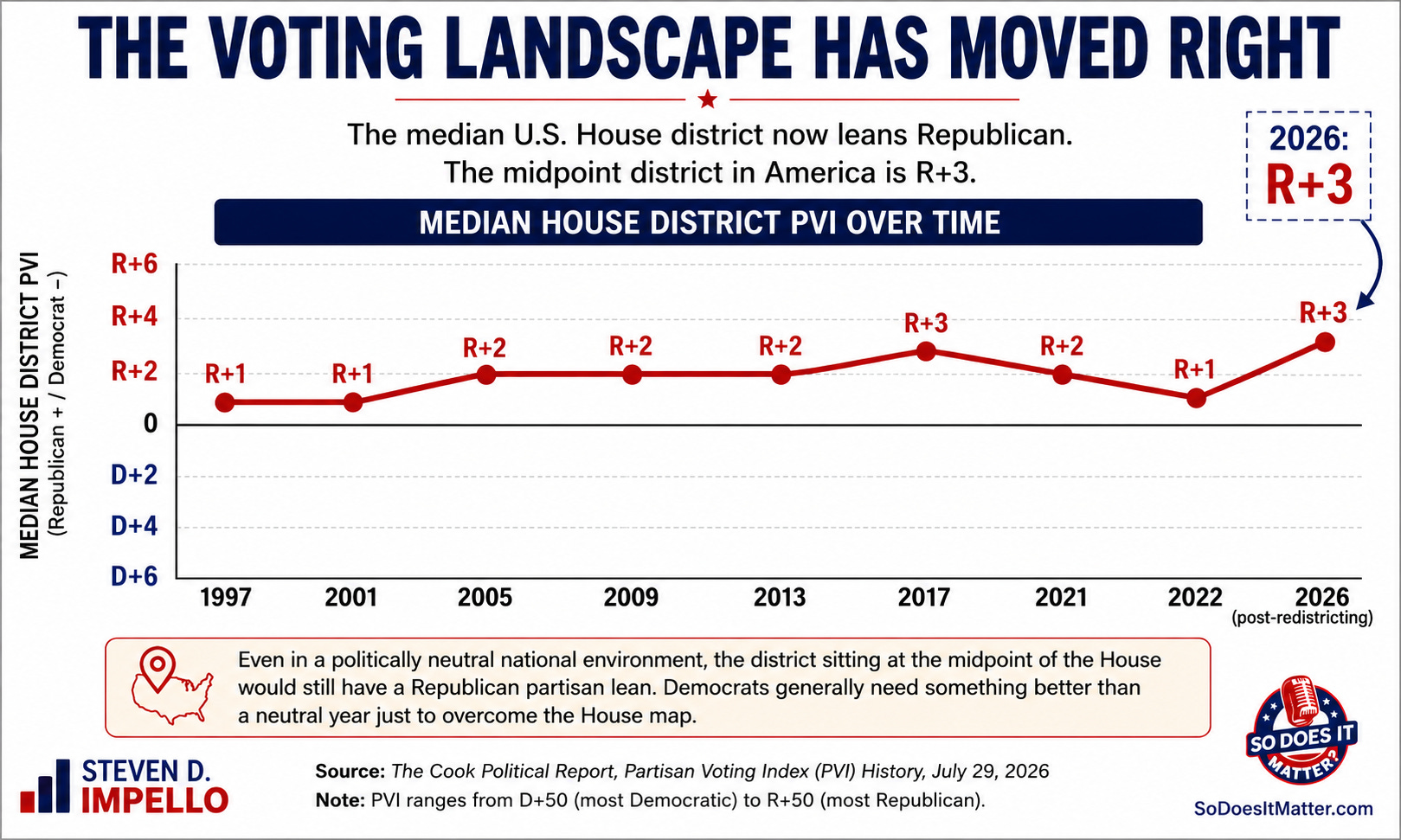
Here’s the number that jumped out at me: the median congressional district in America is now R+3. That’s a two-point move toward Republicans from before the latest round of redistricting.
That matters. Even in a politically neutral national environment, the district sitting at the midpoint of the House would still have a Republican partisan lean. Democrats generally need something better than a neutral year just to overcome the House map.
Now It’s Time For The Real Breakdowns — Buckle Up, There’s A Lot Here… But…
The rest of this column is for paid subscribers!
If you value independent political analysis that goes beyond the horse race and looks at the forces shaping elections underneath it, please consider upgrading your subscription. Paid readers make this work possible and unlock the deeper analysis below.
Below the paywall, I break down:
How the new House map effectively costs Democrats 12 seats
Why the number of competitive congressional districts has been cut by more than half
Why gerrymandering explains only part of what is happening
Why Democrats now need to dominate the remaining swing districts just to reach 218
How California became part of the national redistricting arms race
What all of this means for control of the House in 2026 — and beyond
