

Chris Cillizza’s Case For And Against Gavin Newsom For President
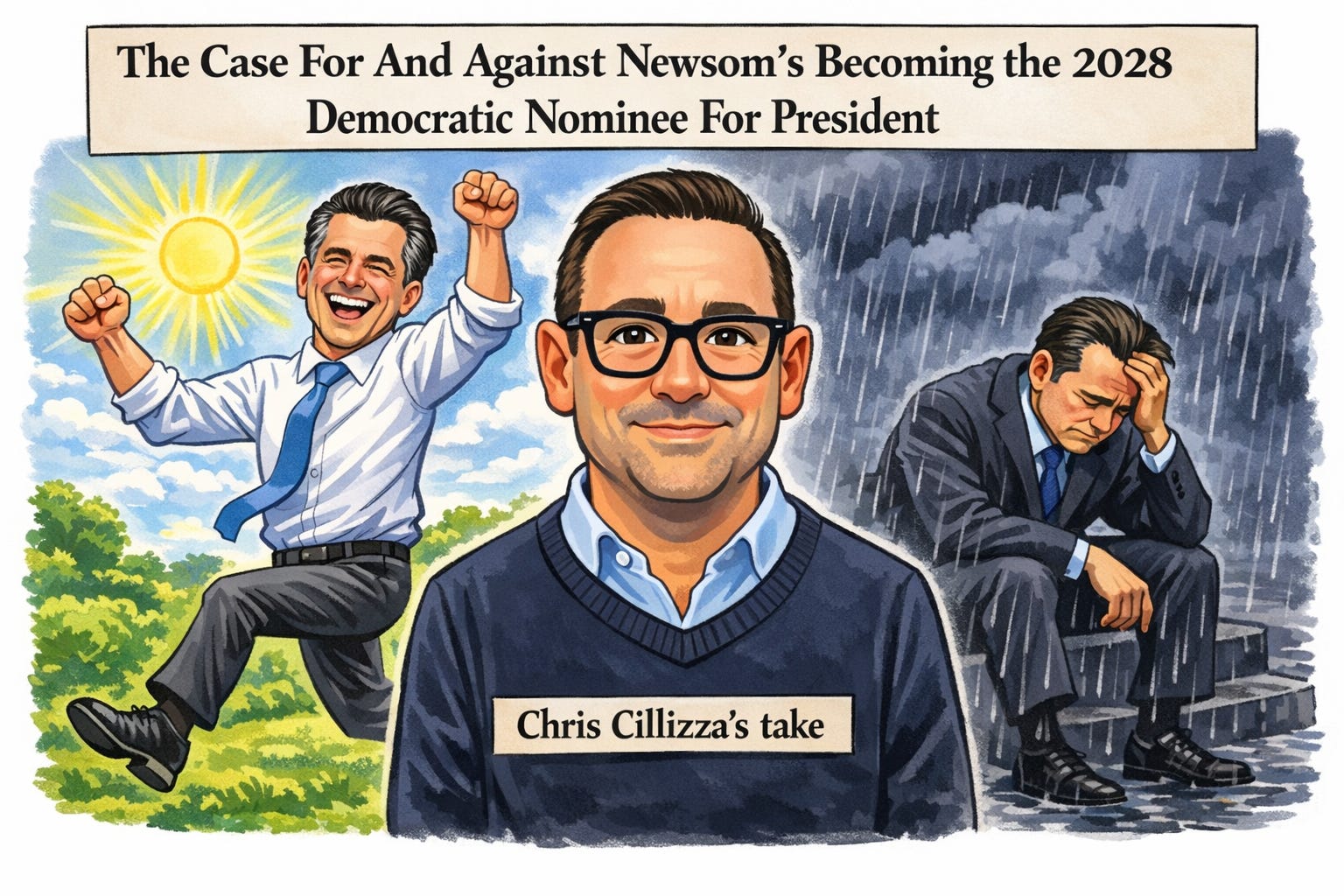
My friend Chris Cillizza lays out both sides of Gavin Newsom’s 2028 case, and both are worth a look.

You can also listen to this post — along with my California Our morning content is free for all subscribers and guests! You can also listen to this post — along with my California Post column — on our podcast feed, So, Does It Matter? SPOKEN. It’s available on your favorite podcasting app. You can listen directly here.
⏱️ 5 min read
Why I Am Writing About Chris’ Analysis
Today, my friend Chris Cillizza is an independent news creator on Substack and YouTube. Before that, he worked at CNN, The Washington Post, and, once upon a time, for National Journal. Chris was an invaluable resource, giving me advice before I started this Substack. He had already made the jump into independent media, knew what he was doing, and was generous with his time and perspective when I was getting started.
And Chris is building something very successful. He is closing in on a couple of hundred thousand YouTube subscribers and has tens of thousands of Substack subscribers. Well deserved.
Now, for my conservative readers, he is not a conservative. If you are looking for perspective through a conservative lens, he is not the place to go. But he does call balls and strikes, and he shares a lot of great information. I have a paid subscription to his Substack, both because of his content and to support his work. (Yes, maybe this is where I remind you that you can upgrade here to support my work.)
Anyway, Chris has launched a new feature where he runs down the pros and cons of each major 2028 presidential candidate. He started with Gavin Newsom, laying out yesterday the reasons why Newsom will be his party's nominee, and today the reasons why he will not.
At the risk of annoying Chris, not really, I am going to summarize his arguments here because I think you will find them interesting. But in return, let me do my part for Chris: go sign up for his stuff. It is worth it. Watch his videos on YouTube too. Just remember that Chris is not conservative or liberal in his approach. Set your expectations appropriately.
OK, on to the substance. (On his site, this content is much more fleshed out, and has charts, links to videos, and more.)
The Five Reasons Chris Says Newsom Could Be The Nominee
Chris’s first point is the simplest one: Newsom is already ahead. Whether you look at betting markets, early polling chatter, donor buzz, or the general invisible-primary conversation, Newsom is already in or near the top tier. Chris’s larger point is that early Democratic frontrunners in open-seat races usually do not disappear. They tend to wind up either with the nomination or in the final fight for it. Being perceived as the likely nominee attracts top staff, major donors, and institutional confidence. That matters, and Chris thinks Newsom has it.
Second, Chris says Newsom looks the part. Some people hate this argument, but it is not wrong. Running for president is not just a contest of white papers and policy memos. It is a persuasion contest, and presence matters. Newsom is tall, polished, camera-ready, and carries himself like someone who belongs on a national stage. Chris argues that this is not trivial. In politics, as in life, appearance and bearing can matter a great deal. Newsom has that advantage.
Third, Chris argues that where Newsom is from and the record he built there help him in a Democratic primary. California is a giant blue state with a huge delegate haul and a massive donor base. More importantly, it gave Newsom a place to build a record that aligns well with the modern Democratic base. Chris points to Newsom’s early move on same-sex marriage in San Francisco and his more recent aggressive positioning against Republicans as examples of a politician whose career has often tracked with where national Democratic activists are. In a Democratic primary, that is a strength.
Fourth, Chris says Newsom will have the money. This one is straightforward but important. Newsom knows how to raise serious money, has done it repeatedly, and has kept his fundraising machine well-oiled. In a modern presidential race, that is not some side issue. It is foundational. Money does not guarantee victory, but lacking it can end a candidacy fast. Chris’s view is that Newsom will be one of a very small number of Democrats capable of running a fully funded national campaign from the start.
Fifth, Chris says Newsom has carved out the Trump-foil lane. Democrats may still be figuring out their policy direction for 2028, but Chris thinks they know exactly one thing: they want someone willing to stand up to Donald Trump and punch back. Newsom has spent a lot of time cultivating exactly that image, whether online, in messaging, or through high-profile partisan battles. Chris thinks that he has real value with Democratic activists and base voters, even if Trump himself is not on the ballot in 2028.
The Three Reasons Chris Says Newsom Should Not Be
Then Chris flips the argument and makes the case against Newsom. He boils it down to three big problems.
The first is California, California, California. Chris argues that what helps Newsom in a Democratic primary could badly hurt him in a general election. Outside the coasts, and especially in the middle of the country, California is not broadly viewed as a model to emulate. It is often seen as an expensive, overregulated, left-wing mess. That means Newsom does not just come from California. He embodies California. He rose out of San Francisco politics and now governs the state itself. Chris argues that Republicans would have a ready-made playbook against him, and that voters may be very willing to accept it.
The second argument is that Newsom is too slick. This is the downside of the same polished image that Chris says helps him. Yes, Newsom looks like a presidential candidate. But he can also come off as overly polished, too smooth, too calculated, and too obviously ambitious. Chris points to the French Laundry episode as a perfect example of how that image gets reinforced. It fed the sense that Newsom is one of those politicians who thinks the rules are for other people. That kind of vibe can be poison in a national race, particularly when voters are already suspicious of elites.
The third, and perhaps most interesting, argument is that it is not entirely clear what Gavin Newsom actually believes. Chris notes that after Trump’s 2024 victory, Newsom seemed to flirt with the idea that Democrats needed to better understand MAGA voters and engage people outside the progressive bubble. He even had figures like Charlie Kirk, Michael Savage, and Steve Bannon on his podcast. At one point, he even broke with parts of his party over men in girls’ sports, framing it as a matter of fairness. But when the Democratic base made clear it had no interest in moderation or outreach, Newsom pivoted hard back into his role as an online anti-Trump brawler. Chris’ point is that this raises a real question of credibility. Is Newsom a centrist-minded pragmatist trying to broaden the party, or is he a full-spectrum progressive partisan warrior? Chris argues that Newsom has tried to be both, and that primary opponents would use that against him.
What Chris Gets Right About Newsom
What makes Chris’s exercise useful is that both cases make sense.
The case for Newsom is not hard to understand. He has the money, the ambition, the profile, the look, and a natural base inside today’s Democratic Party. If you were building a modern Democratic presidential candidate in a lab, Newsom would check a lot of the boxes. Chris is right about that.
But the case against him is just as real. Newsom carries California around his neck like an anvil in any national race. He has spent years governing a state that many Americans view as a cautionary tale rather than a success story. He often comes across less like a leader than a pitchman. And it is not unfair to ask whether his convictions are deeply held or simply whatever is most convenient for the moment.
That is why Newsom is such an interesting political figure. He is obviously talented. He is obviously ambitious. He is obviously a serious contender. But he is also obviously vulnerable in ways that are hard to paper over. Chris’s two pieces capture that tension well.
So, Does It Matter?
Yes, because it is a useful reminder that the case for Newsom and the case against Newsom can both be strong at the same time.
If you are a Democrat looking at 2028, you can easily see why Newsom would be attractive. He looks the part, raises money, commands attention, and knows how to fight. But if you are looking at him through the lens of a general election, you can just as easily see the risks. California baggage. Slickness. Flexibility that can look a lot like opportunism.
That is what makes Chris’s analysis worth reading, even for people who do not share his worldview. He is trying to evaluate the field clinically, not just cheerlead for one side.
So if you found this interesting, go check out Chris’s stuff on Substack and YouTube. It is worth your time.