

"Cap-And-Invest" Is California’s Affordability Crisis In Climate Clothing
Sacramento’s carbon-pricing scheme raises the cost of energy, fuel, goods, and services while producing little measurable effect on global emissions.

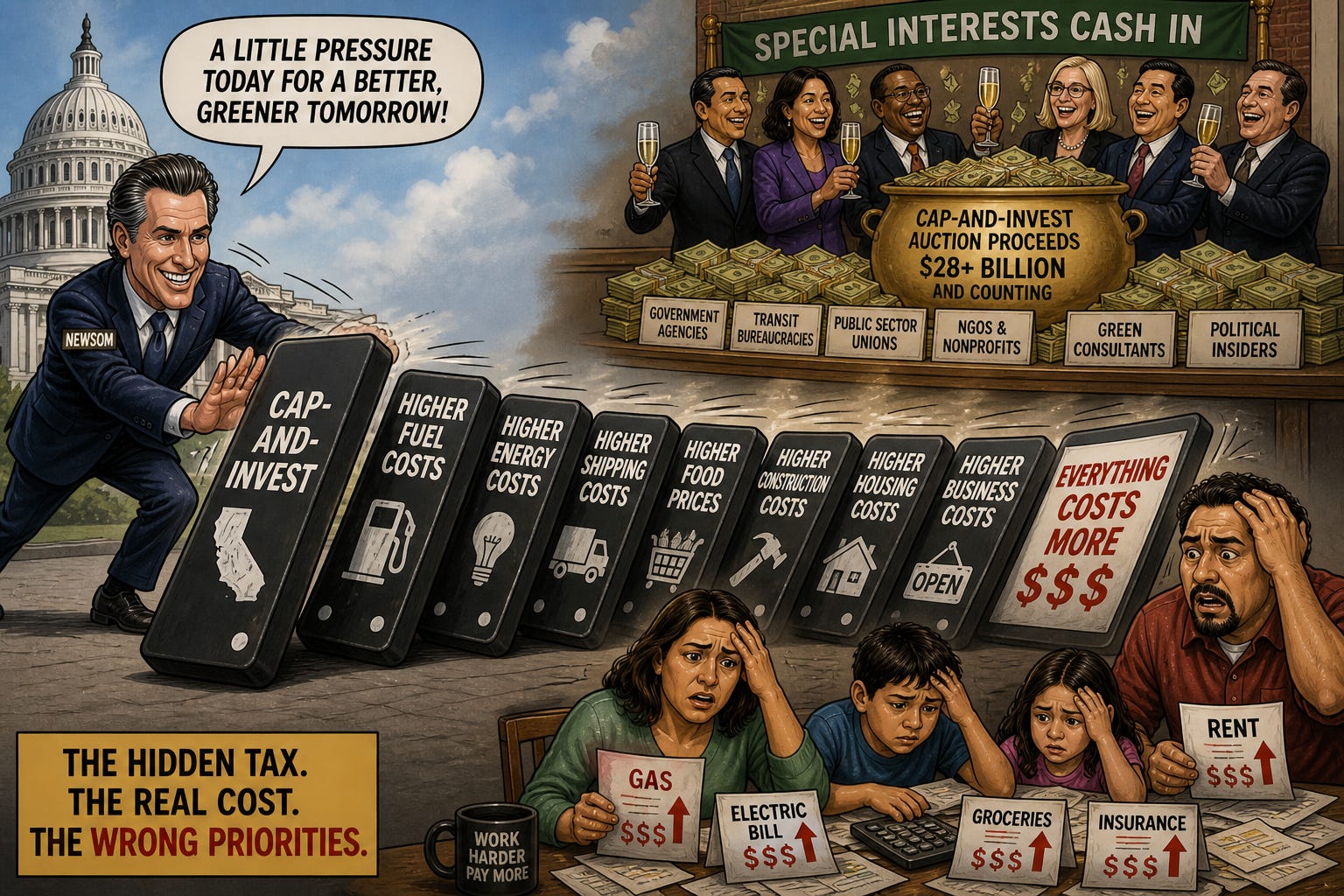
You can listen to this post on our podcast feed, So, Does It Matter? SPOKEN. It’s available on your favorite podcasting app, or you can find it here. Our afternoon content is typically either paywalled for our premium subscribers or has paywalled bonus content. Today, paid subscribers get access to three more premium political cartoons below the paywall. You have to see them - so good.
⏱️ 4-minute read
The Program Nobody Can Make Affordable
Sacramento has finally run into the central problem with Cap-and-Invest: the program works exactly as it was designed to. It makes carbon-intensive activity more expensive. The trouble for California politicians is that carbon-intensive activity is not some narrow category of villainous behavior. It includes driving to work, heating a home, growing food, shipping goods, building housing, running a business, and keeping the lights on.
That is why the latest fight at the California Air Resources Board is so revealing. CARB is trying to redesign the state’s emissions-trading program, formerly known as Cap-and-Trade, now rebranded as Cap-and-Invest. The name changed. The cost didn’t.
The agency is trying to split the difference between California’s climate ambitions and California’s cost-of-living crisis. So far, nobody seems happy. Environmental groups and progressive lawmakers complain that the proposed changes weaken the program. Oil and gas interests warn that more aggressive rules could further destabilize California’s fuel supply. Labor, housing, transit, and climate-spending constituencies worry that changes could reduce funding to the so-called Greenhouse Gas Reduction Fund.
This is not a bureaucratic dispute. It is the central contradiction of California's climate policy being exposed in public. If the program is stringent, it raises costs. If it is softened, climate activists say it no longer does the job. If revenues decline, the spending interests that have built their plans around carbon-auction proceeds panic.
A Hidden Tax By Another Name
At its core, Cap-and-Invest is a government-created market for permission to emit carbon. Regulated companies must obtain allowances. Those allowances cost money. The state collects the proceeds. The companies pass those costs along through the price of gasoline, natural gas, electricity, shipping, construction, manufacturing, food, and retail goods.
That is the whole design. It is not a side effect. It is the theory.
The political genius of the program is that the public rarely sees the cost as a direct tax. There is no line item on a grocery receipt or gas pump that says “Sacramento climate surcharge.” The cost is embedded invisibly into daily life. Consumers pay more, businesses absorb and pass along costs, and state government collects billions through a mechanism that avoids the political accountability of a direct tax increase. Since its launch in 2013, the program has extracted more than $28 billion from California’s private economy — averaging roughly $4 billion a year — with Sacramento now structurally dependent on that revenue to fund billions in annual spending commitments.
That is why calling this “investment” is so slippery. Sacramento is not investing its own money. It is extracting money from the private economy by making energy and production more expensive, then recycling the proceeds into favored programs. State Sen. Tony Strickland put it bluntly: Democrats’ idea of affordability was extending “a hidden tax that drives up costs on everything from gas to groceries.” He called it “economic sabotage” — and that is closer to the economic reality than anything Sacramento wants to say out loud.
You cannot make carbon more expensive without making life more expensive. Carbon is embedded in the modern economy. Punishing it means punishing mobility, production, construction, agriculture, logistics, and household energy use.
The Climate Math Sacramento Avoids
California’s climate political class prefers to talk about ambition, leadership, and moral example. It talks less about scale. That omission is not accidental.
California can reduce its emissions. What it cannot do is move the needle on global emissions trajectories by punishing residents inside one state's economy. The state accounts for only a tiny fraction of global greenhouse-gas emissions, while the largest sources of future emissions growth lie beyond Sacramento’s jurisdiction. China, India, global manufacturing, global shipping, and coal-intensive industrial expansion do not answer to CARB.
The gas price is real. The utility bill is real. The grocery bill is real. The construction cost is real. The business climate damage is real. The planetary effect is largely symbolic. Californians are being asked to pay real costs today for climate benefits that are, at best, globally marginal. Calling that policy serious is a stretch. It is ideological theater with a household bill attached.
That is why the affordability politics are getting harder for Sacramento to manage. Even some Democrats can read the polls and hear from constituents. They know gasoline prices, utility bills, housing costs, insurance premiums, and everyday consumer prices are crushing families. Defending a program premised on raising costs is a tough sell in a state already famous for being too expensive.
So, Does It Matter?
Cap-and-Invest is not an isolated environmental rule. It is part of a governing philosophy that treats private economic activity as a permanent base for extracting resources for Sacramento’s ambitions. The state raises costs, captures revenue, redistributes money through politically favored programs, and then expresses surprise when ordinary Californians say they cannot afford to live here.
The rebranding from Cap-and-Trade to Cap-and-Invest was not accidental. “Trade” sounded technical. “Invest” sounds generous. Neither label changes what the program actually does. It functions as a hidden tax and a permanent revenue platform. Once the revenue stream became large enough, Sacramento built a political economy around it. The practical beneficiaries are familiar: government agencies, public-sector unions, transit bureaucracies, politically connected nonprofits, and favored industries. Working families, commuters, small businesses, farmers, builders, and consumers get the bill. The poster child is the billions of dollars collected through this scheme, which funds the high-speed rail-to-nowhere effort.
The honest answer is not to rename the program, rebalance it, or hide the cost more effectively. The honest answer is to terminate it. California should stop pretending it can regulate the planet by making Californians poorer.
Tonight, seven leading candidates for governor will stand before voters and talk about California’s future — if the moderators even bring up the subject, and if they do, whether any candidate answers on point rather than retreating to talking points. Steve Hilton and Chad Bianco get it: both would move to collapse the program on day one. Matt Mahan may be the one Democrat willing to admit the implementation has been problematic, even if he stops short of indicting the goal itself — an answer that will satisfy nobody but at least reflects honest arithmetic. Then there are Xavier Becerra, Katie Porter, and Tom Steyer — the man who made a fortune in fossil fuels before reinventing himself as California’s climate conscience — who will defend the program without apology. Either way, voters will be watching. And what they know is that they can’t afford these kinds of programs that make everything more expensive in their lives.
More Political Cartoons!
Below the paywall are three more outstanding political cartoons on Cap and Invest that you don’t want to miss!
