

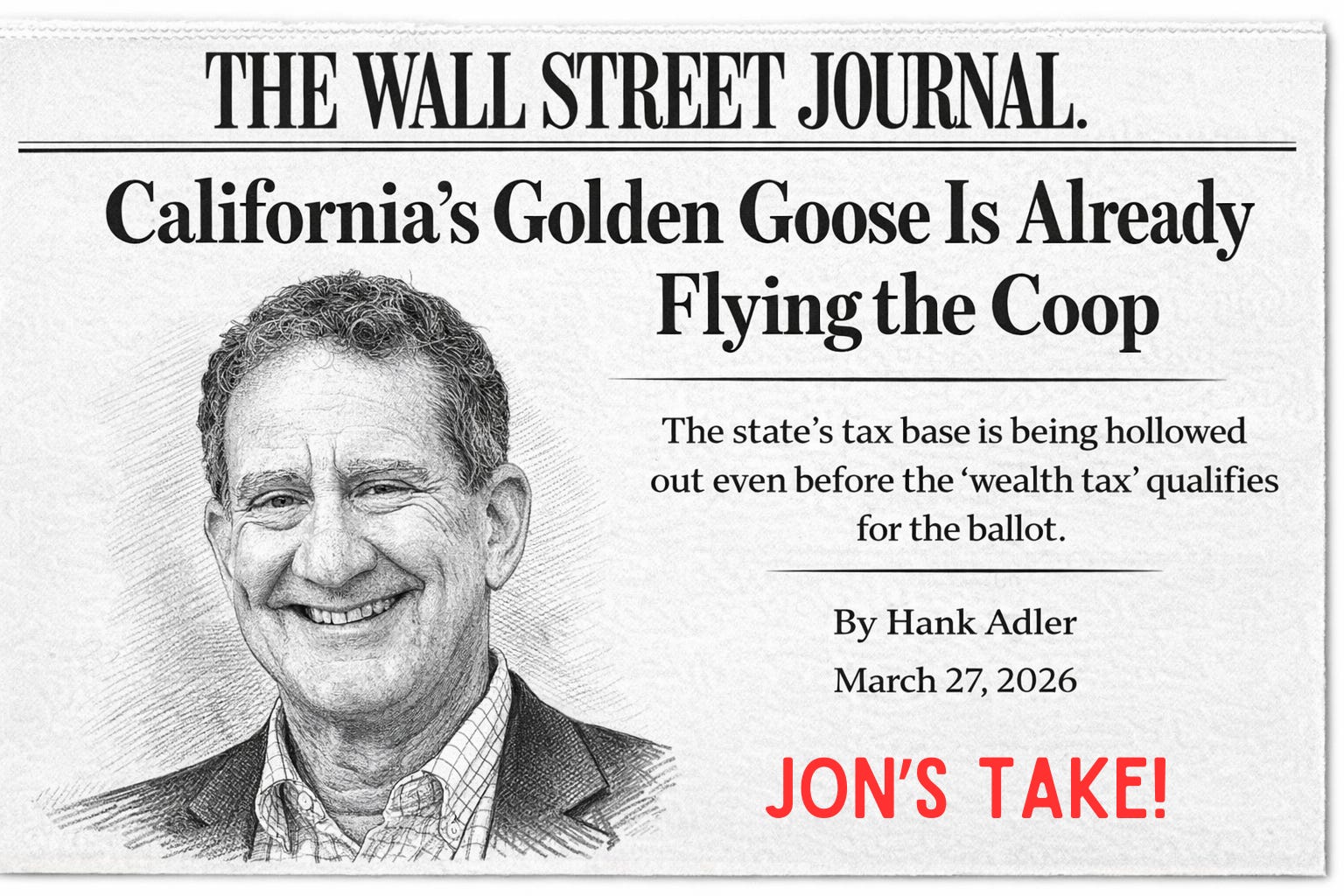
California’s Golden Goose Is Already Flying the Coop
Hank Adler In the WSJ: Even the threat of a wealth tax is accelerating the loss of the taxpayers Sacramento depends on most

Our afternoon columns typically have content for our paid subscribers. Either this column has a preview for all subscribers, but the bulk is below the paywall - OR - like today, there is exclusive content below the paywall to thank our paid subscribers. I have a hard-hitting video commentary that you will not want to miss! Paid subscribers just scroll down. If you’re a free subscriber, you get a one-time free pass - use it. Or a one-week free trial, try that! Or jump in and upgrade, and support this project!
You can listen to this post on our podcast feed, So, Does It Matter? SPOKEN. It’s available on your favorite podcasting app, or you can find it here.
⏱️ 6 min read
California’s Wealth Is Already on the Move
Over the weekend, I read an alarming opinion column from Friday’s issue of The Wall Street Journal warning that California’s tax base is already being hollowed out — not by enacted policy, but by the mere threat of a proposed “billionaire tax.”
Before a single vote has even been cast, the people Sacramento depends on most to fund government are already leaving.
The column was written by my friend of many decades, Hank Adler — a man who has forgotten more about finance than most people will ever learn. Adler, a professor of accounting at Chapman University and a former trustee of the Irvine Unified School District, lays out the case in clear economic terms.
And because the piece sits safely behind one of the tighter paywalls in media — unless you’re willing to shell out about $40 a month, which yes, I do — let me walk you through his argument, with full attribution.
The Damage Is Already Happening
California’s proposed “billionaire tax” hasn’t even qualified for the ballot yet. But according to Adler’s analysis, that almost doesn’t matter anymore.
The proposal would impose a 5% levy on individuals with net worths exceeding $1 billion, based on residency as of January 1, 2026. That retroactive trigger alone raises serious legal questions and sends an unmistakable signal to high earners: act now, not later.
When governments signal intent this clearly, behavior tends to follow. Wealthy individuals are already relocating or preparing to do so — not as a political statement, but as a rational financial decision.
The Billionaire Exodus Is Not Hypothetical
We’ve already seen this movie play out.
Elon Musk left for Texas. Larry Ellison relocated to Hawaii. More recently, Sergey Brin and Mark Zuckerberg have established residency in Florida.
Together, just a handful of these individuals once represented roughly $1.7 trillion of the approximately $1.8 trillion in wealth held by California’s six richest residents earlier this decade.
It’s not in Adler’s piece, but it’s not just founders cashing out. Dara Khosrowshahi, the sitting CEO of Uber, has also relocated to Texas — a reminder that this isn’t about past wealth, but about where current decision-makers choose to live and pay taxes.
Mark my words: companies tend to follow their leadership, and over time, that means investment — and jobs — moving to the states where these decision-makers now reside.
These are not marginal taxpayers. When they leave, California doesn’t just lose current revenue. It loses future windfalls — particularly from capital gains that may now be realized entirely outside the state’s reach.
California’s Entire Model Depends on the Few
California’s tax structure is highly concentrated. Roughly 40% of personal income tax revenue comes from the top 1% of earners.
That means a very small number of people are carrying a very large share of the load. Lose even a handful of them, and the fiscal consequences are immediate.
That matters even more because California relies heavily on capital gains — a volatile but lucrative source of revenue tied directly to high earners. Once those individuals relocate, Sacramento forfeits years, even decades, of future tax collections tied to their investments.
The Policy Incentive Is Backward
Supporters of the tax argue it could generate as much as $100 billion in revenue.
But that estimate assumes the targeted taxpayers will stay put.
Adler highlights a much lower projection from the Hoover Institution — roughly $40 billion — based on the far more realistic assumption that wealthy individuals are mobile.
That gap reflects a basic disagreement: whether the wealthy will stay or leave. So far, the early evidence points one way — they’re leaving.
The Legal Risks Could Make It Worse
Even if the tax passes, it may not survive.
The proposal raises serious constitutional questions, particularly around retroactivity and attempts to tax wealth accumulated outside California.
If courts ultimately strike it down, the state could be forced to refund tens of billions of dollars — with interest — after that money has already been spent. That is a fiscal risk California is in no position to absorb.
So, Does It Matter?
California is already facing projected structural budget deficits of $22 billion to $35 billion annually over the next several years. Losing even a small number of top taxpayers only deepens that hole.
The policy hasn’t even passed, and yet you can already see the effects.
California has built a system that depends heavily on a small number of extremely successful people — and at the same time is signaling that those same people are targets.
When that happens, they don’t stay and negotiate. They leave.
And when they leave, the revenue doesn’t just decline — a lot of it disappears, often permanently, beyond the reach of California’s tax system.
Video Commentary
I have a video commentary below for paid subscribers!
