

California’s Glock Ban Has Arrived — And It Reveals The Real Strategy Behind Its Gun Laws
One of America’s most popular handgun platforms is being pushed out of California’s marketplace, and the constitutional fight is just getting started.


MY BAD, I THINK I MANAGED TO SEND THIS TO PAID SUBSCRIBERS ONLY EARLIER - VACATION BRAIN - SINCE I MESSED UP, I WILL MAKE THIS AVAILABLE TO ALL SUBSCRIBERS :-)
Typically, our afternoon content is behind a paywall… or there’s something extra for paid subscribers. If you are not one, please consider upgrading — you are missing a significant portion of what we produce each week, and your support makes it possible. If you want to get it all and support my efforts, please consider a paid subscription!
Because most of this content is paywalled, it is not available on our podcasting channels.
⏱️ 6 minute read
The Drop-Dead Date
At the beginning of next month, on July first, California begins enforcing Assembly Bill 1127. The law effectively cuts off the future retail sale of Glock pistols and Glock-style handguns across the state.
Supporters claim the law targets “Glock switches”—illegal conversion devices that can turn a semiautomatic pistol into a makeshift machine gun. But machine guns are already illegal. Switches are already illegal. Using one in a crime is already heavily penalized.
Sacramento Democrats did not go after the criminal underground with this bill. They went after the display cases at your local gun store. I say Democrats because not a single Republican voted for this bill in either legislative chamber.
The mechanism matters. AB 1127 does not ban every striker-fired pistol. Instead, it targets pistols that use a cruciform trigger bar—the internal Glock component that interacts with the rear backplate where illegal switches are mounted.
This is not some obscure firearm. Glock is one of the definitive modern handgun platforms. It is what police officers carry, what civilians buy for home defense, and what millions of Americans train with. There are millions of them in the hands of law-abiding citizens.
You have now read roughly 20% of this column. The remaining 80% — including the constitutional issues, the response from California’s leading gun-rights organizations, and why this fight is about much more than Glock — is reserved for paid subscribers.
PAID SUBSCRIBERS GET THE FULL COLUMN
Below the paywall:
Why July 1 may mark the beginning of this fight, not the end of it.
What California’s major Second Amendment organizations are saying about what comes next.
The Supreme Court doctrine that could determine the law's fate.
The regulatory trap Sacramento spent years building for itself.
The question supporters of the ban still struggle to answer.
Upgrade today and get this and a lot more!
The Sacramento Playbook
The implementation timeline has left many buyers stranded. Because of California’s mandatory 10-day waiting period, the practical deadline to start background paperwork on a brand-new Glock was actually June 20. Anyone who waited until the final week before July 1 found out the hard way that the window had already slammed shut.
If you still see Glocks on dealer shelves over the next few months, it is because of a tightly regulated exception: dealers can only sell off stock that was physically logged into their inventory before January 1 of this year. Once that grandfathered inventory dries up, the pipeline is entirely dead.
This is not a possession ban. If you already legally own a Glock in California, you can keep it. You can even still legally buy a used one from a fellow citizen through a Private Party Transfer at a licensed dealer. But as far as walking into a shop and buying a brand-new factory model? That option disappears on July 1. Frankly, given the ten-day waiting period, the practical deadline for purchasing a Glock has passed since you could not take possession before the first of July.
AB 1127 fits perfectly into a predictable Sacramento rhythm.
California has long been a testing ground for restrictive gun control. The state restricts magazine capacity, treats ammunition purchases like controlled substances, levies heavy specialty taxes, and subjects buyers to a rigid, shrinking Handgun Roster.
The justification is always wrapped in the language of public safety. But look closely at the pattern: the state identifies a mainstream piece of lawful gun ownership, highlights how a criminal might abuse it, and uses that abuse to restrict the law-abiding majority.
The hyper-targeted nature of this bill gives the game away. Highly popular striker-fired alternatives—like the Sig Sauer P320 or Smith & Wesson M&P series—remain completely untouched and legal on the state roster because their internal mechanics do not feature that specific cruciform bar. This is not a sweeping safety standard. It is a pinpoint bottleneck on the market leader.
Gun-rights groups are not letting it slide. The California Rifle & Pistol Association has been coordinating with local dealers to manage the logistical mess of grandfathered inventory. A host of groups have been vocally critical of this new law, including the Gun Owners of California, CRPA, the Second Amendment Foundation, and others.
The “Common Use” Collision Course
The underlying reality of this fight is simple: Glocks are everywhere.
That fact carries immense weight in a post-Bruen legal landscape. Modern Supreme Court precedent protects firearms that are in “common use” by law-abiding citizens for lawful purposes. Glocks are not rare, exotic, or fringe collector’s items. They are the benchmark for modern self-defense.
As the July 1 cutoff takes effect, expect swift and comprehensive litigation from the state’s leading Second Amendment organizations. This is exactly the kind of law they are built to challenge: a targeted ban on one of the most common handgun platforms in America, imposed not because law-abiding owners are misusing it, but because criminals might illegally modify it.
The legal question will not be about dealer paperwork or technical definitions. It will be much more basic: can a state shut down the sale of one of America’s most common handgun platforms because criminals may illegally modify it?
That question matters far beyond Glock. If the state can ban a constitutionally protected product because someone else may illegally alter it, the limiting principle becomes hard to find. The same theory could be applied again and again: identify a lawful object, point to criminal misuse, and then restrict the lawful market.
That is why this fight is likely to become one of the more important Second Amendment challenges coming out of California. It is not merely about whether a particular model of handgun remains on store shelves. It is about whether the state can use criminal conduct as a pretext to shrink the lawful exercise of a constitutional right.
The Irony of the Roster
The most frustrating element of AB 1127 is the structural trap California built for its own citizens.
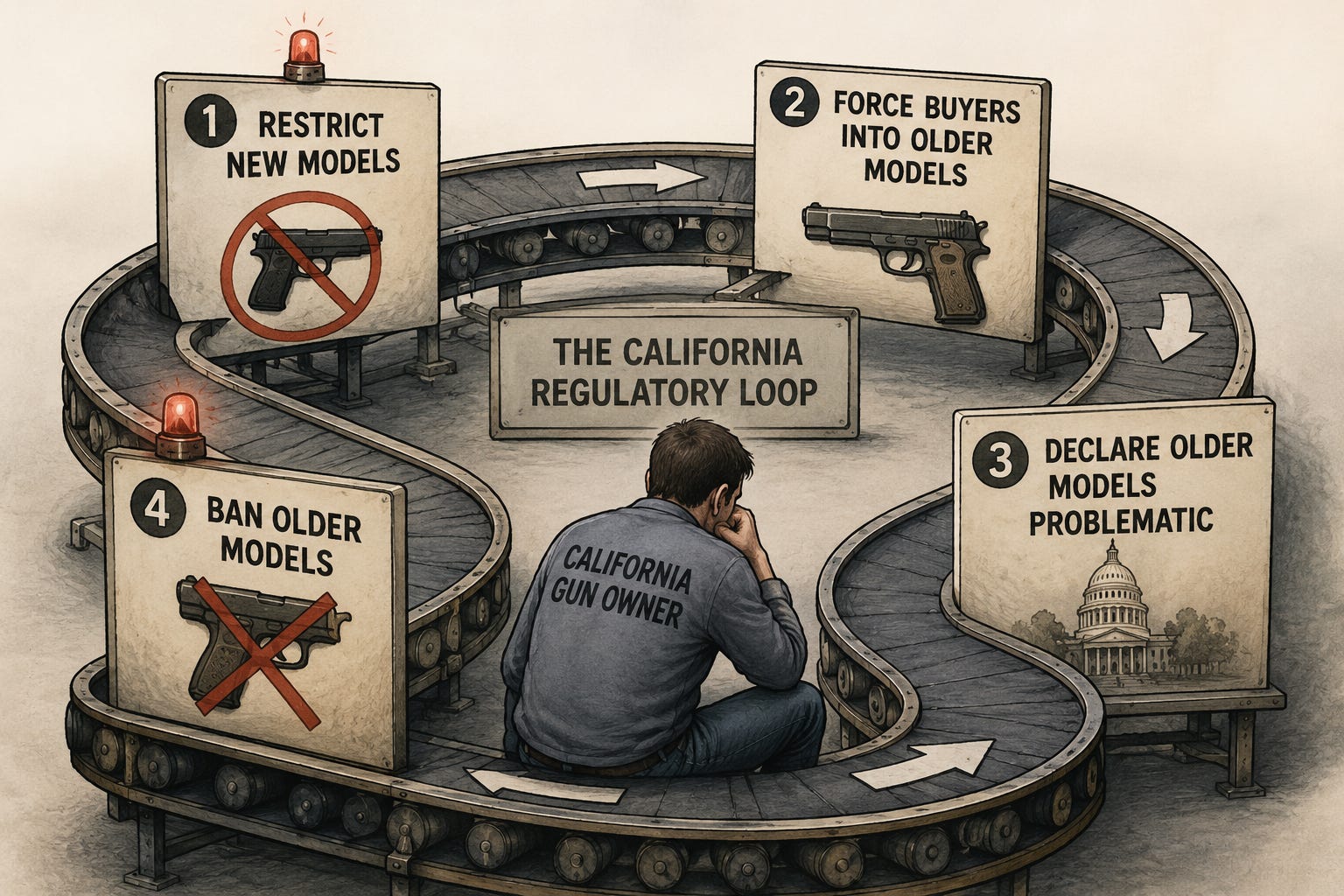
For nearly two decades, California’s microstamping and roster laws froze the market, effectively preventing residents from buying newer generations of handguns. This forced everyday buyers to keep purchasing older, “grandfathered” generations of Glocks.
Then, lawmakers turned around, looked at those exact older models, and claimed their design made them too easy for criminals to alter.
It is the ultimate bureaucratic loop: first, the state restricts your choices, then it bans the remaining choices because everyone is using them.
That point should not be missed. California did not arrive at this market by accident. The state created it. The roster narrowed consumer choice, discouraged newer designs from entering the market, and left Californians dependent on a smaller pool of approved models. Now, Sacramento is using the predictable result of its own regulatory scheme to justify even more regulation.
There are still striker-fired alternatives available. Sig Sauer and Smith & Wesson models remain legal precisely because their internal designs do not match the narrow mechanism targeted by AB 1127. That fact weakens the public-safety argument. If the state were really creating a broad safety standard, the law would look very different. Instead, it looks like a law written to squeeze one dominant platform out of the California market.
A Theory With No Limiting Principle
If a firearm can be erased from the retail market simply because a criminal might illegally modify it, the state’s regulatory power has no logical endpoint. Virtually any mechanical tool can be altered or misused. If the government is allowed to regulate a constitutional right based entirely on hypothetical criminal tampering rather than the behavior of the lawful owner, the right itself becomes hollow.
Today it is a specific trigger mechanism on a Glock. Tomorrow it will be something else. The playbook never changes: find a genuine criminal issue, attach it to a lawful product, and penalize the buyer who follows the law.
That is the real warning here. California’s gun laws are rarely sold as outright bans on the Second Amendment. They are sold as technical fixes, safety updates, roster refinements, ammunition rules, tax adjustments, and dealer requirements. Each one is defended as limited. Each one is described as reasonable. But the cumulative effect is obvious: lawful ownership becomes harder, narrower, more expensive, and more dependent on Sacramento’s permission.
So, Does It Matter?
AB 1127 was never really about the mechanics of a handgun. It is about a steady, incremental narrowing of the Second Amendment until it exists purely on paper.
You may still technically have the right to own a firearm, but only from a shrinking, specialized list approved by Sacramento. You may still have the right to defend your home, but only with the specific tools politicians have not targeted yet. Every year, the state finds a new way to ensure that a constitutional guarantee becomes harder and more expensive to exercise.
For the authors of this bill, cutting off access to one of the country’s baseline self-defense tools is considered progress. For those trying to survive under California’s regulatory regime, it is just another reminder of who Sacramento really trusts.
And of course we must remember that elections have consequences. As long as Californians keep electing politicians who do not respect the important role that private gun ownership plays in a society with a limited role for government, do not be surprised at the results…