

California’s Climate Experiment Has Gone Far Enough
Climate science cannot tell Sacramento what car you should drive, what energy should cost or how much freedom government may take.

Our morning content is free for all subscribers and guests! Usually our afternoon content is behind a paywall… If you are not yet a paid subscriber, consider upgrading — you are missing a significant portion of what we produce each week, and your support makes it possible. If you want to get it all and support my efforts, please consider a paid subscription!
Most of our content is available on our podcast feed. So, Does It Matter? SPOKEN. Which is available on your favorite podcast app. You can listen to it right here as well.
🕐 6-Minute Read
The Science Card
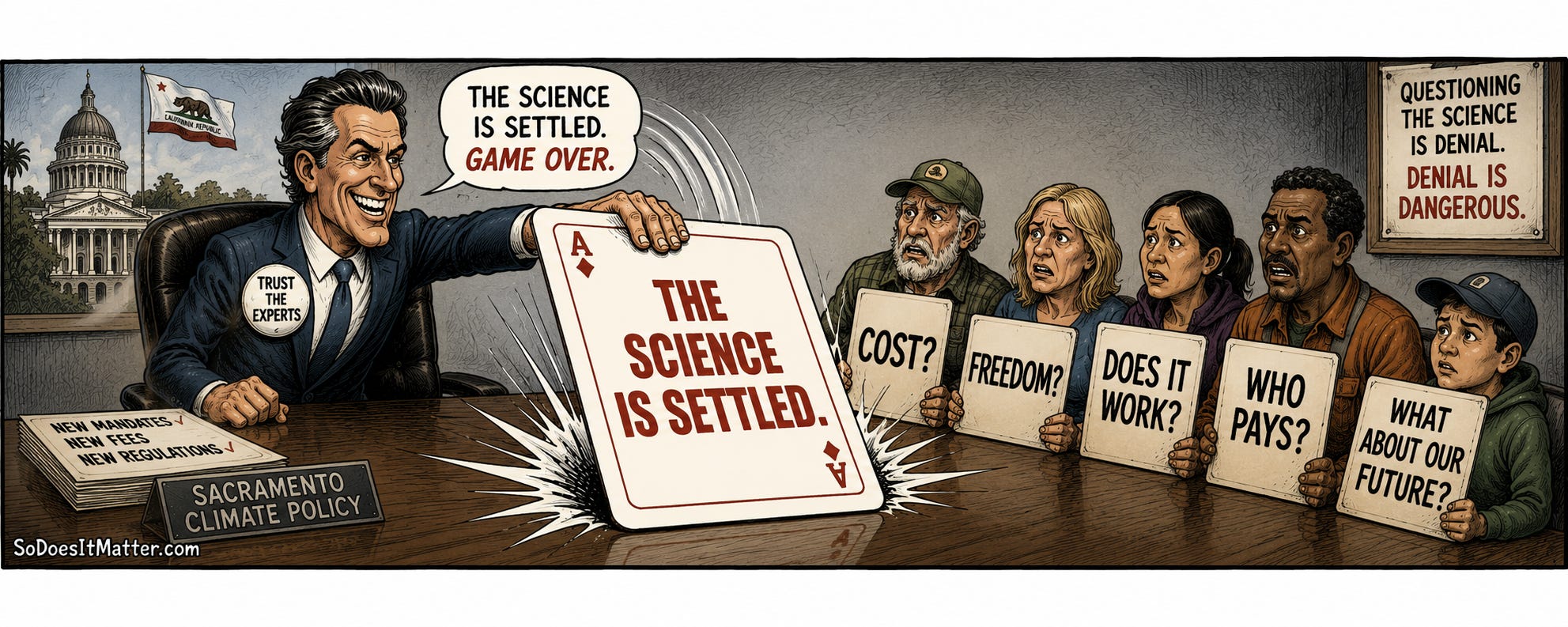
“The science is settled.”
You’ve heard it. Maybe from a governor explaining another mandate, or a regulator explaining why your gas bill went up again. It’s Sacramento’s all-purpose conversation stopper: question a regulation, and the science is settled.
Except it didn’t.
Science can tell us the Earth is warming and measure how greenhouse gases affect global temperatures. What it doesn’t measure is freedom — how much of yours a given policy is worth, or whether imposing it on you is worth the cost.
Those aren’t scientific questions. They’re political and economic ones. And in a free state, liberty is supposed to be the default position — not something you have to win back, mandate by mandate, fee by fee.
Give California’s policymakers the benefit of every doubt. Assume they’re dead right about the underlying science. They still owe you an answer to a pretty basic question:
Which of these taxes, fees, mandates and regulations actually produce benefits big enough to justify what they cost you?
California met climate change with a machine, not a single law — one that’s been running you through it for years, treating skepticism about any policy as skepticism about science itself. Those are different things, and somebody needs to say so.
California’s Grand Experiment
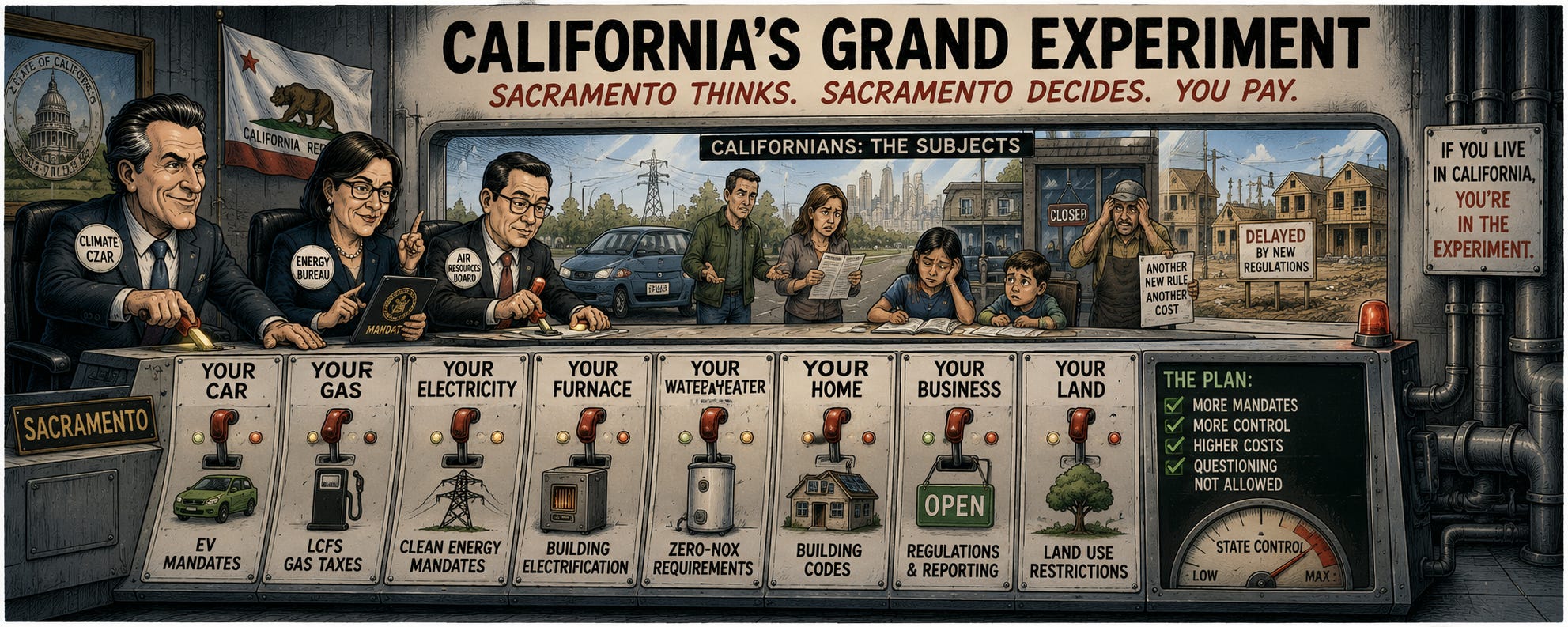
One law was never going to cover it. California built a system that reaches into nearly every corner of your life.
What kind of new car you’ll eventually be allowed to buy. What fuel goes in it. How your electricity gets made and what it costs you. What kind of water heater or furnace state policy is quietly pushing you toward.
Behind it all: an alphabet soup of programs. Cap-and-trade — rebranded “Cap-and-Invest,” like a fresh coat of paint fixes anything. The Low Carbon Fuel Standard. Renewable electricity mandates. Clean-car and clean-truck rules. Building electrification. Methane regulations. Corporate climate disclosures. Land-use policies designed to get you out of your car.
And that’s the short list.
Do any of these actually work? I doubt most of them do — and nobody in Sacramento has ever had to prove otherwise.
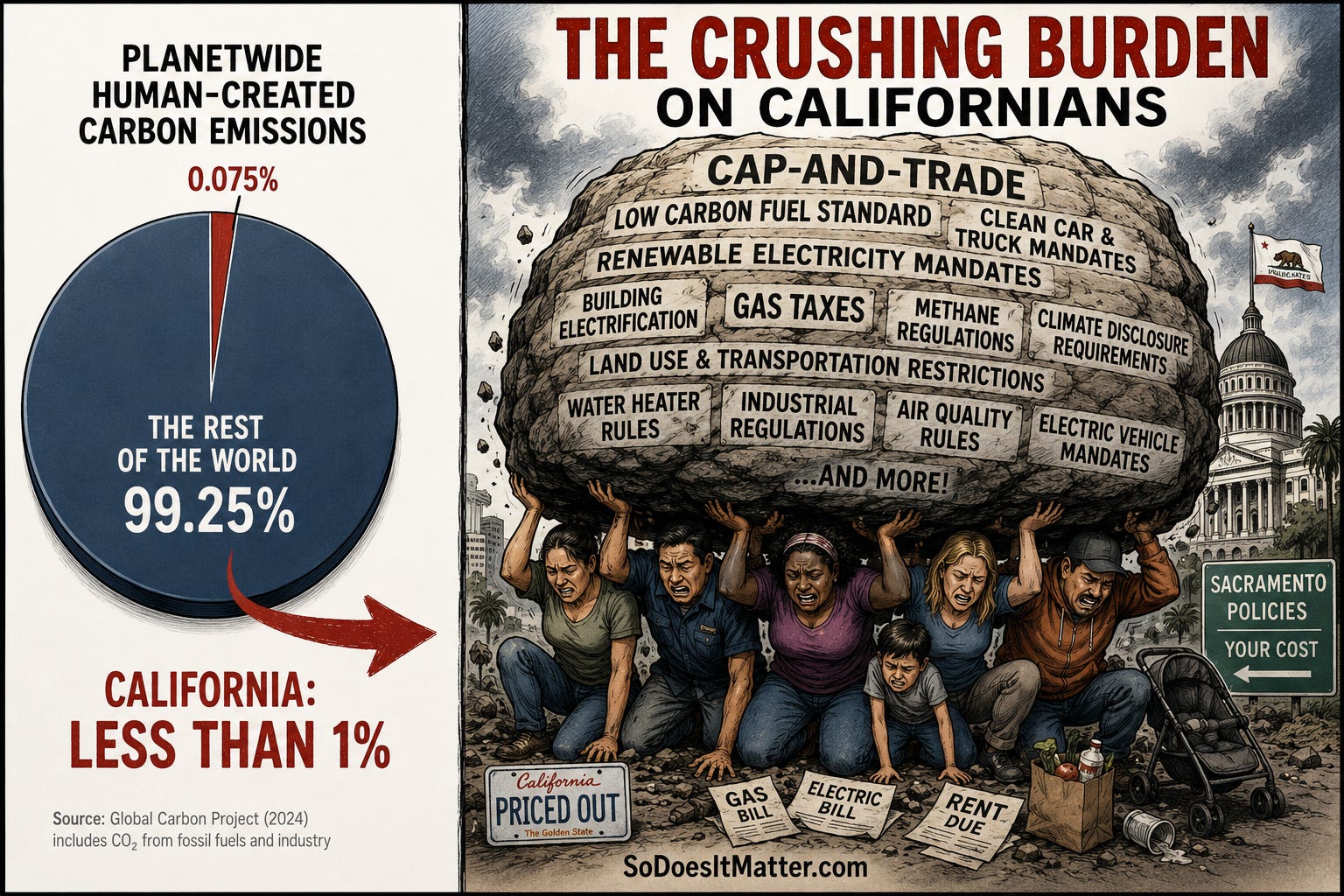
Instead, California keeps piling one policy on the next, using the same logic: greenhouse gases are a problem, California must lead, so here’s another mandate. That skips a step. California accounts for less than 1% of the world’s greenhouse-gas emissions. Keep that number in your pocket — you’ll need it later. That doesn’t mean California should do nothing. It means that when the state extracts real money from 40 million people to move a global thermostat it can’t actually move alone, you’re entitled to ask what you’re getting for it.
What Are We Paying For?
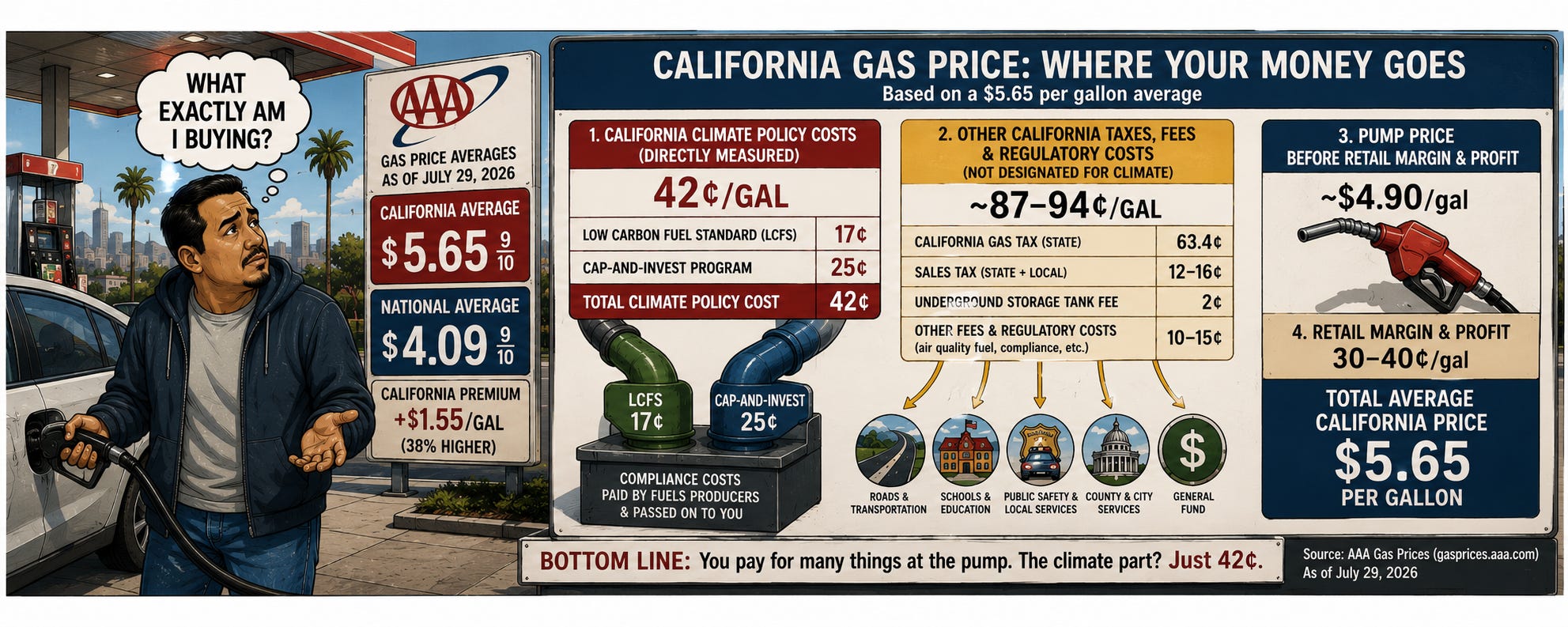
Start with gasoline. In January 2026, the California Energy Commission put the Low Carbon Fuel Standard at about 17 cents a gallon and cap-and-trade at another 25 cents — 42 cents you’re paying every time you fill up.
Maybe that’s worth it. But “maybe” is doing a lot of work there.
What are you actually buying for those 42 cents? And how does that math look for a family with no real alternative to driving?
Then there’s your electricity bill. California requires 60% renewable power by 2030, with a 2045 target of zero-carbon electricity — a target state modeling says could add roughly 6% to total system costs. That doesn’t stop at your meter: businesses pay more for power too, and pass it along in your grocery bill, your dry cleaning, everything else you buy.
The estimates will shift. The bill won’t. You’ll be the one paying it.
Gasoline and electricity are just the two easiest to price. There are dozens more mandates like them, buried in places you’d expect — housing, appliances, manufacturing — and plenty you wouldn’t.
Who Proves It Works?
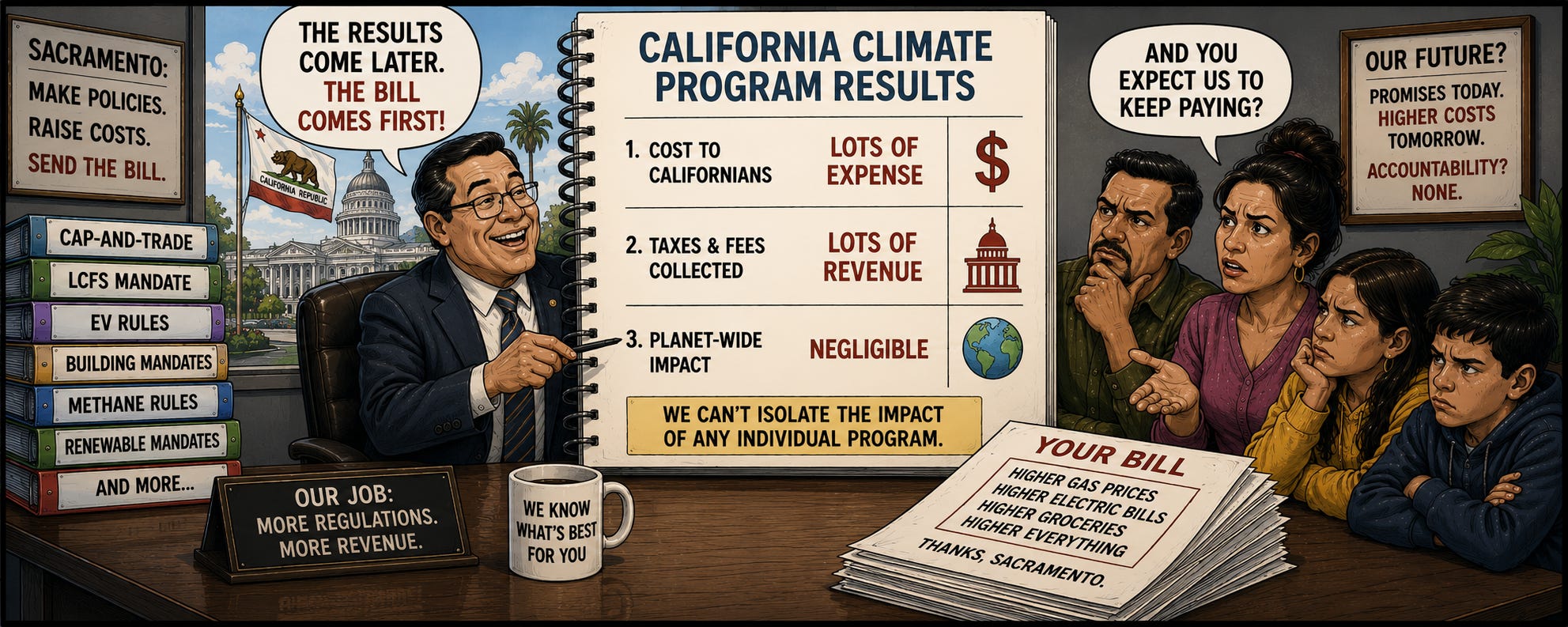
Here’s the part Sacramento would rather you not dwell on: nobody can reliably tell you what most of these policies actually accomplished.
California’s own nonpartisan Legislative Analyst’s Office says it knows of no reliable study isolating cap-and-trade’s effect on emissions — they’ve fallen, but alongside renewable mandates, vehicle standards, fuel rules and a dozen other programs running at once. Untangling cap-and-trade’s own contribution? Nobody’s done it.
The LAO does say cap-and-trade is more cost-effective than most other state programs. Granted. That still doesn’t tell you how much reduction it produced, or whether it changed the planet’s temperature.
The costs are easier to find. The Legislative Analyst estimates that if allowance prices hit the program’s statutory ceiling, cap-and-trade alone could add roughly 74 cents a gallon and cost the average household about $700 a year — hitting lower-income families hardest.
California’s air isn’t sealed off from Nevada’s by some kind of glass dome. If Sacramento wants you paying substantially more for everything to move a global number, asking what difference it makes is basic accountability — not denial.
Here’s the principle: proof comes before the bill, not after. Sacramento should have to show a regulation works before it’s allowed to charge you for it.
That’s the minimum a free people should ever accept. But proving a regulation works is only the first question. The harder one is what should even count as proof.
Science Cannot Choose Policy

Alex Epstein’s work has shaped a lot of my thinking here. Epstein is a philosopher and energy advocate who refuses to let carbon emissions be the only number that counts. His question is bigger: does a policy make human life better — does it advance what he calls “human flourishing”?
Here’s his sharpest point, and it’s the one Sacramento never wants to hear: energy abundance is itself a form of climate protection. The people best protected from heat waves, droughts and storms are the ones who used the most energy, not the least — the ones who could afford air conditioning, hardened infrastructure, modern agriculture. Take energy away from people in the name of fighting climate change, and you can make them more vulnerable to the very thing you claim to be fighting.
Reducing emissions belongs on the ledger. It doesn’t get to be the whole ledger.
Weigh it honestly and you’re counting more than carbon: reliable electricity, affordable gas, air conditioning, mobility, jobs, growth — all on the same scale as the environment.
No formula takes the parts-per-million of carbon dioxide in the air and spits out the correct gasoline tax or water heater rule. None exists. At some point science ends, and judgment — made by people who answer to voters — has to begin.
This is economics, values and the size of government power over your life — not science, whatever lab coat gets put on to declare the matter closed.
So, Does It Matter?
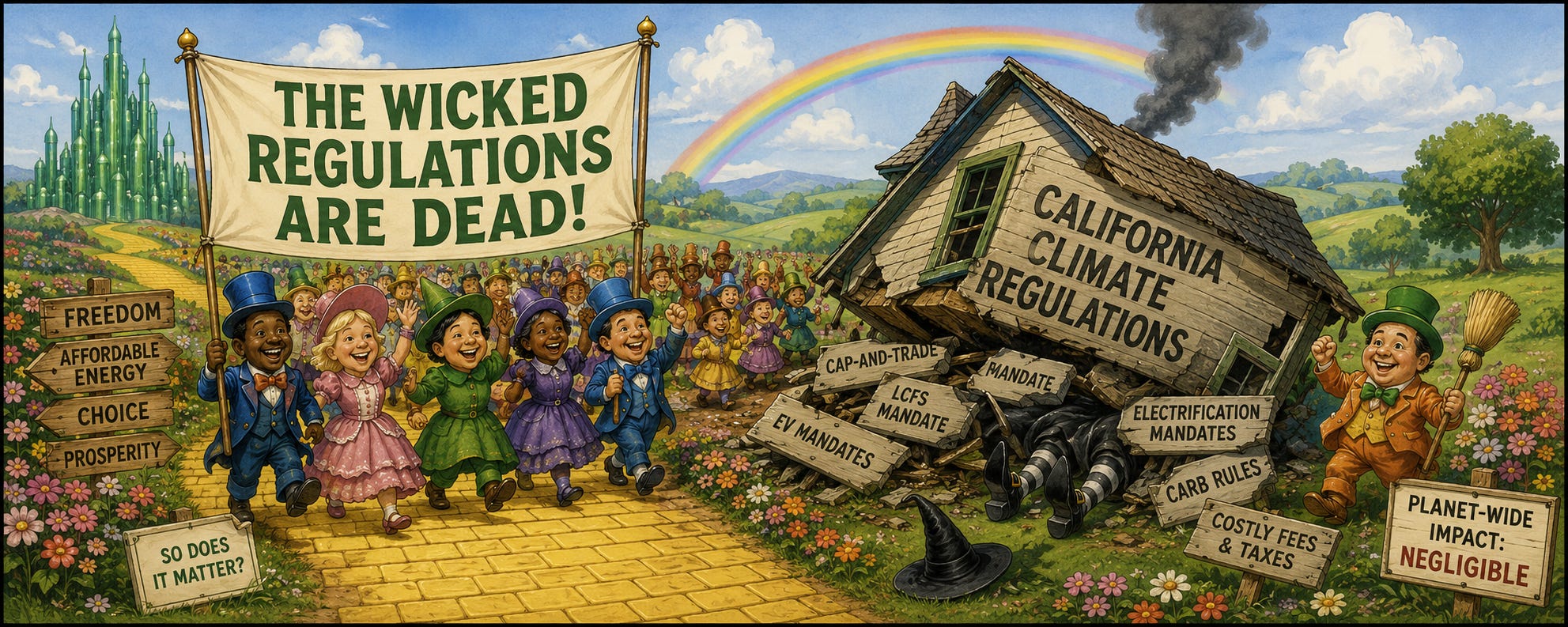
California has spent decades stacking climate taxes, fees, mandates and regulations, treating each as permanent the moment it hits the books. Once a regulation moves in, it’s got squatter’s rights.
Here’s the elephant in the room nobody in Sacramento wants to name: there is no moral, political or environmental justification — none — for regulations this sweeping and this expensive, imposed on a single state that accounts for less than 1% of the planet’s human-made carbon emissions. California could shut down every car, furnace and factory tomorrow, and the global climate wouldn’t notice. That doesn’t mean California should do nothing. It means nobody gets to wave away the cost by pointing at the sky.
Which is why the answer isn’t to reconsider these programs — reconsidering implies some might be worth keeping, and given what one state acting alone can accomplish, none are. What California owes its residents instead is an orderly termination: real wind-down timelines, real transition periods where they’re genuinely needed, but a clear, honest exit from cap-and-trade, the Low Carbon Fuel Standard, the electrification mandates and everything else on the list.
None of this is an accident. If nothing here can be justified, why does it keep piling up anyway? Here’s the part that should make you angry: a lot of the people demanding you accept “the science” aren’t following data at all. They’re progressive ideologues who’ve found a climate-shaped vehicle for what they actually want — bigger government, more control, less of your money left in your own pocket. The climate benefit is secondary. Growing the state is the point.
Underneath that ideology is another kind of rationale, delivered with the same quiet certainty as a line from The Mandalorian: This is the way. California has to go first, the theory goes, and if enough other states — other countries — eventually follow, the sacrifice was worth it.
Maybe. But that’s a bet placed with other people’s money, by politicians who don’t have to live with the bill. It’s the same Californians, year after year, funding a strategy that depends on the rest of the planet copying us — while living through an affordability crisis of epic proportions: priced out of housing, squeezed at the pump, watching their power bill climb every summer. Asking Californians alone to bankroll the world’s climate conscience isn’t leadership. It’s a very expensive kind of unfairness.
Nobody serious questions that carbon dioxide affects the climate. What’s actually in dispute is whether that fact justifies every tax, fee, mandate and restriction California politicians have bolted onto it. For too long, Sacramento has assumed the answer is yes, without ever having to prove it. That failure isn’t a reason for more time. It’s a reason to start winding this down.
Liberty should be presumed. The imposition of regulation in place of it requires significant justification in the United States of America, which last I checked includes California.