

California Patriot Profile: Edwin Meese III, 75th Attorney General of the United States
The man who stood beside Ronald Reagan from Sacramento to Washington, helping shape modern American conservatism.

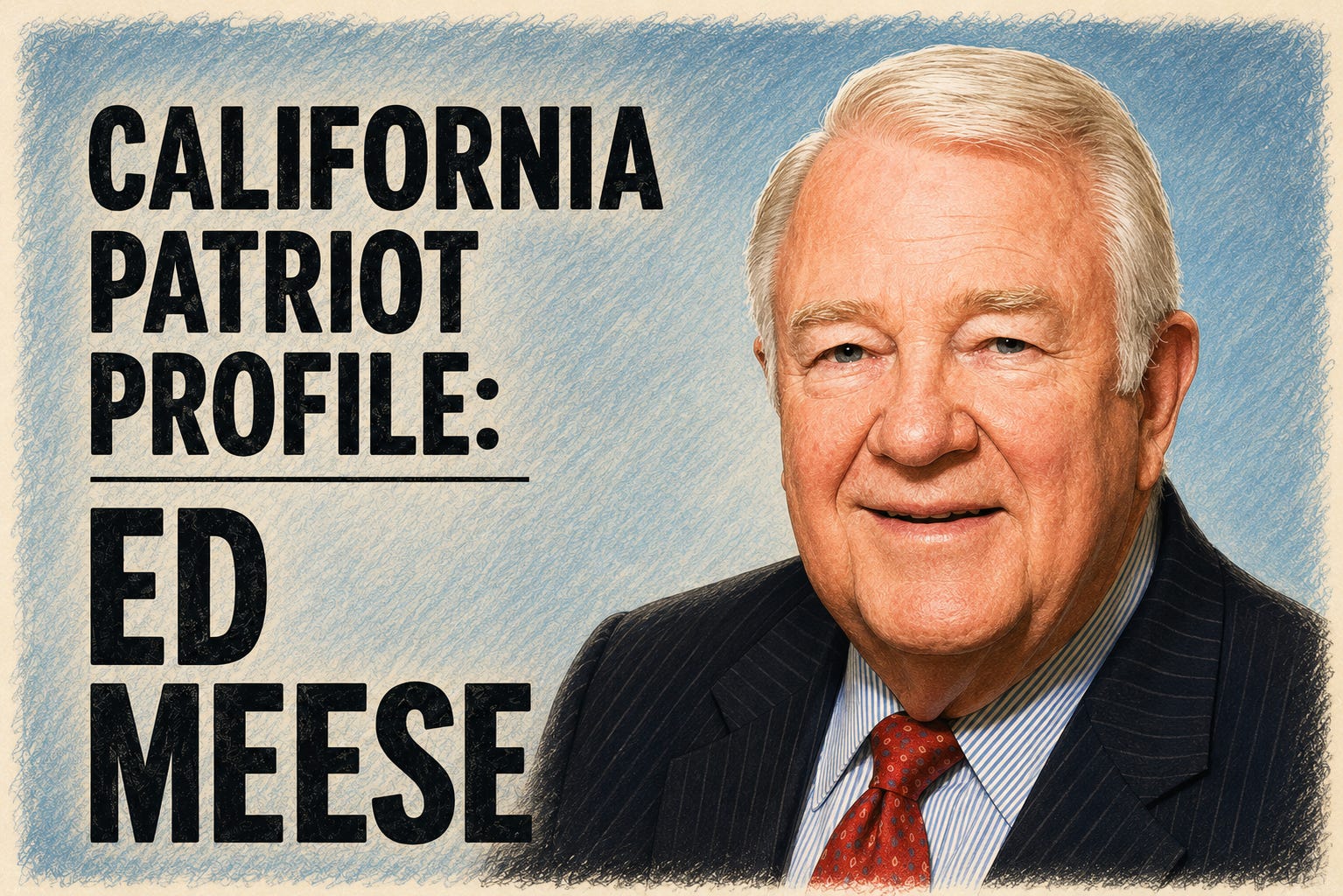
Welcome to another edition of California Patriot Profiles. These profiles are open to all subscribers and guests. You can listen to this post on our podcast feed, So, Does It Matter? SPOKEN. It’s available on your favorite podcasting app, or you can find it here.
🕒 8 Minute Read
The Making of Ed Meese
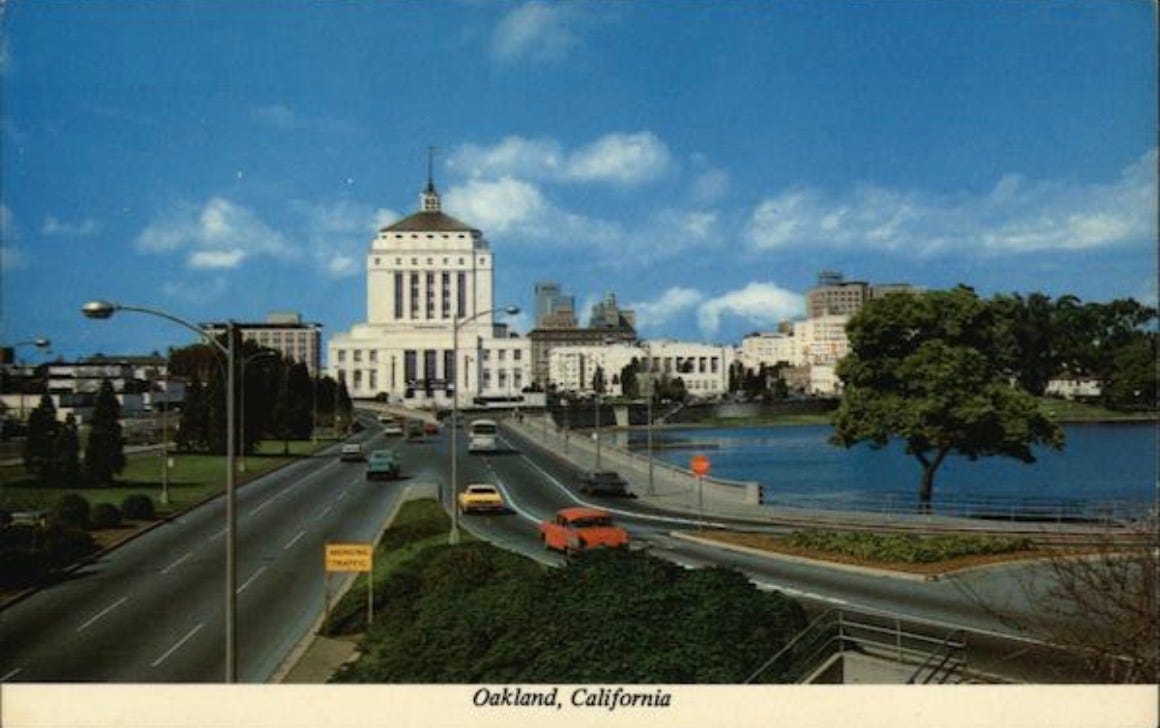
Edwin Meese III was born in Oakland on December 2, 1931, into a family where public service was simply part of life. His father and grandfather both served as Oakland city treasurers, instilling an early appreciation for civic responsibility. An outstanding student, Meese graduated as valedictorian of Oakland High School, where he excelled in debate and participated in the Junior Statesmen of America, an early sign of his lifelong interest in public policy and government.
Meese attended Yale University, where he emerged as a leader in conservative student politics and debate. After serving in the U.S. Army, he returned to California to earn his law degree from UC Berkeley’s Boalt Hall School of Law. He then joined the Alameda County District Attorney’s Office, quickly earning a reputation as a capable, disciplined prosecutor. Those qualities caught the attention of California’s newly elected governor, Ronald Reagan, who was assembling an administration in Sacramento. Reagan’s decision to bring the young Oakland lawyer into his inner circle would shape both men’s careers—and, in many respects, the modern conservative movement.
Meeting the Gipper: A Partnership for the Ages
When Ronald Reagan was elected California governor in 1966, Edwin Meese wasn’t part of his campaign and had never met the governor-elect. Instead, Meese had earned a reputation as a talented young deputy district attorney in Alameda County, where his work on criminal justice issues caught the attention of State Senator Donald Grunsky. Grunsky recommended Meese as Reagan assembled his new administration.
Their first meeting lasted only about 30 minutes, but it changed the course of both men’s lives. The conversation ranged from crime and campus unrest to capital punishment and the challenges facing California. Meese later recalled being struck by Reagan’s command of complex policy issues—something many of his critics underestimated.
At the end of the interview, Reagan offered Meese the position of Legal Affairs Secretary. Meese accepted, beginning a professional relationship that would span nearly a quarter century. From Sacramento to the White House, Reagan repeatedly turned to Meese for some of his administration’s most important responsibilities, forging one of the most consequential partnerships in modern conservative history.
The Man Behind the Governor
Ed Meese quickly proved he was far more than Ronald Reagan’s legal adviser. Within two years, Reagan promoted him to Executive Assistant, effectively serving as the governor’s chief of staff and one of the Capitol’s most influential figures.
As Reagan pursued his ambitious agenda, Meese translated broad conservative principles into practical government. He coordinated policy, managed the governor’s office, and advised Reagan on issues ranging from criminal justice to unrest on California’s college campuses. Never one to seek the spotlight, Meese earned a reputation for careful preparation, calm judgment, and quiet effectiveness.
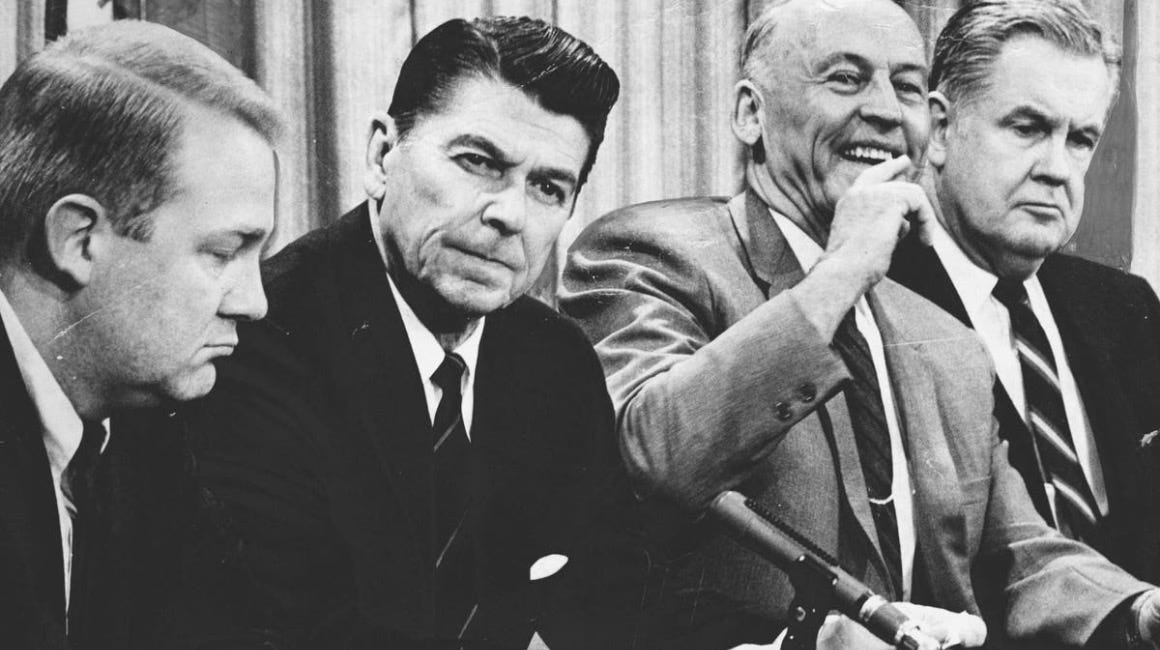
Former Democratic Assembly Speaker Bob Moretti once summed up Meese’s reputation with a compliment any public servant would appreciate: “Were I in the governor’s seat, I would want someone like Ed Meese on my side.”
By the time Reagan completed his second term in 1975, there was little doubt that wherever his political future led, Ed Meese would be alongside him.
The Reagan Presidency: Serving in the White House
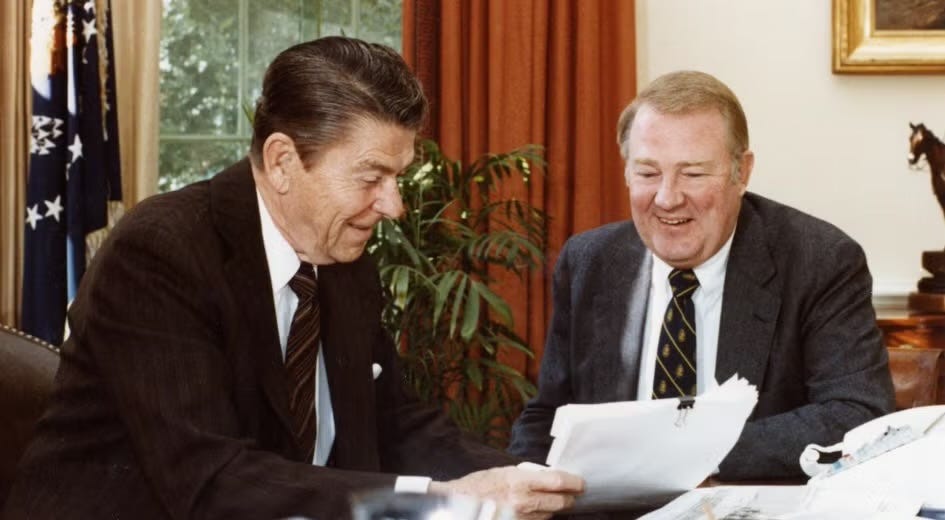
Ronald Reagan’s election as President in 1980 elevated Ed Meese from one of California’s most influential public servants to one of the nation’s. After helping lead Reagan’s presidential transition, Meese was appointed Counselor to the President, joining Chief of Staff James Baker and Deputy Chief of Staff Mike Deaver in the leadership team known as the “Troika.”
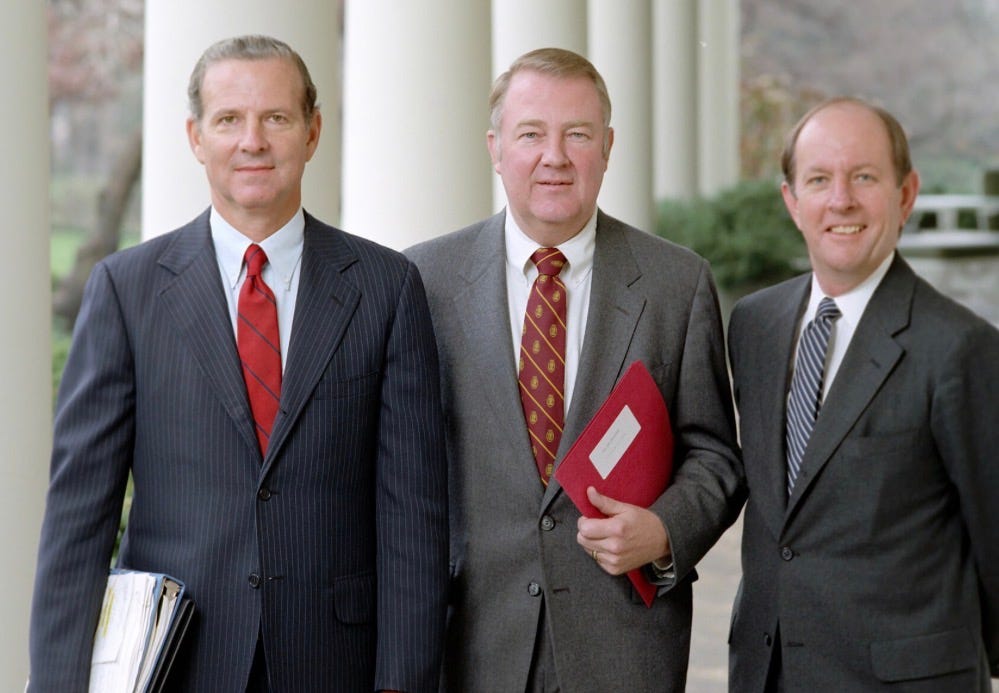
Reagan had relied on Meese for more than a decade in Sacramento, and Washington changed the setting—not the relationship. Meese coordinated domestic policy, oversaw the Cabinet Council system, and worked behind the scenes to turn campaign promises into governing priorities. While others often attracted more public attention, Meese remained one of the administration’s most influential advisers. In 1985, Reagan elevated his longtime confidant to an even greater responsibility.
The Reagan Presidency: Attorney General
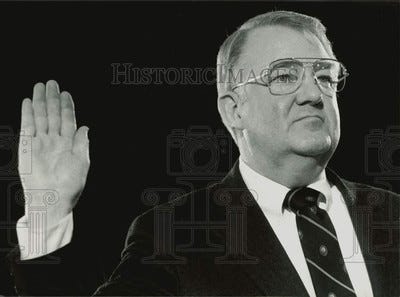
In 1985, President Reagan appointed Ed Meese as the 75th Attorney General of the United States, placing one of his closest advisers at the helm of the Justice Department. Meese believed the Constitution should be interpreted according to its original public meaning rather than evolving political or social fashions. That philosophy—originalism—helped reshape conservative legal thought and continues to influence American jurisprudence today.
Edwin Meese’s tenure as attorney general was one of the Reagan administration’s most important contributions to the conservative legal movement. He pushed the Justice Department toward a stricter reading of the Constitution, arguing that judges should follow its original meaning rather than reshape it to fit changing political views.
Meese also made law enforcement a central priority. His department aggressively pursued organized crime, drug trafficking, and violent criminals, while advocating for victims’ rights and stronger sentencing. Just as important was his influence on judicial selection. Meese helped promote judges who believed in originalism, judicial restraint, and the limited role of the courts.
The Originalist Revolution
Ed Meese’s influence as Attorney General extended well beyond the Justice Department. He became the Reagan administration’s leading public advocate for originalism—the principle that judges should interpret the Constitution according to its original public meaning rather than treat it as an evolving document.
In a series of important speeches, including a 1985 address to the American Bar Association, Meese argued that judges should interpret the law, not rewrite it. His position sparked a celebrated public debate with Supreme Court Justice William Brennan and moved constitutional interpretation to the center of conservative legal thought.
Meese also influenced Reagan’s judicial nominations, pressing for judges committed to judicial restraint and fidelity to the Constitution’s text. He became an important early ally of the Federalist Society, founded in 1982, speaking to its members and giving its constitutional mission powerful support inside the administration. The philosophy he championed helped shape jurists including Antonin Scalia, Samuel Alito and Clarence Thomas. Originalism eventually moved from the legal margins into the judicial mainstream, and Meese deserves substantial credit for that transformation.
The Heritage Years
After leaving the Justice Department in 1988, Ed Meese joined The Heritage Foundation as its inaugural Ronald Reagan Distinguished Fellow. He remained associated with Heritage for more than three decades, continuing to shape the conservative movement long after leaving public office.
Heritage gave Meese a new platform, but not a new mission. He spent the next three decades writing, speaking, mentoring, and advancing the constitutional principles that had guided his career. His influence continued to be felt among policymakers, judges, lawyers, and a new generation of conservative leaders.
Preserving Reagan’s Legacy
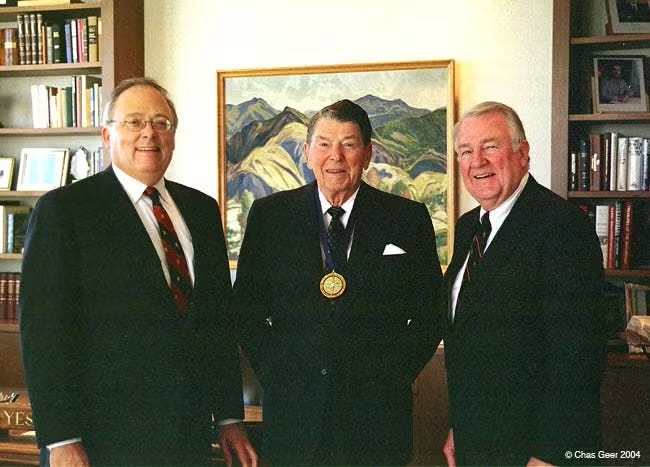
Following President Reagan’s retirement from public life, Ed Meese played an important leadership role in the Ronald Reagan Presidential Foundation, helping preserve and promote the legacy of America’s 40th president and the institution that supports the Ronald Reagan Presidential Library.
If the Reagan Library preserves Ronald Reagan’s presidency, the Reagan Ranch preserves Reaganism itself. For decades, Meese has served as Co-Chairman of Young America’s Foundation’s Reagan Ranch Board of Governors, working alongside Michael Reagan and others to preserve Rancho del Cielo not simply as a historic home, but as a living classroom for Reagan’s ideas.
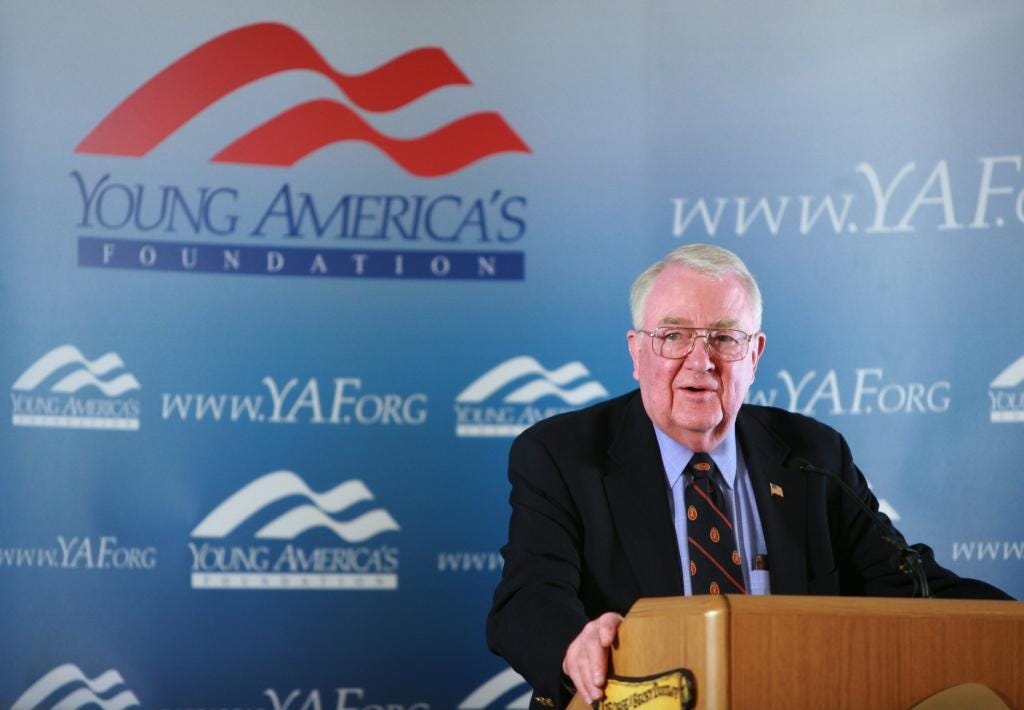
As Meese himself observed, “The Library reveals the history of Ronald Reagan and the presidency, and the Reagan Ranch reveals the personality, basic thoughts, and background of the man.” It is there, introducing young conservatives to Reagan’s ideas of limited government, free enterprise, individual liberty, and a strong national defense, that Meese has devoted much of his post-government life.
Why He’s a California Patriot
It has been my honor to meet Attorney General Ed Meese roughly a half dozen times over the years, and I have always found him to be warm, gracious, and genuinely sincere. I first met him through my involvement with California Young Americans for Freedom at the Conservative Political Action Conference in Washington, D.C. Interestingly, Meese got his own political start in high school through the Junior Statesmen of America—the same organization where I got my own start in politics.
What has always impressed me most about Meese is his unwavering commitment to conservative principles. Ronald Reagan surrounded himself with advisers representing a range of viewpoints. Some were more pragmatic, while others were more ideologically conservative. Meese never wavered. He paired deeply held convictions with the discipline and competence required to turn conservative ideas into effective governance.
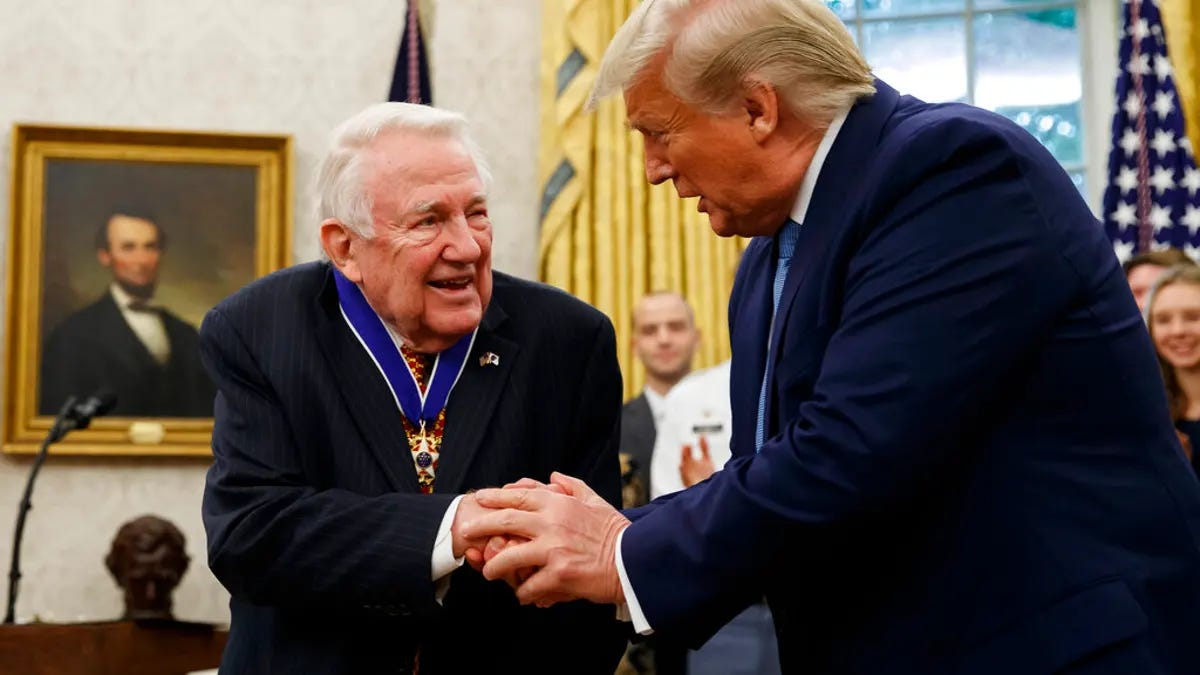
Public servants come and go. Few spend six decades advancing the same principles with the consistency Ed Meese has. Whether serving Ronald Reagan, shaping constitutional thought, or introducing students to Reaganism at the Ranch, he never really changed course. In 2019, President Donald Trump awarded Meese the Presidential Medal of Freedom, the nation’s highest civilian honor, recognizing a lifetime of public service and devotion to the Constitution. Today, at 94, Ed Meese is, without question, one of California’s great patriots.
Thank you for your service to our country, and your deep commitment to conservative principles!
A Few Great Videos
Nine years ago General Meese spoke to the election of President Trump in 2016, and the election of President Reagan in 1980, in a fabulous talk at the Young America’s Foundation College Retreat.
And here is General Meese, while still in office, giving a 1987 address to the National Lawyers Association…
Finally, President Reagan recorded weekly radio addresses back in the day — the early form of the podcast! In this one you can watch and listen to the Gipper praise Meese on the occasion of his retirement after years as Attorney General.
Check Out Our Library: Dozens of Other California Patriot Profiles!

Periodically, we profile an exemplary California conservative. Previous profiles have been of former Los Angeles County Supervisor Michael Antonovich, San Diego County Supervisor Joel Anderson Orange County Sheriff Don Barnes, Political Law Attorney Chuck Bell, Federal Judge Roger Benitez, the late Andrew Breitbart, actor and comedian Adam Carolla, HJTA President Jon Coupal, Assistant Attorney General Harmeet Dhillon, San Luis Obispo County District Attorney Dan Dow, conservative activist Steve Frank, actor Kelsey Grammer, investigative journalist Katy Grimes, pro-liberty attorney Julie Hamill, historian Victor Davis Hanson, Dr. Charles Kesler, Editor of the Claremont Review of Books, , longtime Nixon and Reagan speechwriter Ken Khachigian, Congressman Kevin Kiley, talk radio host John Kobylt, Former San Diego County GOP Chairman Tony Krvaric, the late Congressman Doug LaMalfa, Congressman Tom McClintock, Pastor Rob McCoy of Turning Point Faith, Former CAGOP Chairman Ron Nehring, the late Second Amendment champion Sam Paredes, talk radio hosts John Phillips and Dennis Prager, actor Gary Sinise, economist and author Thomas Sowell, actor James Woods, and constitutional scholar John Yoo.
You can go here to see them all! If you have an idea for a profile of a patriot, let me know!