

California Is the Only State Where Safe Driving Can’t Lower Your Rate Today
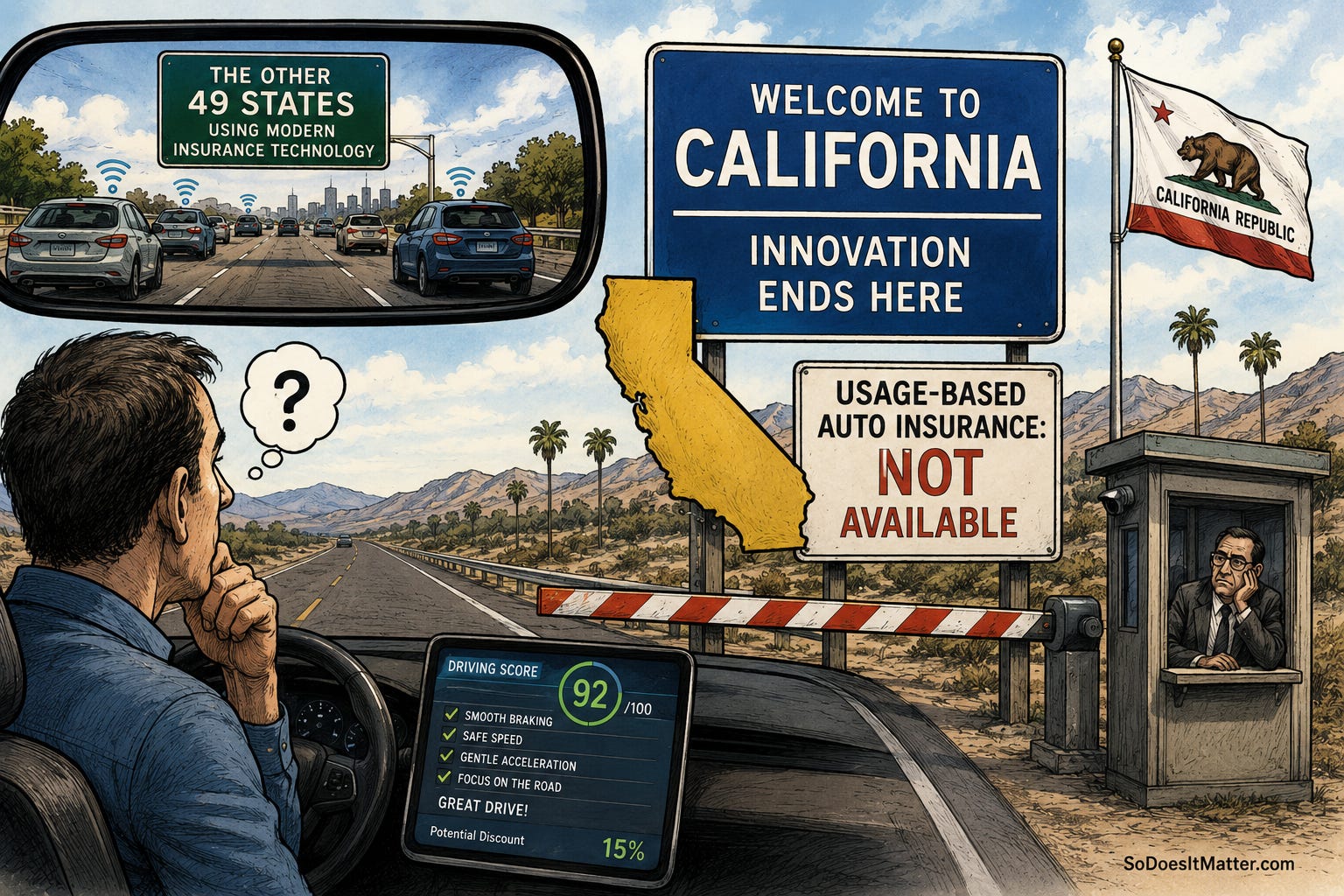
Drivers in 49 states can trade verified safe driving for lower insurance rates. Sacramento won’t let you. AB 311 would change that.

Our morning content is free for all subscribers and guests! Usually our afternoon content is behind a paywall… If you are not yet a paid subscriber, consider upgrading — you are missing a significant portion of what we produce each week, and your support makes it possible. If you want to get it all and support my efforts, please consider a paid subscription! Today there is exclusive content below this column for paid subscribers.
You can also listen to this post on our podcast feed, So, Does It Matter? SPOKEN. It is available on your favorite podcast app. And you can listen to it here.
⏰ 6 minute read
Everyone Else But Us…
Tesla Motors sells an insurance product in a dozen states that ought to make every California driver jealous. It’s called Real-Time Insurance, and it works exactly the way insurance should: your car measures how you actually drive — your speed, your braking, your attention — and your premium adjusts every month based on your real behavior behind the wheel. Drive safely, pay less.
Better still: every mile driven with Full Self-Driving (Supervised) engaged earns a perfect safety score of 100 — because, by Tesla’s actuarial math, the car drives better than you do.
But guess what? You can’t have it here. Tesla sells insurance in California, but state regulators prohibit the company from using your actual driving to price it. Your Safety Score here is offered “for educational purposes only” — you can watch the number, you just can’t save a dime with it.
And this isn’t a Tesla story. Every major insurer offers a version: Progressive’s Snapshot, State Farm’s Drive Safe & Save, Allstate’s Drivewise, GEICO’s DriveEasy — in every state but one.
California is the only state in the nation — the only one — where willing drivers are locked out.
AB 311 by Assemblywoman Tina McKinnor (D-Inglewood), now moving through the Legislature, would finally end it. CalMatters recently framed its coverage around a loaded question: should California drivers be “monitored” for insurance purposes? Wrong question. The right one: should you be allowed to volunteer your own good driving to earn a lower rate? Everywhere else in America, the answer is yes.
What Telematics Actually Is
Telematics — sometimes called “usage-based insurance” — is technology that measures how you actually drive: speed relative to traffic, brake force, hard acceleration, aggressive cornering, miles driven, phone distraction.
The concept is simple: a driver who chooses to be measured gets feedback on his habits and, if the data shows safe behavior, a lower premium. A AAA Foundation for Traffic Safety study found these programs cut speeding by 11 to 13 percent, hard braking by 16 to 21 percent, and rapid acceleration by 16 to 25 percent — habits that persisted even after drivers left the programs.
The operative word: chooses. Nobody is monitored without consent. That’s the whole design of AB 311.
The Last-in-the-Nation Rule
California’s rating rules were frozen in the early 1990s. Under regulations built on 1988’s Proposition 103, insurers must give the most weight to your DMV record — moving violations and at-fault crashes, some up to ten years old — plus annual mileage and years of experience. And California’s regulators bar insurers from rating you on the real-time driving decisions the technology can now measure.
A 29-year-old is still paying for the 22-year-old version of himself. And a genuinely dangerous driver who simply hasn’t been caught yet enjoys “good driver” rates while the rest of us subsidize him.
What AB 311 Would Do
AB 311, the Consumer Driving Data Protection Act of 2026, would let a consumer voluntarily opt in to a telematics program for insurance rating. Observed driving behavior could then outweigh factors many drivers rightly resent: old moving violations, where your car is garaged (the “territorial rating” that penalizes your ZIP code), and crude annual mileage counts that treat a rural two-lane commute the same as rush hour on the 405.
A smartphone app works in a fifteen-year-old Corolla as well as a new Model S — this is a discount for how you drive, not what you drive.
The bill limits telematics to private passenger auto insurance, requires Department of Insurance oversight, and imposes consent, retention, deletion, and privacy rules on insurers and their vendors — including mandatory deletion upon request.
And here’s the part the critics keep omitting: nothing changes for anyone who does nothing. Don’t want to participate? Don’t. Opt in and change your mind? Switch back. The whole thing runs on your say-so.
There’s even an equity case the CalMatters framing entirely missed. Harvard and Stanford researchers, using large-scale telematics data, found actual speeding was uncorrelated with neighborhood demographics — while speeding enforcement was concentrated in small, unrepresentative areas, disproportionately in non-White neighborhoods. Telematics measures what you actually do, not where a patrol car happened to be parked.
The Opposition’s Weak Hand
My friend Rex Frazier, president of the Personal Insurance Federation of California, has written the definitive breakdown of this fight at his aptly named Not Available in All States. His answer to the privacy panic:
“Those protections do not make privacy concerns disappear. But they do answer the claim that telematics is inherently incompatible with privacy. The technology is not the problem by itself; unregulated data collection is.”
The loudest objections come from Consumer Watchdog, the professional opposition group that treats Proposition 103 as holy writ and has built a business model around litigating it. None of its arguments holds up.
“Nobody wants Big Brother in their car.” Then don’t invite him. Big Brother, by definition, doesn’t ask permission. AB 311 requires it. The bill bans audio and visual recording of occupants, restricts secondary use, and limits retention — the very standards the Electronic Frontier Foundation laid out for any California telematics program.
“Privacy protections aren’t strong enough.” Then note that the Legislature is simultaneously advancing SB 354 by Senate President pro Tempore Monique Limón, a sweeping overhaul of insurance-data privacy law. It cleared the Senate 28-10 and an Assembly policy committee 11-4. As Rex frames it, California is not being asked to choose between privacy and innovation — it’s being asked whether it can regulate both intelligently.
“We need to see the algorithms.” Transparency does not require destroying trade secrets. Consumers get plain-language disclosures — what’s collected, how it’s used, how it affects premiums, how to quit — while regulators get confidential access to the underlying models to test legality and actuarial soundness.
“Only safe drivers will opt in, and everyone else will pay more.” This one gives the game away. What the critics are defending is the conscription of safe drivers into subsidizing dangerous ones — accurate pricing doesn’t create a subsidy problem — it ends one. Proposition 103 itself bars “unfairly discriminatory” rates — and courts hold that means exactly this: low-risk drivers cannot be forced to carry high-risk ones. No insurer can charge any premium, legacy or telematics, without prior regulatory approval. That’s not consumer protection. That’s hostage-taking.
The Senate Insurance Committee passed the bill 5-0. The Senate Privacy Committee passed it 8-0. Credit to Chairman Padilla and Chairman Cabaldon for working through hard issues rather than around them. Next stop: Senate Appropriations when the Legislature reconvenes in August.
So, Does It Matter?
This fight is about more than your premium. It’s a test of whether California can still say yes to anything.
Forty-nine states let a willing driver prove he’s safe and pay less. California alone says no — not because the technology fails, not because the privacy rules can’t be written, but because a self-appointed guardian class has decided you cannot be trusted with your own choices about your own data and your own money.
AB 311 forces no one into anything. It simply stops forcing everyone out. And if it passes, the fine print on those national insurance ads — “Not Available in All States” — will finally stop being a polite way of saying “Not Available in California.” Rex named his Substack after that fine print. Here’s hoping Sacramento makes the name obsolete.