


This column is free for all subscribers and guests! You can also listen to this post — along with my California Post column — on our podcast feed, So, Does It Matter? SPOKEN. It’s available on your favorite podcasting app, or you can find it here.
For our paid subscribers, you get a top notch video commentary from me laying the blame right where it belongs and I do not mince any words… it’s below the paywall at the bottom of this commentary.
⏱️ 5-min read
The Setup: A Familiar Story That Has A Clear Cause
If you read the recent CBS News report on California gas prices, you are left with the impression that the causes are numerous and difficult to pin down.
Taxes. Regulations. Refinery outages. Corporate behavior. Market concentration. Investigations.
The piece presents it as a complicated, multi-variable problem.
But it is not a mystery. And it is not random.
It is the predictable outcome of policy choices made over years by California’s Democratic leadership — from the Legislature to the desk of Governor Gavin Newsom.
In California, the structural factors — the ones that consistently drive higher prices — are the result of deliberate policy decisions passed by the Legislature and signed into law by governors including Gavin Newsom.
What You Are Actually Paying For
Start with what is directly built into the price of every gallon.
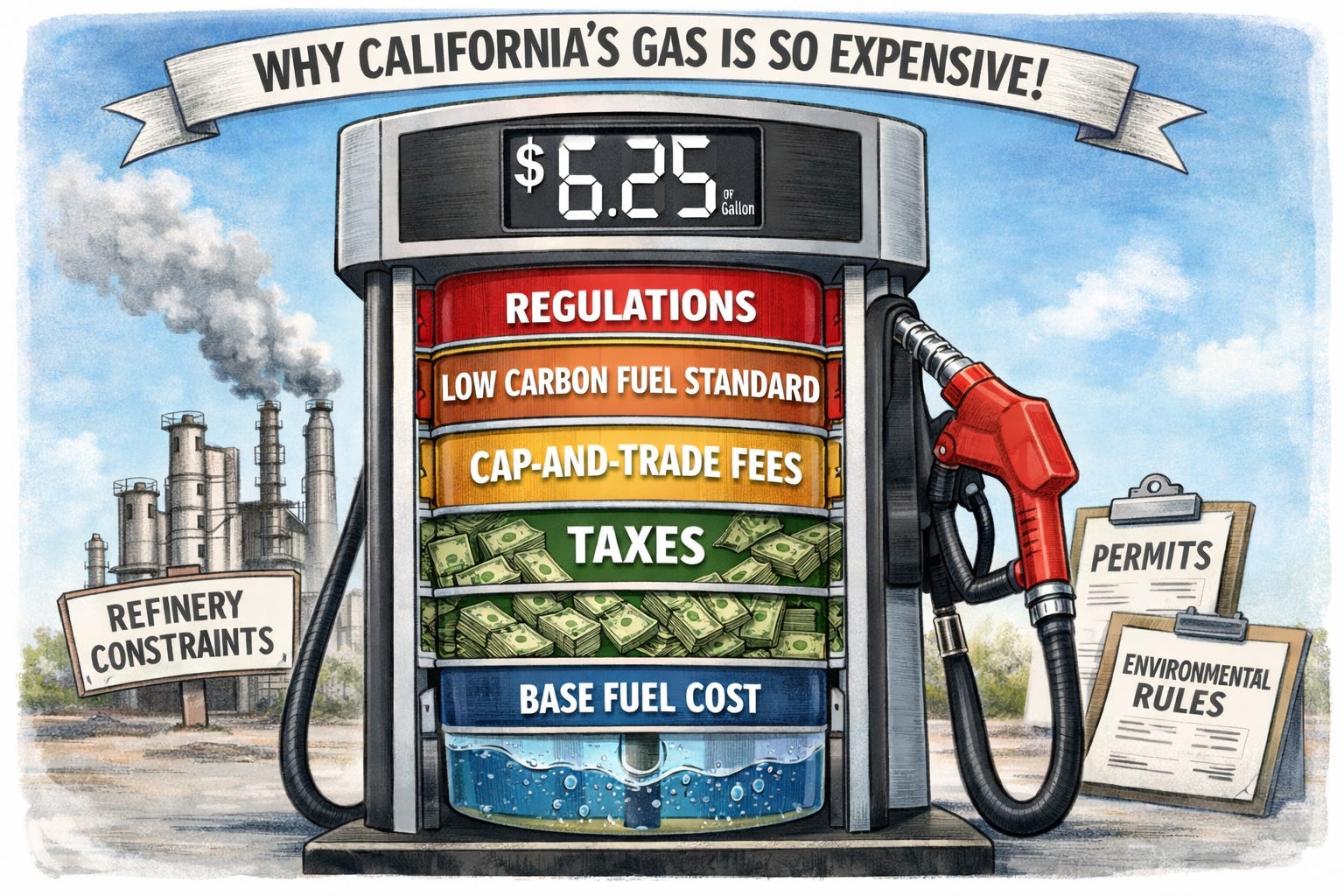
California’s gas taxes alone add up quickly. The state excise tax is roughly 58 cents per gallon. Add in a sales tax that varies by location, often around 10 percent. Then include California’s cap-and-trade (now rebranded as the “cap and invest”) program, which adds another estimated 20 to 30 cents per gallon. The state’s Low Carbon Fuel Standard contributes roughly another 20 cents or more.
Taken together, these policies push the government-driven portion of the price well past $1 per gallon — before accounting for the base cost of fuel.
These are not market outcomes. They are policy-imposed costs, enacted and expanded by California’s Democratic supermajority.
That is the visible part.
Then there is the hidden cost structure.
California requires a special gasoline blend that is cleaner-burning but more expensive to produce and cannot easily be imported from other states. That isolates the state’s fuel market. When this is required, prices are driven up even higher still.
On top of that, extracting oil in California is more expensive due to regulatory requirements, environmental compliance costs, and permitting delays that can delay projects for years or prevent them entirely. Refining is more expensive because of additional mandates. Even transporting fuel within the state faces added regulatory layers. And this is before we get to the layers of costs thrown at retail gas locations.
These costs reflect policy choices that have the effect of discouraging fossil fuel production and use.
All of that gets baked into the final price.
A Fragile System By Design
With the ongoing closures of oil refineries in California, with more threatened closures on the horizon, and with limited ability to import compliant fuel, even a single outage can send prices spiking. When refineries go offline, prices can jump quickly due to tight supply.
That fragility is not an accident.
It is the result of years of policy that have made it harder to build, expand, or even maintain refining capacity in California. Facilities close. New ones are not built.
And when disruption hits, consumers pay the price.
These policies come out of a State Capitol that views the use of fossil fuels as some sort of morally inferior policy choice.
Californians routinely pay significantly more per gallon than the national average — a gap that widens even more sharply during supply disruptions and is driven not by global oil markets, but by California’s policy environment.
The Politics Of Blame
Politicians in Sacramento want to blame “greedy oil companies” for the higher costs of gas. But, inconveniently for this argument, under the auspices of a new law passed last year, an investigation into potential price gauging did not result in any proof of this actually happening.
This blame game is right out of the playbook of the left, who refuses to acknowledge that the taxes, fees and additional regulatory burdens they have placed oil extraction, refining and sales actually drives up prices. Of course let’s remember that just a few months ago Newsom was at a U.N. Climate Summit in Brazil, touting how our regulatory scheme here makes things more affordable. Right.
Blaming oil companies shifts attention away from the laws, regulations, and mandates enacted in Sacramento.
It is easier to investigate than to reverse course.
So, Does It Matter?
California’s high gas prices are not the result of a single bad actor or a temporary disruption.
They are the predictable outcome of a policy framework built over time — one that reflects clear priorities: restrict fossil fuel supply, layer on regulatory costs, and rely on those systems to shape behavior.
Those choices come with consequences.
Higher prices are one of them.
Unless and until you confront the policies that drive costs and restrict supply, nothing will change.
California’s Democratic leaders chose this system.
And Californians are paying for it every time they fill their tank.
That reality may be easy to manage in Sacramento. It is much harder to explain on a national stage — especially for Gavin Newsom, who is positioning himself as a presidential candidate while presiding over the highest gas prices in the country.
And, oh yeah, if you are listening for any of the Democrats looking to succeed Newsom talking about abandoning these reckless policy choices, the closest you will get it San Jose Mayor Matt Mahan who would “temporarily suspend” the gas tax, but stops short of decrying the mindset behind the policy decisions in first place.
Video Commentary
Just below I have a hard hitting a video commentary. You do not want miss it. If you’re not yet a paid subscriber, you should consider jumping in! The water is warm…
