

California Democrats Want Muslim Holidays In State Law — But Not The Jewish High Holidays
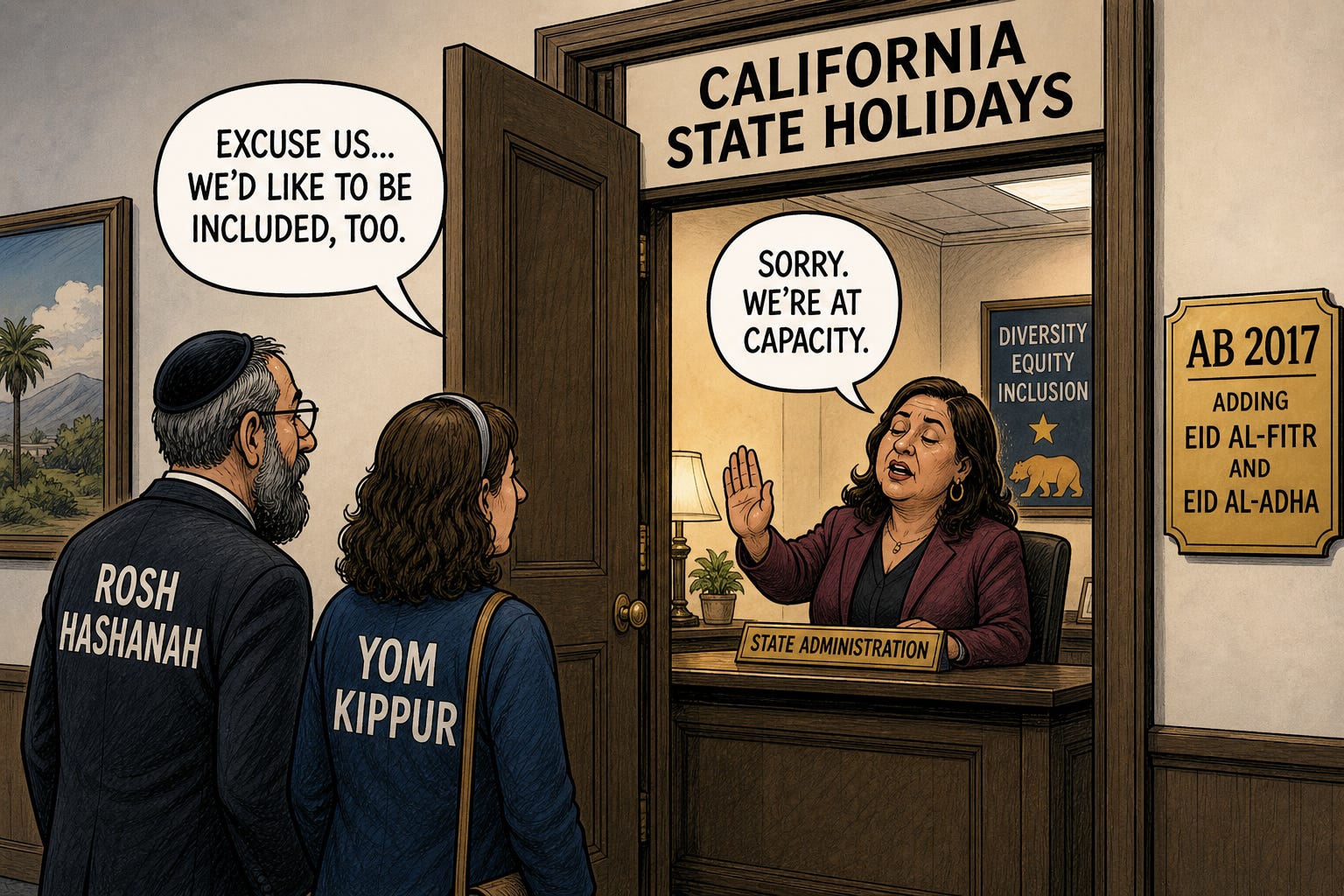
California says AB 2017 is about religious inclusion. Then include the Jews.

You can also listen to this post — along with my California Post column — on our podcast feed, So, Does It Matter? SPOKEN. It is available on your favorite podcast app. And here.
⏱️ 4 min read
The Question Sacramento Should Not Duck
California Democrats say AB 2017 is about religious inclusion. They say it is about equity. They say Muslim Californians deserve to see two important holidays in their faith, Eid al-Fitr and Eid al-Adha, formally recognized in state law.
AB 2017 would add Eid al-Fitr and Eid al-Adha to California’s list of official state holidays. It would also authorize schools and community colleges to close for those holidays and allow public employees to use existing leave or personal holiday time to observe them.
As a Jewish Californian, I do not read this bill as a small clerical matter.
Fine. Then Jewish Californians have a simple question.
Why Eid, but not Rosh Hashanah? Why Eid, but not Yom Kippur?
That is not an anti-Muslim question. It is not a hostile question. It is not even a complicated question. It is the obvious question any fair-minded Californian should be asking if Sacramento is now going to use state law to recognize major religious observances.
Rosh Hashanah and Yom Kippur are not obscure holidays. They are the Jewish High Holidays, among the most sacred days on the Jewish calendar. For observant Jews, they are not casual cultural celebrations. They are central religious observances — days of prayer, repentance, atonement, synagogue, family, and deep spiritual meaning.
So if California is opening the door to religious-recognition legislation, why are Jewish Californians being left outside?
A Troubling Moment to Get This Wrong
I want to be careful here, because I am not arguing that AB 2017 is an antisemitic act. I do not believe the legislators behind it woke up one morning intending to slight Jewish Californians. But intent is not the only thing that matters.
We are living through a real and rising tide of antisemitism across the country. Jewish students have felt it on campuses. Jewish families have felt it in public life. Jewish institutions have felt it in their security budgets. In that environment, visibility matters. Recognition matters. The message sent by omission matters.
When California chooses this particular moment to advance legislation formally elevating Muslim religious holidays — without so much as a conversation about whether Jewish holidays belong in the same framework — it lands differently than it might have a decade ago. That does not make it malicious. But it does make it tone-deaf. And tone-deafness, in a climate like this one, is not a minor thing.
Selective Inclusion Is Not Equity
The issue is not whether Muslim Californians should be able to observe Eid. Of course they should. Students should not be punished for sincere religious observance. Workers should have reasonable accommodation where possible. Religious liberty is not a gift from government. It is a constitutional principle.
But AB 2017 is not merely about private observance. It places two Islamic holidays into California’s official state holiday framework. That changes the question. Once the state starts choosing which religious holidays deserve formal recognition, it has a duty to explain the principle behind the choice.
Is the principle population size? Then say so. Is the principle a historic exclusion? Then explain why Jewish Californians, who have faced centuries of persecution and are currently living through a surge of antisemitism, do not qualify. Is the principle of religious accommodation? Then why stop with Eid? Is the principle political pressure? Then at least be honest about it.
Because right now, the message being sent is not inclusion. It is selective inclusion. And selective inclusion is not equity. It is favoritism dressed up in progressive language.
What I Am Actually Proposing
I am not asking Sacramento to make Rosh Hashanah and Yom Kippur official state holidays. Jewish Californians have observed the High Holidays for generations without that designation, and we will continue to do so. There is no practical crisis here. That is not the point.
The point is simple: if Sacramento is going to use state law to formally recognize religious holidays, that standard must apply equally. Not because Jewish Californians cannot survive without it, but because selective recognition is its own statement — that some communities’ religious lives are worth acknowledging, and others are not. In the current climate, that is not a message California should be sending, even by accident.
Amend the bill. Add Rosh Hashanah and Yom Kippur — not as an afterthought, but as proof that equity means what it says.
So, Does It Matter?
Rosh Hashanah marks the Jewish New Year. It begins a period of deep reflection and repentance. Yom Kippur, the Day of Atonement, is the holiest day of the Jewish year. For many Jews — including some who are not otherwise highly observant — Yom Kippur remains a day set apart from ordinary life. I have memories of attending High Holiday servers at Temple Akiba in Culver City (well at the Veterans Park nearby) from a young age.
These are not niche observances. They are foundational to Judaism. If California legislators are willing to formally recognize Eid al-Fitr and Eid al-Adha, they should be willing to recognize Rosh Hashanah and Yom Kippur.
That does not mean every religious holiday from every faith must become a state holiday. Government can draw lines. But it should draw those lines with a coherent standard, not with political convenience. And right now, the standard is not obvious.
What is obvious is that Muslim holidays are being advanced, while the Jewish High Holidays are not. That is a problem. It is especially a problem in California, a state whose political leadership never misses an opportunity to lecture the rest of the country about diversity, equity, tolerance, and inclusion. If those words mean anything, they cannot disappear when the subject is Jewish religious life.
If Sacramento Democrats truly believe in religious inclusion, this should be easy. If they refuse, Jewish Californians will be left with an uncomfortable conclusion: that in today’s California, some religious communities are fashionable enough to be officially recognized, while others are expected to wait quietly outside the door.
A Video Commentary On This Bill…
Below the paywall is a commentary with your time, as Jon weighs in even more on this bill.
