

California Democrats May Already Be Road-Testing a Strategy to Undercut a Voter ID Initiative
A new Berkeley IGS poll on “voting rights” may offer an early glimpse into how opponents could try to outmaneuver a likely November ballot measure requiring voter ID.

Our afternoon columns typically have content for our paid subscribers. But I’m at a conference where I am speaking, so not this time (I’m in a rush, and this column killed a bunch of my brain cells to write, and I need to recover before I speak!).
You can listen to this post on our podcast feed, So, Does It Matter? SPOKEN. It’s available on your favorite podcasting app, or you can find it here.
⏱️ 6 min read
The Berkeley IGS Poll As A Political Tell
A new statewide survey from UC Berkeley’s Institute of Governmental Studies, released this week, with questions released this morning that on a series of proposed policies framed under the banner of “voting rights.” The topline results emphasize expanding access and reducing perceived barriers, but the more revealing story is what is being tested — and how it is framed. The poll explores ideas like redefining what counts as a barrier to voting, expanding acceptable methods of verifying identity, and imposing new obligations on the state to ensure access. These proposals tend to poll well when presented in isolation and described in broad, aspirational terms.
This release does not include fresh testing of the California Voter ID initiative, though a mid-March Berkeley IGS survey did examine it. That proposal — requiring voters to present government-issued identification before receiving a ballot — reflects a standard used in most other aspects of civic and financial life. Early signals suggest it will perform pretty well with voters if it qualifies for the November ballot, which now appears likely given the volume of signatures submitted.
Why Voter ID Polls Well — And Why The Left Opposes It
The appeal of voter ID is straightforward: confirm a person’s identity before issuing a ballot. Most voters recognize the logic immediately and view it as a basic safeguard.
Opponents frame it differently. They argue ID requirements can burden lower-income voters, seniors, and those without easy access to documentation. They also point out that proven cases of voter impersonation are rare and contend the remedy does not match the problem.
If voter ID continues to poll well, however, messaging alone may not be enough to stop it. The strategy may shift.
The Mechanics Of A Competing Ballot Measure
California’s constitution contains a powerful but often overlooked rule: when two ballot measures conflict and both pass, the one receiving more votes prevails to the extent of the conflict.
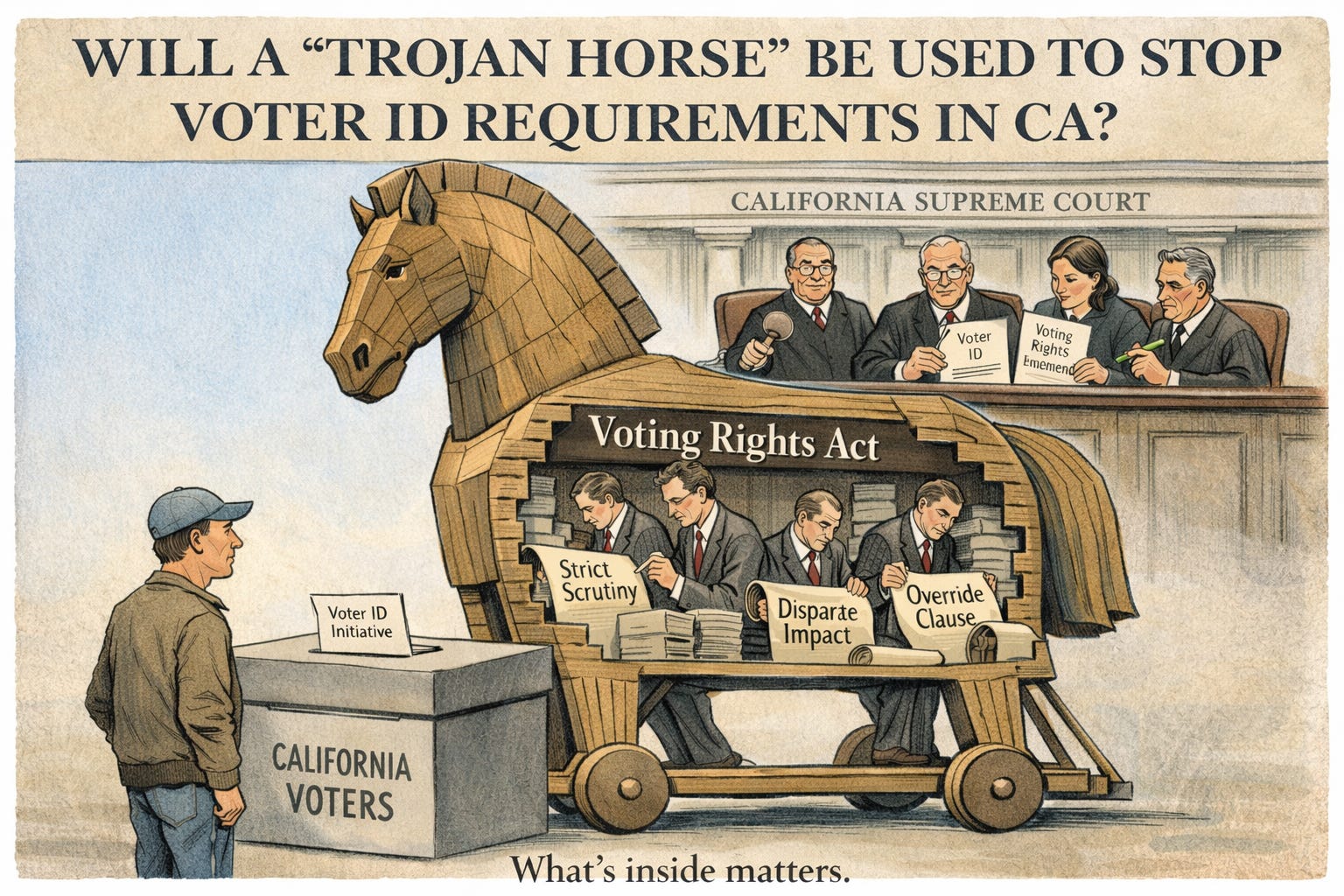
That opens the door to a countermeasure. If a voter ID amendment looks likely to pass, opponents could place a competing constitutional amendment on the same ballot. It would almost certainly be branded as a “Voting Rights” measure, emphasizing access and fairness. The branding is secondary. The drafting is everything.
The language could be structured to conflict — directly or indirectly — with voter ID. If both measures pass, courts would first attempt to harmonize them, reading the provisions together where possible. Where that fails, the constitution answers the question: the higher vote total wins.
This is not hypothetical. It is a feature of California’s initiative system — and one that can be used deliberately.
What Could Be Tucked Into A “Voting Rights” Measure
A competing amendment would not need to ban voter ID outright to undermine it. More precise tools are available.
One option is to declare voting a fundamental right under the state constitution and require any law burdening that right to meet strict scrutiny — forcing the state to prove a compelling interest and narrow tailoring. That creates a direct legal pathway to challenge ID requirements.
Another is to prohibit voting rules that produce a disparate impact on certain groups, regardless of intent. Under that standard, voter ID becomes vulnerable based on statistical outcomes alone.
A third approach would impose an affirmative duty on the state to maximize participation and minimize barriers. That shifts the constitutional baseline toward access, putting pressure on any additional requirement, including ID.
Other provisions could require multiple identity verification methods — affidavits, signature matching — effectively making voter ID optional in practice.
Individually, these provisions are defensible. Combined, they form a framework courts could use to narrow, reinterpret, or invalidate key elements of an ID requirement.
The Liberal, Political California Supreme Court
Ultimately, any conflict between competing measures would be resolved through litigation. In California, that means the state Supreme Court.
Its composition is not politically neutral. Six of the seven justices were appointed by Democratic governors Jerry Brown or Gavin Newsom, and recent decisions show a willingness to shape outcomes in election disputes.
Just last year, the court declined to even hear legitimate challenges to the legally dubious legislative process used to place Prop. 50 on the ballot — a cynical and ultimately successful play by Democrats in the Legislature to impose a partisan gerrymander on California’s congressional districts.
In 2024, the court went further, removing a qualified taxpayer protection initiative from the ballot before voters could weigh in. Siding with Gov. Gavin Newsom and legislative leaders, the justices ruled it was too sweeping to qualify as an amendment.
Agree or disagree with those rulings, the pattern is clear: when election disputes reach the court, the justices are willing to exercise decisive authority.
Both the voter ID proposal and any competing measure would be constitutional amendments. With two-thirds supermajorities in both chambers, Democrats in the Legislature can place such a measure on the ballot without Republican support. The capability is there if they choose to use it.
So, Does It Matter?
This is forward-looking, not a confirmed plan. But the pieces line up. A voter ID proposal with broad appeal. Organized opposition. A poll testing the language of “voting rights.” And a constitutional system that allows one measure to override another based on vote totals.
If you wanted to stop a measure gaining traction, this is how you would do it. Not by defeating it outright, but by shaping the terrain around it — drafting competing language that determines how, or whether, it ultimately takes effect.
As November approaches, the focus should not just be on whether voter ID qualifies or polls well. It should be on what might appear next to it on the ballot — and how the fine print could decide the outcome long after the votes are counted.