

California Democrats Keep Trying To Solve Homelessness — Without Addressing What’s Causing It
While offering bigger solutions, Sacramento Progressives continue to ignore what is driving the crisis. Hint: It's their own world-view, and their policies.

You can listen to this post on our podcast feed, So, Does It Matter? SPOKEN. It’s available on your favorite podcasting app, or you can find it here. Our afternoon content is typically for our paid subscribers. Certain columns, like this one, are made available to all of our readers.
🕒 4.5 min read
The Debate Everyone Is Having — And The One They’re Not
If you watched the Gubernatorial debate last night, you would have heard five Democrats on the stage say variations of the same thing: homelessness demands an aggressive response. The candidates argue over details, but the direction never changes — more housing, more services, more funding, more coordination. The more the government does, the problem recedes. That’s the theory.
Nobody asks how so many people got there in the first place. That question is harder, because the answer points beyond programs and budgets to the conditions of life before the crisis hit.
Skip that question, and policy becomes purely reactive — managing what’s visible while ignoring what produced it.
The Cost Of Living Crisis That Precedes The Homelessness Crisis
The immediate causes of homelessness vary, but California’s broader context is hard to ignore. Maintaining a stable life here keeps getting more expensive. Housing, energy, insurance, taxes, fees, regulation — the economics of ordinary family life have been steadily reshaped.
One consequence gets almost no attention. Even twenty years ago, two incomes were required to stay in the Golden State. Today it’s worse: California housing runs nearly double the national average, and a two-parent family with one working parent can’t cover basic expenses in virtually any county without public assistance. The single-income household — once a genuine option during the child-rearing years — is financially out of reach for most California families.
This isn’t only about money. When both parents are consumed by economic demands, what goes first is the time for family life, religious observance, civic involvement, and community. An economic adjustment hardens into something deeper over time.
That’s where instability takes root.
The Disappearing Institutions That Once Caught People Before They Fell
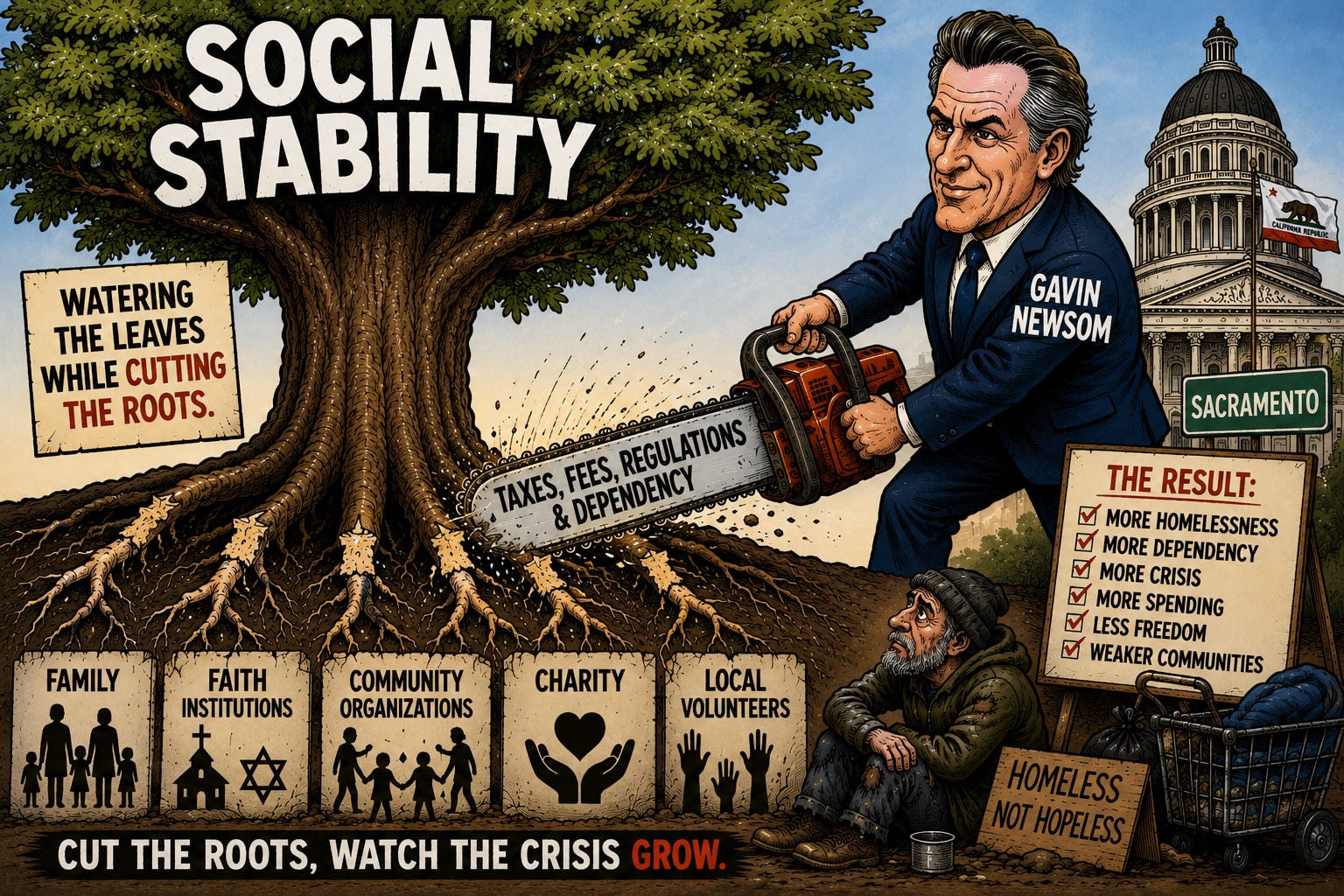
For most of American history, personal crises were met first by family, extended family, churches, synagogues, neighbors, and local associations. These weren’t bureaucracies. They were close to people, which meant they noticed trouble early — before it became a catastrophe.
They did something else that government programs can’t. They formed character — responsibility, restraint, obligation, care for others. A church didn’t just hand out food; it placed people within a moral framework in which they understood what they owed to family, neighbors, and themselves.
Societies stay stable not because services are available but because people are formed to live within them responsibly. When the institutions that do that forming weaken, the damage isn’t only practical — it’s moral.
Those institutions are weaker now. Church attendance is down. Social trust has eroded. Economic pressure has eaten into community life. When the social fabric thins, people fall harder and farther before anyone who knows them notices.
When Government Becomes The First Responder Instead Of The Last
As those institutions pulled back, the state moved in. The last resort became the first call. Programs multiplied, funding grew, and responsibility drifted toward centralized systems.
But homelessness doesn’t sort neatly into administrative categories. Some people are pushed there by job loss, rising costs, and financial shock. Others are dealing with mental illness or addiction — a statewide study found 66 percent of homeless Californians are currently experiencing mental health problems, and 82 percent have faced such challenges in their lifetime. Those conditions are real, and treatment matters; the government has a role to play there. But services delivered without the accountability and personal investment that come from people who actually know you — family, friends, a congregation — rarely produce lasting recovery.
These are human problems before they’re policy problems. The government can write checks and build programs. It can’t replicate what a family or a church does. By the time the state gets involved, the earlier moments to help have usually passed. What’s left is expensive management of a collapse that already happened.
When The Safety Net Becomes The Substitute
There’s a further problem that gets overlooked. When government steps in for families and communities, it doesn’t just fill the gap — it tends to make the gap permanent. Responsibility shifts away from the people closest to the problem, and those relationships become less likely to re-engage. What starts as support becomes a substitute for the expectations and connections that actually sustain people. Dependence deepens while the underlying sources of support erode further.
The system ends up struggling to solve the problem while making it harder to restore what would prevent it.
So, Does It Matter? What Is The Alternative?
The real question isn’t just how California reduces homelessness. It’s how to maintain a society where fewer people get there at all. A system that keeps raising the cost of stability while hollowing out the institutions that preserved it will continue to produce instability — regardless of how many programs are launched or how much is spent.
Nothing changes if the underlying conditions don’t. The pattern continues: expanding bureaucracy, rising costs, persistent failure.
The problem isn’t only that the government has taken on too much. It’s that the institutions a healthy society runs on — family, faith, community, and local obligation — have been allowed to decay. The government cannot rebuild them.
And here’s what California Democrats won’t say out loud: every new tax, fee, and costly regulation that raises the cost of living makes stable life harder to sustain. The very policies aimed at solving homelessness are feeding the conditions that produce it — treating symptoms while the underlying causes go unaddressed.
At some point, the question becomes unavoidable: will the progressive policymakers who control every lever in Sacramento reconsider what they’ve built — or keep expanding it while the problem grows?
As a thank you for our premium subscribers, below are three more insightful and interesting political cartoons on this very topic. You don’t want to miss them!
