

*Breaking Video Footage* Assemblywoman Alexandra Macedo And And An Investigative Reporter Walk Through Suspected Medi-Cal Hospice Fraud In Los Angeles
A California Courier investigation shows Macedo on the ground examining suspicious hospice and home healthcare operations tied to billions in taxpayer-funded Medi-Cal spending...

MUST-SEE VIDEO BELOW
⏱️ 3 min read
A System That Doesn’t Look Like Healthcare
Every once in a while, a story comes along that makes you stop and ask a basic question: how could something this obvious be happening without anyone in government stopping it? That is exactly the reaction many viewers will have watching this new investigative video from the California Courier.
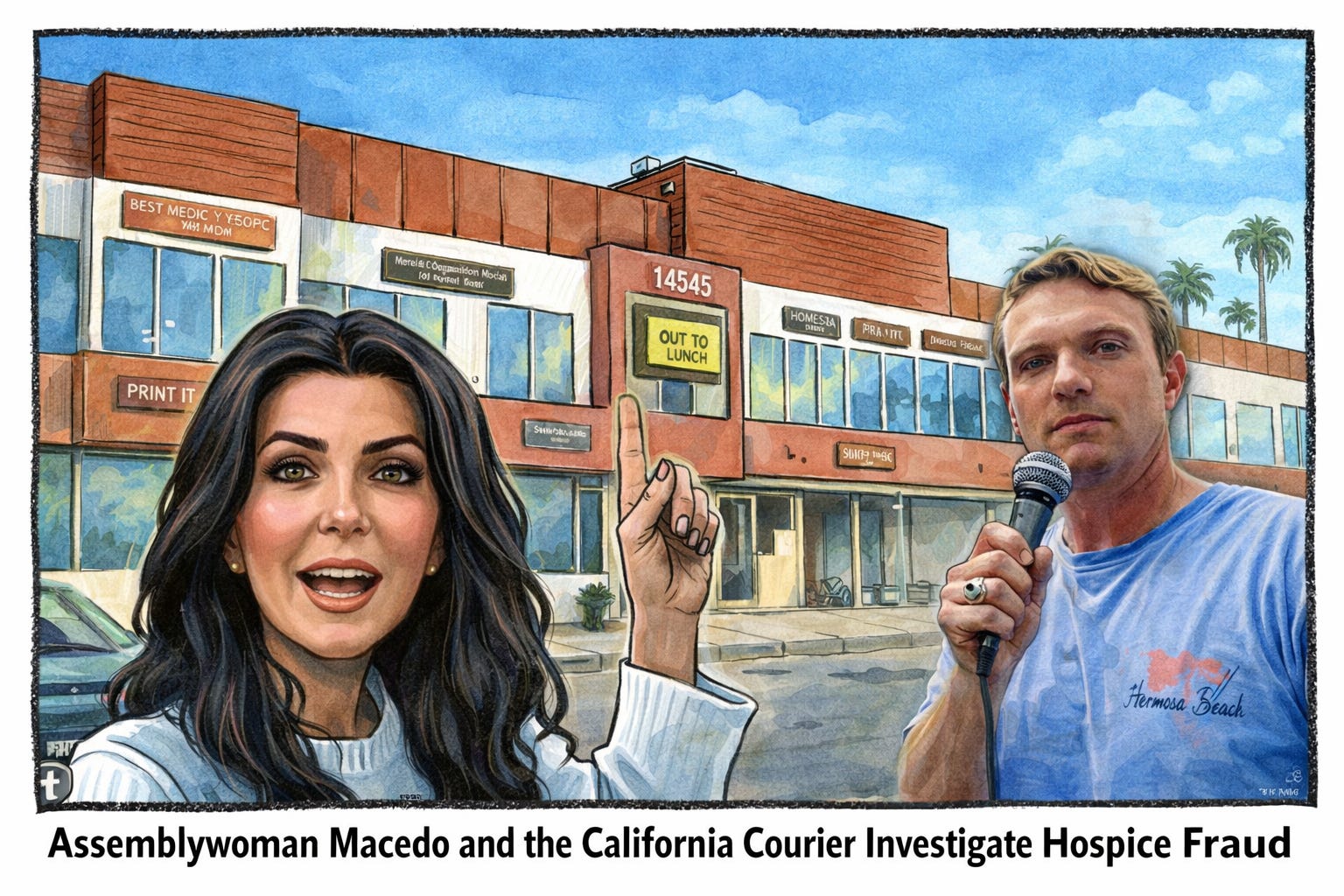
In the video, investigative reporter Christian Hartsock and California State Assemblywoman Alexandra Macedo travel to a series of addresses associated with hospice and home healthcare agencies operating in Los Angeles County that bill the state’s Medi-Cal program. What they found doesn’t look like a functioning healthcare system.
Many of the listed providers appear to operate out of the same deteriorating buildings, and some locations lack wheelchair ramps or handicap parking. In several cases, no one answers the phone, and the offices appear empty. In other words, the physical reality on the ground looks very different from what the billing records suggest.
The Numbers That Raise Red Flags
The scale of the issue is what really stands out. According to reporting cited in the investigation, more than $3.5 billion in Medi-Cal fraud has been identified in Los Angeles County alone, tied to hospice and home health operations.
Even more striking is the geographic concentration. Roughly 31 percent of all hospice and home healthcare companies in the United States are registered in Los Angeles County, yet only about 2 percent of the nation’s senior population lives there. Those numbers should immediately set off alarms for anyone responsible for administering a taxpayer-funded health program.
When nearly a third of the nation’s providers are clustered in a single county that houses only a small fraction of the patient population, something is clearly out of alignment.
A Problem The State Already Knows About
This isn’t a newly discovered issue. Back in 2020, the Los Angeles Times exposed widespread fraud in California’s hospice industry and documented how loosely regulated providers were able to enroll in Medi-Cal and bill the system.
In response to that reporting, the state ordered emergency hospice regulations intended to tighten oversight and stop questionable operators from flooding the system. Those regulations were supposed to take effect by January 2026. That deadline came and went.
Meanwhile, the companies continue to register, bill Medi-Cal, and collect taxpayer dollars.
When Oversight Fails
Assemblywoman Macedo, who represents communities in the San Joaquin Valley, is now sounding the alarm about the scale of the problem and pressing the issue with the Governor’s office. Her argument is straightforward: if billions of dollars are being siphoned out of a healthcare program meant to serve vulnerable patients, the state cannot pretend the issue is marginal.
What Hartsock and Macedo show in the video is something Californians have seen before in other government programs — a regulatory system that was slow to react, slow to enforce, and ultimately overwhelmed by opportunists who exploited the gaps.
When oversight lags behind incentives, the incentives usually win.
Where The Money Goes
That raises the obvious question. If the physical facilities associated with these businesses appear largely empty, and multiple providers are registered at the same addresses, where exactly is the money going?
That is precisely what investigators — and lawmakers — say needs much closer scrutiny. Because when billions in public healthcare dollars are involved, even a fraction of fraud quickly becomes a massive taxpayer exposure.
So, Does It Matter?
California already spends enormous sums on Medi-Cal, and the program continues to expand as policymakers add new populations and services. That makes oversight more important, not less.
When a single county houses nearly a third of the nation’s hospice providers while serving only a tiny share of the country’s seniors, it suggests the system has been shaped less by patient needs and more by financial opportunity.
If the investigation highlighted in this video is even partially accurate, it points to a structural problem in how California licenses providers, monitors billing, and enforces its own rules. And those kinds of structural problems rarely fix themselves.
Macedo ends the video by saying she has sent a letter to Governor Newsom asking him to look into this. And acknowledges she has sent him letters before, to which there have not been responses. No one is holding their breath here.
Below, you can watch the full video investigation from the California Courier, featuring Assemblywoman Alexandra Macedo and investigative reporter Christian Hartsock as they examine firsthand the addresses tied to these providers.
WATCH THIS VIDEO NOW.