

*Breaking News* U.S. Moves to Roll Back Climate Regulation and Unleash Affordability
Just moments ago the EPA has now formally initiate the rollback of the 2009 “endangerment finding” reasserting federalism and leaving climate policy to individual states.

🕒 Read Time: 6 min.
Today’s EPA Action Seeks To End Climate Policy As Ideology
Just now the Environmental Protection Agency initiated the process of rescinding the Obama-era “endangerment finding” — the regulatory determination that declared carbon dioxide and other greenhouse gases a threat to public health and welfare. That finding has served as the legal foundation for most major federal climate regulations for nearly two decades.
When finalized, this action would mark a significant reversal of draconian federal climate policy. It would also represent something larger than regulatory reform: a rejection of the idea that climate alarmism should function as governing philosophy.
For years, the political left — in Washington, D.C., and especially in California — has treated climate change less like a policy issue and more like a belief system. Questioning the orthodoxy is not merely discouraged; it is treated as heresy. Dissenters are labeled “deniers,” motives impugned, and debate replaced with moral certainty. What passes for climate policy often resembles religious fervor more than sober cost-benefit analysis — from banning gas appliances to mandating electric vehicles regardless of cost or grid capacity.
That is why this announcement out of Washington is already causing aneurysms on the political left, particularly in California.
The Endangerment Finding: The Regulatory Foundation
The Trump administration, through the Environmental Protection Agency, formally announced it is initiating the proposed rollback of the 2009 “endangerment finding” — the Obama-era determination that declared carbon dioxide and other greenhouse gases a threat to public health and welfare. That finding has been the legal foundation for most major federal climate regulations, allowing regulators to impose sweeping rules on energy, transportation, manufacturing, and land use under a law never designed for that purpose.
EPA Administrator Lee Zeldin did not soften the significance of the moment.
“This is the greatest day of deregulation our nation has seen,” Zeldin said, adding that the EPA is “driving a dagger straight into the heart of the climate-change religion to drive down the cost of living for American families, unleash American energy, and bring jobs back to the United States.”
Zeldin also said that by overhauling rules built on the endangerment finding, the EPA is “rolling back trillions of dollars in regulatory costs and hidden taxes” imposed in the name of climate policy.
That rhetoric may offend activists, but it captures what the endangerment finding became in practice: the most powerful regulatory lever used to advance a climate agenda without congressional approval or meaningful accountability.
How We Got Here
With one bureaucratic determination in 2009, climate policy was transformed from a legislative question into a regulatory weapon. The finding allowed federal agencies to bypass Congress and dictate how Americans drive, heat their homes, power businesses, and build communities. It justified vehicle emission standards, power-plant regulations, methane rules, and an expanding web of mandates — all sold as “settled science” and an emergency.
The result was predictable: higher prices, more regulation, and an expansion of government authority imposed through administrative fiat.
We all must reject the premise that unsettled and model-driven climate projections justify the scale, cost, and urgency of the policies imposed in their name. Nor should we accept the claim that human-produced carbon emissions present an existential threat requiring the dismantling of modern energy systems and economic growth.
The dominant climate narrative minimizes the benefits of fossil fuels — reliable energy, economic growth, food production, longer life expectancy, and resilience against natural disasters — while exaggerating worst-case scenarios to justify intervention. The claim that human carbon emissions are the dominant driver of global temperature changes, and that drastic reductions are necessary and cost-effective, is treated as established fact. In reality, it rests on models filled with assumptions, projections decades into the future, and a refusal to grapple honestly with tradeoffs and cost.
What is not theoretical is the size of the regulatory state that has grown up around this agenda.
California: Escalation, Not Moderation
Nowhere is that clearer than in California.
California didn’t merely follow federal climate policy; it escalated it. The Global Warming Solutions Act of 2006 set aggressive targets and created the cap-and-trade program, now rebranded as “cap-and-invest.” Under this system, businesses must purchase allowances for the right to emit carbon, embedding those costs into fuel prices, electricity rates, housing construction, and consumer goods.
But these programs are only part of the damage.
Layered on top of cap-and-invest are dozens of pieces of ownerless legislation that have quietly become law in California as part of a quixotic single-state-in-a-single-nation war against human-created, planet-wide carbon emissions. These laws mandate new building codes, restrict fuels and appliances, impose reporting regimes, reshape land-use decisions, and micromanage energy use across the economy.
The cumulative effect is expansion of state power that raises the cost of living and punishes affordability — all while delivering no meaningful impact on global climate outcomes. California could eliminate its carbon emissions entirely and still have no measurable effect on worldwide temperatures, a reality rarely acknowledged by the architects of this agenda.
Since the launch of cap-and-trade, California has generated more than $30 billion in auction revenue, with billions directed toward high-speed rail — a project still years from completion, massively over budget, and repeatedly criticized for delivering little near-term climate benefit. Meanwhile, allowance prices have climbed into the $30-to-$40-per-ton range, with state planning documents projecting higher costs as emission caps tighten.
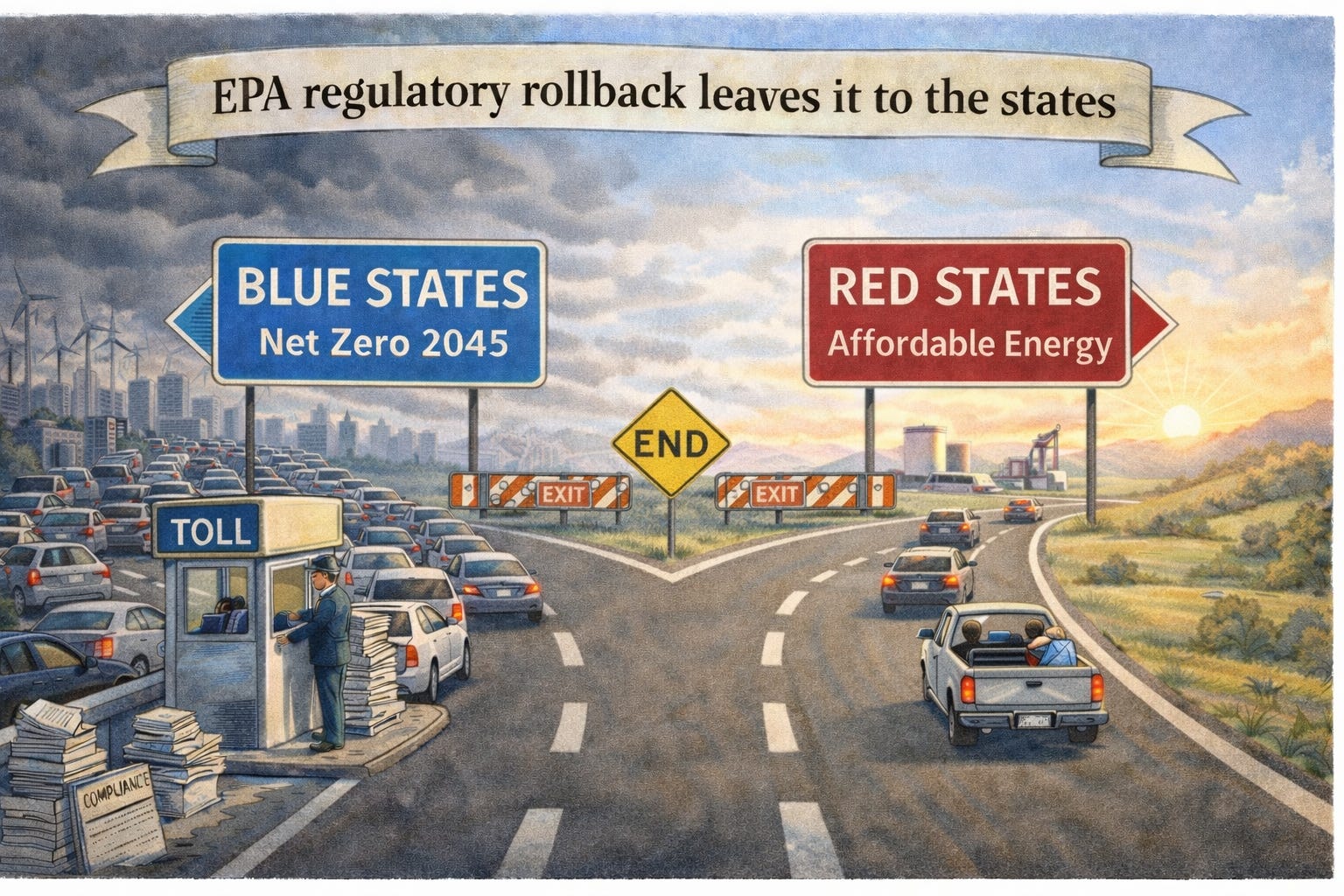
Ramping Up the Red State/Blue State Divide
Undoing the EPA’s endangerment finding will not end the climate debate. But it restores an essential principle: policy choices should be debated openly and made through accountable institutions — not imposed through regulatory fiat under the banner of emergency.
This shift will expose an already widening divide. Many red states have generally pursued lower taxes, lighter regulation, and relatively more affordable energy. Blue states, led by California, have chosen higher taxes, more regulation, and a larger role for government — all justified by climate absolutism.
The results are visible. Blue states are more expensive. Red states are growing faster, as reflected in recent Census data showing net domestic migration flowing from high-tax blue states to lower-cost red states. Families and businesses are voting with their feet.
So Does It Matter?
The red state/blue state divide will grow even larger.
Most Americans believe in conserving natural resources and protecting clean air and water. What many are rejecting is extremism that treats economic sacrifice as moral obligation and dissent as immoral.
This course correction is welcome. It reaffirms that America’s legacy is rooted in individual liberty and skepticism of centralized power — not bureaucratic crusades that make life more expensive while insulating policymakers from accountability.
Affordability is the key issue facing Americans. And this strong action by the Trump Administration will, when complete, reduce costs and increase everyone’s standard of living.