

*Breaking News* Supreme Court Ruling On Colorado Ban On “Conversion Therapy” Imperils Similar California Law
High Court Raises First Amendment Concerns That Could Undermine California Statute

When we put out breaking news, typically the “hard news” and some analysis are behind the paywall, but the bulk of the analysis and what the ruling means are below for our paid subscribers.
⏱ 5 min read
In Defense Of The First Amendment Comes An 8-1 Ruling
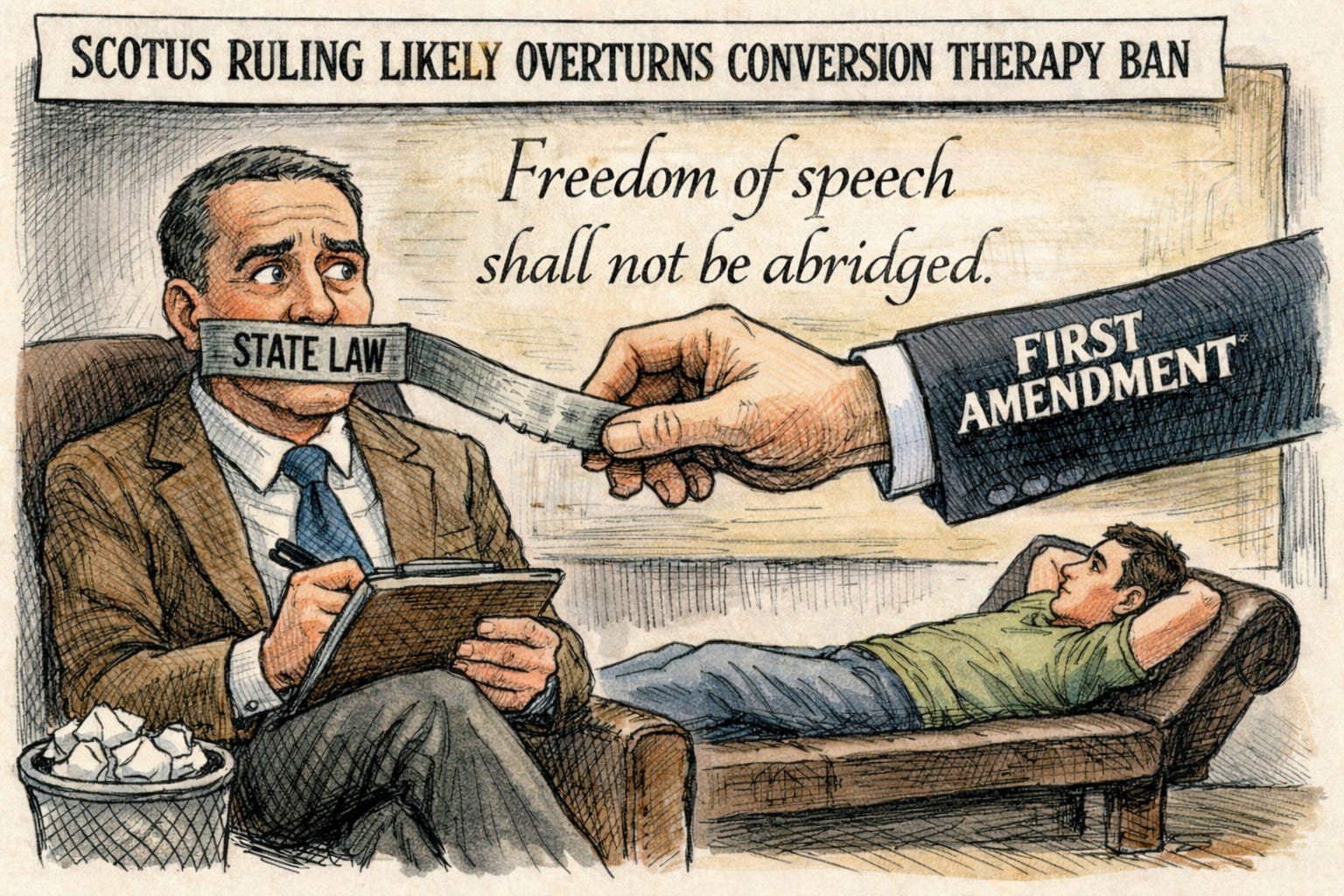
Breaking News: This morning, in a decision authored by Justice Neil Gorsuch, U.S. Supreme Court issued a major First Amendment ruling that places California’s ban on so-called “conversion therapy” on legally unstable ground. While the case arose from Colorado, the Court’s reasoning directly threatens the structure of California law.
The Supreme Court sent a challenge to Colorado’s law back to a lower court, instructing it to apply a far more demanding constitutional standard. The Court did not strike the law down outright, but it made clear that government limits on what licensed professionals can say raise serious First Amendment concerns.
The core issue is straightforward. Is talk therapy speech, or is it government-regulated conduct? The Court signaled strongly that when therapy consists of conversation, it is speech. And speech cannot be restricted on the basis of viewpoint without facing the highest level of constitutional scrutiny.
Colorado’s law permits counseling that affirms a minor’s chosen identity while prohibiting counseling that seeks to guide a patient in a different direction. The Court suggested that this type of one-sided rule may amount to viewpoint discrimination, which is rarely upheld under the Constitution.
Why California Is Directly Affected
California’s statute is built on the same foundation. It prohibits licensed therapists from engaging in efforts to change a minor’s chosen identity or attractions, while allowing counseling that supports acceptance and exploration. That distinction is now the central legal vulnerability.
For years, California relied on a Ninth Circuit ruling that treated its law as a regulation of professional conduct rather than speech. That framework allowed the state to avoid serious First Amendment scrutiny. The Supreme Court has now undercut that reasoning.
The Court rejected the idea that states can sidestep constitutional protections simply by relabeling speech as treatment. If the interaction is words, then it is speech. That is the key shift, and it puts California’s law directly in the crosshairs.
What you will find under the paywall…
- What California’s law actually says and how it is structured
- The narrow argument the state will use to try to defend it
- Why past court rulings upholding the law may no longer stand
- The strongest constitutional case against the statute
- How quickly this could move through California courts
